Plaza Mayor is one of those places that seems to appear in almost every photograph of Madrid. Before seeing the square for myself, however, I treated it as just another compulsory stop on the city’s tourist map. Beautiful, historic and surrounded by restaurants – Spain certainly has no shortage of places like that. It was only when I entered through one of the gateways and suddenly found myself standing in the middle of the square that I understood why the people of Madrid are so proud of it.
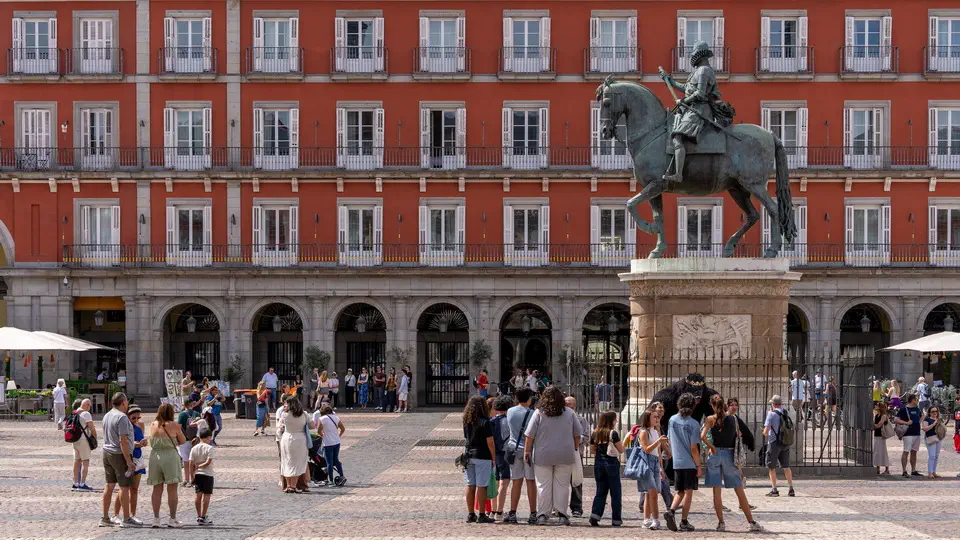
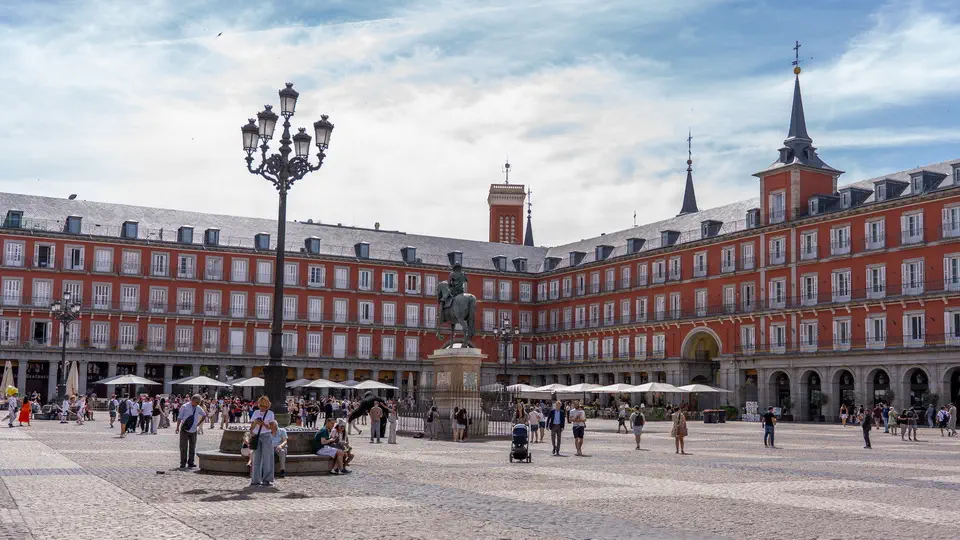
What impressed me most was the very moment of arrival. Plaza Mayor is completely enclosed by buildings and is practically invisible from the surrounding streets. You walk through the city centre, squeeze between people, pass souvenir shops, bars and restaurants, then step beneath an arch and suddenly find yourself in an enormous open space. Red façades lined with seemingly endless balconies surround you, cafés occupy the arcades, and an equestrian statue of Philip III stands in the centre. Everything looks remarkably elegant, almost theatrical. In fact, for hundreds of years, Plaza Mayor really was one of Madrid’s most important stages. Royal celebrations, markets, bullfights, religious processions, public trials and executions all took place here.
Today, the atmosphere is considerably calmer. Instead of knights, merchants and inquisitors, you will see tourists carrying cameras, street performers and waiters trying to persuade passers-by to take a seat at one of the tables. Even so, history is still very much present here. You only need to put your phone away for a moment and take a proper look around.
Plaza Mayor in the heart of old Madrid
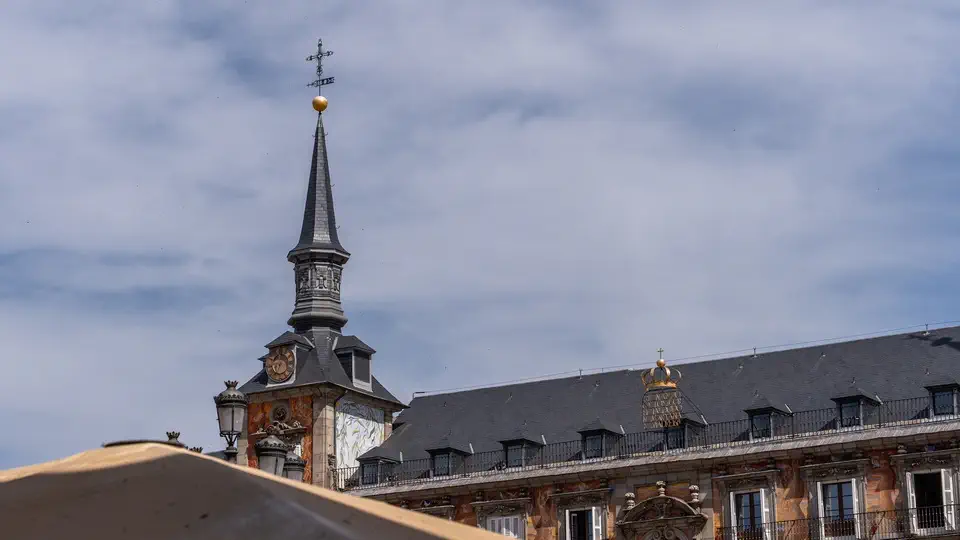
Plaza Mayor lies in the historic part of the city known as Madrid de los Austrias, or Habsburg Madrid. It is only a few minutes’ walk from Puerta del Sol, while the historic streets of La Latina, the Royal Palace and the popular Mercado de San Miguel are also close by.
The square is shaped like a large rectangle and surrounded on every side by multi-storey buildings. At first glance, their façades appear almost identical. Red walls, grey roofs and long rows of windows and balconies form an unusually ordered whole. Only after spending a little time here do you begin to notice the differences and small details that are effortless to miss when simply crossing the square rushing.
Plaza Mayor is extremely popular and usually becomes very busy in the middle of the day. I liked it best in the morning, when the restaurant terraces were only just being prepared for their first customers. The square was almost empty, only a handful of people were walking across the stone paving, and shopkeepers were quietly opening their businesses. If you want good photographs, this is definitely the time to come. Later in the day, finding a frame without a collection of accidental strangers can become surprisingly difficult.
The history of Plaza Mayor – from market square to Madrid’s grand ceremonial space
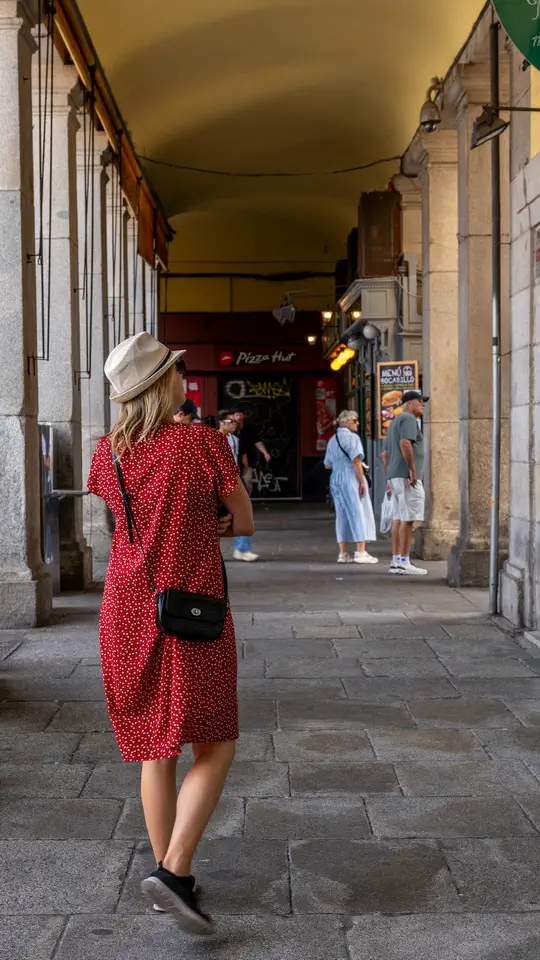
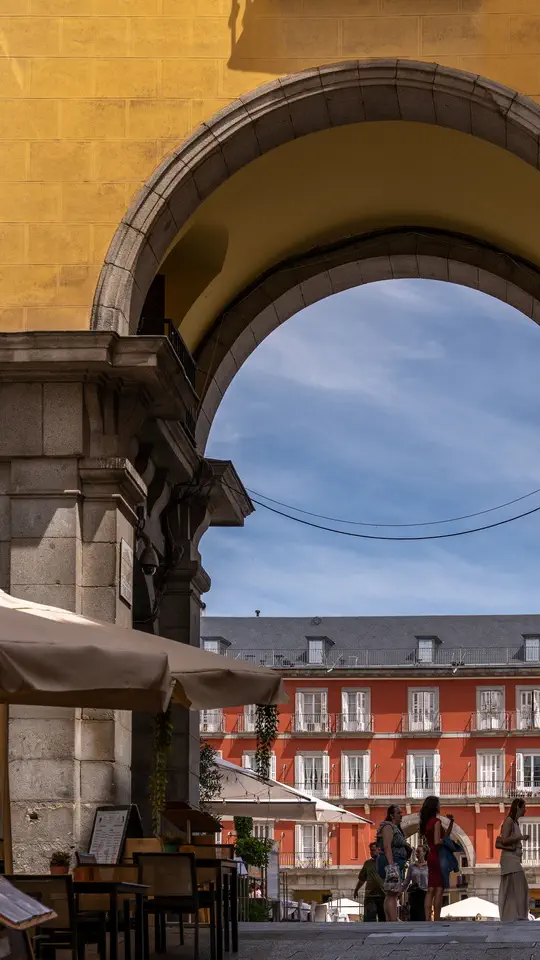
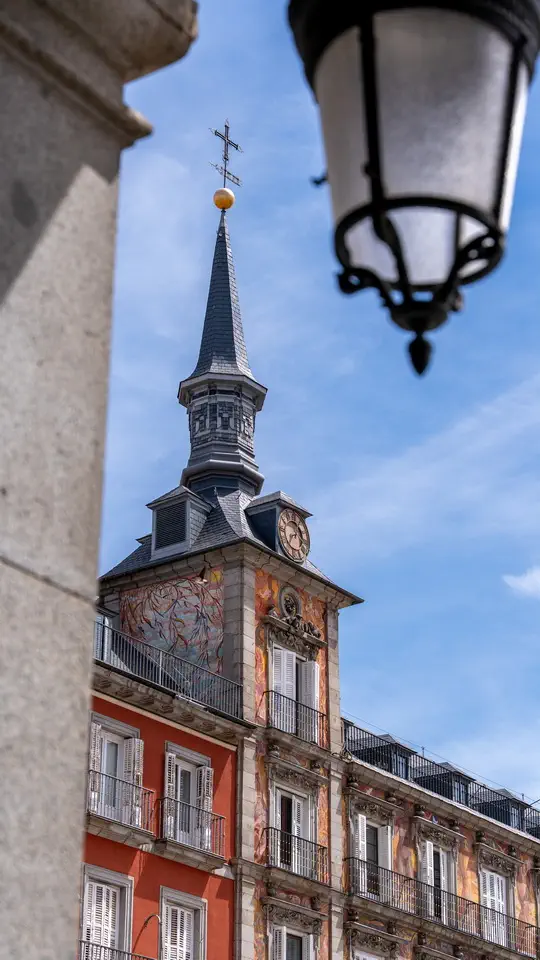
Before Plaza Mayor as we know it today was created, this site was occupied by Plaza del Arrabal. Originally located outside the walls of medieval Madrid, it served mainly as a marketplace. Food, fabrics, tools, goods produced by local craftsmen and almost everything else required by the inhabitants of the growing town could be bought here.
Everything changed after 1561, when Philip II moved the royal court from Toledo to Madrid. The previously modest town began to expand rapidly. New palaces, churches, monasteries and impressive public squares appeared, while the old market no longer suited the capital of one of Europe’s most powerful states. The first plans to redesign the square were drawn up during Philip II’s reign, although the most important work was not carried out until the reign of his son, Philip III. Architect Juan Gómez de Mora was entrusted with the project, and the new square was completed in 1619.
Plaza Mayor was intended to remain a place of trade while also becoming a prestigious setting for major public celebrations. Religious festivals, theatrical performances, royal ceremonies, beatifications, parades, and official welcomes for members of the royal family were organised here. Bullfights were also enormously popular. On such occasions, the balconies surrounding the square became viewing galleries and the entire space was transformed into a giant arena.
Not every event, however, was a cause for celebration. Plaza Mayor was also used for public executions and autos-da-fé, during which sentences handed down by the Spanish Inquisition were announced. It is difficult to imagine similar scenes today. Tourists sit at restaurant tables, children run around the statue and street performers pose for photographs, yet several hundred years ago people gathered here to witness events that could determine whether another human being lived or died.
Plaza Mayor was repeatedly damaged by major fires. Flames swept through the square in 1631, 1672 and 1790. At a time when large parts of buildings were constructed from timber and open flames were routinely used inside homes, a fire could spread along an entire side of the square with terrifying speed. The blaze of 1790 caused the greatest destruction. Reconstruction was entrusted to Juan de Villanueva, the architect who also designed the building now occupied by the Prado Museum.
Villanueva altered the earlier appearance of Plaza Mayor. He reduced the height of the surrounding buildings, regularised their façades, enclosed the corners and designed monumental passageways leading towards neighbouring streets. As a result, the square began to resemble an enormous courtyard hidden inside the city. It is this enclosed character that most clearly distinguishes Plaza Mayor from Madrid’s other major squares. Puerta del Sol is open, busy, and connected to broad streets, while Plaza Mayor feels more intimate despite the thousands of people who pass through it every day.
Casa de la Panadería and its extraordinary frescoes
The most distinctive building on Plaza Mayor is Casa de la Panadería, or the Bakery House. It is easy to recognise thanks to its two towers, clock and façade covered with colourful frescoes. Construction began around 1590 under the supervision of Diego Sillero. Most of the original structure has disappeared, although the cellars and parts of the ground floor survive. The building was later altered and incorporated into the new design of Plaza Mayor.
The name Casa de la Panadería is no coincidence. Madrid’s main municipal bakery once operated on the ground floor. It was responsible not only for baking and selling bread but also for controlling its price, helping to ensure that this basic food remained affordable even for the poorest residents of the city.
The upper floors had a much more ceremonial purpose. During important celebrations, members of the royal family could watch events taking place in the square from the balconies. Over the following centuries, the building housed several institutions, including the Royal Academy of Fine Arts of San Fernando and the Royal Academy of History.
The most striking feature of Casa de la Panadería today is its modern fresco decoration, created in 1992 by Carlos Franco. The paintings depict mythological characters associated with the history and legends of Madrid, including Cybele, Cupid, Bacchus, Proserpina, and a phoenix.
The phoenix is not there accidentally. A mythical bird reborn from its ashes is a particularly fitting symbol for Plaza Mayor, which repeatedly rose again after devastating fires. Today, Casa de la Panadería houses a tourist information centre, where you can pick up a city map and find information about events taking place around the square.
Casa de la Carnicería
Directly opposite Casa de la Panadería stands Casa de la Carnicería, or the Butcher’s House. Its appearance resembles that of Casa de la Panadería, although the façade is more restrained and lacks the same colourful frescoes.
In the past, the building contained meat stores and rooms used by Madrid’s butchers’ guild. It is another reminder of the commercial history of the square. Plaza Mayor was never created solely as an elegant setting for kings and aristocrats. For a long time, it was also a practical place where ordinary residents of Madrid came to do their daily shopping. Today, Casa de la Carnicería houses a hotel, although the historic building remains one of the most important architectural elements of Plaza Mayor.
The statue of Philip III
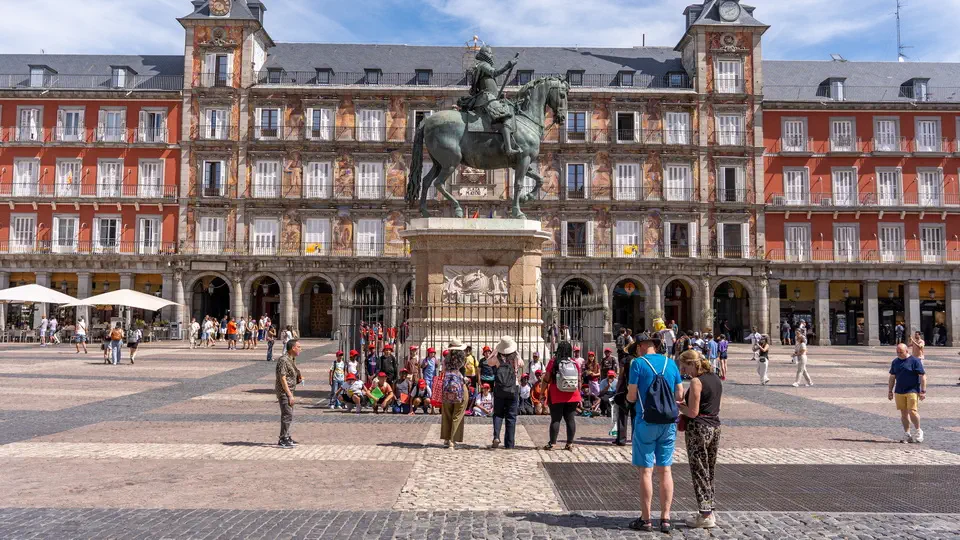
An equestrian statue of Philip III stands in the middle of the square. Work on the monument was begun by the Flemish sculptor Giambologna and completed after his death by his pupil Pietro Tacca. The statue was finished in 1616. Interestingly, it was not originally intended for Plaza Mayor at all. It initially stood near the entrance to Casa de Campo and was moved to the square only in 1848 on the orders of Queen Isabella II.
It is worth walking closer and having a look at the statue from every side. Philip III is depicted wearing armour and holding a baton in his right hand. The monument is now one of the most photographed objects on Plaza Mayor, and also provides a convenient place to stop for a moment while exploring the square.
There is a rather macabre story connected with the statue. A small opening once existed in the horse’s mouth. Birds could enter the hollow interior through it, but were unable to find their way back out. When the statue was damaged during the 20th century and subsequently opened during repairs, a large quantity of bird remains was discovered inside. The opening was later sealed.
Arco de Cuchilleros – the most beautiful entrance to Plaza Mayor
Several gateways lead into Plaza Mayor, but the most famous is Arco de Cuchilleros, located in the south-western corner of the square. The tall arch and steep steps descend towards Calle de Cuchilleros. The street takes its name from the knife makers who once had their workshops here and supplied blades to the butchers working in nearby Casa de la Carnicería. In old Madrid, people practising the same trade often concentrated in a single street, and many street names still preserve traces of this tradition.
Walking down beneath the arch reveals Plaza Mayor from a wholly different perspective. From the outside, the surrounding buildings appear much taller than they do from within the square. This is because of the considerable difference in ground level. Some façades are also slightly inclined because they effectively act as supporting structures for the buildings above.
Arco de Cuchilleros looks particularly beautiful in the evening. Warm street lighting highlights the brick walls, stone steps and small balconies. It is one of those corners of Madrid where it is worth stopping for a little longer rather than simply taking a photograph and immediately moving on.
Restaurants on Plaza Mayor
Numerous restaurants and cafés operate beneath the arcades of Plaza Mayor. Their tables occupy a considerable part of the square, while waiters can be quite enthusiastic in encouraging passers-by to look at the menu. It has to be said, however, that this is certainly not the cheapest place in Madrid to eat. You are paying not only for the food but also for the view and prestigious location, and prices can be noticeably higher than in bars just two or three streets away.
A coffee, glass of wine or cold beer can still be tempting, particularly if you want to rest and spend a little time watching life unfold around the square. For a substantial meal, however, I would probably choose one of the nearby side streets. It is usually cheaper, quieter and more local. One of Madrid’s most characteristic snacks is bocadillo de calamares, a bread roll filled with fried squid rings. It sounds basic, and it really is, yet the sandwich has achieved something close to cult status in Madrid. Several bars around Plaza Mayor specialise in this particular local favourite.
If you would rather sample a wider selection of Spanish food, take a short walk to the nearby Mercado de San Miguel in Madrid. The historic food hall stands only a few dozen steps from the square and is filled with tapas, cheeses, cured meats, seafood, sweets, and wine. It is a very attractive place, although during the summer you should be prepared for large crowds and prices considerably higher than those found in ordinary Madrid bars.
Plaza Mayor at Christmas
The square continues to play an important role during Madrid’s public celebrations. Concerts, outdoor events and religious festivities are organised here throughout the year. On Easter Sunday, the traditional tamborrada fills central Madrid with the thunderous sound of drums. The best-known event, however, is the Christmas market, whose tradition reaches back to the 17th century. In the past, visitors could buy food, gifts, decorations, and even animals. Today, the wooden stalls primarily sell nativity figures, Christmas decorations, toys and small presents.
Plaza Mayor looks particularly attractive in December. Evening lights, festive stalls and the red façades of the surrounding buildings create a beautiful setting. Unfortunately, this is hardly a secret, and during the Christmas season the square can become packed with visitors. If you are not particularly fond of crowds, the morning is once again the best time to come.
Practical information that may help you plan a visit to Madrid
Plaza Mayor itself is accessible 24 hours a day, although the shops, restaurants, and tourist information centre naturally have their own opening hours. The nearest Metro stations are Sol, Ópera and Tirso de Molina, with Sol being the most convenient option for most visitors. From there, the walk to the square takes around five minutes. The route is easy, although the surrounding streets can become packed in the afternoon.
Half an hour is enough for a brief look around Plaza Mayor, but in my opinion that is a little too rushed. It is worth walking beneath the arcades, examining the frescoes on Casa de la Panadería, circling the statue of Philip III and then descending beneath Arco de Cuchilleros. Add a coffee or quick snack, and you can easily spend more than an hour here.
During summer, the centre of the square becomes very hot. Shade is limited, so it is sensible to carry water and wear something to protect your head from the sun. Mornings and late afternoons are much more pleasant, once the sunlight has lost some of its intensity. As in every heavily visited tourist area, keep an eye on your phone, camera, and wallet. The area around Plaza Mayor is generally safe, but dense crowds create excellent opportunities for pickpockets.
What can you see near Plaza Mayor?
Plaza Mayor’s location means there is no reason to treat it as a separate attraction. The best option is to include the square in a longer walk through Madrid’s historic centre. The Royal Palace of Madrid is only a few minutes away. It is one of the most important attractions in the Spanish capital, and somewhere I would recommend allowing at least a few hours to explore properly. Even if you have no intention of visiting the interiors, it is worth walking up to the main façade and seeing the neighbouring Almudena Cathedral.
In front of the Royal Palace lies the elegant Plaza de Oriente. It is a pleasant place for a short rest after walking through the busy city centre. The gardens are carefully maintained and filled with sculptures and greenery, while the paths offer excellent views of the palace and Teatro Real.
Right beside it, you should also have a look at Jardines del Cabo Noval. This small garden is easily overlooked by tourists, which is precisely why it can provide a welcome moment of peace. It works particularly well as a brief stop between Plaza Mayor, Plaza de Oriente and the Royal Palace.
If, after several hours of walking along stone streets, you begin to long for some greenery, head towards Retiro Park in Madrid. It is not directly beside Plaza Mayor, but you can reach it either on foot during a longer walk across the centre or by Metro. This huge green space contains tree-lined avenues, palaces, monuments and the famous lake where visitors can hire rowing boats. Those interested in historic interiors and slightly less obvious attractions should also consider the Museum of Romanticism in Madrid. It lies a little further away, close to the Chueca and Malasaña neighbourhoods, but makes an excellent addition to a day spent exploring historic Madrid.
Is Plaza Mayor really worth visiting?
Plaza Mayor is undeniably touristy. The restaurants are not particularly cheap, the shops sell endless variations of the same souvenirs, and some street performers can become a little tiresome. Even so, I cannot imagine a first visit to Madrid without seeing the square. There is no ticket to buy and no particular time slot to reserve. You simply walk down from Puerta del Sol, follow one of the neighbouring streets and pass beneath the arcades. The best thing is to do it without rushing. Stop beside the statue, look up at the dozens of balconies, and try to imagine what Plaza Mayor might have looked like several centuries ago.
This was where Madrid residents once bought their bread and meat, where kings watched grand celebrations and where crowds gathered to witness bullfights, trials, and executions. The square burned, was rebuilt and repeatedly changed its purpose. Today, it is one of the most popular meeting places in Madrid.
What I liked most was the fact that Plaza Mayor has never become a lifeless historic monument. It is still filled with conversations, smells of food, music, and people arriving for entirely different reasons. Some stop only longs enough to take a photograph, others eat a calamari sandwich, while others simply sit at a table and watch the city at their pace. And perhaps that is the best way to experience Plaza Mayor – not through a succession of dates and famous names, but through a quiet moment spent right in the middle of the square.
Plaza Mayor in Madrid – facts, information and interesting details
- Before Plaza Mayor was created, this was a marketplace. The area was originally known as Plaza del Arrabal and lay outside the walls of medieval Madrid. Food, fabrics, tools, and goods made by local craftsmen were sold here to the inhabitants of the growing town.
- The square was partly created on the site of a former lagoon. Historical municipal documents indicate that Plaza Mayor developed on land shaped after the draining of Laguna de Luján. Looking at the stone paving today, it is difficult to imagine that this was once marshy ground.
- Construction of the present square took only two years. The most important building work was carried out between 1617 and 1619 according to plans by Juan Gómez de Mora. The speed was remarkable considering the scale of the project and the construction methods available at the time.
- Plaza Mayor was created after the royal court moved to Madrid. Philip II established Madrid as the permanent seat of the royal court in 1561. The city began to expand rapidly, and the old, rather chaotic marketplace no longer suited the capital’s new status.
- The square has not always been called Plaza Mayor. During different periods of its history, it was known as Plaza del Arrabal, Plaza de la Constitución, Plaza Real and Plaza de la República. Its present name was restored after the Spanish Civil War.
- Plaza Mayor has burned several times. The largest fires occurred in 1631, 1672 and 1790. The final blaze caused such extensive damage that the square required major reconstruction, which eventually gave it the enclosed appearance we recognise today.
- The architect responsible for rebuilding the square was also associated with the Prado Museum. Following the great fire of 1790, reconstruction was entrusted to Juan de Villanueva, who also designed the building that now houses one of the world’s most important art museums.
- Nine major gateways lead into Plaza Mayor. They were created during the reconstruction overseen by Juan de Villanueva. Closing the corners made the square resemble an enormous courtyard hidden among the dense streets of central Madrid.
- The most famous gateway is Arco de Cuchilleros. The Spanish word “cuchilleros” refers to knife makers. Craftsmen working nearby once supplied blades to the butchers associated with Casa de la Carnicería.
- The buildings beside Arco de Cuchilleros are taller than they appear from the square. Plaza Mayor stands on uneven ground, which means that more storeys are visible from Calle de Cuchilleros. Some slightly inclined façades also serve a structural supporting function.
- Casa de la Panadería was Madrid’s main municipal bakery. The institution was responsible not only for baking and selling bread but also for regulating its price, helping to keep this essential food affordable for the city’s poorest inhabitants.
- Spanish monarchs watched events from the balconies of Casa de la Panadería. The building’s upper floors were used by members of the royal family during celebrations, processions and public spectacles. The balconies effectively became prestigious private boxes overlooking the entire square.
- The frescoes on Casa de la Panadería are much younger than they appear. The current decorations were created by Carlos Franco in 1992. They include Cybele, Bacchus, Cupid, Proserpina and various figures connected with Madrid’s history and legends.
- A symbol of Plaza Mayor’s rebirth is hidden among the frescoes. A phoenix can be seen on one of the towers of Casa de la Panadería. The mythical bird rising from the ashes recalls the devastating fires that repeatedly destroyed parts of the square and the subsequent rebuilding that followed.
- Casa de la Carnicería once served Madrid’s butchers. Meat intended for sale to the city’s residents was stored in the building. Its name literally means the Butcher’s House, although an elegant hotel now occupies its historic interiors.
- The statue of Philip III was not created specifically for Plaza Mayor. Completed in 1616, the sculpture originally stood near the entrance to Casa de Campo. Queen Isabella II ordered it to be transferred to Plaza Mayor in 1848.
- Bird remains were discovered inside the statue of Philip III. Small birds entered through an opening in the horse’s mouth but could not escape from the hollow interior. The problem was discovered when the damaged statue was opened during restoration work.
- Plaza Mayor once served as a bullfighting arena. During these spectacles, the centre of the square was converted into an arena, while the balconies of the surrounding buildings provided seating for spectators. The best positions were reserved for members of the royal family and aristocracy.
- Ceremonies of the Spanish Inquisition were held in the square. Autos-da-fé took place here, during which sentences issued by inquisitorial tribunals were publicly announced. Plaza Mayor was also used for executions, giving it a much darker past than its modern atmosphere might suggest.
- The most characteristic food associated with the area is the calamari sandwich. Bocadillo de calamares consists simply of a fresh bread roll filled with fried squid rings. You can try one of numerous bars around the square, or combine your visit with a stop at the nearby Mercado de San Miguel.