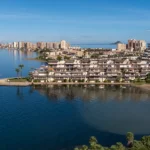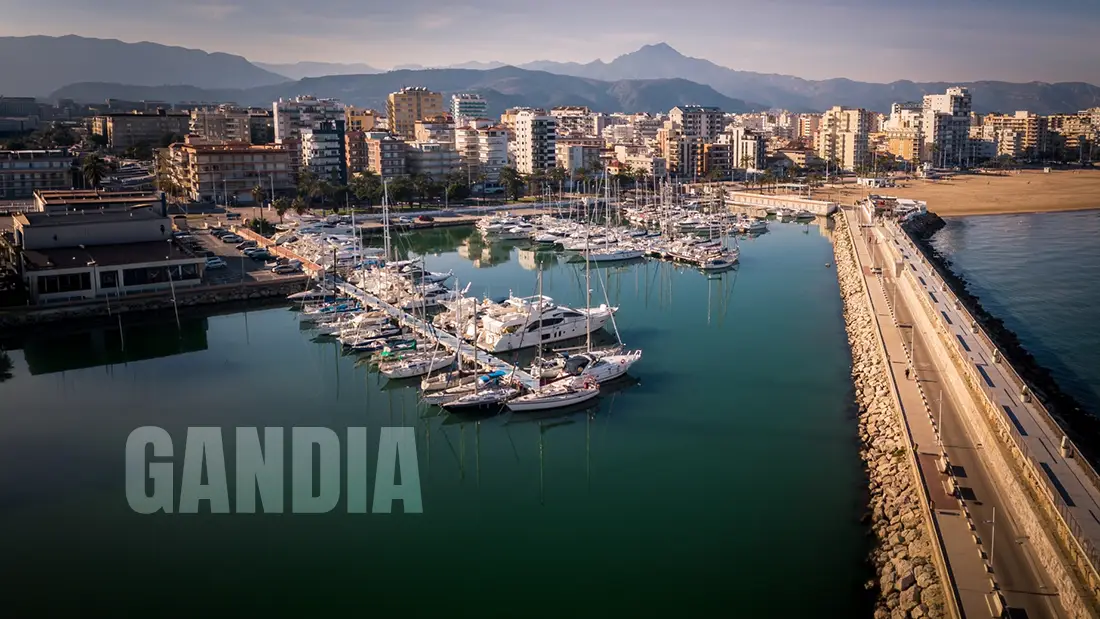
Gandia lies on the sunny Costa del Azahar, along Spain’s eastern coast.
Spain’s eastern coastline is best known for its long sandy beaches, seaside promenades and small towns where life moves at a leisurely pace. I love the tranquillity of this part of the country, its unhurried atmosphere and the opportunity to relax in a way that is difficult to find elsewhere. However, even the most enjoyable beach holiday can become a little repetitive, and that is when it is worth discovering somewhere that takes you on a journey into the distant past. One such place, in my opinion, is Gandia, a town with two very different faces. One belongs to visitors looking for sunshine and relaxation beside the Mediterranean, while the other appeals to those interested in history, architecture, and stories from centuries gone by.
You only need to walk a little way inland from the beach to find yourself surrounded by medieval streets, historic churches and palaces that witnessed the rise and influence of one of the most powerful families in Spanish history. This is where the Borja family, better known throughout Europe by their Italian name, the Borgias, left their mark. Today, I would like to take you on a walk through Gandia. Rather than simply listing one monument after another, we will explore the town’s history, visit its most important squares, step inside the ducal palace and discover places that are easy to walk past without realising how much history they hold. If you are planning a trip to the Costa Blanca, Costa del Azahar or Valencia, remember the name Gandia. It is definitely worth setting aside a day to explore.
Gandia: from prehistoric settlements to the ducal residence of the Borgias
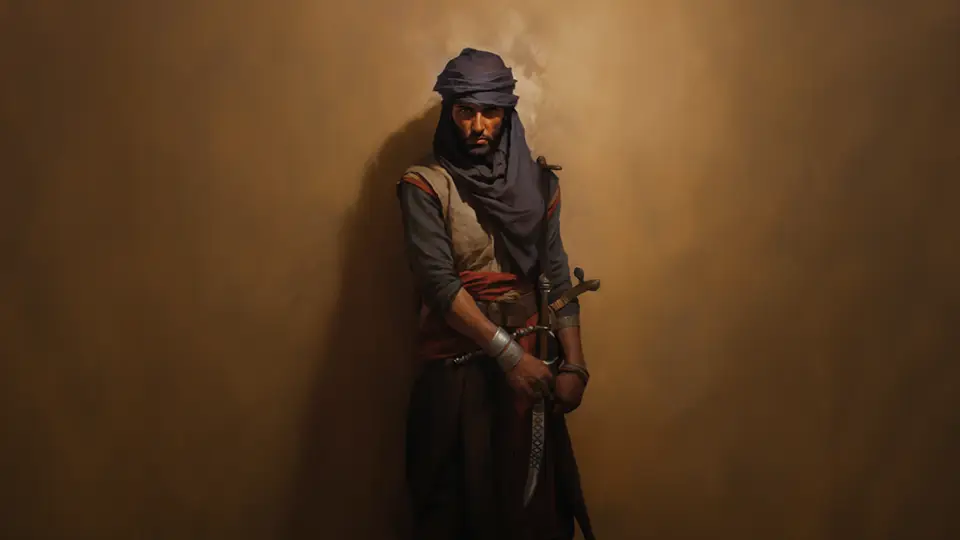
The history of Gandia is considerably older than you might imagine while strolling through its elegant streets and squares. Today, the town is primarily associated with its wide beach, tourism and summer holidays, but for centuries it was an important political, economic and cultural centre of the Kingdom of Valencia. Its position was largely thanks to its favourable location, the fertile land of the Serpis River valley and the influential families who turned it into one of their principal residences.
The most recognisable chapter of this history is, of course, connected with the Borja family, known throughout Europe as the Borgias. However, long before its members arrived in Gandia, the surrounding area had already experienced thousands of years of human settlement, the rule of different cultures and the turbulent events associated with the Christian conquest of the Iberian Peninsula.
Let’s go back to a time when neither Gandia nor Spain existed in anything resembling their present-day form. The area around the town is one of the most important locations for research into the prehistory of the eastern Iberian Peninsula. Of particular significance are the caves in the Mondúver mountain range, just a few kilometres from the modern town centre. The most important is Cova del Parpalló, where thousands of small stone plaques have been discovered, decorated with engravings and paintings depicting animals and other scenes connected with Palaeolithic life. They form one of Europe’s most important collections of prehistoric art from this period.
People were already living in this area tens of thousands of years ago. They used natural shelters, hunted animals and gathered plants, while the surrounding landscape looked wholly different from the one we see today. There were no cultivated fields, roads or buildings, and the valley and nearby mountains provided a natural environment for small groups of hunter-gatherers. Another cave worth mentioning is Cova de les Meravelles, or the Cave of Wonders, located near Gandia. Like Parpalló, it is an important archaeological site. Both locations demonstrate that this area attracted human communities long before the first permanent towns were established.
If you are interested in this distant past, a visit to the Museu Arqueològic de Gandia, which I mentioned earlier, is an excellent way to round off your exploration. The museum helps visitors understand how people once lived in this region and why the area around Gandia occupies such an important place in research into the European Palaeolithic.
The next chapter in the region’s history is connected with the Iberians. These were groups of people who inhabited the eastern and south-eastern parts of the Iberian Peninsula in ancient times. They established settlements, developed agriculture, crafts and trade, and maintained contacts with other Mediterranean peoples, including the Phoenicians and Greeks.
There were settlements associated with Iberian culture in the area around modern-day Gandia. One of the more important archaeological sites in the region is nearby El Castellar de Oliva. Finds from these locations help us reconstruct the lives of communities that inhabited the fertile valley and made use of its natural resources. With the expansion of Rome, the region became part of the Roman Republic and later the Roman Empire. Roman rule brought changes to the economy, settlement patterns and communications network. Agriculture developed, and produce from the fertile countryside became part of wider trading networks.
It is important, however, not to imagine that a large Roman city stood on the site of Gandia’s present-day centre. The main settlements were scattered across the surrounding countryside, alongside agricultural estates and nearby urban centres. Gandia itself, as a medieval town, would not emerge until several centuries later.
The history of Gandia as an established urban centre began during the period of Muslim rule on the Iberian Peninsula. Following the conquest of Visigothic Spain by Arab and Berber forces in the eighth century, the territory of modern-day Valencia came under Muslim control. Over the following centuries, this region, later known as Al-Andalus, developed economically and culturally. Gandia grew from a small agricultural settlement connected with the Muslim system of farms and landed estates. Its development was no coincidence. The surrounding countryside offered excellent conditions for cultivation, while the nearby Serpis River provided the water essential for agriculture.
The Muslim inhabitants developed irrigation systems, using channels and ditches to carry water to the fields. This made it possible to cultivate the land intensively, even during periods of limited rainfall. These agricultural methods left a lasting mark on the landscape of the entire La Safor valley. Even today, an extensive network of irrigation channels can be seen in the area, and traditional agriculture continues to play an important role in the local economy.
Many elements of the region’s spatial and economic organisation date back to this period. Cereals, fruit, and vegetables were cultivated, while sugar cane gradually became increasingly important in later centuries. Nevertheless, it would be misleading to imagine that Gandia was already a major Muslim city. Its medieval beginnings were considerably more modest. The settlement grew in importance gradually, as agriculture, trade and local administration developed.
In the fourteenth century, Gandia began to play an increasingly important role in the politics of the Kingdom of Valencia. In 1323, King James II granted the local lordship to his son, Prince Peter of Aragon, Count of Ribagorza. After Peter’s death, the estate passed to his son Alfonso, known as Alfonso the Elder. He was largely responsible for transforming Gandia into an important aristocratic centre. In 1399, King Martin the Humane elevated the lordship to the status of a royal duchy. Gandia consequently acquired considerable prestige, and its ruler became one of the most important figures in the Aragonese monarchy.
Alfonso the Elder made the town his permanent residence. He expanded the ducal palace, supported the development of the local church and worked to enhance the prestige of his court. Gandia was no longer simply an agricultural settlement. It became a place where members of the aristocracy, clergy, cultural circles and royal administration came together.
It was during this period that the town began to develop a cultural tradition of which it remains proud today. People associated with Catalan-language literature and culture were welcomed at Alfonso the Elder’s court. Among the figures connected with Gandia’s courtly circles were Ausiàs March and Joanot Martorell. The former was one of the greatest poets of medieval Catalan literature, while the latter became famous as the author of the chivalric novel Tirant lo Blanc, regarded as one of the most important works of late medieval European literature.
Imagine what courtly life in Gandia must have been like at that time. There were no wide modern streets, hotels or seaside promenades. Instead, there was a palace, a church, town walls, markets, and the residences of people connected with power. The town was becoming an increasingly important place within the Kingdom of Valencia. After Alfonso the Elder’s death, his son Alfonso the Younger inherited the title. He had no children, however, and following his death in 1424, the duchy reverted to the Crown. Over the following decades, it passed into the hands of successive members of the Trastámara dynasty.
During the second half of the fifteenth century, the Borja family began to play an increasingly important role on the European political stage. Originally from the Aragonese town of Borja, its members built their influence primarily in the Kingdom of Valencia and within the Catholic Church. One of the most important figures in the family was Rodrigo de Borja, who would later become Pope Alexander VI. Before reaching the highest position in the Catholic Church, he enjoyed a remarkable ecclesiastical career. His uncle, Alfonso de Borja, became Pope Callixtus III in 1455, giving the family access to the highest circles of power in Rome.
Rodrigo understood perfectly well that political influence needed to go hand in hand with landed wealth and social standing. He therefore sought to establish a lasting position for his family in Spain. Gandia was ideally suited to this purpose. In 1485, the Borgias acquired the town from the Catholic Monarchs, Isabella of Castile and Ferdinand of Aragon. Gandia, together with the surrounding estates, was intended to become the foundation of the family’s wealth and its ducal seat.
The first Duke of Gandia from the Borja family was Pedro Luis de Borja, Rodrigo’s son. After his death in 1488, power passed to his half-brother Juan de Borja, who married María Enríquez de Luna. Their descendants governed the duchy for several generations. Gandia had now entered a period that would permanently associate its name with one of the most recognisable families of Renaissance Europe.
It is worth remembering that the notorious black legend surrounding the Borgias, reinforced by literature and later stories, does not tell the whole story of the family. Its members included political operators, ambitious churchmen and people who built considerable fortunes, but there were also individuals involved in religious activity, education, and the development of the arts. It is particularly this second side of their legacy that you can discover in Gandia.
What to do and what to see in Gandia and how much it costs
- From Valencia: The Borgia´s legacy and Gandia beach Day Trip; Discover the true story of the Valencian popes who were the focus of the Vatican during the Renaissance and enjoy the gastronomy of our region with views of the Mediterranean Sea in Gandia Beach.
- History, Beach & Albufera Natural Park Private Tour; Explore Gandía and its charm on a guided tour with hotel transfers included. See the port, local beaches, and castle, and end the day at Albufera Natural Park far from the city’s hustle and bustle.
- Sunset at sea from Gandia; Contemplate the wonderful sunset from the sea of Gandia Relax with the sea breeze and Chill Out music. Drink included!
- Book a hotel at a good price and enjoy the beauty of Alicante.
- Rent a car; The rented car will help you realize travel plans faster and more efficiently.
The eighteenth century – a change of dynasty and the end of the old order
Another difficult period arrived at the beginning of the eighteenth century, when Spain became embroiled in the War of the Spanish Succession following the death of Charles II. The conflict lasted from 1701 to 1714 and ended with the Bourbon dynasty taking the Spanish throne. The war had enormous consequences for the Kingdom of Valencia. In 1707, following Philip V’s victory at the Battle of Almansa, the king issued the Nueva Planta decrees, which abolished many of the former institutions and laws of the Kingdom of Valencia. The region lost much of its previous autonomy, and its administration was reorganised along Castilian lines.
These changes also affected Gandia. The old political system, in which local institutions and privileges had played an important role, gradually gave way to a new order. By this time, the position of the Borgias was no longer as powerful as it had been in the sixteenth century. The family still owned extensive estates and held prestigious titles, but its political and economic influence was gradually declining. Over the years, the duchy passed into the hands of successive aristocratic families, until the main Borja line eventually died out. The title of Duke of Gandia, however, survived long after the family had ceased to play a direct role in the town.
During the nineteenth century, Gandia gradually began to change its character. The old town, once enclosed by defensive walls, needed more space, and parts of its medieval fortifications were therefore demolished. This was a familiar development in many European towns at the time, as they expanded beyond their historic boundaries.
Agriculture, trade and local crafts continued to develop. Citrus cultivation became particularly important and eventually turned into one of the defining features of the economy of Valencia province. The opening of the railway connection with Alcoy in 1893 also had a considerable impact on the town’s development. The railway made it easier to transport goods and connected Gandia with important industrial centres further inland. In the following years, the port infrastructure was expanded as well.
The town increasingly began to make use of its position on the Mediterranean coast. The port played an important role in exporting agricultural products, particularly oranges. This provided Gandia with new sources of income, reducing its dependence on the traditional sugar industry. During the twentieth century, the town underwent another major transformation, gradually evolving from a place largely dependent on agriculture and trade into an important tourist destination.
The port remained significant, handling the export of agricultural produce, while improvements to transport infrastructure encouraged further industrial and commercial development. Gandia became an increasingly important centre within the La Safor region. At the same time, people began to recognise the potential of its extensive sandy beaches. Initially, the coastal area was far less developed than it is today, but the first holiday accommodation, guesthouses, and restaurants gradually began to appear.
Tourism really took off during the second half of the twentieth century. Spain was becoming an increasingly popular holiday destination, and the Mediterranean coastline attracted visitors from both within the country and abroad. Gandia began investing in hotels, flat blocks, promenades, and beach facilities. This was how modern Playa de Gandia developed into one of the most important seaside resorts in Valencia province. It is worth remembering, however, that the historic centre and the coastal district are practically two different worlds. They are separated by several kilometres and have wholly different characters. This is precisely what makes Gandia an interesting destination outside summer as well.
Gandia today – a town that has preserved its history
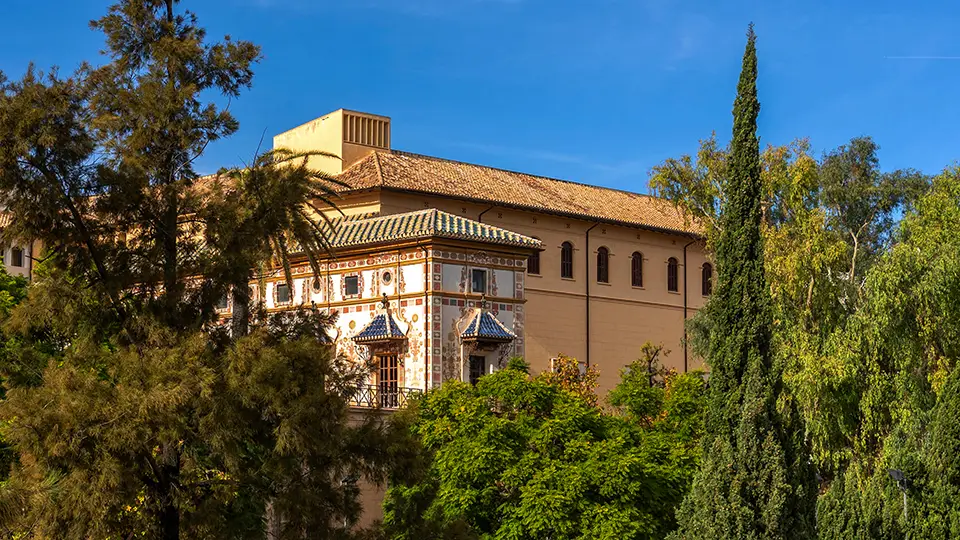
Modern Gandia is a town where the development of tourism has not completely overshadowed its historic heritage. Of course, the beach, hotels and seaside facilities are an important part of the local economy, but the historic centre has retained its own distinctive character. During a walk through the streets, you can follow the different stages of the town’s development. The Collegiate Church of Santa María recalls the Christian conquest and the medieval dukes. The ducal palace tells the story of the Borgias, while the former Jesuit university brings to mind Francisco de Borja. The archaeological museum, meanwhile, takes visitors back to a period long before the town itself came into existence.
Gandia’s history also provides a fascinating insight into the wider transformation of Spain’s eastern coastline. Over the centuries, Christian and Muslim cultures met here, agriculture flourished, great landed estates were established, and local aristocratic families built their influence on the European political stage.
For me, the most interesting thing is that Gandia does not have just one story to tell. It has several, and each has left visible traces behind. That is why I would not limit my visit to the Borgia palace and the main square. I would try to look at the town as a whole, remembering its Muslim roots, its former sugar industry and the people who shaped its character over many centuries.
A walk through Gandia’s historic centre
The suggested route takes you past the most important sights in the old town. I would allow around three to four hours for a leisurely visit, including time to explore the palace and church interiors.
Passeig de les Germanies – the starting point
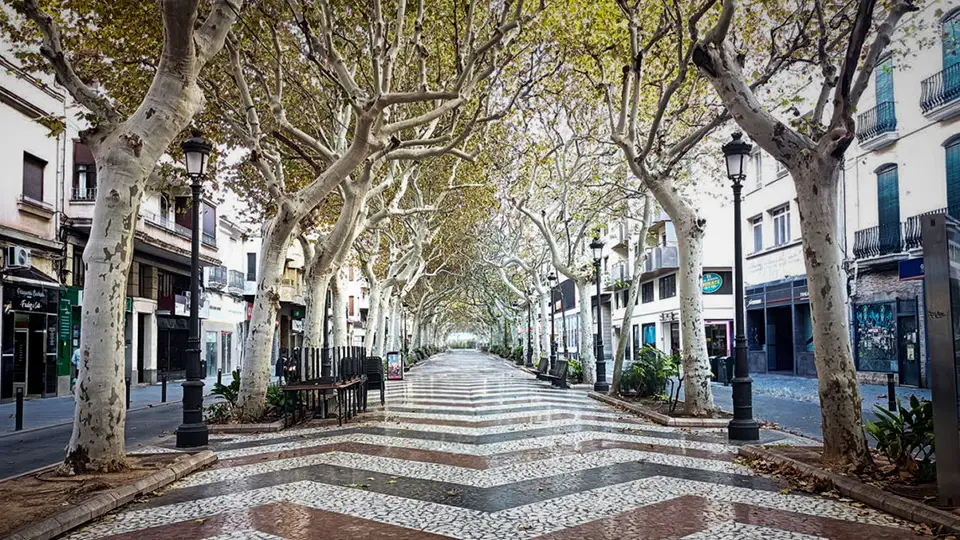
I suggest beginning our walk along Passeig de les Germanies. This is one of the town’s main avenues and a good place to discover the more contemporary side of Gandia. There are trees providing welcome shade, benches, shops, and cafés. It does not yet have the atmosphere of a medieval town, but that is precisely why it makes a good starting point. You can ease yourself into the rhythm of the place before wandering into its older quarters.
The name of the avenue refers to the Germanías, an uprising by craft guilds and urban brotherhoods against the power of the nobility, which spread across the Kingdom of Valencia between 1519 and 1523. The conflict also affected Gandia and its surroundings. It was an important episode in the region’s history, and its legacy can still be found in stories about the local dukes. If you happen to visit on a Saturday morning, you may come across the local market. It is a good opportunity to see the town from an everyday perspective, rather than focusing exclusively on its historic monuments.
Plaza Mayor and the Collegiate Church of Santa María
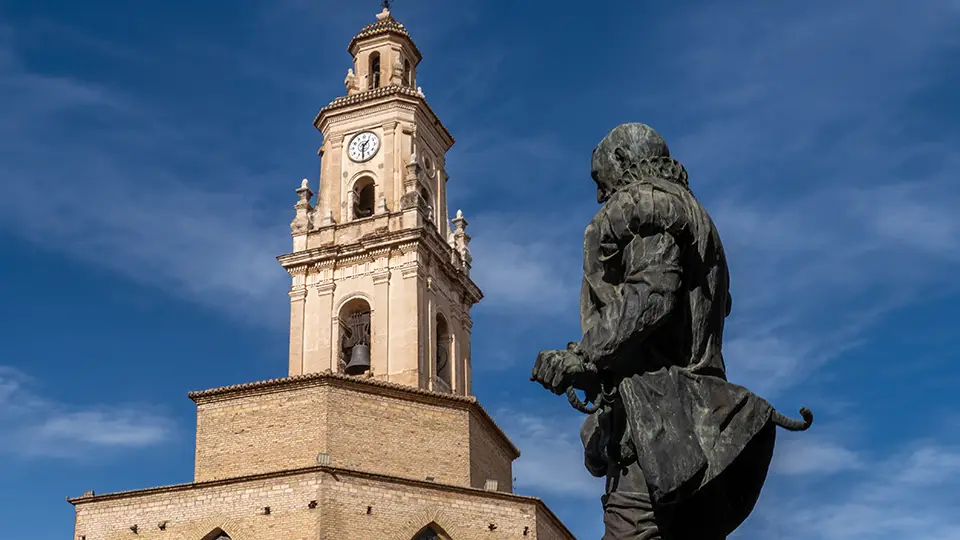
Walking towards the old town, we arrive at Plaza Mayor, one of the most important spots in Gandia’s historic centre. This is where you will find the Collegiate Church of Santa María, also known as La Seu. Its imposing structure immediately catches the eye, making it difficult to walk past without stopping. The history of the church is long. A mosque once stood on this site, a reminder of the region’s Muslim past. Following the Christian conquest, the area was converted into a place of Christian worship, and construction of the Gothic church began in the fourteenth century. Work continued over the following centuries, and in 1499 Pope Alexander VI elevated the church to the status of a collegiate church.
One feature worth paying particular attention to is the Portal of the Apostles. It is one of the building’s most distinctive elements and is associated with the sculptural work of Damià Forment. The façade and entrances contain numerous architectural details that are best appreciated when you take your time and look closely.
The church is also closely connected with the history of the Borja family. María Enríquez, the wife of the second Duke of Gandia, played a particularly important role in its development. Thanks to her involvement, the collegiate church was completed, while the religious and cultural life of the town gained greater importance. If you are interested in religious architecture, it is well worth stepping inside. Bear in mind, however, that the building has undergone several alterations over the centuries, and its present appearance reflects many periods.
The Ducal Palace – Gandia’s most important historic monument
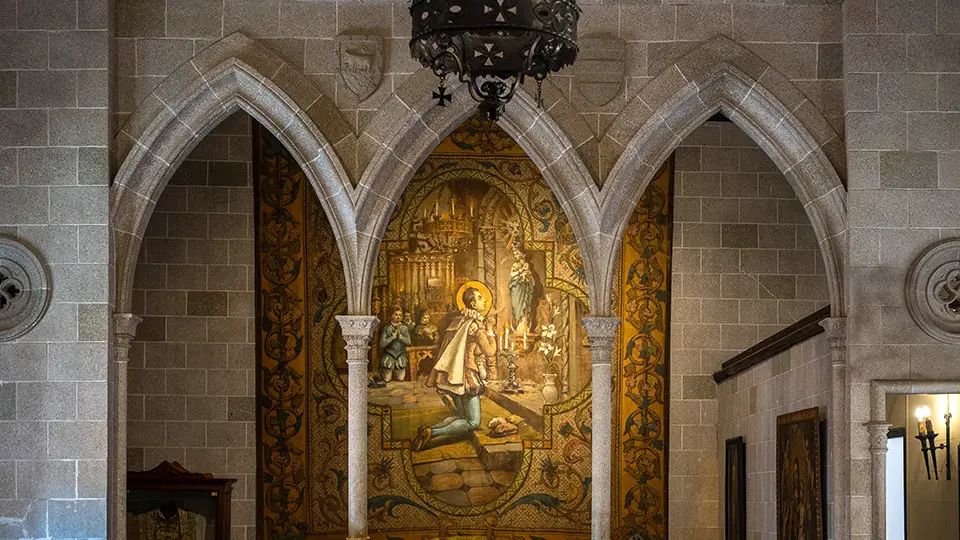
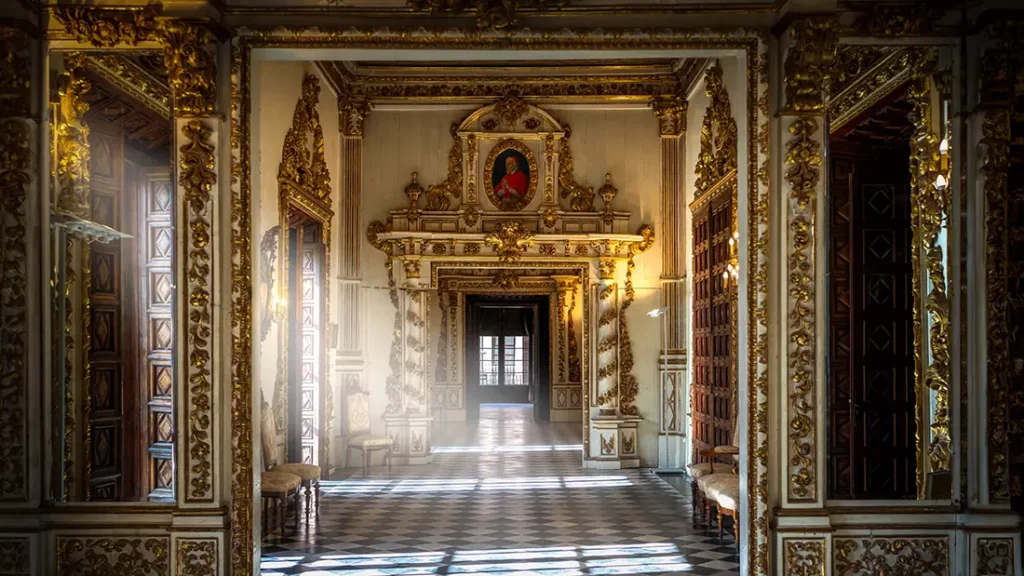
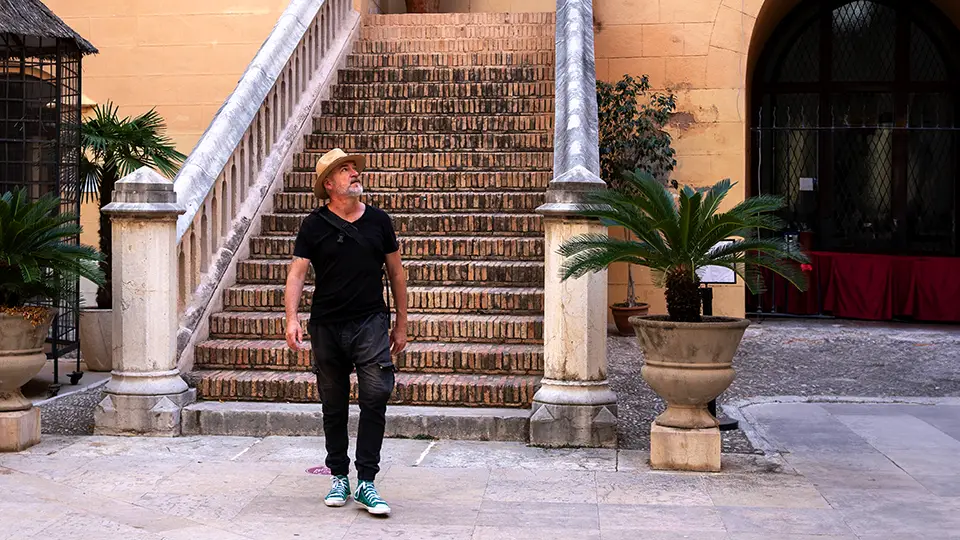
Just a few steps from the collegiate church stands what I consider the highlight of the entire walk. The Palau Ducal dels Borja, or Ducal Palace of the Borgias, is a building without which it is difficult to understand Gandia’s history. Its origins date back to the fourteenth century when a ducal residence was established here. The building was extended, remodelled and adapted to suit the needs of successive owners on numerous occasions. As a result, visitors can now find Gothic, Renaissance and Baroque features, as well as later restorations.
This was the home of the Borja family, and it was here that Francisco de Borja, the fourth Duke of Gandia and later a saint of the Catholic Church, was born in 1510. The family became famous far beyond Spain. Its members played important roles in the history of the Catholic Church and European politics. Rodrigo de Borja became Pope Alexander VI, while his uncle Alonso de Borja had previously occupied the papal throne as Callixtus III. The Italian version of the family name, Borgia, is associated with numerous stories of intrigue, ambition, and the struggle for power.
Inside the palace, you can explore several impressive rooms, including the Patio de Armas, or Arms Courtyard, the Salón de Coronas and the Galería Dorada, known as the Golden Gallery. The latter is particularly striking. This Baroque gallery was created in the early eighteenth century to commemorate the canonisation of Francisco de Borja. This is not a typical palace where everything looks as though its owners simply stepped out yesterday. Over the centuries, the building changed its purpose and underwent numerous restorations. That is precisely why walking through its rooms feels like travelling through different periods of architectural history. I recommend allowing yourself plenty of time here. Seeing the palace only from the outside would be a considerable-missed opportunity.
Escuelas Pías – the former university and the legacy of the Borgias
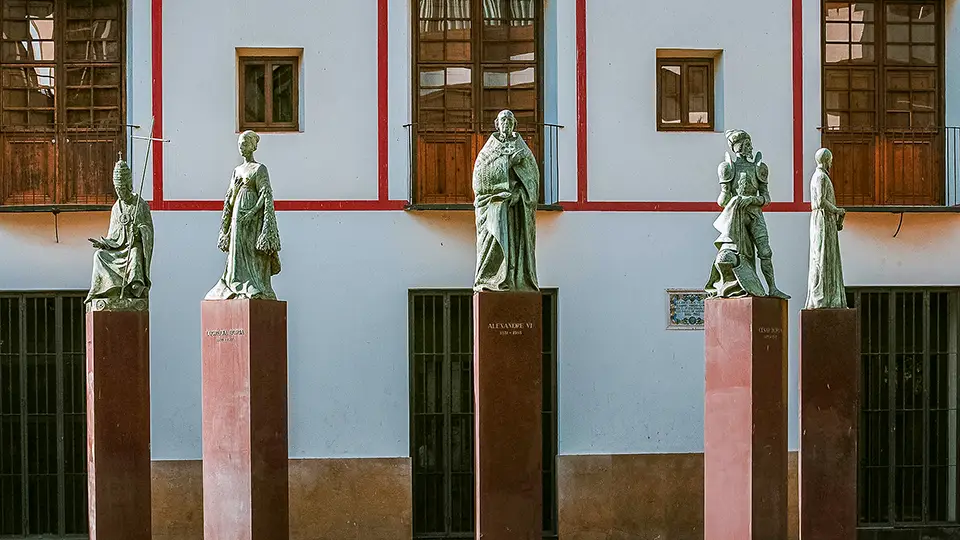
Our next stop is the building known as Escuelas Pías, also called the Antigua Universidad. It stands close to the palace and is one of the places that demonstrate how Gandia was once an important centre of education. The history of the institution is closely connected with Francisco de Borja. The duke, who eventually abandoned his secular life and joined the Jesuit order, contributed to the establishment of a Jesuit college. The institution opened in the middle of the sixteenth century and later acquired university status.
The university operated until 1767 when the Jesuits were expelled from Spain. The building itself, however, retained its educational role. From the beginning of the nineteenth century, it was associated with the Piarist order, whose members ran a school here. Have a look at the sculptures standing in front of the building. They represent members of the Borja family and commemorate the people who helped shape the town’s history. It is a good place to stop for a moment and reflect on how important education and culture were to Gandia, alongside the influence of the aristocracy.
Torreón del Pino – a remnant of the old town walls
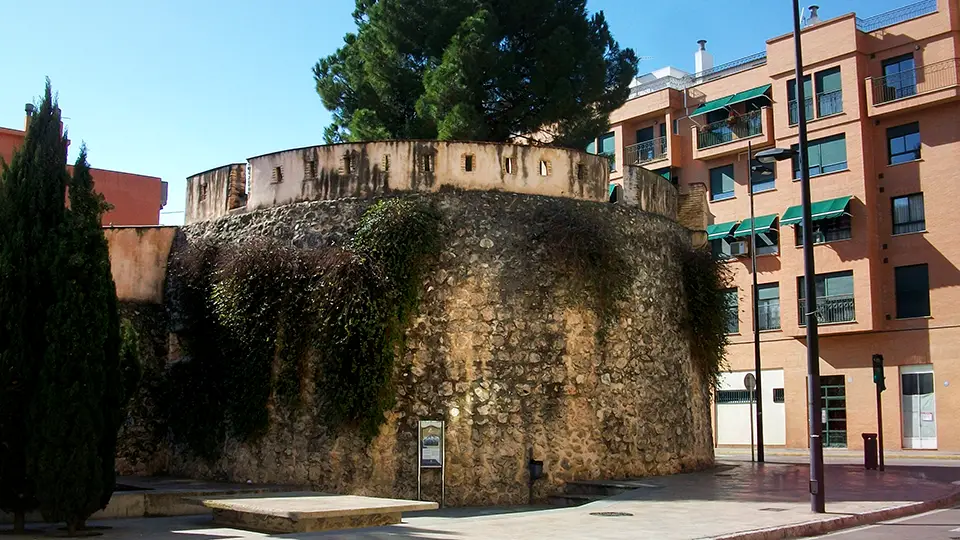
After leaving the former university, I suggest looking for Torreón del Pino, or the Pine Tower. It is one of the surviving fragments of Gandia’s old defensive system. The town was once surrounded by walls, the construction of which began in the early fourteenth century. Over time, these fortifications proved insufficient, and during the sixteenth century, under Francisco de Borja, work began on a second defensive circuit. The expansion was connected with the growth of the town and the need to protect its newer districts.
Today, most of the old fortifications have disappeared. Their demolition began in the nineteenth century, and some stonework was reused in other buildings. Nevertheless, a few sections of the walls, towers and remains of the old defences have survived, incorporated into the later urban landscape.
I enjoy discovering places like this along city walking routes. They are not always monumental, nor do they necessarily have impressive façades, but they allow you to imagine what a town looked like several hundred years ago. When exploring Gandia, it is worth looking beyond the most famous monuments and keeping an eye out for older architectural features hidden between modern buildings.
The former Sant Marc Hospital and the Archaeological Museum
We now make our way towards Carrer de l’Hospital, where another interesting part of the town’s history awaits us. The former Sant Marc Hospital is home to the Museu Arqueològic de Gandia, also known as MAGa. The building itself deserves attention. Its history dates back to the Middle Ages, and for centuries it served as a hospital and place of care. Today, it offers an opportunity to discover a much older chapter of the region’s history than the one associated with the Borja dukes.
The museum displays archaeological finds from Gandia and the wider La Safor region. Particular attention is given to objects from the Palaeolithic period, as the area around the town is one of the most important locations for research into the earliest human settlements on the Iberian Peninsula.
If you are interested in human history, I recommend going inside. It is an excellent complement to a visit to the ducal palace. There, we discover the lives of rulers and aristocratic families, while here we travel thousands of years further back, to a time when there was not even a town in this part of Valencia. Nearby, you will also find the Museu de Santa Clara, which displays religious art and objects connected with the history of the Poor Clare convent. It is another worthwhile stop for anyone who enjoys discovering less obvious historic attractions.
Gandia beyond the old town – a walk towards the sea
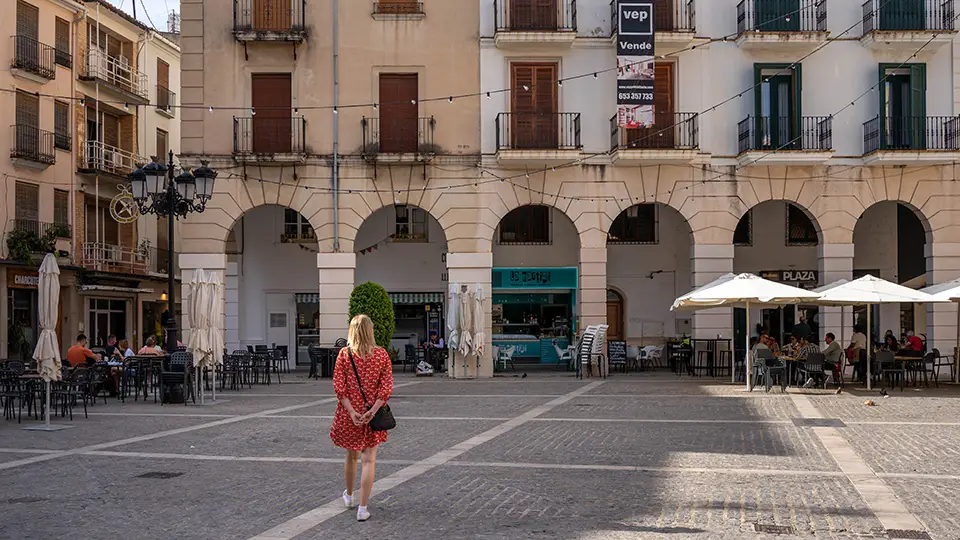
After exploring the historic centre, you can head back towards the more modern part of the town. Gandia is not an open-air museum where time has stood still. It is a lively place with wide streets, shops, restaurants and the everyday activities of its residents. One of the nicest places to continue your walk is the area around Casa de Cultura Marqués de González de Quirós, also known as Casa de la Marquesa. This historic residence is surrounded by gardens and hosts exhibitions and cultural events. Its grounds provide a pleasant opportunity to escape the bustle of the town for a while.
It is also worth paying attention to the squares and smaller streets branching off the main avenues. This is where you will find small local businesses, bakeries, and cafés where residents meet for their morning coffee. Not everything has to be a historic monument to deserve your attention. Gandia has another attraction that is impossible to overlook: its extensive beach, located a few kilometres from the historic centre. Playa Nord, the town’s main beach, stretches for almost five kilometres. It is wide, sandy, and well-equipped with facilities.
A promenade runs along the coastline, lined with restaurants, cafés, and hotels. During the summer, this part of Gandia attracts large numbers of visitors, and the atmosphere is wholly different from the quieter streets of the old town. If you prefer a more natural setting, have a look at Playa de l’Ahuir. This area is characterised by its dunes and valuable natural habitats. Compared with the main beach, it is much less developed and offers a glimpse of the more natural side of the coastline.
South of the port, you will also find Playa de Venecia and Playa de Rafalcaid. They are smaller beaches with a slightly quieter atmosphere. In my opinion, combining a visit to the old town with some time beside the sea is one of Gandia’s greatest advantages. You do not have to choose between sightseeing and a beach holiday. You can enjoy both during the same trip.
Fideuà – the dish you must try in Gandia
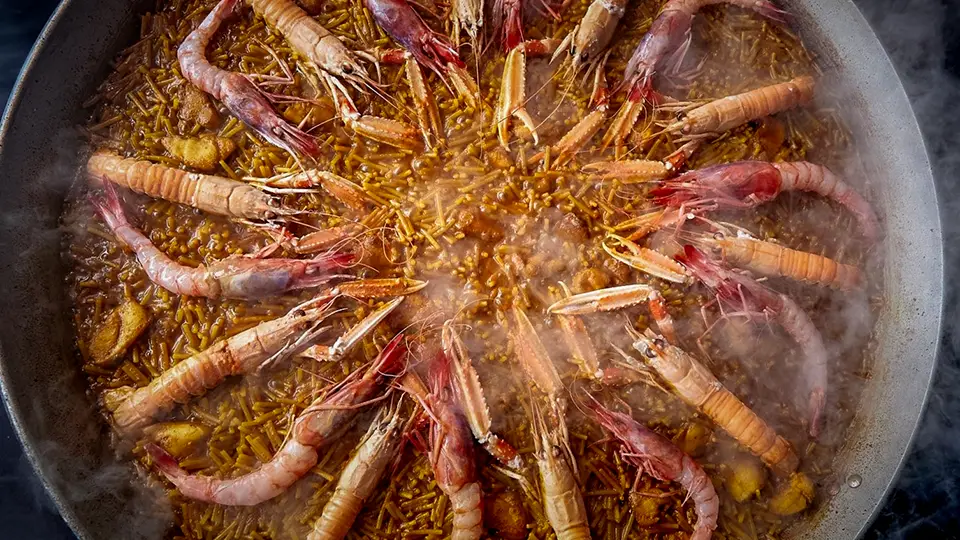
After all that walking and sightseeing, it is time for something that is almost as important to Gandia as the history of the Borgias. I am talking about fideuà, a traditional dish that originated in this very town. At first glance, it may look a little like paella, but instead of rice, it is made with short, thin noodles. The dish is prepared in a large, shallow pan, usually with fish, seafood and a flavoursome stock.
There is a story connected with the local culinary tradition about fishermen who supposedly decided to prepare their dish using pasta instead of rice. This tale is often repeated when explaining the origins of fideuà, although some details are part of local folklore rather than firmly established history.
Today, fideuà is one of Gandia’s most recognisable gastronomic specialities. Competitions dedicated to preparing the dish are even organised here, and local chefs take the traditional recipe very seriously. If you visit the town, make sure you order a portion. In my opinion, it is a much better choice than ordering yet another standard paella in a random restaurant.
Gandia – a town worth returning to
Gandia is one of those Spanish towns that are easily and unfairly pigeonholed as seaside resorts. Its long beach, hotels, and holiday facilities mean that many visitors associate it almost exclusively with summer holidays. Yet just a few kilometres from the sea lies a historic centre with a genuinely fascinating past.
What I like most about this place is the opportunity to discover several historical periods during a single walk. We begin with the remains of medieval walls, pass a Gothic collegiate church, step inside the palace of one of Europe’s most influential aristocratic families and then discover traces of the former university and a history stretching back to prehistoric times.
This is not a town that needs to be explored rushing. I would set aside at least half a day for the historic centre, or preferably a full day if you want to visit the palace, explore the museum and enjoy a relaxed meal in one of the local restaurants. Gandia makes an excellent day trip for anyone staying around Valencia, Dénia or Oliva. You can easily visit for a single day, but the town also works very well as a base for a longer stay.
So, the next time you plan a journey along Spain’s eastern coast, do not limit yourself to beaches and seaside promenades. Make time for Gandia. I think that after walking through its old town, you will have a much more profound understanding of just how rich and diverse the history of this part of Valencia really is.
Gandia information and interesting facts
- Gandia was one of the most important residences of the Borja family, known throughout Europe by its Italian name, Borgia. The family produced two popes: Callixtus III and Alexander VI.
- Francisco de Borja, who later became Superior General of the Society of Jesus and a saint of the Catholic Church, was born in Gandia. He came into the world in 1510 as a member of one of Spain’s most powerful families.
- The Ducal Palace of the Borgias has medieval origins. It was extended over successive centuries, which is why visitors can find Gothic, Renaissance, and Baroque features within the building.
- The Borja family was so influential that its members played important roles not only in Spain but also in the politics of papal Rome. Rodrigo de Borja became Pope Alexander VI in 1492.
- Gandia has an extraordinarily rich archaeological heritage in its immediate surroundings. Thousands of small stone plaques decorated with Palaeolithic depictions of animals have been discovered in the nearby Cova del Parpalló cave.
- Cova del Parpalló is one of the most important sites of Palaeolithic art on the Iberian Peninsula. The discoveries made there offer an insight into the artistic expression and imagination of people who lived tens of thousands of years ago.
- During the Middle Ages, Gandia was an important centre of sugar production. Sugar cane was cultivated in the area, and the local product was traded in other parts of Europe.
- The wealth of medieval Gandia was largely based on agriculture and an extensive irrigation system. Many of the methods used on local farms had their origins in the period of Muslim rule.
- In 1399, Gandia was elevated to the status of a royal duchy. This event considerably increased the town’s prestige and strengthened its position within the Kingdom of Valencia.
- One of Gandia’s most important medieval rulers was Alfonso the Elder. During his reign, the town became a significant aristocratic residence and a centre of cultural life.
- Gandia was associated with Ausiàs March, one of the greatest poets of medieval Catalan literature. His work had a considerable influence on the development of European poetry.
- Gandia was once home to a Jesuit university. Its establishment was connected with the activities of Francisco de Borja, and the institution remained in operation until 1767.
- Francisco de Borja abandoned his aristocratic lifestyle and prestigious position at the court of Emperor Charles V to join the Jesuit order. He eventually became its Superior General.
- The Collegiate Church of Santa María, also known as La Seu, was built on the site of an earlier mosque. Its history is a reminder of the centuries-long presence of Muslim culture in this part of Spain.
- In 1499, Pope Alexander VI elevated the Church of Santa María to the status of a collegiate church. This was a critical moment in the religious and social history of Gandia.
- Gandia once had an extensive system of defensive walls. Most of the fortifications were demolished during the nineteenth century, as the town began to expand beyond its medieval boundaries.
- In 1609, the expulsion of the Moriscos began. These were descendants of Muslims who had previously been forced to convert to Christianity. For Gandia, this resulted in serious economic difficulties, as the Moriscos comprised an important part of the local workforce.
- The name of the La Safor region, of which Gandia is the main centre, comes from an Arabic term associated with mountains. The surrounding landscape is indeed characterised by distinctive mountain ranges and fertile valleys.
- Gandia is the birthplace of fideuà, one of the best-known dishes of Valencian cuisine. It resembles paella, but instead of rice it is made with noodles, fish, and seafood.
- A story about fishermen is often told when explaining the origins of fideuà. According to the popular version, they prepared the dish using noodles instead of rice because one of the cooks wanted to limit the captain’s appetite for rice. The story has become part of the town’s culinary tradition.
- Gandia hosts an international fideuà competition. The event promotes local cuisine and attracts chefs interested in preparing this traditional speciality.
- Playa Nord is almost five kilometres long. It is a wide, sandy beach and one of the town’s most important tourist attractions.
- Gandia also has a more natural stretch of coastline. Playa de l’Ahuir is known for its dunes and natural habitats, which contrast with the heavily developed main beach.
- In the nineteenth century, Gandia gained a railway connection with Alcoy. The line, which opened in 1893, made it easier to transport goods and contributed to the town’s economic development.
- Modern Gandia brings together two very different environments: a historic centre with the Borgia palace and Gothic churches, and a modern seaside district with hotels, restaurants, and a long sandy beach. This makes it possible to combine visits to historic monuments with a traditional Mediterranean holiday.