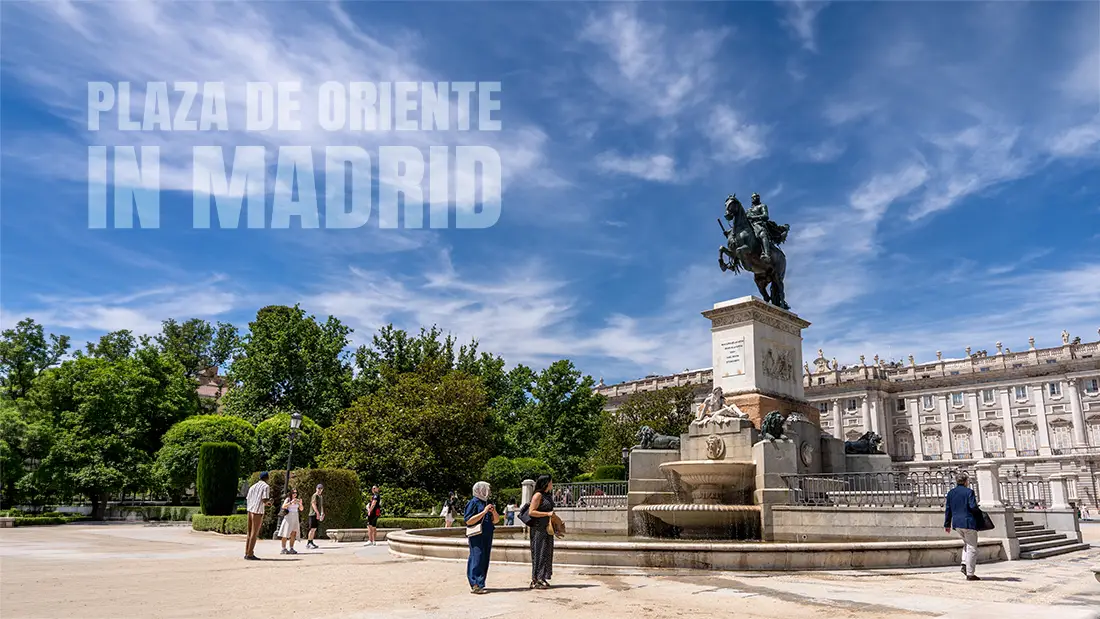
If you are planning to visit the Royal Palace of Madrid, you will probably walk through Plaza de Oriente. Let me tell you straight away – do not treat it merely as a square leading to one of the greatest attractions in the Spanish capital. It is worth stopping here for a while, sitting on a bench and taking a good look around.
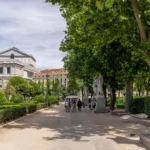
Plaza de Oriente is not a vast park where you can spend hours wandering along woodland paths. It is more of an elegant city garden surrounded by monumental architecture. On one side, you will see the enormous Royal Palace of Madrid, while on the other stands the façade of Teatro Real, the city’s most important opera house. It is difficult to imagine a more impressive setting.
What I liked most was the contrast between the peaceful greenery of the garden and the immense structure of the palace. Madrid is noisy, filled with cars, restaurants, and people rushing in every direction. Yet all you need to do is step between the hedges of Plaza de Oriente to slow down for a moment. Below, I will tell you about the history of the gardens and everything I managed to discover about this fascinating place.
Plaza de Oriente – a square, garden, or park?
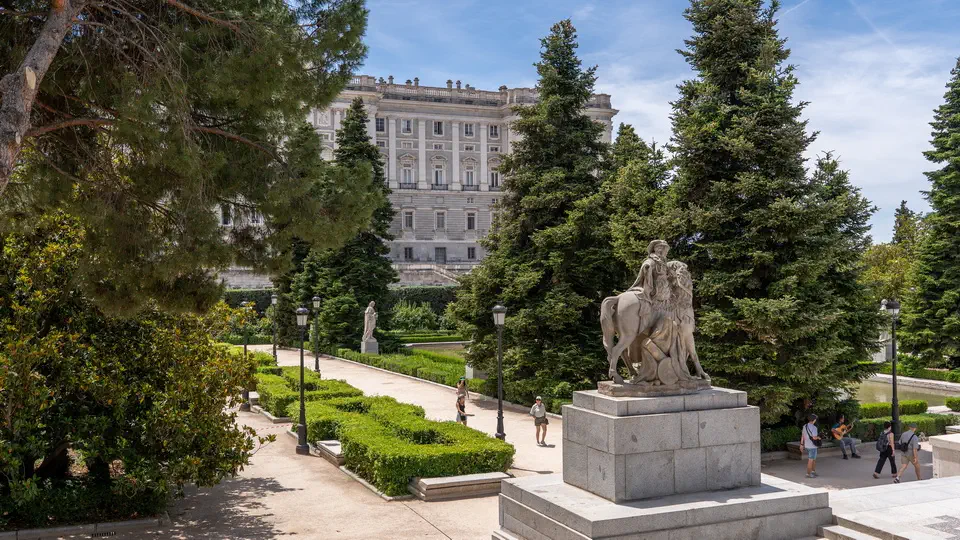
The name can be slightly misleading. Plaza de Oriente literally means Eastern Square, but the area resembles a formal city park more than a typical stone-paved square. It lies on the eastern side of the Royal Palace and covers approximately 1.6 hectares. Madrid’s official tourist information describes it as one of the city’s best-known historic gardens. Plaza de Oriente connects the royal residence with the Teatro Real building.
In my opinion, the best way to enter is from the theatre side. This allows the palace to appear gradually in front of you instead of revealing itself all at once. First, you see trees, statues, and the monument standing in the centre of the gardens. Only then does the enormous façade of the royal residence emerge behind them. The view is genuinely impressive, particularly in the morning before the larger groups of tourists arrive.
You do not need to set aside several hours for Plaza de Oriente. Around 30–45 minutes should be enough for a relaxed walk. However, if you want to sit on a bench, take photographs or visit one of the cafés and restaurants around the square, you could easily stay much longer.
The history of Plaza de Oriente
The idea of creating an impressive open space in front of the Royal Palace first appeared during the reign of Joseph Bonaparte. Napoleon’s brother became King of Spain in 1808. The Spanish people were not particularly fond of him, although it must be admitted that he had ambitious plans for rebuilding Madrid.
Joseph Bonaparte wanted to expose the eastern façade of the palace and create a spacious square in front of it. To achieve this, he ordered the demolition of houses, churches, and other buildings standing in the area. It was one of the reasons why residents sometimes called him the “king of squares”. It was not always intended as a compliment.
After his fall, work on developing the area continued for many years. The present appearance of Plaza de Oriente began to take shape in the 19th century during the reign of Queen Isabella II. In 1844, architect Narciso Pascual y Colomer prepared plans for the formal square and gardens.
The area was subsequently redesigned several times. One of the most important modern renovations took place during the 1990s under the direction of architect Miguel de Oriol. Today, it is difficult to believe that this was once a densely built-up part of Madrid. The square feels like a natural extension of the palace, almost as though both places had been designed together from the very beginning.
The monument to Philip IV – a horse that defies gravity
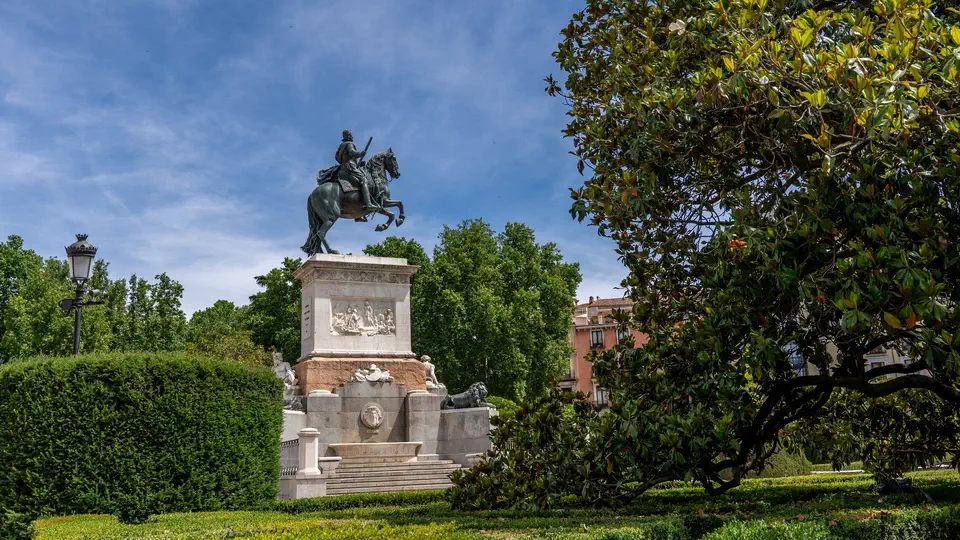
The central feature of Plaza de Oriente is the equestrian monument to King Philip IV. It is worth having a closer look because this is far more than just another monarch cast in bronze.
The horse is shown in a dynamic pose, balancing entirely on its hind legs. Creating such a sculpture was an enormous technical challenge in the 17th century. It was made by the Italian sculptor Pietro Tacca, who based the king’s appearance on a portrait painted by Diego Velázquez. The monument was completed during the first half of the 17th century, although it was not placed in the centre of Plaza de Oriente until the 19th century.
When you stand beside it, look not only at the king, but also at the horse itself. The front of the sculpture had to be made sufficiently light, while the rear section was deliberately made heavier. This clever distribution of weight keeps the huge bronze monument balanced.
You do not need to be particularly interested in art to appreciate the ingenuity behind its construction. I spent quite some time walking around the monument, trying to understand how its creators managed to achieve this at a time when they had neither computer modelling nor modern machinery.
The stone kings of Plaza de Oriente
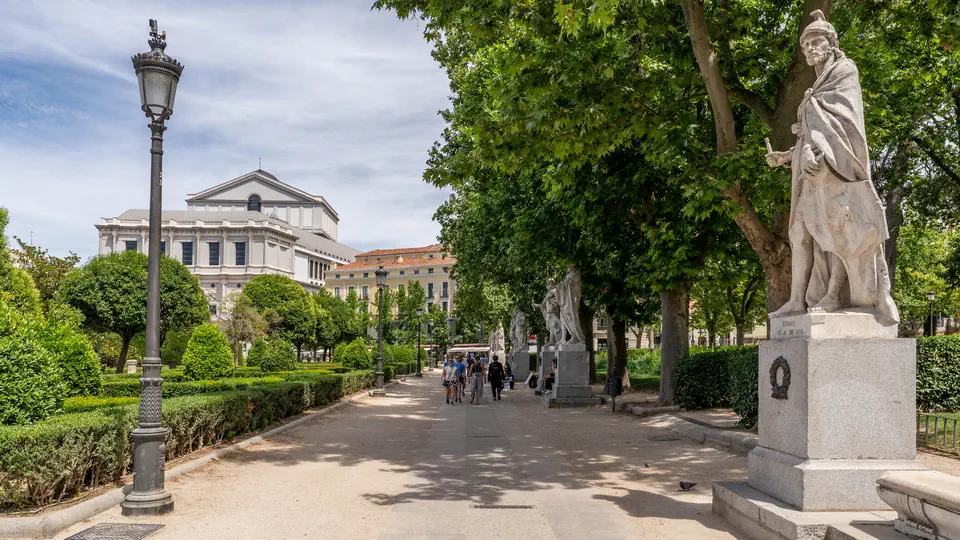
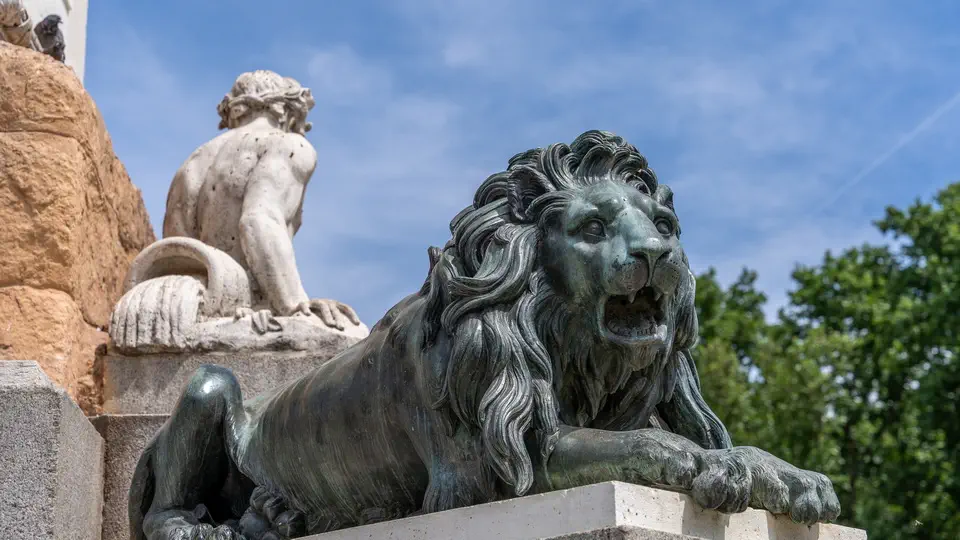
As you walk through the gardens, you will notice two rows of limestone statues portraying former monarchs. There are 20 figures in total – five Visigothic rulers and 15 monarchs associated with the earliest Christian kingdoms of the Iberian Peninsula.
The statues were made in the 18th century and were originally intended for the balustrade of the Royal Palace. Eventually, however, they were considered too heavy. Some were therefore placed in Plaza de Oriente, while others were distributed around different parts of Madrid.
I must admit that I did not try to remember all their names. After the first few kings, they begin to blur together, particularly as most of them stare at passers-by with similarly serious expressions. Nevertheless, the figures create an unusual setting and perfectly complement the square’s royal character.
Jardines del Cabo Noval and Jardines de Lepanto
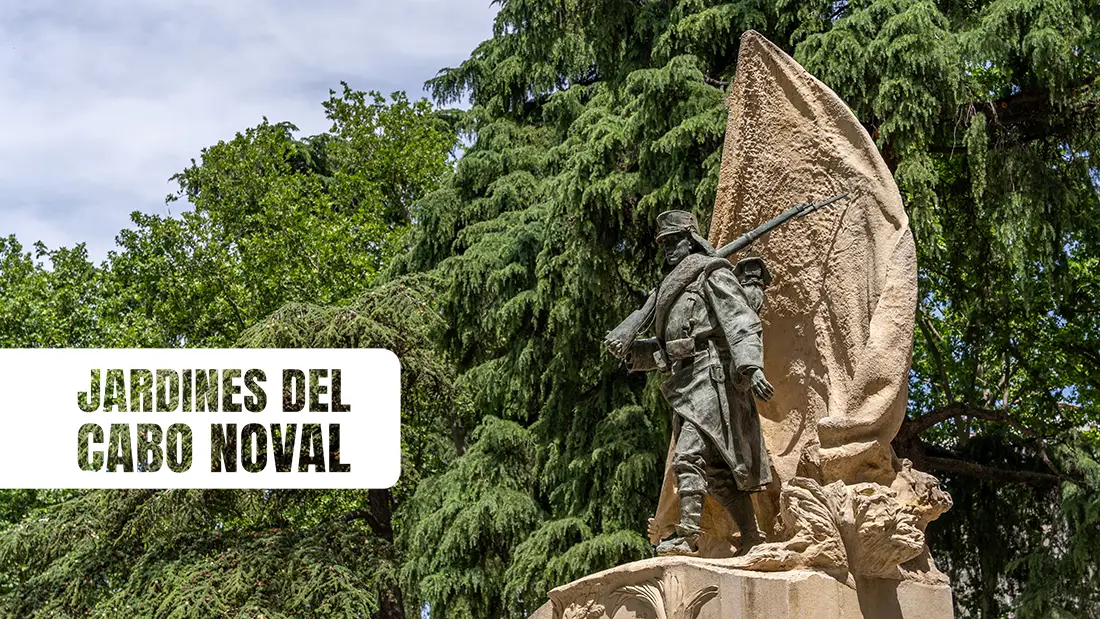
Plaza de Oriente consists of several distinct sections. The formal gardens surrounding the monument to Philip IV occupy the centre. To the north are Jardines del Cabo Noval, while Jardines de Lepanto lie to the south.
I have particularly fond memories of the northern section. It is quieter, offers more shade and provides a welcome escape from the activity around the palace. If you would like to explore it in greater detail, have a look at my separate guide to Jardines del Cabo Noval beside Madrid’s Royal Palace. I also describe the monument dedicated to Luis Noval Ferrao and provide practical information to help you plan your visit.
The southern garden is named after the famous Battle of Lepanto, fought in 1571. Both side gardens are less formal than the central section. Their larger trees provide considerably more shade, something that becomes critical during summer. The Madrid sun can be merciless, especially around the middle of the day.
The Royal Palace seen from Plaza de Oriente
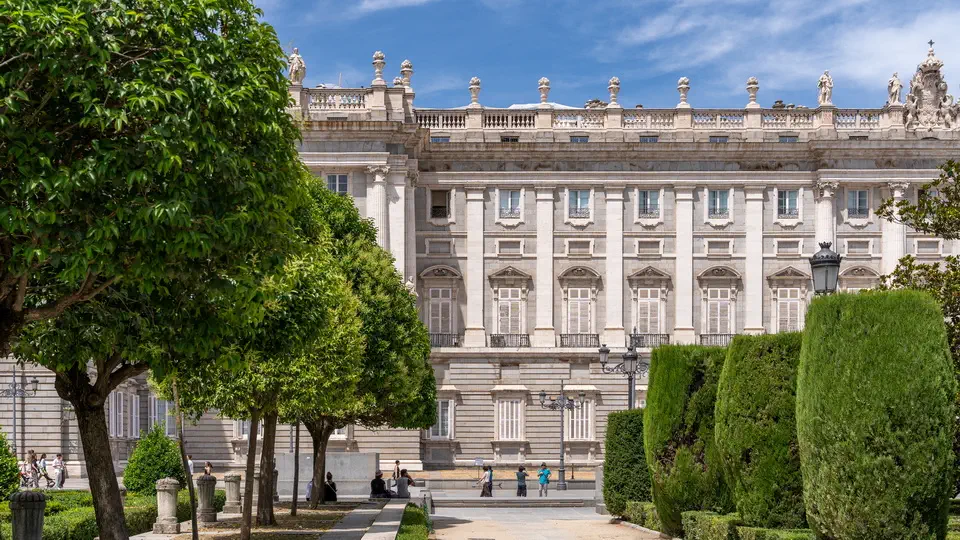
The greatest attraction here is, of course, the Royal Palace. From Plaza de Oriente, you can admire its eastern façade and the Puerta del Príncipe, or Prince’s Gate, located in front of it.
The building looks particularly monumental from this side. It is only when you move closer that you begin to appreciate its enormous scale. The palace covers approximately 135,000 square metres and contains more than 3,400 rooms.
I would recommend walking around Plaza de Oriente before entering the palace. This allows you to see the royal residence in its proper setting. After touring the interior, you can return to the gardens, sit on a bench and give your legs a well-earned rest. Believe me, after walking through all those palace chambers, the break will be very welcome.
When is the best time to visit Plaza de Oriente, and what can you see nearby?
I liked Plaza de Oriente most in the morning. The air was still cooler, and organised tour groups had not yet filled the paths. The light falling across the palace façade was also excellent for photography.
In the evening, the square develops a different atmosphere. The illuminated Royal Palace and Teatro Real create an elegant setting, while the surrounding restaurants and cafés become livelier. It is a lovely place for a quiet walk after dinner.
During summer, I would avoid visiting between 1:00 pm and 5:00 pm. There is not much shade in the central garden, and temperatures can rise above 35°C. In that kind of heat, it is better to shelter beneath the trees in the side gardens or return in the late afternoon.
Admission to Plaza de Oriente is free. The easiest way to reach it is by metro. The nearest station is Ópera, served by lines 2 and 5, as well as the Ramal shuttle line.
The square is perfectly positioned for exploring more of Madrid. The Royal Palace, Almudena Cathedral, Sabatini Gardens and Teatro Real are all nearby. Plaza Mayor is also only a few minutes away on foot.
If you become hungry, you can walk to Mercado de San Miguel, one of Madrid’s best-known places for tapas. I should warn you, however, that prices there are noticeably higher than in ordinary local bars, while the summer crowds can make choosing something to eat rather less enjoyable.
For a longer break surrounded by greenery, I would decide Retiro Park, the green heart of Madrid. Plaza de Oriente is an elegant formal garden, whereas Retiro is an enormous park where you can easily spend half a day.
Is Plaza de Oriente worth visiting? My opinion
In my opinion, it certainly is, although I would not treat it as a standalone attraction requiring several hours. Plaza de Oriente works best as part of a walk through Madrid’s royal quarter. It gives you somewhere to pause between monuments, admire the Royal Palace and briefly experience the atmosphere of the former royal court.
There are no flashy attractions, elaborate tourist facilities or queues for ticket offices. Instead, you will find trees, flowers, statues, and one of the finest views of the royal residence.
If I could give you just one piece of advice, it would be this: do not rush through Plaza de Oriente on your way to the palace. Slow down, walk around the monument to Philip IV, look into the faces of the stone kings and find an empty bench.
Those quiet moments are often the ones I remember from my travels, far longer than yet another chamber filled with gold.
Plaza de Oriente – facts, information and interesting details
- The square’s name has nothing to do with the Far East. Plaza de Oriente simply means Eastern Square, as it lies on the eastern side of the Royal Palace. Its name therefore describes its location in relation to the royal residence.
- Plaza de Oriente is both a square and a garden. Although officially classified as a square, much of the area is occupied by paths, trees, flower beds and neatly trimmed hedges. As a result, it feels more like an elegant city park.
- The idea of creating the square emerged during the reign of Joseph Bonaparte. Napoleon’s brother, who became King of Spain in 1808, wanted to reveal the eastern façade of the Royal Palace and create a monumental open space in front of it.
- Creating the square required the demolition of older buildings. On Joseph Bonaparte’s orders, dozens of houses and religious buildings were removed from the area. This opened up the space between the palace and what is now Teatro Real.
- Madrid’s residents called Joseph Bonaparte the “king of squares”. The nickname was connected with the numerous demolitions carried out during his redevelopment of the city. In Spanish, he was known as Pepe Plazuelas, and the name was not always meant kindly.
- The present layout of Plaza de Oriente largely dates from the 19th century. The final design for the formal square was prepared in 1844 by the architect Narciso Pascual y Colomer. The work took place during the reign of Queen Isabella II.
- The square connects two of Madrid’s most important buildings. The Royal Palace stands on its western side, while Teatro Real occupies the eastern side. Plaza de Oriente therefore forms an impressive link between the monarchy and the world of culture.
- The monument to Philip IV is the focal point of the square. The king is portrayed on horseback, with the animal balancing on its hind legs. It is one of the most recognisable and valuable equestrian monuments in Madrid.
- The monument to Philip IV was an extraordinary technical achievement. Pietro Tacca had to distribute the sculpture’s weight with great precision to keep the horse balanced. The front section of the casting is thinner and lighter, while the rear is considerably heavier.
- The appearance of the king and his horse was based on a work by Diego Velázquez. Pietro Tacca did not design the monument entirely from his imagination. He drew inspiration from an equestrian portrait of Philip IV painted by one of the greatest artists of the Spanish Baroque period.
- The monument was not originally displayed in Plaza de Oriente. The sculpture was completed in the 17th century but was not installed in the centre of the square until 1843. Before that, it stood in several locations, including the royal gardens of Buen Retiro, close to today’s Retiro Park in Madrid.
- There are 20 stone statues of monarchs in Plaza de Oriente. They represent five Visigothic rulers and 15 kings associated with the Christian kingdoms that developed on the Iberian Peninsula during the Reconquista.
- The statues were originally intended to decorate the roof of the Royal Palace. During the 18th century, there were plans to place them along the upper balustrade of the royal residence. The idea was eventually abandoned, and the figures were distributed around the square and other parts of Madrid.
- A popular Madrid legend is associated with the statues. According to the story, Queen Elisabeth Farnese dreamed that the figures were falling from the palace and killing people below. Frightened by the vision, she ordered them to remain on the ground. Historians, however, usually point to structural and aesthetic reasons for the decision.
- The stone rulers are sometimes called the “fat kings”. Madrid residents occasionally refer to them as reyes gordos. The humorous nickname comes from their solid figures and the heavy robes in which the monarchs were portrayed.
- Plaza de Oriente consists of three garden sections. In addition to the central gardens surrounding the monument to Philip IV, it includes Jardines del Cabo Noval to the north and Jardines de Lepanto to the south.
- The northern garden commemorates a Spanish soldier. Jardines del Cabo Noval is named after Luis Noval Ferrao. You can learn more about the garden, its monument and its history in my guide to Jardines del Cabo Noval beside Madrid’s Royal Palace.