Puerta del Sol is neither the most beautiful nor the most atmospheric square in Madrid. You will not find many trees here, romantic corners or rows of benches tucked away in the shade. Even so, if you are visiting the Spanish capital for the first time, it is almost impossible to leave it out. This is one of those places you will, eventually, pass through anyway.
I found myself at Puerta del Sol many times. Occasionally I came here deliberately, while on other occasions I arrived completely, returning from another attraction or simply trying to find my way to the Metro. The square lies right in the middle of tourist Madrid. Several important streets meet here, a busy transport interchange operates beneath the pavement, and many of the most important sights in the historic centre are within a fifteen-minute walk.
Sol is noisy, crowded, full of movement and, unfortunately, rather dirty. On one side you have street performers, on another groups following guides, while between them local people try to cross the square as quickly as possible. Yet this mixture is precisely what gives Puerta del Sol its character. You do not come here looking for peace and quiet. You visit to feel Madrid’s energy and to see symbols that almost every Spaniard would recognise.
Puerta del Sol – the former Gate of the Sun
The name Puerta del Sol means Gate of the Sun. It is not a modern label invented for tourists, but a reminder of the period when Madrid was a much smaller city surrounded by defensive walls. During the 15th century, one of the gates leading into Madrid stood in this area. The most widely accepted explanation is that it faced east, towards the rising sun. Another theory suggests that the gate itself was decorated with an image of a solar disc, which later gave it its name.
The original structure did not survive for very long. The gate was demolished in the 16th century as Madrid began to expand beyond its medieval limits. Its name, however, remained in the memory of local people and gradually came to describe the entire square.
At first, this was not the orderly and representative space we see today. Houses, shops, monasteries, and inns gradually appeared around the former gate. Merchants, travellers, and people looking for the latest news gathered here, and Puerta del Sol slowly became one of Madrid’s most important meeting places, even though for a long time, its appearance left much to be desired.
The square’s present semi-circular shape is largely the result of 19th-century redevelopment. Older buildings were demolished, the open space was enlarged, and the surrounding façades were made more uniform. Another major renovation was completed in 2023, reducing vehicle access and making the square much more pedestrian-friendly.
The history of Puerta del Sol – a square at the heart of major events
Puerta del Sol has long been much more than an ordinary city square. Before radio, television, and the internet existed, this was one of the places where Madrid residents came to hear important news. Government decisions were announced, information was exchanged and politics was discussed in public.
In the 18th century, the Real Casa de Correos, or Royal Post Office, was built beside the square. Construction was completed in 1768. The building performed several functions, although its main role was naturally connected with postal services. Today, it houses the government of the Community of Madrid.
One of the most important events in the history of Puerta del Sol took place on 2 May 1808, when Madrid residents rose against Napoleon’s troops. Fighting broke out in the square and neighbouring streets, later becoming a powerful symbol of Spanish resistance to French occupation. The events of early May 1808 inspired Francisco Goya to create his famous paintings depicting the Madrid uprising and the executions that followed.
Puerta del Sol has also repeatedly served as a stage for demonstrations and political events. In 1912, anarchist Manuel Pardiñas assassinated Prime Minister José Canalejas near the square. In 1931, crowds gathered here to celebrate the proclamation of the Second Spanish Republic.
A much darker chapter came during General Franco’s dictatorship, when the Real Casa de Correos became a headquarters of the security services. Political opponents were imprisoned and interrogated in its basement. Looking at the elegant façade today, I found it difficult to imagine how dramatic the events taking place inside the building must once have been.
The square’s political history did not end with Spain’s return to democracy. In May 2011, Puerta del Sol was occupied by members of the 15-M movement, also known as the Indignados. Protesters set up tents and demanded political reforms, less corruption and greater social justice.
Sol remains one of Madrid’s traditional protest locations. While walking through the square, you may still encounter a demonstration, public gathering or local event. In a way, Puerta del Sol continues to perform much the same function it did centuries ago – it gives people a place to gather and publicly express their views.
What to see in Puerta del Sol
You can cross Puerta del Sol in only a few minutes, but I would definitely not rush. The main sights are spread around the entire square and some are surprisingly easy to miss, particularly when hundreds of people are moving around you.
I would allow around 30–45 minutes to explore the square properly. That allows you enough time to find Kilometre Zero, photograph the bear, look at the famous clock and search for both Mariblanca and the Tío Pepe sign.
The Bear and the Strawberry Tree
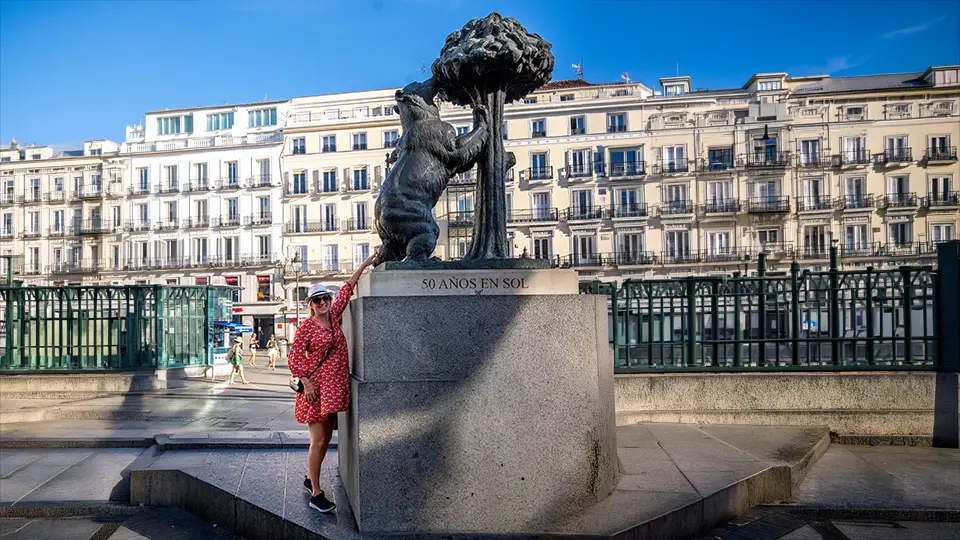
The most popular landmark in Puerta del Sol is El Oso y el Madroño, the Bear, and the Strawberry Tree. The sculpture shows a bear standing on its hind legs beside a strawberry tree, and both elements appear on Madrid’s coat of arms. The monument was created by Antonio Navarro Santafé and officially unveiled on 19 January 1967. It stands roughly four metres high and weighs several tonnes.
The bear had already appeared in Madrid’s symbolism during the Middle Ages. The tree was added later, probably in connection with an agreement concerning the division of land between the city and the Church.
Today, El Oso y el Madroño is one of the most photographed sights in Madrid. Taking a picture without strangers wandering into the frame is almost impossible. If that matters to you, come early in the morning before the larger tour groups arrive. The monument is also a popular meeting point. Arranging to meet someone “by the bear” sounds wonderfully simple, although finding that person in the crowd may take rather longer than you expect.
Kilometre Zero
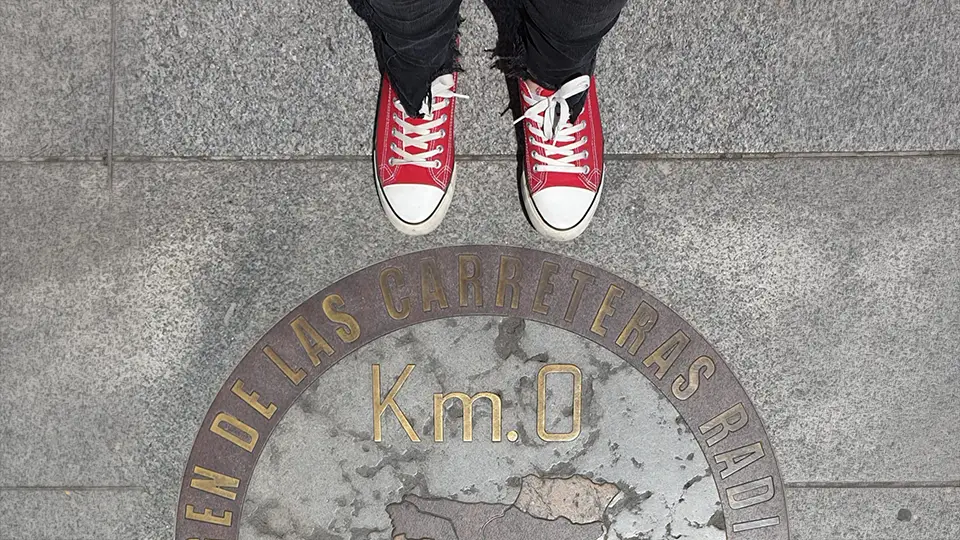
In front of the Real Casa de Correos, you will find the plaque marking Kilómetro Cero. It is set directly into the pavement and symbolically marks the starting point of Spain’s six main national roads radiating outwards from Madrid. The plaque does not mark the exact geographical centre of Spain. It is primarily a historical reference point from which road distances were traditionally measured.
Kilometre Zero is effortless to miss. I only noticed it after spotting a group of people queuing to photograph their shoes. If you see visitors staring determinedly at the pavement in front of the Real Casa de Correos, you are probably in the right place.
Real Casa de Correos
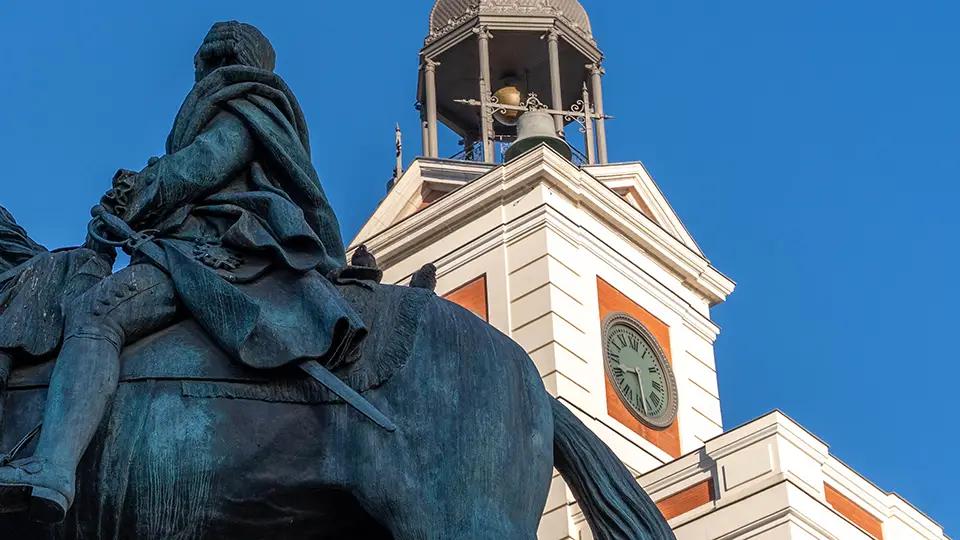
The most important building overlooking Puerta del Sol is the Real Casa de Correos. Its long Neoclassical façade dominates the southern side of the square. The former Royal Post Office now houses the government of the Community of Madrid, so visitors normally admire it from the outside. Several plaques on its façade commemorate critical moments in the city’s history.
One honours the people who fought against French troops on 2 May 1808. Another commemorates the victims of the terrorist attacks carried out on Madrid commuter trains on 11 March 2004. The building’s most recognisable feature, however, is its clock tower. On an ordinary day, it is easy to see it as little more than another architectural detail. On New Year’s Eve, however, the attention of the entire country turns towards it.
The clock and the tradition of twelve grapes
The clock on the Real Casa de Correos was made by José Rodríguez Losada and inaugurated in 1866. Since then, it has become one of the great symbols of Puerta del Sol. Every year on 31 December, thousands of people gather in the square to welcome the New Year. With each of the clock’s twelve chimes, tradition says that you should eat one grape. The twelve grapes are meant to bring good luck during each month of the coming year.
The event is broadcast by Spain’s major television stations. For many Spaniards, the New Year’s Eve chimes from Puerta del Sol are every bit as important as the countdown itself.
Eating twelve grapes in rhythm with the clock sounds easy until you actually try it. Some people prepare small seedless grapes with the skins removed, which makes the challenge slightly safer. If you are planning to celebrate New Year’s Eve in the square, expect security checks, restricted access and enormous crowds. I would not personally choose Sol if I were hoping for a quiet celebration. The atmosphere must be extraordinary, but comfort clearly takes second place.
The statue of Charles III
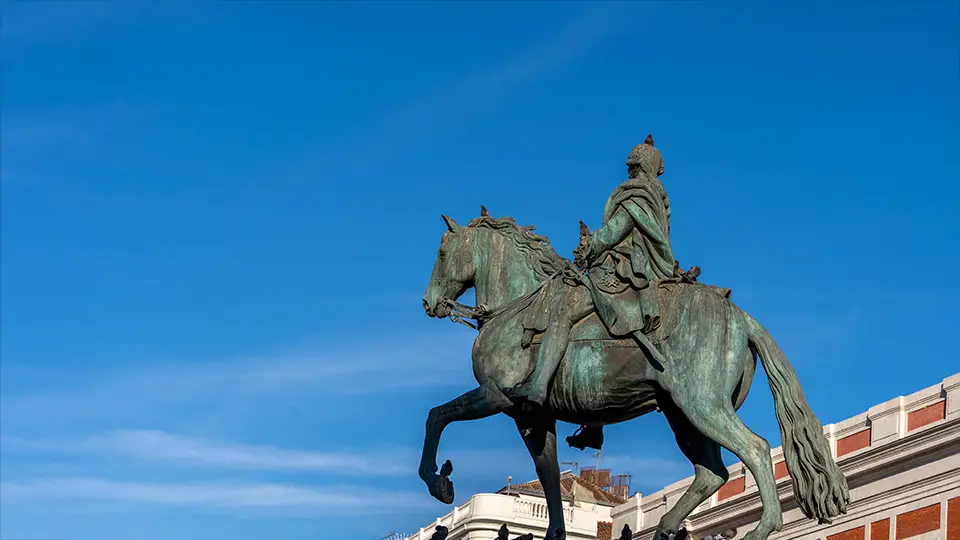
An equestrian statue of Charles III stands in the central part of the square. The king is sometimes described as Madrid’s best mayor, even though he never actually held the office. During his reign in the second half of the 18th century, Madrid underwent major modernisation. The drainage system was expanded, roads were improved, street lighting was introduced and new public buildings were constructed.
Madrid gradually began to move away from its more chaotic past and transform itself into a modern European capital. The statue of Charles III was placed in Puerta del Sol in 1994. Interestingly, its location was chosen by Madrid residents through a public vote.
Mariblanca
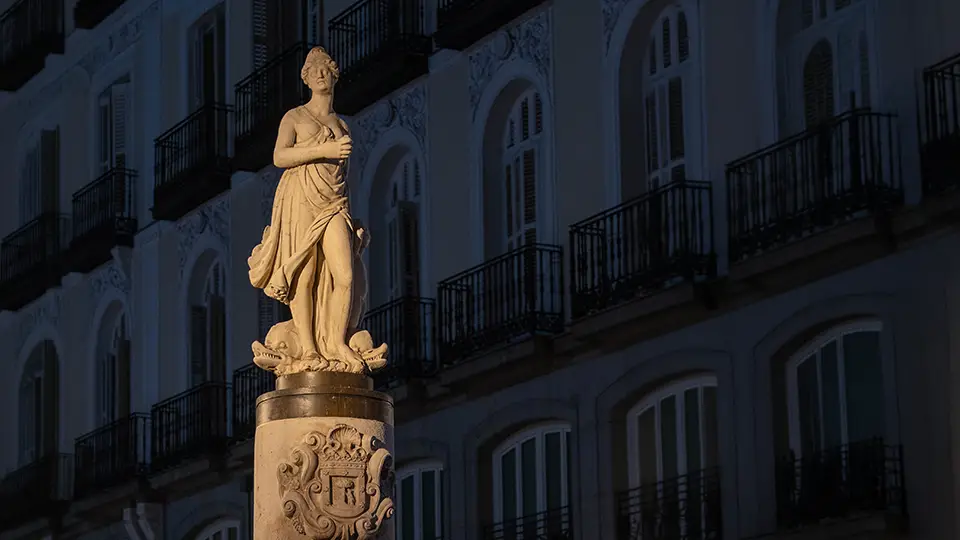
Near the entrance to Calle del Arenal stands a small white figure known as Mariblanca. It is easy to overlook, especially if most of your attention is focused on the bear and Kilometre Zero. The figure is a copy of a 17th-century statue that once stood on a fountain. Nobody knows for certain whom it represents. Depending on the interpretation, it may depict Venus, Diana or an allegorical figure.
Madrid residents were not especially bothered by this uncertainty and simply called her Mariblanca, or White Mary. Under that informal name, she became one of the square’s historic symbols. The original sculpture is now kept safely in Casa de la Villa.
The Tío Pepe sign
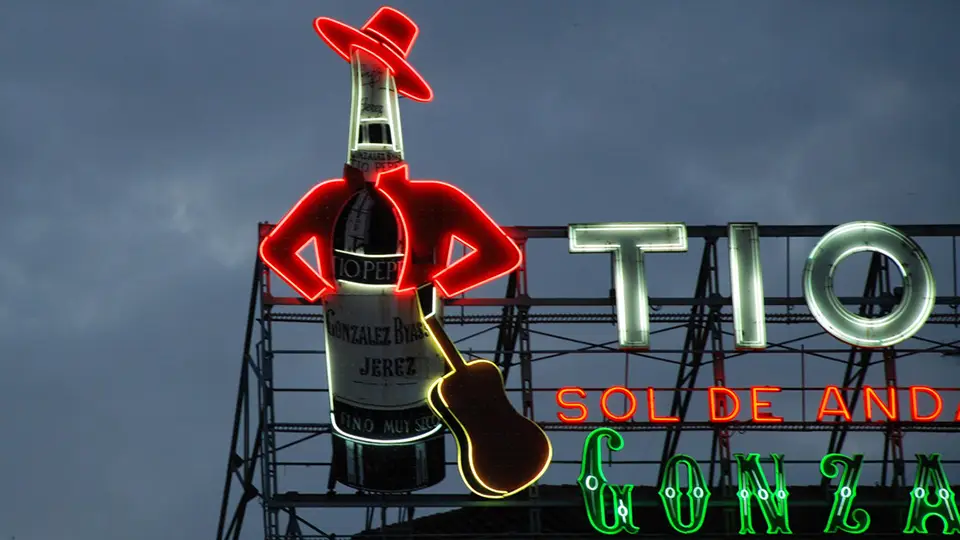
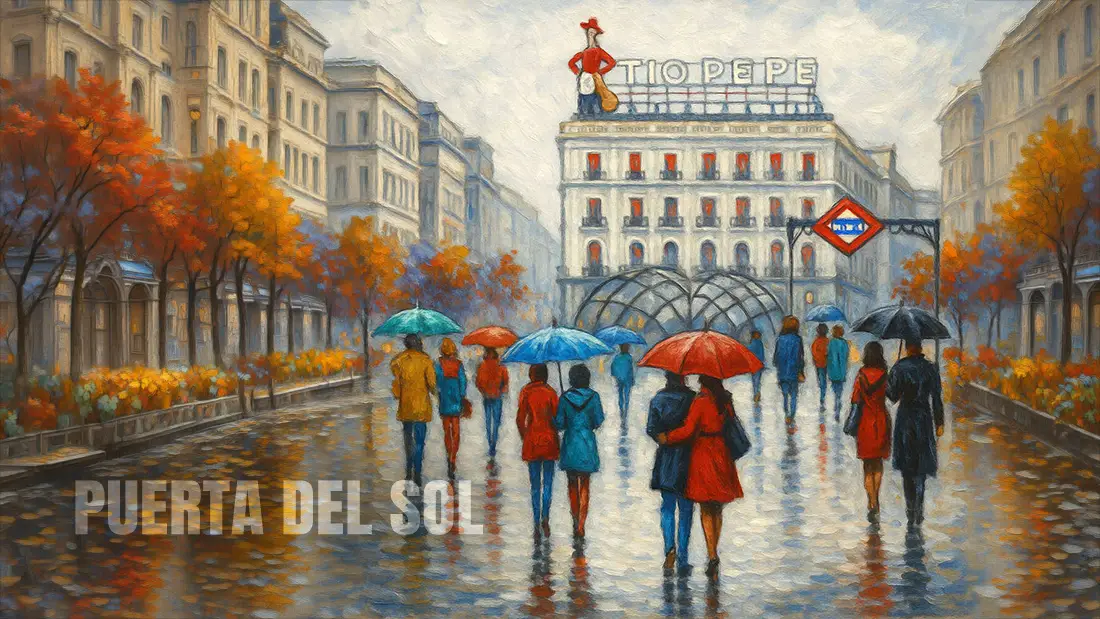
Above the surrounding buildings, you will notice the distinctive Tío Pepe neon sign, featuring a bottle of sherry wearing a red hat and short jacket while holding a guitar. I would not normally describe advertising as a historic attraction, but in this case an exception has to be made. The sign dates back to the 1950s and has become part of Madrid’s visual identity over the decades.
When it was removed during renovation work on the building where it once stood, residents protested. Tío Pepe eventually returned to Puerta del Sol, although not to the same façade. It looks best in the evening, when shop windows, signs and building lights illuminate the square. At that point, Sol begins to resemble a vast metropolitan crossroads that never really goes to sleep.
My impressions of Puerta del Sol
Puerta del Sol left me with mixed feelings. On the one hand, it is impossible to deny its energy and historical importance. On the other, it is not somewhere I would want to spend several hours. There is little greenery and almost no shade. In summer, the stone surface heats up quickly, and during the middle of the day the sun can be relentless. The crowds make the heat feel even worse. In those conditions, you are more likely to dream about cold water than admire architectural details.
If, after exploring the city centre, you need trees, shaded paths and somewhere to sit quietly, Retiro Park in Madrid is a much better choice. Puerta del Sol serves a wholly different purpose. It is a square you pass through, a place where people arrange to meet and a starting point for further sightseeing.
What I liked most was simply watching everyday life. Sol resembles a giant stage where the cast changes every few minutes. Guides raise brightly coloured umbrellas, street performers begin their shows, tourists search for Kilometre Zero, while residents try to navigate around the entire commotion. The best thing to do is stand slightly to one side for a moment and simply look around. That is when you realise Puerta del Sol is not merely a collection of monuments and photo opportunities. It is a living part of Madrid that continues to function as a meeting place and centre of information.
What to see near Puerta del Sol
One of Puerta del Sol’s greatest advantages is its location. The square makes an excellent starting point for exploring Madrid’s historic centre. From Sol, walk along Calle Mayor towards Plaza Mayor in Madrid. The journey only takes a few minutes, yet the two squares feel wholly different. Puerta del Sol is open, busy, and modern, whereas Plaza Mayor resembles an enormous theatrical courtyard enclosed by red façades.
I definitely recommend entering Plaza Mayor through one of its arched gateways. A narrow street suddenly opens onto a giant square, and that transition was one of the things I liked most. Just nearby is also the Mercado de San Miguel, where you can try tapas, seafood, cheeses, cured meats and Spanish sweets. It is an impressive place and works well for a short food stop, although prices are noticeably higher than in less touristy establishments. During the summer, finding somewhere to sit can also be a challenge.
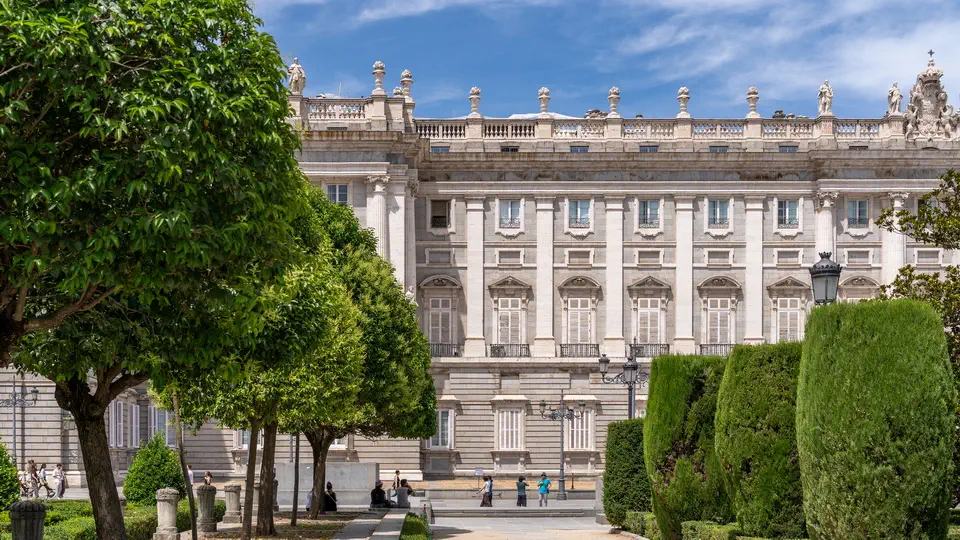
Continue along Calle Mayor and you will eventually reach Almudena Cathedral and the Royal Palace of Madrid. Its interiors were among the most impressive I saw in the Spanish capital, although you should allow a separate block of time for the visit and check ticket availability beforehand. In front of the palace lies Plaza de Oriente, whose formal gardens, benches, and palace views can feel like a genuine relief after the noise of Sol. If you prefer smaller green spaces, Jardines del Cabo Noval stands nearby and is often noticeably quieter. In the opposite direction, Calle de Alcalá leads from Puerta del Sol towards Gran Vía. This is one of Madrid’s grandest routes, lined with historic façades, shops, theatres, and restaurants.
Anyone interested in the development of the Spanish capital should also consider the Museum of the History of Madrid. Nearby, you can visit the Museum of Romanticism in Madrid, a much quieter attraction set inside the former Palace of the Marquis of Matallana. After the crowds of Sol, walking through its elegant rooms and small garden felt like a very pleasant change of pace. Puerta del Sol also works perfectly as part of a first visit to Madrid, since its central position allows you to connect the Royal Palace, Plaza Mayor, Gran Vía and many other attractions without unnecessary detours.
How to get to Puerta del Sol
The easiest option is the Metro. Sol station is served by lines 1, 2 and 3. A Cercanías commuter railway station also operates beneath the square, including services on the C-3 and C-4 lines. One of the station entrances is covered by a distinctive glass structure resembling a shell. It has become a modern feature of Puerta del Sol, although Madrid residents have never been completely united in their opinions about its appearance.
If you are staying in the historic centre, however, you probably will not need public transport at all. Puerta del Sol is best reached on foot. Calle Mayor, Calle de Alcalá, Calle del Arenal, Calle de Preciados and Carrera de San Jerónimo all lead towards the square.
I would not recommend driving. Much of the surrounding area is pedestrianised, traffic restrictions apply and parking in central Madrid can be expensive. A car is more likely to become a problem than a convenience.
When is the best time to visit Puerta del Sol?
The best time for a quieter visit is early in the morning, preferably before 9.00 am. The square will not be empty, but you can usually reach the bear statue and Kilometre Zero without too much difficulty. Morning is also better for photography. Later in the day, groups gather around the main landmarks, and finding an empty frame becomes practically impossible.
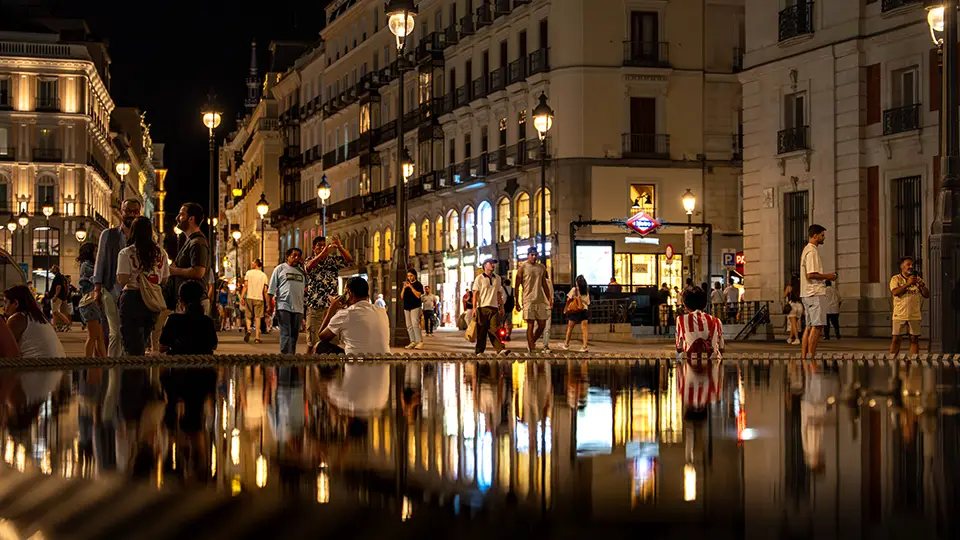
In the evening, Puerta del Sol develops a thoroughly different atmosphere. The neon signs, shop windows and façades light up, and the square begins to feel like the true centre of a large European capital. It is even busier at this time, but also more atmospheric.
During the summer, I would avoid the hours between roughly 1.00 pm and 5.00 pm. There is very little shade and the stone paving radiates accumulated heat. Bring water, sunglasses, and something to cover your head.
What should you watch out for?
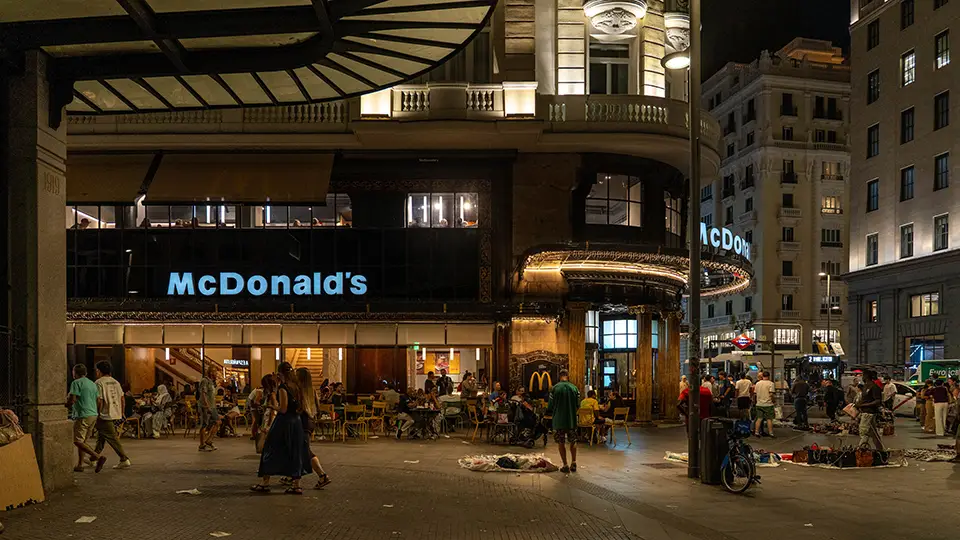
Puerta del Sol is extremely busy, so keep an eye on your belongings. Phones, wallets and documents are best kept in a closed bag, especially near Metro entrances and while taking photographs, when it is easy to become distracted.
You may also encounter people dressed as film or cartoon characters. Taking a photo with them is not normally free, even if nobody mentions payment beforehand, so it is worth agreeing the price first.
Do not be surprised by a visible police presence either. Puerta del Sol regularly hosts demonstrations, celebrations, and large public gatherings. Restaurants and cafés immediately around the square also tend to charge more than places located only a few streets away. If good food matters more to you than the view, walk slightly further from the main tourist routes.
Is Puerta del Sol worth visiting?
Yes, Puerta del Sol is definitely worth seeing, although I would not call it Madrid’s prettiest square. Its importance comes from its history, symbols, and location. This is where you will find the Bear and the Strawberry Tree, Kilometre Zero, the famous clock, Mariblanca and the Tío Pepe sign. In front of the Real Casa de Correos, you are also standing in a place that witnessed uprisings, demonstrations, political transformation and public celebrations.
Around 30–45 minutes is enough for the square itself. Afterwards, continue towards Plaza Mayor, the Royal Palace, Gran Vía or Barrio de las Letras. For me, Puerta del Sol is above all a crossroads between history and everyday life. It can be tiring, crowded and rather unforgiving during the summer heat, yet every time I emerged from Sol station again, I had the unmistakable feeling that I had returned to the very heart of Madrid.
Puerta del Sol facts, information and interesting details
- The name Puerta del Sol means Gate of the Sun. During the 15th century, one of the gates leading into Madrid stood here, probably facing east or decorated with an image of the sun.
- The original gate has not survived. It was demolished in the 16th century as Madrid expanded beyond its medieval walls, although local people continued to use its name for the surrounding area.
- Puerta del Sol is not the geographical centre of Spain. That common misconception comes from Kilometre Zero, which symbolically marks the starting point of Spain’s main radial roads.
- The Kilometre Zero plaque lies directly beneath pedestrians’ feet in front of the Real Casa de Correos, which makes it surprisingly easy to miss despite its fame.
- Kilometre Zero was temporarily removed during the most recent redevelopment of Puerta del Sol. The historic plaque was protected during the works and returned to its traditional position on 31 March 2023.
- The Bear and the Strawberry Tree is one of Madrid’s best-known symbols. Both the animal and the tree appear on the city’s coat of arms, while the monument was unveiled on 19 January 1967.
- Madrid’s famous bear may theoretically be a female bear. One interpretation connects the animal with Ursa Major, although official descriptions of the sculpture still use the masculine Spanish word oso.
- A strawberry tree does not resemble an ordinary strawberry plant. The madroño is an evergreen tree or shrub producing small red edible fruits whose flavour is rather unusual.
- The bear statue has changed position several times. During the 2023 redevelopment, it was moved towards the eastern part of the square’s northern curve.
- The Real Casa de Correos is no longer a post office. The former Royal Post Office now serves as the headquarters of the government of the Community of Madrid.
- The famous clock was presented during the reign of Queen Isabella II. It was created by José Rodríguez Losada, a Spanish clockmaker who worked in London, and inaugurated in 1866.
- On New Year’s Eve, Puerta del Sol becomes one of the most watched places in Spain as television channels broadcast the twelve midnight chimes from the Real Casa de Correos.
- Each of the twelve New Year’s grapes represents one month of the coming year. Eating all twelve in time with the clock is traditionally believed to bring good fortune.
- Before the actual midnight chimes, four warning sounds known as cuartos are heard. These are not the moment to begin eating the grapes, although first-time participants sometimes make that mistake.
- Mariblanca is older than most of the square’s famous modern symbols. The original marble sculpture was acquired in 1625, while the figure you see in Puerta del Sol today is a copy.
- Nobody knows with complete certainty whom Mariblanca represents. She is most often identified as Venus, although Diana is another possibility.
- Charles III is often called Madrid’s best mayor, despite never holding the position. His reign brought important improvements to roads, lighting, drainage and public architecture.
- Madrid residents helped choose the location of the Charles III monument through a public vote before the equestrian statue was placed in Puerta del Sol in 1994.
- The Tío Pepe neon sign has effectively become a historic landmark despite originally being nothing more than advertising. Its bottle-shaped figure is now one of Madrid’s most recognisable illuminated signs.
- Puerta del Sol is now primarily a pedestrian space. Major restrictions on traffic were introduced in 2020 and later redevelopment made the area even more focused on people rather than cars.