If you fancy taking a break from the beaches, promenades and seaside resorts during your stay on the Costa Blanca, Cuevas del Canelobre in Busot is well worth adding to your list of places to visit. It is one of the most remarkable attractions in the Alicante area, located around 25 kilometres north of the city, on the slopes of the Cabeçó d’Or mountains.
I have visited several large caves in Spain, and I have to admit that Canelobre really stands out, mainly because of its impressive scale and fascinating history. This is not the sort of cave where you spend an hour squeezing through narrow passages. Instead, after walking through a short tunnel, you suddenly find yourself in an enormous underground chamber resembling a natural cathedral. In this article, I will explain where the cave is located and why I think it is well worth a visit.
Where Are Cuevas del Canelobre and What Is Their History?
Cuevas del Canelobre is located in the town of Busot, in the province of Alicante, approximately 25 kilometres from the centre of Alicante. The caves lie at an altitude of around 700 metres above sea level, on the northern slopes of the Cabeçó d’Or mountain range. The drive there is an enjoyable experience in itself, although the road is winding and full of bends. In some places, it reminds me of the mountain roads that cross the Alps.
Before long, you leave the coastline and the urban sprawl of Alicante behind, and the landscape gradually becomes more mountainous. In my opinion, the best way to get here is by car, allowing you to combine a visit to the cave with a walk around Busot and its surroundings. If you are planning to explore more of the Costa Blanca by car, you could also include Canelobre in my Costa Blanca in 7 Days road trip itinerary.
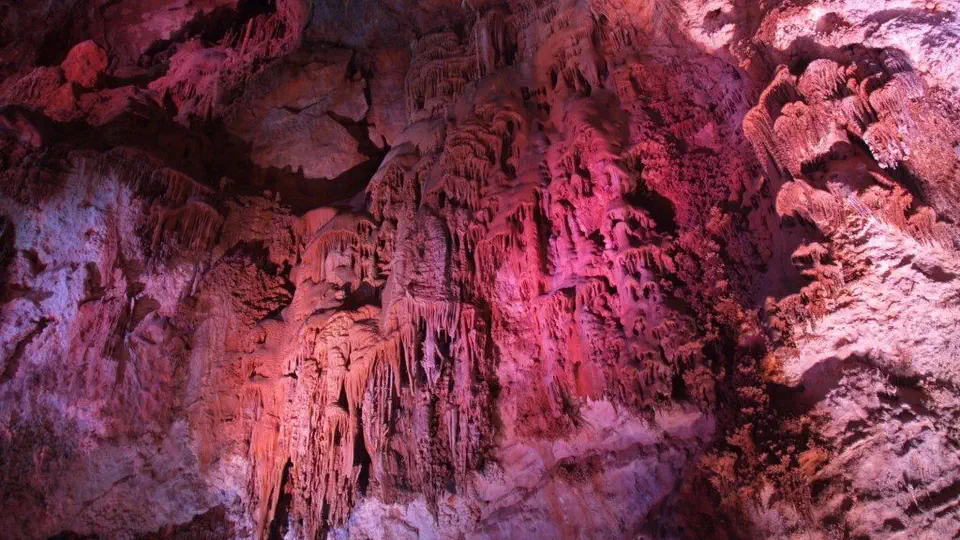
When you enter the cave, take a moment to consider just how long it took nature to create what you are about to see. Cuevas del Canelobre developed in Upper Jurassic limestone, with the rocks dating back approximately 145 million years. Over countless millennia, water slowly dissolved the limestone, creating stalactites, stalagmites, columns, and other karst formations.
In places like this, it is not simply the size of the cave that impresses me most, but the immense timescale involved. What we now visit as a tourist attraction on a day trip took nature an almost unimaginable length of time to create. Interestingly, the accessible underground area covers more than 80,000 square metres, although the tourist route only includes part of it. A 45-metre tunnel, carved through solid rock by soldiers at the beginning of the previous century, leads to the main chamber.
Although the cave itself is much older, its more recent history is particularly fascinating. According to the information I found, people may have used the cave as far back as the Moorish period, around the 10th century, although written records of its existence appeared much later. The most remarkable chapter in the history of Cuevas del Canelobre came during the Spanish Civil War, when the Republican side used the cave as a workshop for repairing aircraft and equipment needed for military operations. It was during this period that the entrance tunnel and some structures required to operate the workshop were created.
It is difficult to imagine an enormous chamber filled with stalactites being used as a place to repair aircraft, yet that is precisely what happened. The workshop’s activities also affected some of the cave’s natural formations. Unfortunately, several features were damaged when the space was adapted for military purposes, something you can still notice when looking closely at the affected rock formations. As so often happens, nature spends millions of years creating its masterpieces, only for people to damage them in a matter of months.
Cuevas del Canelobre – A True Underground Cathedral
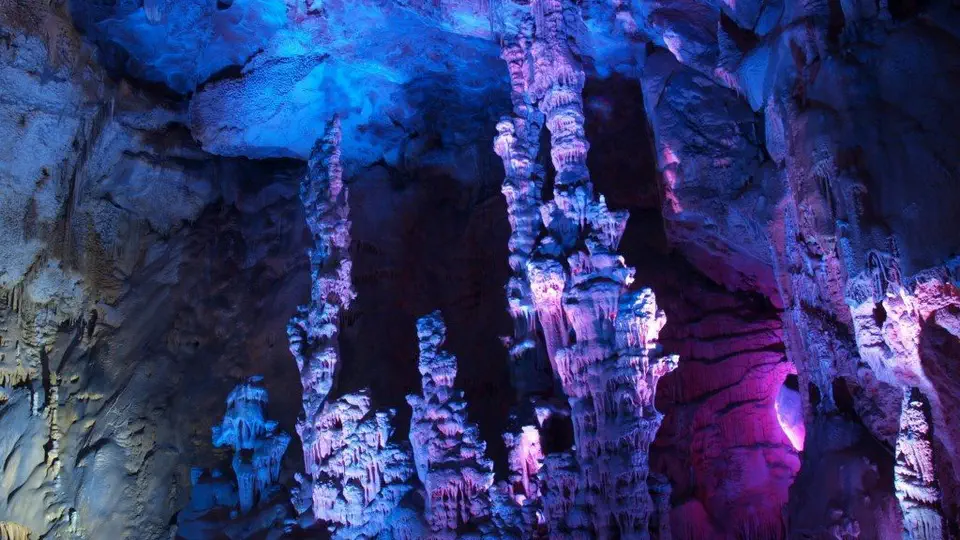
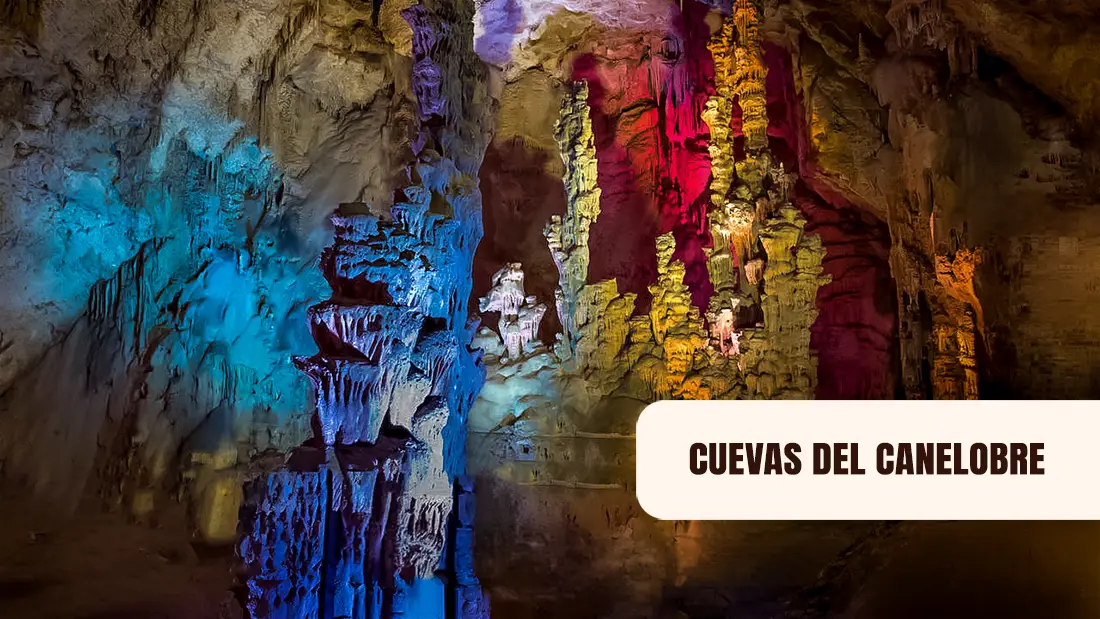
The main attraction at Cuevas del Canelobre is its enormous central chamber. The ceiling rises to approximately 70 metres, which is why the cave is regularly compared to a vast natural cathedral. It is one of the tallest underground spaces of its kind in Spain, and the first impression is genuinely striking. Instead of a narrow passage, you are faced with an immense open space, where the lighting gradually reveals different sections of the rock formations emerging from the darkness.
The cave takes its name from one of its most distinctive formations. El Canelobre is a stalagmite shaped like a large candlestick. According to tourist information, this formation is more than 100,000 years old, and it is one of the main features highlighted by guides during the visit.
You will also see numerous stalactites, stalagmites, columns and mineral deposits. Over time, some of these formations have come to resemble familiar objects or buildings, which is why they have been given their names. One of the best-known is La Sagrada Familia, an enormous rock column standing more than 25 metres tall. Its shape brings to mind the famous Sagrada Família basilica in Barcelona.
It is an interesting example of how people try to find familiar shapes and meaning in natural creations. As you look around the cave, it is easy to imagine all sorts of figures, buildings and everyday objects in the rock formations.
Visiting Cuevas del Canelobre
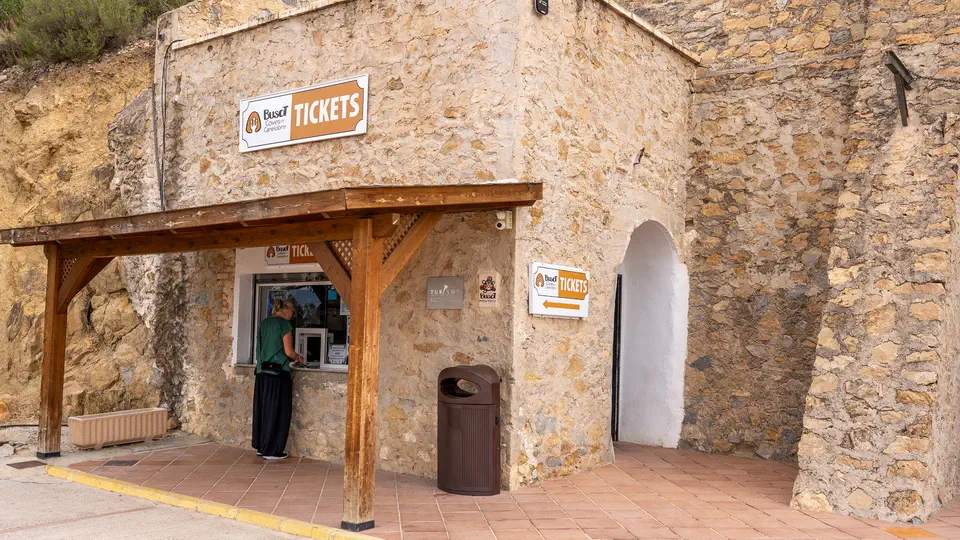
Visits to Cuevas del Canelobre take place with a guide. A typical tour lasts around 45 minutes, although it is worth allowing a little extra time for buying tickets, waiting for your entry slot and enjoying the surrounding area. Groups enter at scheduled times, so I recommend arriving with plenty of time to spare, particularly at weekends and during the summer holidays.
During the visit, you will learn about the cave’s history, its geological origins and its most important rock formations. The guide also explains how the cave was used during the Spanish Civil War as an aircraft repair workshop. This is a particularly interesting part of the story, showing that Canelobre is much more than a geological curiosity.
The main chamber naturally attracts the most attention. Here, you can see stalactites hanging from the ceiling, stalagmites rising from the ground and columns formed when deposits growing from above and below eventually gathered. Among them, El Canelobre stands out because of its candlestick-like shape, which gave the cave its name. You should also look for La Sagrada Familia, whose distinctive outline resembles Barcelona’s famous basilica.
There is no need to rush. I recommend simply looking up for a while and taking in the vast ceiling. You appreciate the true scale of the space when you stop concentrating on individual stalactites and instead take in the chamber as a whole. The lighting reveals more details of the rock, while its irregular shapes allow you to pick out all sorts of figures and objects.
Cuevas del Canelobre – Practical Information
- Cuevas del Canelobre ticket prices – Current tourist information from Busot lists the following prices for a combined ticket covering the cave and the Museum of Ethnic Music:
- Adults aged 16 and over: €12
- Pensioners: €6
- Visitors with disabilities: €6
- Carnet Jove or university card holders: €6
- Children aged 5–16: €5
- Children under 5: free
- Residents of Busot: free
- Prices may change, so it is worth checking the latest information on the official Busot tourism website before setting off.
- Opening hours – Opening hours vary depending on the season.
- From 1 September to 30 June, the caves are usually open:
- Tuesday to Friday: 10.30 am–4.50 pm
- Saturdays, Sundays and public holidays: 10.30 am–5.50 pm
- Mondays: closed
- During summer, from 1 July to 31 August, the attraction is open daily from 10.30 am to 7.30 pm.
- From 1 September to 30 June, the caves are usually open:
- If you are planning a visit for a particular day, I would check the opening hours shortly before travelling, as special arrangements may apply on public holidays or during events.
- Are Cuevas del Canelobre suitable for children? – Yes, the caves are an interesting option for a family day out. The route is relatively short, and the unusual rock formations can capture the imagination even of children who are not particularly interested in geology. They can observe the different formations, learn how caves develop and discover how this underground space was used during the Spanish Civil War. However, bear in mind that visits take place in groups, so you need to follow the guide’s pace. This is not a leisurely walk where you can turn back whenever you wish or stop for as long as you like. If you are travelling with young children, check the current admission rules and route arrangements in advance.
- What should you bring when visiting the cave? – Even on a hot day, it is worth bringing a light jumper or jacket. Conditions underground are different from those outside, and the lower temperature and humidity can be noticeable after spending time in the sunshine.
- Comfortable shoes with good grip are also useful. Some sections of the route may be uneven or damp, so beach flip-flops are not the best choice. It is also worth checking the photography rules that apply during your visit. Do not touch the mineral formations, as oils and dirt transferred from your hands can damage their delicate surfaces.
- Is the visit difficult? – You do not need to be an experienced hiker to visit Cuevas del Canelobre. This is primarily a sightseeing attraction rather than a mountain expedition. Nevertheless, you should allow for steps, changes in elevation and uneven surfaces along the route. Visitors with limited mobility should contact the attraction before travelling to check whether the current route is suitable for their needs. Remember, too, that the cave is in a mountainous area. Even if Alicante is experiencing hot weather, the drive to Busot involves winding roads and potentially changing weather conditions. It is worth taking these factors into account when planning your day.
- When is the best time to visit Cuevas del Canelobre? – The cave is worth visiting at any time of year, provided it is open to the public. I particularly recommend it in summer, when you might want to escape the heat for a few hours and see something other than beaches. In spring and autumn, it is easy to combine a visit with a walk around Busot or an excursion into the Cabeçó d’Or mountains. Before setting off, check the latest opening hours, ticket prices and available entry times. It is also worth confirming whether any special visiting arrangements apply on the day. In my opinion, the best approach is to treat Cuevas del Canelobre as part of a day trip away from Alicante. After exploring the cave, you can enjoy a walk around Busot before returning to the coast or visiting other places along the Costa Blanca. This way, you will discover not only the region’s seaside attractions but also its mountainous landscape and fascinating geology.
- The Remarkable Acoustics of Cuevas del Canelobre – Canelobre has another feature that sets it apart from many other caves: its excellent acoustics. The enormous underground chamber functions rather like a natural concert hall, which is why concerts and other musical events are held here. I have to admit that I really like the idea of a concert in such a setting. The chamber itself is already a spectacle, and adding music to the experience must create a truly unique atmosphere.
Cuevas del Canelobre – Key Facts at a Glance
- Name: Cuevas del Canelobre
- Location: Busot, Alicante province, Spain
- Altitude: Approximately 700 metres above sea level
- Age of the rocks: Approximately 145 million years
- Height of the main chamber: Approximately 70 metres
- Entrance to the main chamber: A tunnel around 45 metres long
- Visiting time: Approximately 45 minutes
- Visits: Guided tours
- Most distinctive formations: El Canelobre and La Sagrada Familia
- Distance from Alicante: Approximately 25 kilometres
- The address of the cave is Carretera Cuevas del Canelobre, CV-776, 03111 Busot, Alicante, Spain.
What Else Can You See Nearby?

It is best to combine a visit to Canelobre with other attractions along the Costa Blanca. Busot itself deserves a short walk, and I would particularly recommend visiting the Museum of Ethnic Music in Busot, especially as you can visit it using the combined ticket purchased for the cave.
If you have more time, you could easily plan a full day exploring this part of Alicante province. If you are interested in the region’s natural attractions, have a look at my article about the most beautiful beaches on the Costa Blanca. It introduces places that are quite different from the popular urban beaches, including rocky coves and wilder stretches of coastline.
A visit to Alicante itself would also make a good addition to your itinerary. While in the city, make time for a walk through its parks, including El Palmeral Park in Alicante. If you have several days to spare, I would definitely recommend exploring more of the region by car. My Costa Blanca in 7 Days guide includes a ready-made road trip itinerary taking in some of the most interesting places along the coast.
Cuevas del Canelobre – Facts and Interesting Things to Know
- The cave is approximately 145 million years old. The rocks in which Cuevas del Canelobre developed date from the Upper Jurassic period, meaning their history goes back to the time when dinosaurs roamed the Earth.
- Cuevas del Canelobre is close to Alicante. The cave lies near Busot, around 25 kilometres from Alicante, making it easy to include in a trip around the Costa Blanca.
- The main chamber resembles an enormous cathedral. Its ceiling rises to approximately 70 metres, and this monumental space is one of the reasons the cave is considered one of the area’s most remarkable natural attractions.
- The cave takes its name from a rock formation shaped like a candlestick. Known as El Canelobre, this stalagmite resembles a large candlestick. The Spanish word canelobre refers to this type of shape.
- An artificial tunnel leads to the main chamber. The passage is approximately 45 metres long and was carved through the rock to provide access to the cave’s interior.
- The cave was used during the Spanish Civil War. In the 1930s, it served as a workshop for repairing aircraft, making this one of the most surprising chapters in its history.
- The cave still bears traces of human activity. Adapting the space for military purposes involved construction work and changes to the natural environment, meaning not all the rock formations have survived in their original condition.
- The cave contains a formation known as La Sagrada Familia. Its shape brings to mind Barcelona’s famous Sagrada Família basilica, demonstrating how natural formations can resemble human-made structures.
- Stalactites and stalagmites develop very slowly. Stalactites hang from the ceiling, while stalagmites grow upwards from the floor. Both form as minerals are deposited by water seeping through the rock.
- Some mineral formations may be thousands of years old. The formations inside the cave developed over different periods, with their ages depending on environmental conditions, water availability and the rate at which minerals accumulated.
- The cave lies on the slopes of the Cabeçó d’Or mountains. This mountain range sits inland, not far from the Costa Blanca coastline, revealing a side of Alicante province that extends well beyond its beaches.
- Cuevas del Canelobre is approximately 700 metres above sea level. The drive offers mountain views and a different perspective on the surrounding landscape from the one you get along the seaside promenades.
- The cave was created by karst processes. Over a very long period, water dissolved the limestone, gradually forming underground chambers and passages.
- The entire cave system is much larger than the tourist route. Visitors only explore the section open to the public, so a standard visit does not reveal every part of the underground complex.
- The cave has remarkable acoustics. The size and shape of the main chamber affect the way sound travels through the space, making it an interesting venue for musical performances.
- Concerts are held inside Cuevas del Canelobre. The natural chamber provides an unusual concert venue, where music combines with the monumental rock formations to create a memorable setting.
- A visit is relatively short. A standard tour lasts approximately 45 minutes, making it easy to combine the cave with a visit to Busot and other attractions around Alicante.
- The cave can only be explored on a guided tour. During the visit, you can learn about its history, discover more about the rock formations and see the main features accessible to tourists.
- Canelobre is a good attraction for hot days. When temperatures rise along the coast, spending time inside the mountain offers an interesting alternative to the beach. However, it is worth bringing a light jumper because conditions underground differ from those outside.
- Cuevas del Canelobre reveals another side of the Costa Blanca. The region may be best known for its turquoise waters, beaches and seaside resorts, but it also hides remarkable geological attractions. Visiting the cave is a great way to discover more than just the coastline.
- Interesting cities near Costa Blanca:
- La Mata is a small town in the south of Spain, located on the Costa Blanca coast.
- Torrevieja is a coastal city and municipality located on the Costa Blanca in the province of Alicante.
- Attractions near Costa Blanca:
- Cuevas del Canelobre is located in the town of Busot, in the province of Alicante, approximately 25 kilometres from the centre of Alicante.
- Dino Park Algar on the Costa Blanca coast, is a land ruled by prehistoric dinosaurs.
- Terra Natura Benidorm – A beautiful zoo on the Costa Blanca.
- Aqua Natura in Benidorm is a large water park connected to the Benidorm Zoo.
- Algar Waterfall is a perfect idea if you want to get away from civilisation for a few hours and spend some time surrounded by nature.
- El Palmeral Park in Alicante, a place where you can relax and regain strength.
- La Pasarela de Relleu a walkway over a gorge near Alicante
- Las Salinas de Torrevieja is an industrial plant that extracts sea salt from a shallow but vast lake in Laguna Salada de Torevieja.
- Natural Park El Fondo, or as the Spanish say, Parque Natural el Hondo, is located in the beautiful region of Valencia, near cities such as Alicante, Valencia, La Mata, Torrevieja.
- Palm Grove of Elche largest palm grove in Europe.
- Rio Safari Elche is a zoo located on the Costa Blanca coast of Spain.
- Tetería Carmen del Campillo, a Moorish-style teahouse hidden between Crevillent and Albatera.
- The goal of our today’s trip is the Valor chocolate factory and museum.
- The Castle of Santa Barbara (Castillo de Santa Barbara), also known as the Alicante Fortress, looms over the city like an unconquerable defender.
- The Museum in Torrevieja is an interesting attraction in the port part of the city.
- Ethnic Music Museum of Busot, offers an opportunity to discover musical instruments from different corners of the world