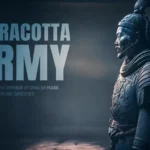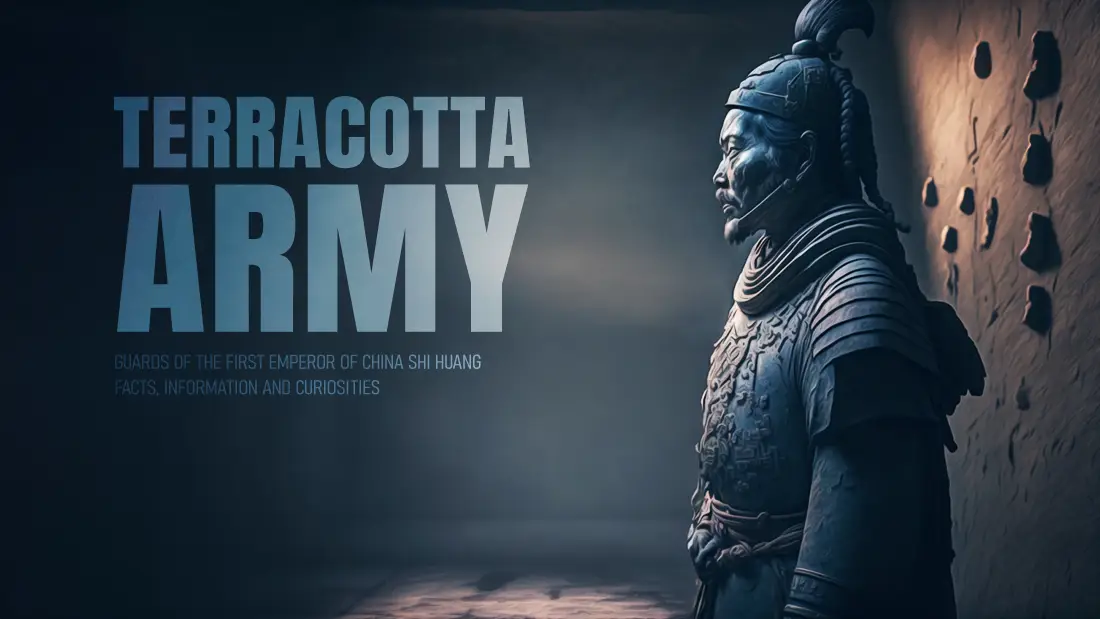
For centuries, the Terracotta Army of Emperor Qin Shi Huang was little more than a myth or legend about the wonders of a distant past. Stories of a vast stone or clay army had circulated throughout China for hundreds of years, but it was not until 1974 that these remarkable tales were finally confirmed.
Emperor Qin Shi Huang and his Terracotta Army
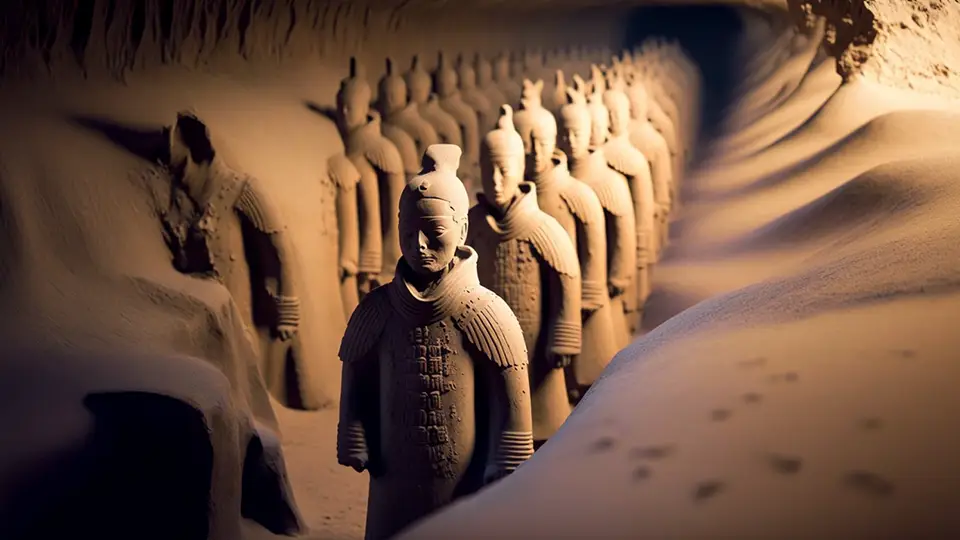
- The creation of the Terracotta Army was commissioned by Qin Shi Huang, the first emperor of China, a highly controversial historical figure.
- Qin Shi Huang is regarded as the first ruler of imperial China because it was under his rule that the various Chinese states were finally united.
- Qin Shi Huang conquered six major rival kingdoms, eventually creating a unified empire.
- The unification of China brought to an end more than two centuries of conflict known as the Warring States period.
- Qin Shi Huang was born in 259 BC and died in 210 BC, at the remarkably young age of 49.
- He ascended to the throne in 247 BC, when he was just thirteen years old.
- The young ruler’s ambition was to conquer the neighbouring kingdoms.
- A major military campaign began in 234 BC.
- The young king defeated his first major opponent with such ease that he did not stop there, pushing deeper into the country and fighting a succession of further battles.
- The last of the rival kingdoms fell in 221 BC, after which the king issued an edict changing his title from king to emperor.
- In the following years, the emperor ordered the unification of the state and strengthened the centralised system of government.
- China was divided into dozens of administrative and military districts.
- Former positions held by the nobility were taken over by newly appointed officials.
- The most important aristocratic families were forcibly moved to the capital, where they could be closely monitored. Any sign of rebellion could result in the execution of an entire family.
- Emperor Qin Shi Huang introduced numerous reforms, including an agricultural reform under which traditional forms of forced labour were abolished and peasants became owners of the land they cultivated, while also becoming official taxpayers.
- Forced public labour was also introduced for major projects, including the construction and reinforcement of the Great Wall, irrigation canals and an extensive network of roads.
- Under the emperor’s rule, the writing system, weights, currency, administration and army were also standardised.
- The changes were certainly not entirely positive. In 213 BC, the emperor ordered the burning of books, particularly Confucian works, because he feared rebellion among scholars and educated elites. According to traditional accounts, he also ordered more than 400 scholars to be buried alive in front of a crowd.
- After Emperor Qin Shi Huang’s death, Confucianism eventually became the dominant state ideology, while the former emperor came to be remembered as a tyrant.
The Terracotta Army and the story of its discovery
- The discovery of the imperial burial complex and the enormous Terracotta Army took place on 29 March 1974.
- The discovery confirmed legends that had circulated for centuries about a vast clay army belonging to China’s first emperor.
- The Terracotta Army was discovered in central China, near the city of Xi’an.
- The discovery was made completely accidentally by local farmers who were digging a well.
- The Terracotta Army is now regarded as one of the most extraordinary and valuable archaeological discoveries in human history.
- Archaeologists called to the site initially recovered fragments of ancient pottery and gradually reconstructed them into life-sized statues of warriors. This was only the beginning, and nobody could have imagined that an entire army numbering in the thousands was waiting beneath the ground.
- The first excavations revealed a huge underground chamber containing more than 1,300 soldiers arranged in rows. It is difficult to imagine the impression this extraordinary sight must have made on the archaeologists.
- It eventually became clear that the site contained four enormous pits, three of which were filled with life-sized terracotta warriors.
- The chambers were originally reinforced with wooden walls and a timber roof. Over the course of two thousand years, the wooden structures collapsed, covering the army with earth and debris.
- Only a small proportion of the figures survived intact. Many others were smashed into pieces, and hundreds of people have had to painstakingly reassemble them like enormous three-dimensional jigsaw puzzles.
- Alongside the imperial soldiers, the underground corridors also contained statues of horses, chariots, and other military equipment.
- All the figures were made from terracotta, while additional elements such as reins, harnesses and some soldiers’ equipment were made from leather and metal.
- Individual parts of the soldiers’ bodies were produced according to standardised patterns, almost like an early form of mass production, yet each completed figure has its own distinctive character.
- The face of every soldier is different from the others, with variations in facial features, hairstyles and facial hair.
The Terracotta Army in numbers
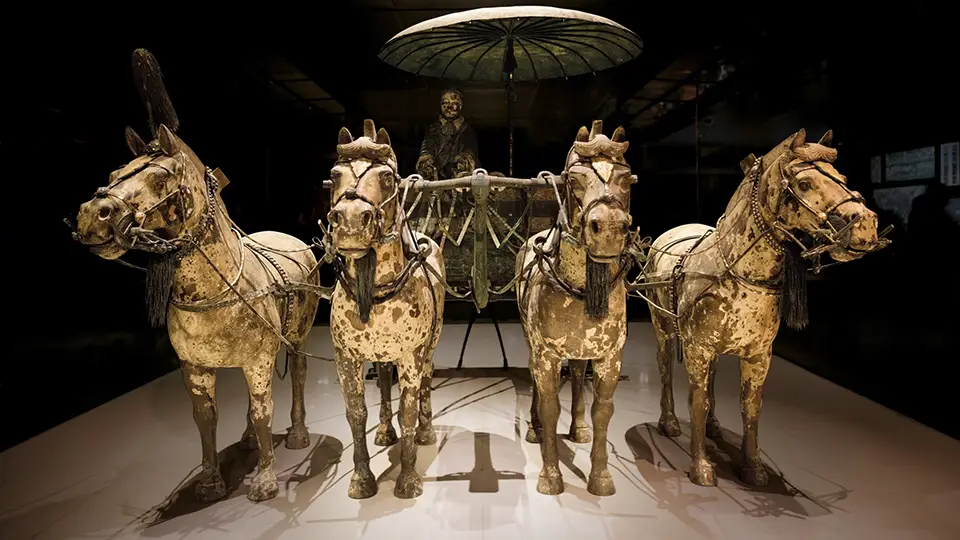
- The Terracotta Army dates back around 2,200 years.
- So far, approximately 8,100 human and horse figures have been discovered within the burial complex.
- The imperial army stands less than two kilometres from the tomb of Emperor Qin Shi Huang.
- The entire complex containing the terracotta figures is around 210 metres long and 60 metres wide.
- The tunnels containing the army were approximately 3 metres high.
- The floors of the underground chambers were paved with bricks.
- The entire imperial mausoleum, including the burial chamber, covers an area of more than 100 square kilometres.
- The burial chamber itself forms the central part of the mausoleum and is surrounded by an underground defensive wall.
- Construction of the emperor’s mausoleum lasted for 38 years and began when he was still a child.
- Around 700,000 craftsmen and labourers from across the empire are said to have worked on the project.
- According to historical accounts, enslaved workers involved in the construction were killed and buried several hundred metres from the tomb so that they could continue serving the emperor in the afterlife.
- Four main chambers have been identified, although only three contained the clay army.
- The largest chamber contained a complete infantry formation. Around 3,210 soldiers were placed there, including approximately 200 archers.
- Most of the soldiers were equipped with real weapons made from wood and bronze. Unfortunately, the wooden components have not survived.
- In addition to the infantry, four chariots drawn by two horses each were discovered.
- Another chamber contained auxiliary troops and cavalry.
- The command structure of the Terracotta Army was located in the third chamber.
- Originally, all the figures were painted in vivid, natural colours. Today, however, most of the surviving figures appear grey, revealing the colour of the fired clay from which they were made.
Why was the Terracotta Army created?
- Emperor Qin Shi Huang believed that after death, a person would continue to surround themselves with the things they had possessed and created during their lifetime. This explains the idea of constructing an enormous and seemingly indestructible personal guard that would accompany him into the afterlife.
- China’s first emperor devoted enormous resources to the search for an elixir of immortality. He supported hundreds of magicians, alchemists and mystics in the hope that they would discover the secret of eternal life.
- Qin Shi Huang had been preparing for his existence after death from a young age, reflecting the importance of the afterlife in the beliefs of people living at the time.
- The huge army was intended to protect its emperor after death, as he believed that the enemies he had defeated while unifying China might be waiting for him in the next world.
More interesting facts about the Terracotta Army and the material from which it was made
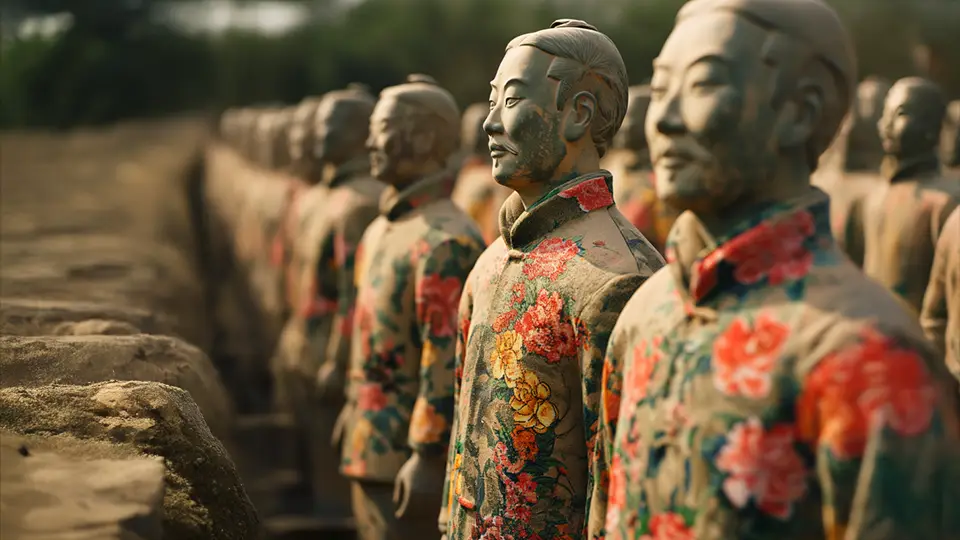
- Terracotta is a form of carefully prepared and fired clay commonly used to make figures, tiles and decorative objects.
- Terracotta was known long before the birth of Christ, not only in Asia but also in Egypt, Greece and Rome.
- One of the oldest well-known terracotta figures is the Apollo of Veii, dating from around the 6th century BC.
- Terracotta became widely used in Europe during the medieval period.
- The Terracotta Army was added to the UNESCO World Heritage List in 1987.
- The fourth chamber was left unfinished when the emperor died, after which construction work was abandoned.
- The Terracotta Army is sometimes described as the eighth wonder of the world, although this is not an official UNESCO designation.
- After the emperor’s death, much of the information about him and his achievements disappeared from historical memory, including knowledge of the Terracotta Army. Within roughly a century, his clay army had become little more than a legend.
The story of the Terracotta Army is just one example of how history, archaeology and ancient beliefs can come together to create some of the world’s most fascinating discoveries. If you enjoy this kind of content, you can also explore our collection of interesting facts and extraordinary information, where we look at surprising details from many areas of life and history.
For more travel inspiration and unusual stories from around the world, visit Get Ready For Adventure.