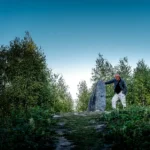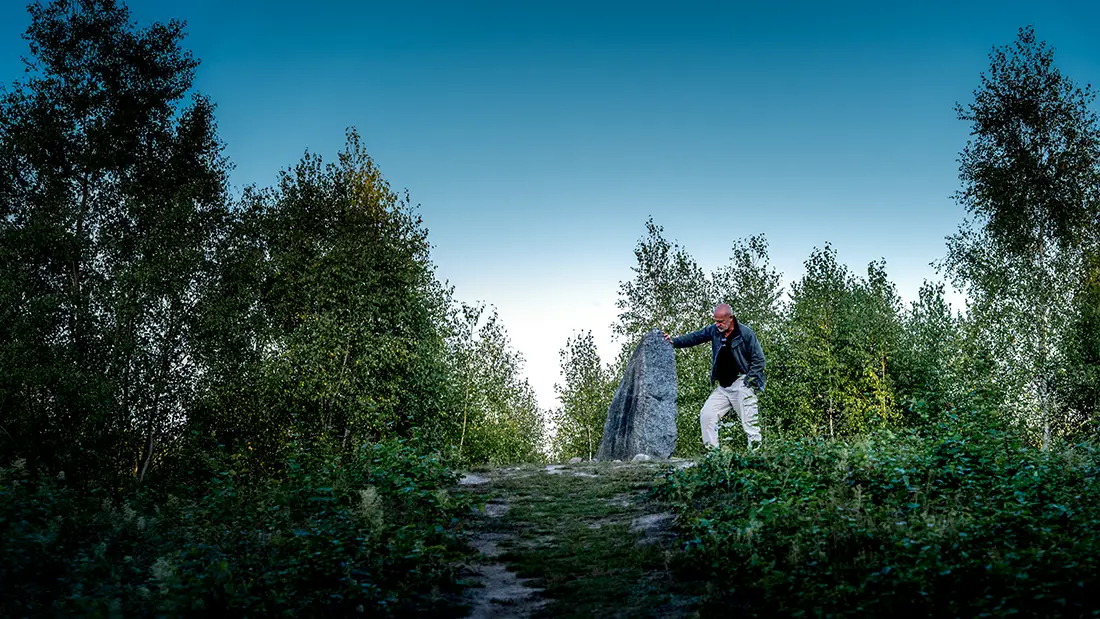
The Stone Circles in Leśno are circular structures in Kashubia made from large boulders set vertically or partially embedded in the ground.
Whenever I walk among the stones standing in the Kashubian forest, I always get a similar feeling. Suddenly, an ordinary walk turns into a journey into the distant past, to a time when mysterious tribes travelled across these lands. There are no great ruins, towering walls or monumental temples here. Instead, there are trees, a forest clearing, a few enormous boulders and silence. It was here, almost two thousand years ago, that people gathered and left behind one of the most remarkable traces of antiquity in Pomerania. The Stone Circles in Leśno are the remains of an extensive cemetery associated primarily with the Wielbark Culture and the Goths. The site contains stone circles, burial mounds, graves and an unusual stone stele resembling a human figure.
Leśno is also part of a much larger story. If you are interested in mysterious megaliths, it is well worth combining your visit with a trip to Odry, where one of the most important cemeteries of this kind in Pomerania can be found. We have described it in more detail in our article Stone Circles in Odry in Kashubia. Odry is one of the places that best demonstrates the extraordinary landscape created here by people living during the first centuries of our era. In this article, I will tell you more about the circles, their history, and their links with other megalithic sites.
Where are the Stone Circles in Leśno and how do you get there?
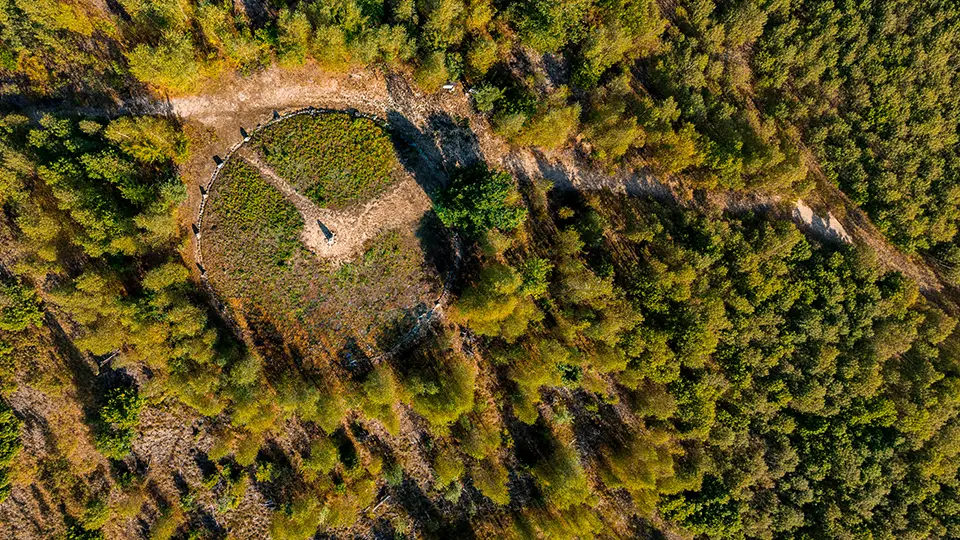
Leśno is located in the municipality of Brusy, in Pomeranian Voivodeship, within the Zaborski Landscape Park. The archaeological site lies in the forest, not far from Leśno Górne and Leśno Dolne lakes. This place is quite different from many popular tourist attractions. You do not come here to see one enormous monument standing in the middle of a square. The stone circles are part of a much larger archaeological landscape.
As you walk between the trees, you can see further burial mounds, stone rings and individual boulders. Only when you start paying attention to their arrangement do you realise that these are not simply stones scattered randomly across the forest. They are the remains of a place that held a special significance for people for centuries.
To reach the stone circles, you need to leave Road 235 at Zalesie and turn onto Główna Street, followed by Leśna Street. The final section of the route is a gravel road, so bear that in mind if you happen to be driving an expensive, freshly cleaned car.
The Stone Circles in Leśno and their history
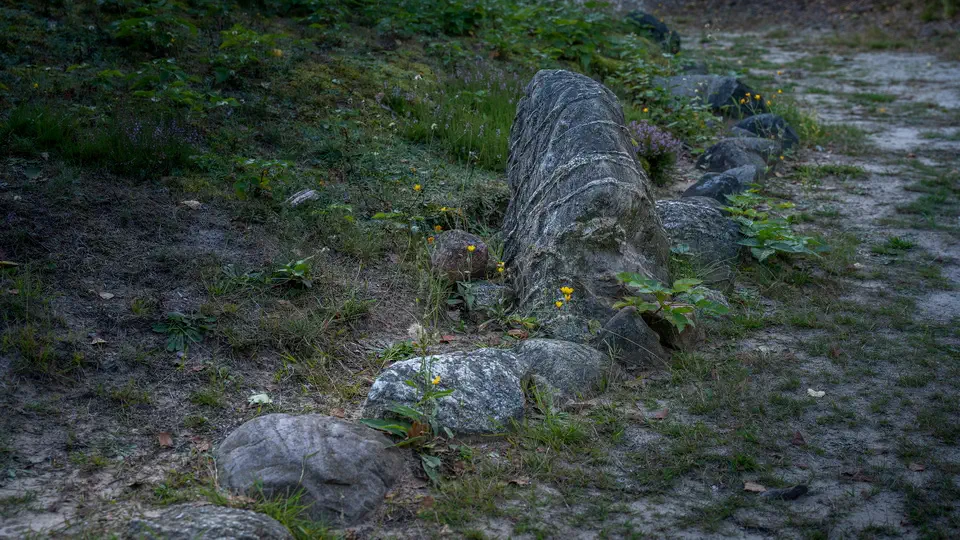
The history of the stone structures at Leśno began long before the arrival of the Goths. Archaeological research has shown that the area was used by different communities much earlier. The oldest burials are associated with the Pomeranian Culture. Later, representatives of the Wielbark Culture appeared here, a culture which archaeologists associate, among others, with the Goths.
This is important because the Goths were not simply characters in stories about the great Migration Period. Their presence left very tangible traces across Pomerania. These include cemeteries, graves, everyday objects and distinctive stone structures. Leśno is one of the most interesting archaeological sites of this kind.
The cemetery reached its greatest development during the Roman Influence Period, when Northern Europe maintained contacts with the Roman world. This does not, of course, mean that Romans came here to build their cities. Contacts took place mainly through trade and the movement of people and objects, and some finds from Leśno show that the inhabitants of Pomerania were far from completely isolated.
Objects have been discovered here whose origins point to long-distance trade. Among the finds are a silver coin and an amulet in the shape of a scarab. When I stand in a place like this, it is details such as these that capture my imagination most strongly. Objects made somewhere far from today’s Kashubia must have travelled a long way before reaching the person buried among these circles almost two thousand years ago.
The Goths are one of the most mysterious peoples of European antiquity. Written sources concerning their origins are scarce, while much of what we know comes from later accounts. According to the Roman historian Jordanes, the Goths came from Scandinavia to the southern shores of the Baltic. This tradition remains the subject of discussion among historians and archaeologists to this day, but there is no doubt that the Wielbark Culture left very clear traces across Pomerania.
A good place to learn more about the history of this people is the Archaeological and Historical Museum in Elbląg, where you can see an exhibition devoted to the Goths and their migration from the Baltic region towards the Roman Empire. Leśno is therefore more than just an interesting site for people fascinated by archaeology. It is one part of a much larger story about the history of Europe.
What does the archaeological site at Leśno consist of?
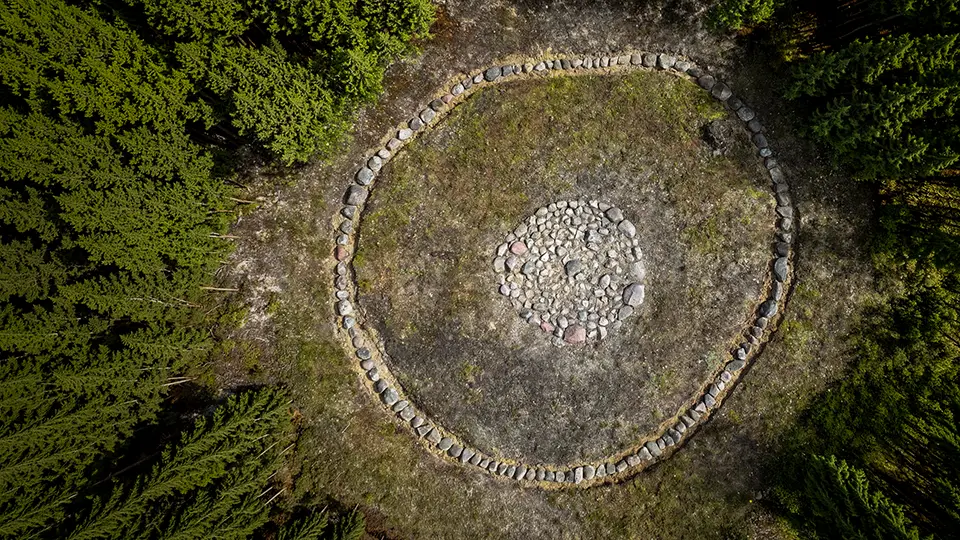
The archaeological site at Leśno is much more extensive than the name “stone circles” might suggest. You will not find only circles made from boulders here. The entire area forms a large cemetery, where various types of burials and stone structures have survived. Individual elements were created during different periods, which means that while walking around the site you can see traces of several stages in its history.
- Stone circles – The most characteristic feature of the site is the stone circles, circular structures made from large boulders set vertically or partly embedded in the ground. Their diameters vary and the arrangement of the stones is not always perfectly regular. The circles are associated primarily with the Wielbark Culture and burial customs. They probably marked a special, symbolic area within the cemetery.
- Stone rings – Leśno also contains stone rings which surrounded burial mounds or other burial areas. They formed a kind of stone boundary separating a place associated with the dead from the rest of the cemetery. 15 such structures have been discovered at the site. Today, some are best viewed from a short distance because their original shape has been partly altered by the passage of time.
- Burial mounds – Another important feature is the burial mounds, artificially constructed earth mounds covering burials. 13 burial mounds have been identified at Leśno. They vary in size, with the largest measuring approximately 26 metres in diameter. The mounds are particularly interesting because they demonstrate the importance attached to certain burials. Building a large mound and surrounding it with stones would have required the work of an entire community.
- Anthropomorphic stele – One of the most unusual finds at Leśno is an anthropomorphic stone stele, a boulder shaped in a way that resembles a human figure. It stands within the largest burial mound. We do not know exactly whom it represented or what meaning it had for the people who erected it. It may have had a symbolic function or been connected with the person buried in the mound. This is precisely why the stele remains one of the most mysterious elements of the entire site.
- Cist graves – The cemetery also contains cist graves. Their name comes from their characteristic construction using stone slabs which formed a small box-like structure. These graves are characteristic of the earlier phase of the site’s use and are associated with the Pomeranian Culture. Around 20 have been discovered at Leśno, containing, among other things, urns with the ashes of the dead.
- Pit graves and urn burials – Archaeologists have also found pit graves and urn burials. In the first case, the ashes of the deceased were placed directly into a prepared pit, while urn burials contained vessels used to hold the ashes. Particularly interesting are face urns, vessels decorated with stylised human faces. They are one of the characteristic artefacts of the Pomeranian Culture.
- Evidence of settlement – Leśno was not solely a place of burial. Archaeological research has also provided evidence of settlement associated with people who lived in the area. Among the discoveries are the remains of a structure described as a longhouse. This is an important part of the site’s history because it allows us to see Leśno not only as a place of death and funerary ceremonies, but also as a space where people lived, worked and formed their community.
- Longhouse – Particularly interesting are the remains of a longhouse, a large residential or domestic structure. The building is unusual among sites associated with the Wielbark Culture and suggests that an area connected with everyday life existed close to the cemetery. Of course, you will not see the wooden building today. What remains are mainly archaeological traces which researchers use to reconstruct its appearance and purpose.
When you look at all these elements together, Leśno stops being simply a place with several stone circles. It becomes an extensive archaeological landscape where different burial traditions, cultures and historical periods meet. The stone circles, rings, and burial mounds are associated primarily with the Goths and the Wielbark Culture, while the cist graves and face urns remind us of the earlier presence of the Pomeranian Culture. In this sense, walking through Leśno is rather like reading a book whose successive chapters were written not on paper, but in the soil, stones and remains of ancient graves.
The largest burial mound and the mysterious stone stele
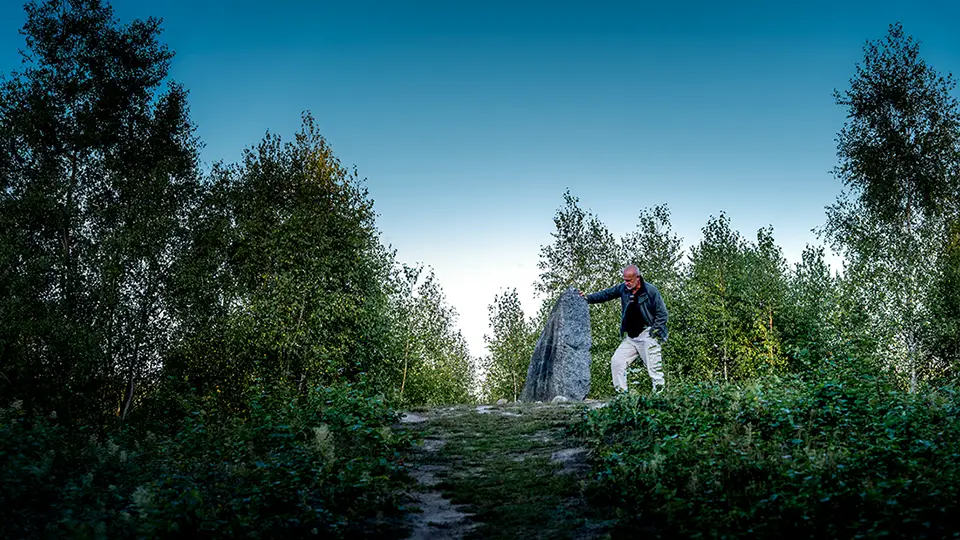
One of the most fascinating elements of the site is the largest burial mound, which measures approximately 26 metres in diameter. Within it was a stone structure and an unusual anthropomorphic stele, a stone resembling a simplified human figure. This is one of those archaeological remains where the imagination starts working considerably faster than the evidence allows.
Who was the person for whom such an extraordinary place was created? Was it the leader of a travelling people, a great warrior, a priest or someone who performed an entirely different role within their community? I do not know, and this is precisely where it is important to separate facts from legends and fantasy. Popular descriptions sometimes claim that a tribal chief or sorcerer was buried beneath such a mound. We do not, however, have sufficient evidence to treat such an interpretation as certain. Archaeology can tell us a great deal about the grave itself, but it cannot always tell us exactly who the person buried inside it was.
What were the stone circles used for?
The most likely answer is considerably more down-to-earth than many modern theories suggest. The stone circles were primarily associated with cemeteries and funerary rituals. That does not mean that we know all the functions these structures served. A stone circle may have marked a special area where ceremonies connected with the dead took place. It may have been a meeting place for the community, a setting for rituals or a place where ancestors were remembered.
Similar questions arise when we look at other megalithic structures across Europe. That is why, while exploring Leśno, I kept thinking about other places I have visited. In England, I saw the famous Stonehenge, whose history and mysteries I described in the article Stonehenge – Stone Circles in England. Nearby you can also find the enormous Avebury complex, which we covered in Stone Circles of Avebury in England. The difference in scale is enormous, but the question remains similar: why did ancient people devote so much effort to building stone structures?
If I had to choose two places in Kashubia that best demonstrate the mystery surrounding stone circles, I would choose Leśno and Odry. The landscape at Odry is more monumental. The nature reserve covers more than 16 hectares and contains numerous circles and burial mounds. One of the largest circles has a diameter of around 30 metres.
On Nasze Szlaki, we also have a more personal account of the site. In Hunters of Mysteries and Ancient Stone Circles, I describe a trip to Odry and stories I heard from residents. This is where stories about strange lights, mysterious energy and the devil Babin appear, opening the door to the second, much more mysterious side of the stone circles: the legends and mysteries surrounding Leśno.
The Stone Circles in Leśno, the Stolemy and other legends
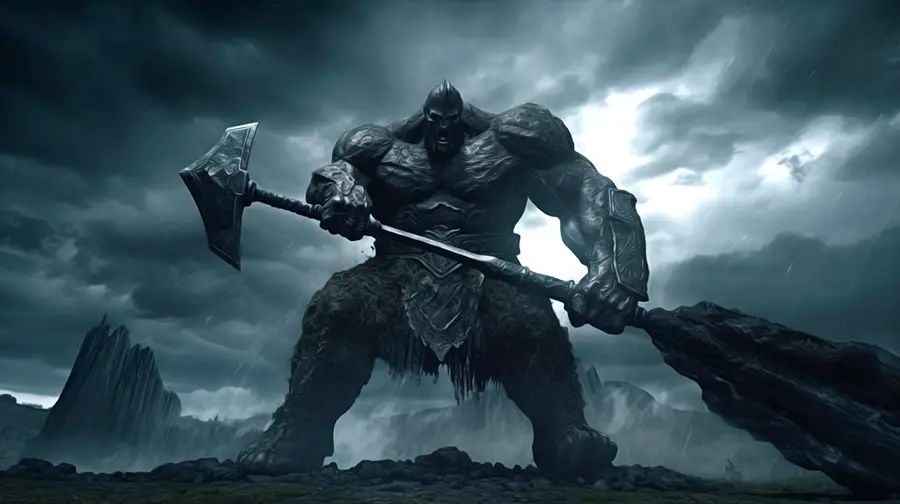
Stones have always inspired the human imagination, particularly the largest ones and those with unusual shapes. Perhaps this is because they seem almost eternal. A tree grows and dies, a person is born and passes away, while a stone remains where you put it. So when people from later generations saw enormous boulders standing in the forest, apparently placed there by people whose names and stories had long been forgotten, they naturally tried to find their explanation for their origins.
One of the most characteristic Kashubian legends concerns the Stolemy, enormous creatures said to have inhabited Kashubia before humans appeared. According to legend, the Stolemy were giants. They could carry enormous boulders and throw them over great distances. It is hardly surprising, therefore, that when people tried to explain the presence of giant stones arranged in the forest, the Stolemy fitted the story perfectly.
On Nasze Szlaki you can find a separate article, Kashubian Stolemy and the Legend of the Stone Circles in Odry, where you can explore these Kashubian legends in greater depth. In the case of Leśno, it is easy to imagine how such a story might have developed. Long ago, when the forests were much larger and people did not yet know the real history of the stone structures, someone might have said that the enormous boulders had been left behind by ancient giants, and so the legends began.
The Devil Babin and the lights in the forest
Even more intriguing stories are associated with nearby Odry. Local people once spoke of a mysterious light appearing above the cemetery. It was said to descend from the area around the stone circles and move towards the river before returning again. According to local stories, the light was associated with the devil Babin.
Such stories may sound extraordinary today, but it is worth remembering that for centuries people observed the world without electricity, street lighting or modern knowledge of atmospheric phenomena. Mist, St John’s fires, reflections on water or distant sources of light could easily become the starting point for an unusual story. That does not mean we should laugh at such tales. Legend is part of the history of places such as the Stone Circles in Leśno.
Stones that were believed to possess special powers
Stories about unusual energy also developed around the stone circles of Pomerania. Some people claimed that the stones had healing properties or that you could feel something near them that was absent from an ordinary forest. People travelled to Odry believing that spending time within the circles could help with health problems.
There is no scientific evidence confirming such properties. There is, however, something that does not require any measuring instrument to prove. The silence of the forest, the enormous stones, an awareness of the age of the site and the thought of people standing here two thousand years ago can genuinely make a powerful impression.
Were the stone circles observatories?
This is one of the most popular theories concerning megaliths. In the case of Stonehenge, there are well-documented links between the monument and observations of the solar cycle. With other stone circles, however, the situation is considerably more complicated. Theories attributing astronomical functions to the stone circles at Odry have also appeared.
We cannot automatically transfer interpretations from Stonehenge to every stone circle in Europe. Leśno was primarily a cemetery, and its structures should be considered within the context of the culture and beliefs of the communities who buried their dead here.
Are the Stone Circles connected with Stonehenge and other ancient structures?
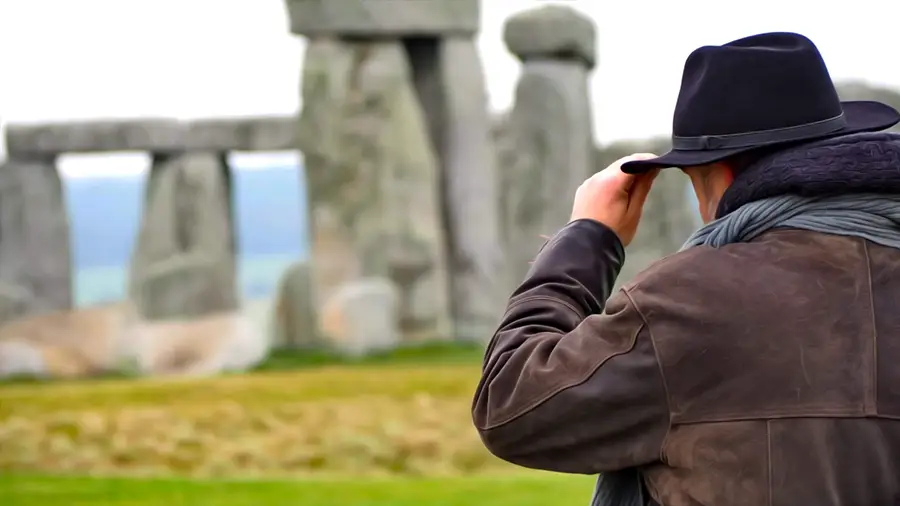
At first glance, the similarity seems obvious. Stones arranged in circles can be found both in Kashubia and southern England. However, there is an enormous difference in age between them. Stonehenge was built thousands of years before the stone circles at Leśno. We should therefore not speak of a single common culture responsible for creating all structures of this kind.
The similarity is nevertheless fascinating. In different parts of the world, people independently used stone to create spaces associated with burial, ceremonies and probably religious beliefs. If you enjoy such comparisons, it is also worth reading about the Stone Circles of Avebury, which are truly impressive in scale.
The Stone Circles in Leśno are part of a much broader history of humanity’s fascination with stone. Similar structures can be found in many parts of Europe. Malta is home to monumental prehistoric temples which are considerably older than both Leśno and Stonehenge. I wrote about them in more detail in Malta – Stone Circles and Prehistoric Temples.
Other remarkable structures can be found on Menorca. The island is full of mysterious Bronze Age buildings, including talaiots, navetas and the characteristic stone taulas. You can read more about them in The Monuments of Menorca, Stone Structures and Other Attractions. These places show that the history of stone structures is not limited to the one famous name of Stonehenge. From Kashubia, through the British Isles and all the way to the Mediterranean, people have left behind extraordinary constructions whose meaning we cannot always reconstruct today.
The Stone Circles in Leśno – a few final words
During my latest visit to Leśno, I was accompanied by my son, who seemed fascinated by the history of the Stone Circles and their mysterious character. I hope that the younger generation will not forget places like this and that they will continue to inspire imagination and curiosity, just as they did years ago when I first discovered these remarkable structures with friends.
It is definitely worth visiting the Stone Circles in Leśno, particularly if you are travelling through Kashubia and looking for places that are a little less obvious. If you have more time, the best approach is to treat Leśno as part of a larger journey following in the footsteps of the ancient inhabitants of Pomerania. I would combine it first and foremost with Odry and, if you are fascinated by megaliths and ancient structures, then continue with our articles about Stonehenge, Avebury, Malta and Menorca. In this way, a simple walk through a Kashubian forest can become a journey through several thousand years of history.
These are exactly the kinds of places I like most. They do not shout for attention with spectacular architecture and they do not need a huge amount of publicity. They simply wait for you quietly among the trees. All you have to do is enter the forest, stop beside one of the stones and wonder who placed it here almost two thousand years ago and what happened in this very place at the time.
The Stone Circles in Leśno – practical information
The Stone Circles in Leśno are located in the municipality of Brusy, within the Zaborski Landscape Park.A cultural trail and information boards describing the archaeological site have been prepared on site.Allow around an hour for a relaxed walk and to see the most important features. If you want to read the information boards carefully and combine the visit with a walk through the forest, it is worth allowing more time.Remember that the burial mounds, graves and stone structures here are archaeological monuments. Do not climb onto the mounds, move the stones or interfere with the archaeological site.
- The Stone Circles in Leśno – key information
- Location: Leśno, municipality of Brusy, Pomeranian Voivodeship
- Type of site: archaeological site and cemetery
- Main monuments: stone circles, burial mounds, graves and an anthropomorphic stele
- Associated culture: primarily the Wielbark Culture and the Goths
- Most interesting comparison: the Stone Circles in Odry, Kashubia
- Worth combining with: Odry, the Tuchola Forests and other attractions in Kashubia
Stone Circles in Leśno information and interesting facts
- The Stone Circles in Leśno are almost 2,000 years old – the most important period in the site’s history falls within the Roman Influence Period, when the Wielbark Culture was developing in Pomerania.
- Leśno is associated with the Goths – the archaeological site is primarily linked with the Wielbark Culture, whose development in Pomerania is associated, among others, with the Goths.
- There are 13 burial mounds at the site – artificially constructed earth mounds beneath which burials were placed.
- 15 stone rings have been discovered at Leśno – these stone structures surrounded selected burial mounds and burial areas, forming a distinctive feature of the cemetery.
- The largest burial mound is approximately 26 metres in diameter – it is the largest structure of its kind at Leśno and is distinguished by the stone stele located within it.
- An anthropomorphic stele stands within the largest burial mound – the stone was shaped to resemble a human figure. Its exact meaning remains a mystery.
- One of the stone circles originally consisted of 23 stones – some boulders have not survived, but traces of their original arrangement allowed archaeologists to reconstruct the appearance of the structure.
- Around 20 cist graves have been discovered at Leśno – these characteristic stone burial structures are associated primarily with the Pomeranian Culture.
- Face urns have been found here – these burial vessels decorated with stylised human faces are characteristic of the Pomeranian Culture.
- The cemetery was used by different communities – archaeological discoveries show that the area was used during different periods, including by people associated with the Pomeranian and Wielbark cultures.
- A silver coin, probably of Celtic origin, was found at Leśno – such a discovery demonstrates that objects and ideas could reach Pomerania from very distant regions of Europe.
- An amulet in the shape of a scarab was also discovered here – the object points to cultural contacts extending towards areas associated with the Mediterranean world.
- Graves contained objects associated with warriors – archaeological finds include elements of weapons, belt fittings and objects connected with feasting.
- Remains of a longhouse were discovered at the site – this is a particularly interesting trace of settlement, showing that the area was not used exclusively for burials.
- The stone circles may also have had a ritual significance – their arrangement suggests that they could have been used for ceremonies, gatherings, and rituals associated with the dead.
- We do not know all the functions of the stone circles – their connection with cemeteries is well documented, but the meaning of individual structures and the rituals that took place around them remains the subject of research.
- Leśno is one of the most important sites of its kind in Pomerania – together with Odry and Węsiory, it is among the best-known places associated with the stone circles of the Wielbark Culture.
- Several burial traditions meet at Leśno – alongside older graves associated with the Pomeranian Culture, there are later structures connected with the Wielbark Culture.
- The stone circles have become part of local legends – as in Odry, the mysterious boulders inspired the imagination of local people and gave rise to stories about the unusual properties of the site.
- The greatest mystery remains the person buried beneath the largest burial mound – the monumental structure, stone circle and anthropomorphic stele suggest that this was an exceptional burial. We do not know, however, exactly who the person was for whom this remarkable place was created.