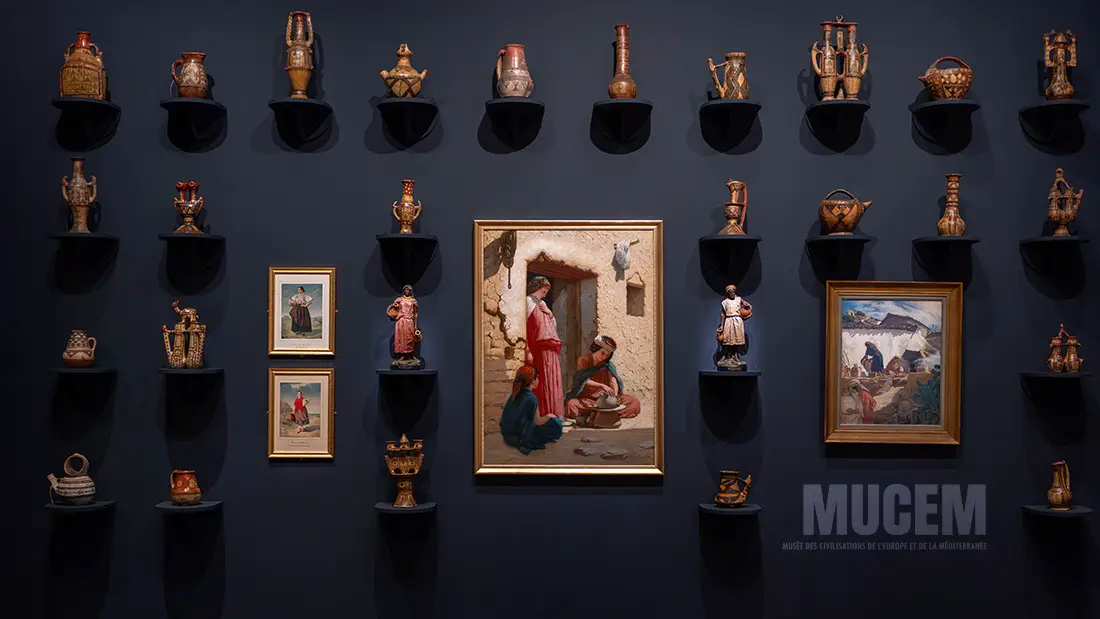
MUCEM in Marseille is one of those museums that is almost impossible to miss. As you walk towards the sea from the Old Port, a dark, almost lace-like building suddenly appears in front of you, standing right beside the water. From one angle it looks light and strikingly modern, while from another it seems slightly mysterious, rather like a huge stone cube wrapped in an intricate openwork net.
I have to admit that, at first, I was more interested in the building itself than in the exhibitions. I wanted to reach the terrace, cross the famous footbridge high above the water and enjoy the views across Marseille. It did not take long, however, to realise that MUCEM is far more than an impressive viewpoint. You can easily spend several hours here discovering the history, culture and everyday lives of people from countries surrounding the Mediterranean Sea.
The museum’s full name is Musée des Civilisations de l’Europe et de la Méditerranée, or the Museum of European and Mediterranean Civilisations. It is quite a mouthful, but it describes the character of the museum rather well. MUCEM does not concentrate on a single country or historical period. Instead, it tells stories about people, religions, journeys, trade, migration, art, and customs that have connected the two shores of the Mediterranean for centuries.
MUCEM is a modern symbol of Marseille
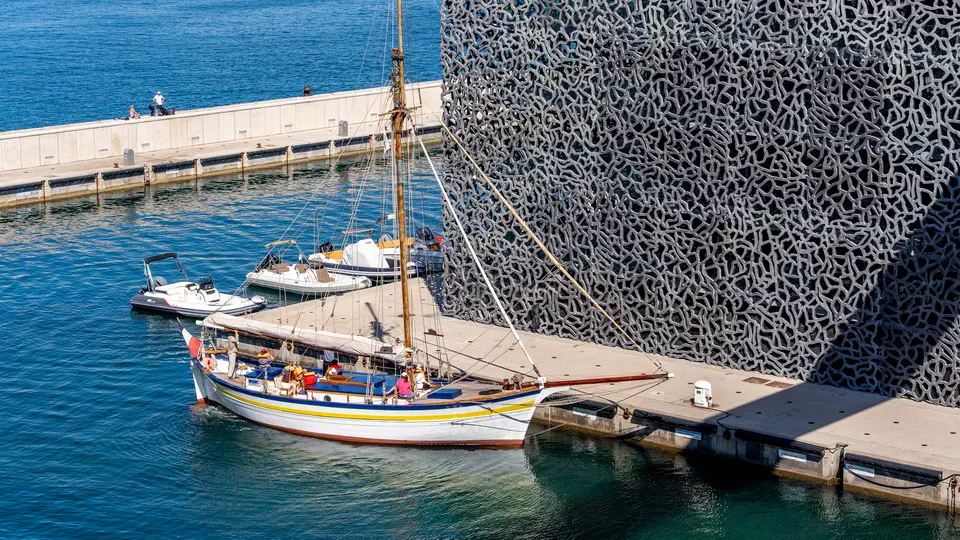
The museum opened in 2013, when Marseille was the European Capital of Culture. The main part of the complex was built on the former J4 harbour pier. The building was designed by French architect Rudy Ricciotti in collaboration with Roland Carta. Even from a distance, its most characteristic feature is easy to recognise: a dark concrete screen wrapping around the façade and roof. Depending on where you stand, it can resemble a fishing net, tree branches, sea foam or an enormous piece of complicated lace.
What I particularly enjoyed was watching the sunlight filter through this concrete lattice. Inside, irregular shadows appear on the walls and walkways, constantly moving as the position of the sun changes. As a result, the building looks different in the morning, different again at midday and yet once more shortly before sunset. In this respect, MUCEM is a rather unusual museum. Even if none of the current exhibitions particularly interests you, it is still worth coming here simply for the architecture, terraces, and views across the Mediterranean.
What does the name MUCEM actually mean?
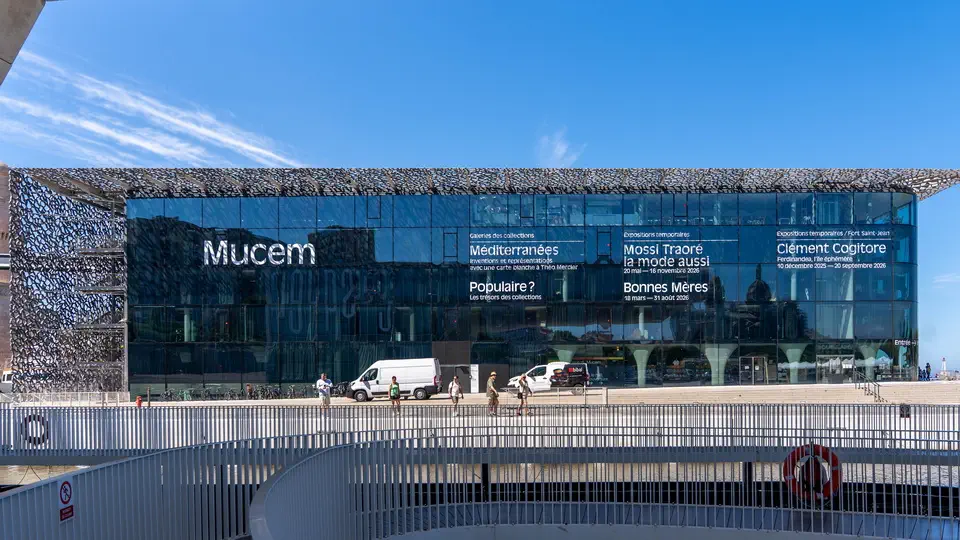
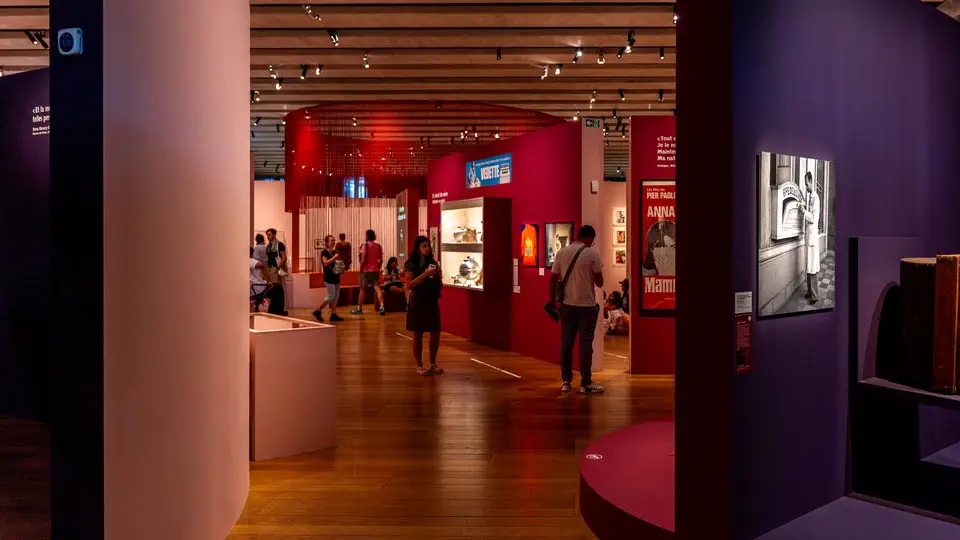
MUCEM explores the cultures of Europe and the Mediterranean region, although it is not a conventional history museum, taking you neatly from antiquity to the present day. Instead, exhibitions often examine a particular subject from several perspectives. You may come across displays devoted to migration, religion, agriculture, folk traditions, food, fashion, music, conflict, travel or social change. An old everyday object might be displayed beside a contemporary artwork, documentary photograph, film or recorded interview. During my visit, one of the special exhibitions was devoted to mothers and their role in different societies.
MUCEM’s collections are enormous. The museum looks after more than 250,000 objects, around 350,000 photographs, approximately 200,000 posters, prints and postcards, as well as roughly 150,000 books. The origins of these collections date back to the nineteenth century, even though the museum itself has only operated in Marseille since 2013. Naturally, only a small proportion of these objects can be displayed at any one time. Exhibitions change regularly, so it is always worth checking the current programme before your visit.
Visiting MUCEM and my first impressions
I entered the main J4 building from the waterfront. Almost immediately, I noticed a giant contrast between noisy, sun-baked Marseille outside and the calm interior of the museum. Beyond the doors I could hear seagulls, tourists talking and the constant background noise of the port. Inside there was subdued light, cool air and a welcome silence, something Magda particularly appreciated after spending hours surrounded by the constant noise of the city.
The exhibition galleries are spread across several levels. Some displays can be explored relatively quickly, while others make you want to stop and spend far longer looking around. Much depends on the temporary exhibitions, as these often have the greatest influence on your overall impression of MUCEM. This is not a museum filled with gilded palace interiors or monumental sculptures. Instead, you will find everyday objects, clothing, tools, photographs, documents, posters, contemporary artworks and film material.
Not every section will appeal to everyone. I certainly had moments when a subject seemed too abstract or was explained in a rather academic way. A few minutes later, however, I would walk into another gallery that completely drew me in. For that reason, I would not judge the museum on the first exhibition you encounter.
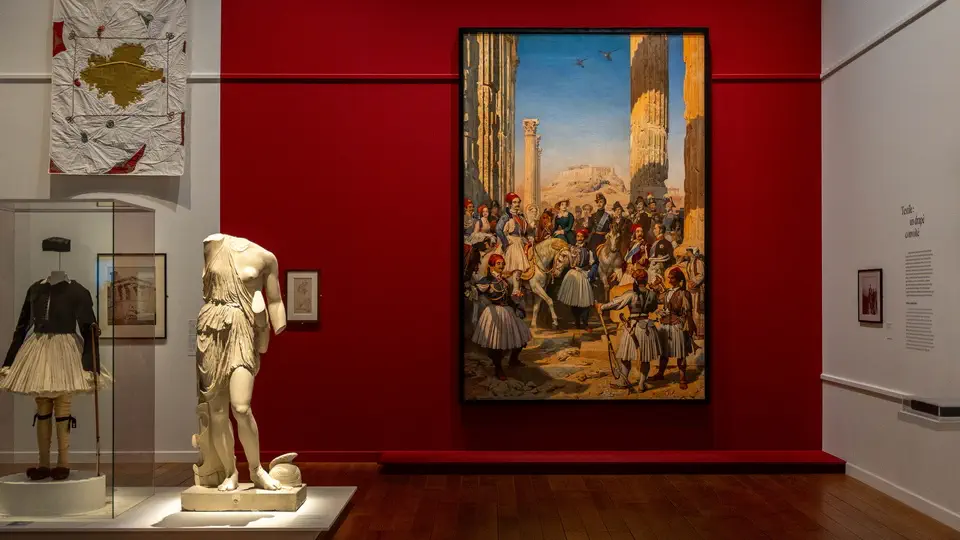
One of MUCEM’s major permanent displays is “Populaire?” an exhibition presenting treasures from the museum’s collections. Here you can see objects connected with everyday life, folk culture, celebrations, work, and the beliefs of people living throughout Europe and the Mediterranean region.
This part of the museum perhaps illustrates better than any other that history is not made exclusively of wars, kings, and treaties. It is also created by ordinary things: clothes, dishes, tools, toys, decorations, religious objects and family keepsakes. I enjoy exhibitions like this because they allow you to look at the past through the lives of ordinary people. Occasionally, an old jug or a hand-decorated chest can tell you more about a vanished world than an official document signed by a ruler.
After visiting the galleries, make sure you head outside and follow the ramps running around the building. For me, this was one of the best parts of the entire visit. You walk between the glass walls of the museum and the concrete lattice covering its exterior. Every few steps a different view appears: the sea, the harbour, Fort Saint-Jean, the hills of Marseille and nearby La Major Cathedral.
From the upper levels you get an excellent view of the cathedral’s distinctive striped façade. Modern MUCEM and the monumental nineteenth-century church stand almost beside one another, yet they look as though they belong to two entirely different worlds. In my opinion, this contrast creates one of the most interesting views in Marseille.
The footbridge connecting MUCEM with Fort Saint-Jean
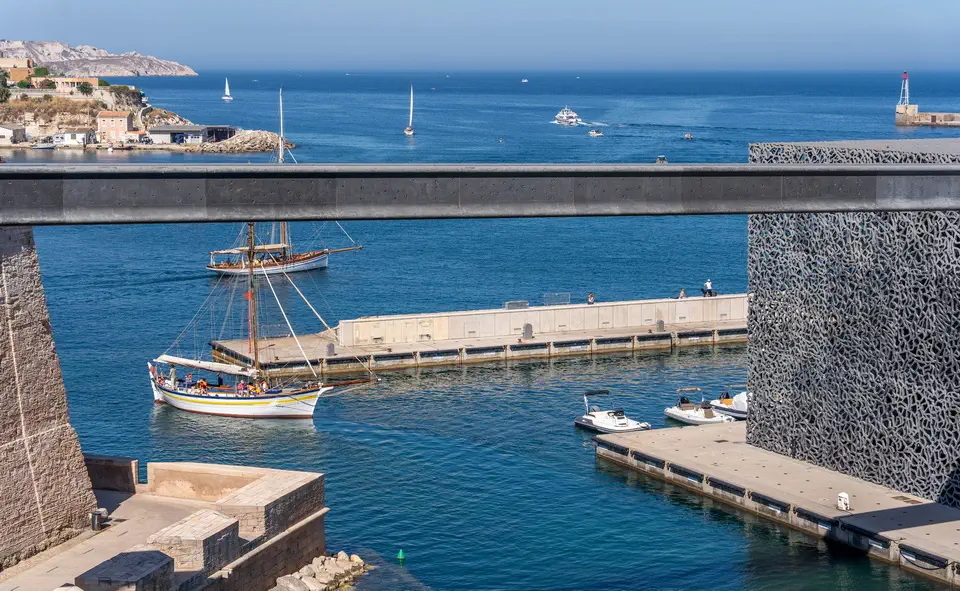
Perhaps the most recognisable feature of the entire complex is the high footbridge leading from the roof of the J4 building to Fort Saint-Jean. It is around 135 metres long and runs high above the waterfront and the former moat. From below it does not look particularly intimidating, but once you are standing on it the experience is wholly unique. The barriers are perfectly secure, although anyone with a serious fear of heights may still feel slightly uncomfortable.
I crossed it slowly, stopping several times to look out over the harbour and sea. On one side stood the modern museum building, while on the other were the walls of the old fortress. Below my feet I could see the stone waterfront, and ahead stretched the panorama of historic Marseille. The bridge is therefore more than an impressive architectural feature. Symbolically, it connects a contemporary museum with centuries of the city’s history.
Fort Saint-Jean is an integral part of MUCEM and I definitely would not finish your visit after exploring only the J4 building. The history of this site reaches back to the end of the twelfth century, when commanders of the Knights Hospitaller stood here. Much of the present fortress was developed in the seventeenth century on the orders of Louis XIV, who wanted to strengthen control over the entrance to the port. During the Second World War, German forces used the site as an ammunition depot, and in 1944 it was badly damaged by an explosion. Fort Saint-Jean was listed as a French historic monument in 1964, while major restoration work was carried out before MUCEM opened.
Walking around the fort sometimes feels rather like exploring a small stone town. There are staircases, defensive walls, terraces, courtyards, towers and narrow passages. Some buildings contain exhibitions, but I found the outdoor areas far more impressive. Almost every few minutes I discovered another viewpoint. From one spot I could see the entrance to the Old Port, from another the MUCEM building itself, and from yet another La Major Cathedral.
Fort Saint-Jean is also home to the Jardin des Migrations, or Garden of Migrations. It contains plants characteristic of different parts of the Mediterranean region, including herbs, flowers, shrubs and useful plants. This is not a huge botanical garden; it feels more like a series of green terraces spread between the old stone walls. Even so, it provides a very pleasant break during a visit.
In summer, the warm scent of sun-baked herbs hangs in the air. It is worth slowing down, touching the leaves, sitting for a while and simply looking out towards the sea. After several hours spent walking through museum galleries, that kind of break can be extremely welcome.
What can you see at MUCEM without buying a ticket?
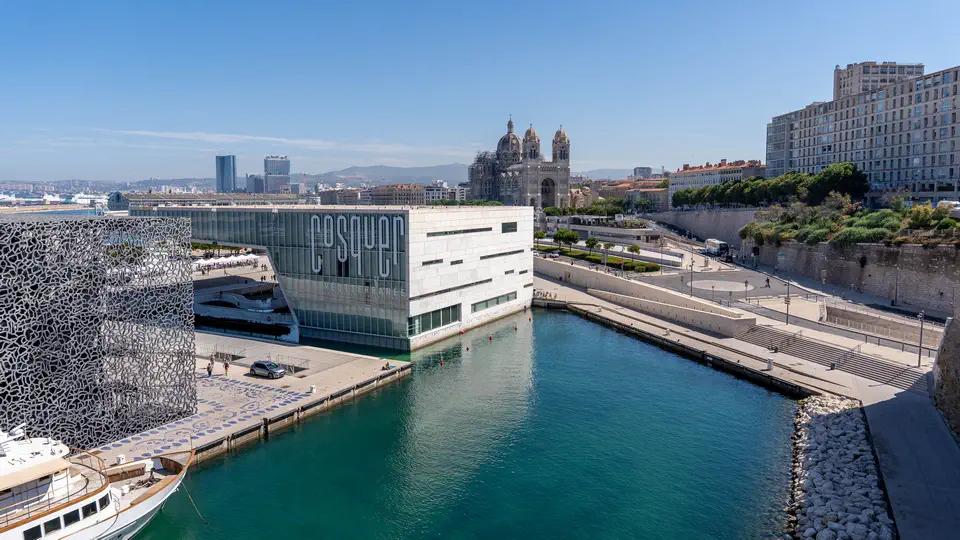
One of MUCEM’s biggest advantages is that a substantial part of the complex can be explored free of charge. The outdoor areas of both J4 and Fort Saint-Jean are accessible without paying admission. This means you can visit the exterior terraces, cross the footbridge into Fort Saint-Jean, walk along the fortifications and explore the Garden of Migrations without buying a museum ticket.
It is an excellent option if you have limited time or none of the current exhibitions particularly appeals to you. Personally, however, I would recommend seeing at least one exhibition because only then can you fully understand what MUCEM is trying to achieve. Admission to the exhibitions is also free on the first Sunday of each month, although naturally, you should expect more visitors on those days.
How much time should you allow for MUCEM?
For a quick walk around the outdoor areas and across to Fort Saint-Jean, I would allow at least an hour and a half. If you want to see one or two exhibitions as well, plan for around three hours. If you prefer to explore thoroughly, read the information panels and stop regularly for photographs, it would be effortless to spend half a day here.
Personally, I would not rush the route between J4 and the fort. Much of the pleasure of MUCEM comes from simply walking around, watching the views change and discovering one terrace after another.
Visiting MUCEM with children
MUCEM can certainly be visited with children, although not every exhibition will be equally interesting for younger visitors. Some displays include films, multimedia installations and unusual objects capable of holding a child’s attention, whereas others rely much more heavily on written explanations and may become rather boring fairly quickly.
The bridges, fortifications, towers, gardens, and views of ships entering the harbour are likely to prove much more exciting. MUCEM also organises family activities and workshops, particularly during the holiday season. It is worth checking the programme before travelling, as the schedule changes regularly.
Practical information if you are planning a visit
MUCEM stands directly beside the Mediterranean, between the Old Port and La Major Cathedral. Address of the main J4 building: 7 Promenade Robert Laffont, Esplanade du J4, Marsylia.
The museum is open every day except Tuesdays, 1 May and 25 December. Opening hours vary depending on the season. During summer, the complex generally remains open longer, whereas it closes earlier during the winter months. In July and August 2026, the main areas are open from 10:00 am until 8:00 pm.
Standard admission to the exhibitions currently costs €11, with a reduced ticket priced at €7.50 and a family ticket at €18. A single ticket provides access on the same day to exhibitions in both J4 and Fort Saint-Jean. Admission is also included with selected Marseille tourist passes. Prices, exhibitions, and opening times can change, so I always recommend checking the museum’s official website before visiting.
How to get to MUCEM – If you are already near the Old Port, walking is probably the best option. The route follows the waterfront and allows you to see several interesting parts of the city along the way. You can also take the metro to Vieux-Port or Joliette and then walk for around ten to fifteen minutes. Buses and trams also serve the area. If you are exploring central Marseille, you are unlikely to need a car. Parking around the port is paid, and traffic in the city can be rather chaotic.
What to see near MUCEM – After leaving the museum, it is worth walking straight to La Major Cathedral, which stands only a few minutes from J4. The cathedral is one of Marseille’s most recognisable historic landmarks. From Fort Saint-Jean, you can also continue towards Le Panier, the oldest district of Marseille, filled with steep streets, staircases, little squares, cafés, colourful façades and murals. Another natural stop is the Old Port. It is worth visiting in the morning when the fish market is operating, or in the evening when the waterfront fills with people out for a walk. Thanks to its location, MUCEM fits easily into a full day spent exploring Marseille’s most important attractions. I would also recommend the nearby Cosquer Cave replica.
My tips before visiting MUCEM
Firstly, wear comfortable shoes. The complex is large and a visit involves walking through exhibition halls, ramps, bridges, stone stairways and the courtyards of the fort. During summer, carry water and something to protect your head from the sun. Part of the route crosses exposed terraces where the Mediterranean sunshine can become strong. The museum interior is air-conditioned, so the difference in temperature between inside and outside can be quite noticeable.
Do not try to see absolutely everything simply for the sake of it. It is much better to choose one exhibition that genuinely interests you and then explore the fort at a relaxed pace than to rush from gallery to gallery while constantly checking the time.
It is also worth arriving in the morning or later in the afternoon. Around midday, especially during summer, the ticket desks and footbridges can become quite busy.
Even if museums are not normally your favourite places, MUCEM may surprise you in the same way that it surprised me. This is not simply another building filled with display cases. MUCEM forms a single experience with the sea, Fort Saint-Jean, its bridges and terraces and the views across historic Marseille. The boundary between museum and urban space almost disappears here.
What I remember most is not one particular exhibit, but the atmosphere of the whole place: rays of sunlight filtering through the concrete lattice, the wind on the high footbridge, the scent of herbs in the Garden of Migrations and the sight of ships entering the harbour.
I originally came here mainly because I wanted to see the famous building. Several hours later, I’m left feeling that MUCEM is one of those places that best represents the character of modern Marseille – an old, chaotic and multicultural city, open to the sea and constantly reinventing itself.
MUCEM Museum facts, information and interesting details
- MUCEM is the first French national museum devoted to the civilisations of Europe and the Mediterranean region. Its exhibitions combine history, archaeology, anthropology, art, and contemporary social issues.
- The museum’s full name is Musée des Civilisations de l’Europe et de la Méditerranée. The rather lengthy French title was shortened to the far easier-to-remember MUCEM.
- The museum opened in June 2013. The date was not accidental, as Marseille was European Capital of Culture that year and was undergoing a major period of urban redevelopment.
- The museum’s main building is known as J4. The name comes from the former harbour pier on which the modern MUCEM building was constructed.
- J4 was designed by Rudy Ricciotti in collaboration with Roland Carta. Soon after opening, the building became one of the most recognisable symbols of contemporary Marseille.
- The museum building takes the form of a perfect square measuring 72 metres along each side. Its austere geometric shape creates a striking contrast with the irregular stone walls of neighbouring Fort Saint-Jean.
- Its characteristic exterior resembles concrete lace or a fishing net. The pattern is not purely decorative, as it also reduces the amount of intense Mediterranean sunlight reaching the building’s interior.
- The structure was built using forceful fibre-reinforced concrete. This modern material made it possible to create the thin, complex sections of the façade as well as the building’s unusual supports.
- The main J4 structure is supported by 309 columns resembling branching trees. Museum staff have apparently also jokingly compared their shape to enormous chicken bones.
- These branching supports are positioned around the exhibition spaces. As a result, the centre of the building does not require conventional massive load-bearing walls, giving exhibition designers much greater freedom when arranging displays.
- Outdoor walkways and ramps run around the building. They allow visitors to climb all the way to the roof while enjoying views of the sea, harbour, La Major Cathedral and Fort Saint-Jean along the way.
- The J4 terraces provide panoramic views in virtually every direction. You can see the Mediterranean, the entrance to the Old Port, the fortifications and several historic districts of Marseille.
- J4 is connected with Fort Saint-Jean by a high footbridge suspended above the waterfront. It measures around 135 metres, although some museum-related sources also give a figure of 115 metres.
- A second footbridge connects Fort Saint-Jean with the Le Panier district. It is around 70 metres long and allows visitors to move almost seamlessly from the modern museum into the oldest part of Marseille.
- Fort Saint-Jean is not simply a historic monument conveniently located beside MUCEM. It forms an integral part of the museum and contains exhibition spaces, gardens, a bookshop, a restaurant, and areas used for cultural events.
- The origins of Fort Saint-Jean date back to the late twelfth century. A commandery of the Knights Hospitaller once stood here, while most of the present fortifications were built in the seventeenth century during the reign of Louis XIV.
- For centuries, the fort remained a military site closed to ordinary residents. It was only in 2013, following restoration and its incorporation into MUCEM, that it was opened widely to the public.
- Fort Saint-Jean covers an area of roughly 15,000 square metres. Around 1,100 square metres are occupied by exhibition galleries, while approximately 12,000 square metres are devoted to gardens.
- The Garden of Migrations was created on the fort’s walls and terraces. Plants originating from different shores of the Mediterranean are intended to evoke centuries of travel, trade and cultural exchange.
- The Garden of Migrations is divided into six themed sections. During your walk you can see myrtle, pomegranate, orange trees, herbs, and other plants characteristic of Mediterranean gardens.
- MUCEM actually operates across three locations. In addition to J4 and Fort Saint-Jean, it also includes the Conservation and Resource Centre in Marseille’s Belle de Mai district.
- The museum’s collections are considerably older than its Marseille headquarters. Their history stretches back to the nineteenth century because MUCEM inherited collections assembled by earlier French ethnographic institutions.
- MUCEM looks after more than 250,000 objects and approximately 350,000 photographs. Its archives also contain hundreds of thousands of prints, posters, postcards, and books.
- The textile collection alone contains more than 30,000 objects. Items have been catalogued, photographed, barcoded and packed in specialist materials designed to protect them from damage.
- Many of MUCEM’s most attractive areas can be explored without buying a ticket. The outdoor parts of J4, its footbridges, terraces, gardens and much of Fort Saint-Jean are accessible free of charge.