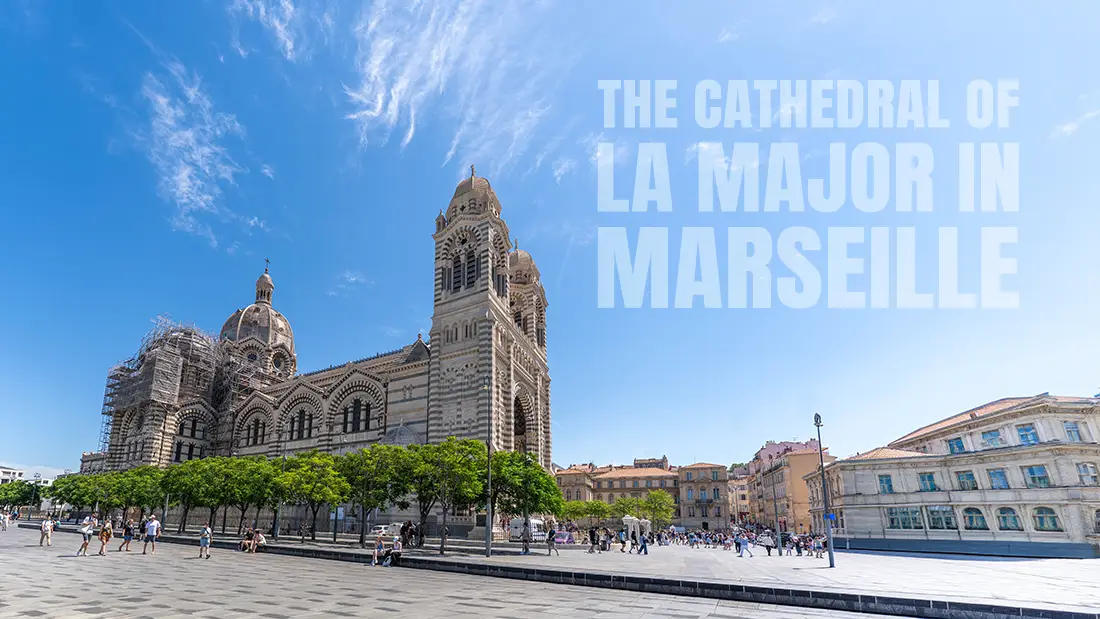
The Cathedral of Sainte-Marie-Majeure in Marseille, known to local people simply as La Major, is one of those buildings that would be difficult to mistake for any other church. When I first saw it from the harbour, I thought it looked more like a monumental palace from Constantinople than a typical French cathedral. Although religious buildings are not usually among my favourite attractions, Marseille Cathedral made a powerful impression on me.
Its alternating bands of pale and dark stone, enormous domes, twin towers and position almost directly beside the Mediterranean Sea give the cathedral a remarkably exotic appearance. It has none of the slender elegance of French Gothic architecture or the austerity of Romanesque churches. Instead, there is grandeur, space and a clear combination of European architecture with influences from the East.
La Major stands between the Old Port and the former commercial harbour of La Joliette, close to the Le Panier district and the modern Mucem museum. This makes it easy to include the cathedral in a walk through the oldest part of Marseille. In my opinion, this is one of those attractions that should not be left until the end of the day. It is best to visit when you still have enough time to walk around the entire building, explore its interior and sit for a while on the esplanade overlooking the sea.
The history of La Major Cathedral in Marseille and the origin of its name
The church’s full name is Cathédrale Sainte-Marie-Majeure de Marseille, meaning the Cathedral of Saint Mary Major. The people of Marseille, however, shortened it to the simple and memorable name La Major. The name is also connected with the older cathedral, now known as Vieille Major, the remains of which stand directly beside the present building. The old church was partly demolished during the construction of the nineteenth-century cathedral, but the surviving section still reminds visitors that Christianity had been present on this site for many centuries before La Major was built.
The contrast between the two buildings is fascinating. On one side stands a relatively small and austere Romanesque church, while beside it rises an enormous cathedral that seems to express the wealth, ambition and former importance of Marseille. The site occupied by the cathedral was associated with Christianity as early as Late Antiquity. An early Christian church and a large baptistery once stood here. Later churches were built over the remains of earlier structures, meaning that the history of La Major spans approximately 1,600 years.
The old cathedral began to take shape during the earliest centuries of Christianity, although its later Romanesque form dates mainly from the Middle Ages. It was rebuilt several times but continued to serve as Marseille’s most important church for centuries.
The surviving part of Vieille Major is considered a valuable example of Provençal Romanesque architecture, although its interior is normally closed to visitors. During the nineteenth century, Marseille developed at an extraordinary pace. Increasing numbers of ships entered its harbour, the population grew rapidly, and the city became one of France’s most important commercial centres.
The old cathedral no longer reflected the ambitions of a city that saw itself as a great Mediterranean metropolis and a gateway connecting Europe with the East. The construction of the new cathedral therefore had more than religious significance. It was intended to be clearly visible from ships entering the harbour and to show travellers from the moment they arrived that they had reached a powerful and prosperous city.
The foundation stone was laid on 26 September 1852 by Louis-Napoléon Bonaparte, the future Emperor Napoleon III. The design was created by the French architect Léon Vaudoyer, who proposed an unusual combination of Romanesque and Byzantine styles.
The work proved extremely complicated and continued for more than four decades. After Vaudoyer died in 1872, responsibility for the construction passed to Henri-Jacques Espérandieu. He was also involved in the creation of Notre-Dame de la Garde, another famous church overlooking Marseille.
Espérandieu supervised elements including the structure and the domes, but he died in 1874. The work was completed by Henri Antoine Révoil, who paid particular attention to the decorations, mosaics, sculptures and bronze details. The cathedral was completed in 1893 and received the title of minor basilica several years later. At the beginning of the twentieth century, it was officially listed as a French historic monument.
This was a project of enormous scale. La Major was the only great cathedral constructed in France during the nineteenth century, following a break of around two centuries in projects of this kind. It was designed to accommodate as many as 3,000 people and to underline Marseille’s importance as France’s second city and its leading port.
Architecture that is impossible to ignore
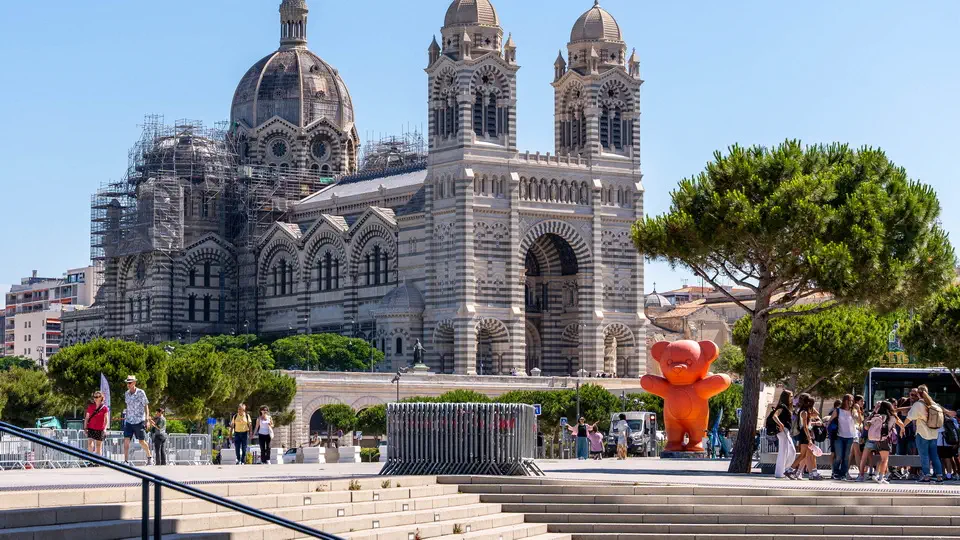
The façade naturally makes the greatest impression. Bands of greenish and white stone form a characteristic pattern that has led the people of Marseille to jokingly refer to the cathedral as “the pyjamas”. I have to admit that the comparison is quite accurate, although the building looks considerably more dignified than a set of nightclothes.
The architecture of La Major was intended to connect the West symbolically with the East. Its bell towers resemble those found in traditional European churches, while the domes bring to mind Byzantine temples and the monumental buildings of Istanbul. Italian influences are also clearly visible, particularly those associated with the cathedrals of Lucca and Siena.
Materials used in the cathedral’s construction and decoration were brought from many parts of the Mediterranean. These include white Carrara marble, green stone from Florence, Provençal stone, onyx from Italy and Tunisia, and mosaics produced in Venice.
This international collection of materials suits Marseille perfectly. Since ancient times, the city has been a meeting place for different cultures, languages, and religions. The cathedral is approximately 146 metres long. Its main dome rises to a height of almost 70 metres and measures roughly 18 metres in diameter.
The proportions of the building are difficult to appreciate from close range, so I recommend walking a little further towards Mucem or the harbour. Only from a distance does the true scale of La Major become apparent.
What can you see on the cathedral’s façade?
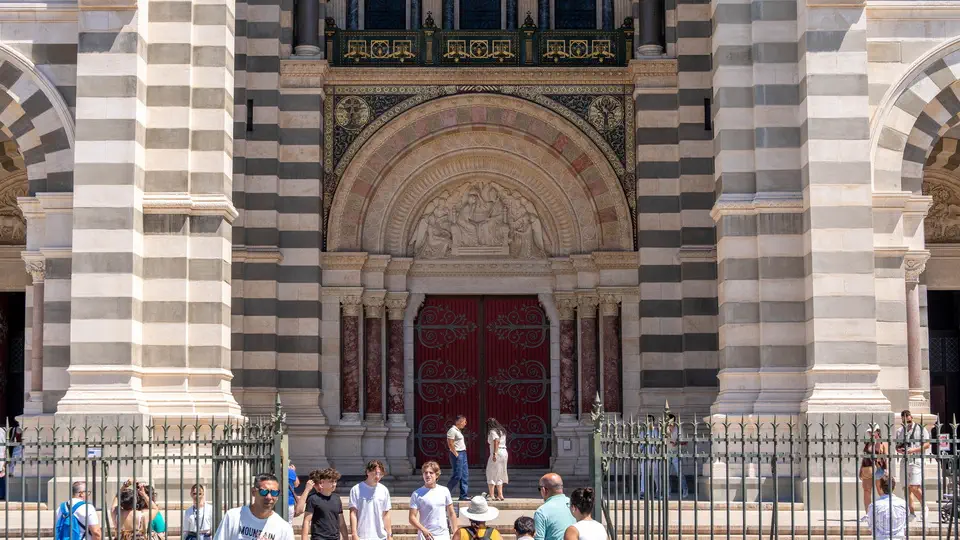
Before entering, it is worth spending a few minutes examining the decorations. The façade is adorned with figures of Christ, the apostles, Saints Peter and Paul, and saints associated with Provence. A monument to Bishop Henri de Belsunce, one of the most important figures in Marseille’s history, also stands in front of the cathedral. He is remembered for remaining in the city during the plague epidemic of 1720, helping the sick and dying.
Whether you are interested in religious symbolism or simply enjoy architecture, I recommend walking all the way around the cathedral. The entrance side is dominated by the monumental façade and twin towers, while the arrangement of the domes and the immense scale of the structure can be appreciated much better from the side facing the sea.
Visiting the interior of La Major
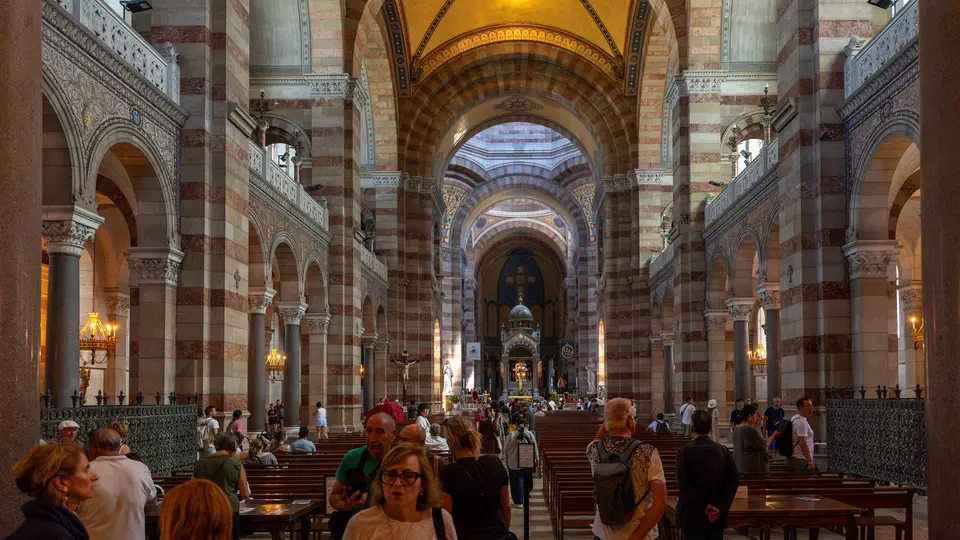
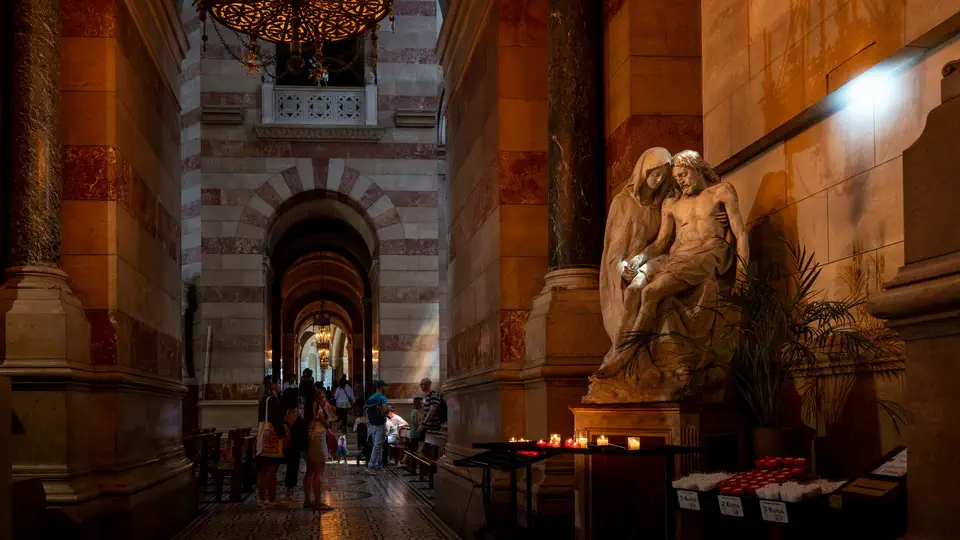
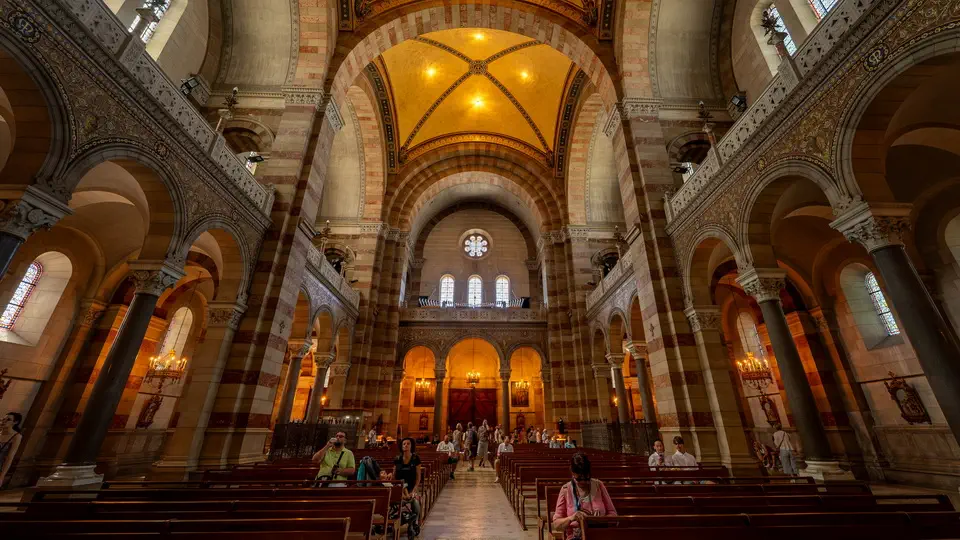
After seeing the richly decorated façade, I expected an interior covered in gold from floor to ceiling. My first impression, however, was rather different. The cathedral is enormous, but parts of it feel quite dark and cool. It was precisely this sense of scale and shadow that remained most clearly in my memory.
The interior is divided by massive columns and arches. The bands of stone seen on the exterior also appear inside, drawing the eye towards the sanctuary. Domes rise above the nave and the crossing of the transept, while numerous chapels, mosaics, and sculptures mean that a visit involves much more than simply walking quickly along the central aisle. Among the details particularly worth seeing are:
- the statues of the four Evangelists created by Louis Botinelly;
- the sculpture of Christ and Saint Veronica by Auguste Carli;
- the onyx ciborium and altars associated with Jules Cantini;
- the tomb of Saint Eugène de Mazenod in the axial chapel;
- the mosaics and decorations made from marble and porphyry.
I am not particularly religious, but I always appreciate churches that tell the story of a city through their architecture. La Major does this exceptionally well. Inside, France, Italy, Byzantium, North Africa and the wider Mediterranean world all meet beneath the same domes.
A similar combination of history art, and symbolism can be found in the medieval city of Carcassonne and its Basilica of Saint-Nazaire, although Romanesque and Gothic elements dominate there. A wholly different vision of monumental religious architecture can be seen in the Sagrada Família in Barcelona.
Vieille Major – the old cathedral hidden beside a giant
It is easy to overlook the remains of the older church standing in the shadow of La Major. That would be a mistake, as Vieille Major helps visitors understand the enormous scale of the changes that took place in Marseille during the nineteenth century.
The old church was built on the site of an early Christian place of worship and baptistery. It was altered repeatedly over the centuries, while its most characteristic surviving sections represent the Romanesque style. Part of the older building was demolished during the construction of the new cathedral to make room for a far larger structure.
Vieille Major is currently closed to tourists, so it can only be viewed from the outside. Even so, it is worth walking closer. The contrast between the modest medieval church and the nineteenth-century giant is one of the most interesting sights in this part of Marseille.
La Major and the procession on 15 August
One of the most important ceremonies held at the cathedral is the Feast of the Assumption of the Virgin Mary, celebrated on 15 August. A procession leaves La Major and moves through the streets of the nearby Le Panier district. A statue of the Virgin Mary is carried along the route, accompanied by residents, members of the clergy and pilgrims.
The procession is much more than an ordinary church ceremony. It reflects the multicultural and Mediterranean character of Marseille. For centuries, religion in this city has mixed with the traditions of sailors, fishermen, merchants, and travellers arriving from many parts of the world.
When planning a visit in mid-August, you should expect larger crowds. On the other hand, it is also an opportunity to see La Major as a living place of worship rather than simply a historic monument.
What can you see near the cathedral?
The location of La Major could hardly be better for exploring the rest of Marseille. In fact, we spent several days walking around the city without ever travelling particularly far from the cathedral. This part of Marseille is filled not only with interesting attractions but also with wonderful views of the Old Port and the city surrounding it. Several of Marseille’s most important attractions can be found in the immediate area:
- Mucem – The modern Museum of European and Mediterranean Civilisations stands directly beside the water. Its dark, openwork structure creates a fascinating contrast with the striped façade of the cathedral. Walking between the two buildings takes only a few minutes.
- Fort Saint-Jean – From Mucem, you can continue directly to the historic fort that once guarded the entrance to the Old Port. Its walls offer excellent views of the sea, the harbour, and La Major itself.
- Le Panier – Marseille’s oldest district begins almost immediately behind the cathedral. There you will find narrow streets, stairways, colourful façades, small galleries, murals, cafés, and shops selling local products.
- Stary Port – Vieux-Port is the tourist heart of Marseille. It can be reached on foot in around fifteen minutes by following the waterfront. It is a good place to continue your walk or join a boat trip towards Château d’If and the Frioul Islands.
When Marseille is only one stop on a longer journey through France, it is worth comparing this lively Mediterranean city with the far more orderly Grenoble, surrounded by the French Alps, or with historic Montpellier and its many attractions. Each of these cities reveals a completely different side of France.
Mysteries and legends of La Major Cathedral in Marseille
The Cathedral of Sainte-Marie-Majeure is not usually associated with ghosts wandering through cloisters or bloody curses. Its mysteries are much older and, in my opinion, far more interesting. They are hidden beneath the floor, inside reliquaries, in ancient processions and in stories passed down through generations of Marseille residents.
As I walked around La Major, what impressed me most was the awareness that the present cathedral is merely the most recent layer of a much older place of worship. Beneath the monumental nineteenth-century building lie the remains of churches whose origins reach back to the earliest centuries of Christianity.
The lost baptistery hidden beneath the cathedral
The greatest mystery of La Major is not a legend but an archaeological fact. During the construction of the present cathedral in the nineteenth century, workers discovered the remains of an early Christian baptistery, probably dating from the fifth century.
Depending on how its original layout is reconstructed, the building measured approximately 22–23 metres in diameter or width. It is considered one of the largest early Christian baptisteries discovered in ancient Gaul and perhaps even one of the largest in the entire Christian West of that period.
Archaeologists uncovered fragments of mosaics, walls and other elements connected with the former episcopal complex. The most intriguing detail is that the baptistery was covered again during the construction of the new cathedral.
Today, visitors cannot descend into it as they might enter an ordinary archaeological crypt. The remains lie beneath the modern structure and are known mainly through historical descriptions, plans and archaeological studies. Stories of a submerged underground church hidden beneath La Major gradually developed around these discoveries. Some local people imagine it as an almost complete church lying directly below the cathedral floor.
In reality, what survives consists mainly of foundations, sections of walls and fragments of mosaics. Even so, the truth is fascinating enough without any embellishment.
Was the cathedral built over a pagan temple?
One old tradition claims that before the first Christian cathedral was built on the hill, a temple dedicated to the Roman goddess Diana stood here. The story probably appeared because columns originating from older structures were discovered during the excavation of the baptistery.
During the nineteenth century, some researchers interpreted them as the remains of an ancient temple. Later historians have been more cautious.
The Roman columns may simply have been building materials reused by the people who constructed the early Christian complex.
There is therefore no firm evidence that a temple of Diana stood directly beneath La Major. The legend does, however, fit well with the history of Marseille, a city founded by the Greeks that remained an important port throughout the ancient world.
The legend of Saint Lazarus, the first Bishop of Marseille
One of the most important legends connected with the cathedral concerns Saint Lazarus of Bethany, the man whom, according to the Gospel, Jesus raised from the dead. Provençal tradition claims that after the persecution of the first Christians, Lazarus was driven out of Palestine together with Mary Magdalene, Martha and several other disciples.
They were placed aboard a boat without sails, oars, or provisions. Their persecutors expected them to die at sea, but divine protection supposedly carried them safely to the coast of what is now Provence. Lazarus is then said to have travelled to Marseille, begun preaching Christianity and become the city’s first bishop.
According to the legend, he was eventually arrested, tortured and beheaded near what is now Place de Lenche, beneath the Le Panier district. La Major contains a chapel dedicated to Saint Lazarus and a reliquary holding remains traditionally believed to be his relics.
Their authenticity cannot be confirmed using historical methods, but the cult of Saint Lazarus played an important role in Marseille for centuries.
While visiting the cathedral, it is worth remembering that the story of Lazarus travelling to Provence belongs to religious tradition rather than to events confirmed by first-century historical sources. For the people of Marseille, however, the legend became an important part of the city’s identity.
The relics that were said to have disappeared during the French Revolution
Another mysterious story connected with the relics of Saint Lazarus concerns the French Revolution. During that period, many churches were looted, while their furnishings and valuable objects were destroyed or sold. The reliquaries belonging to the old cathedral were also in danger.
According to church accounts, some relics were secretly removed and hidden by local worshippers. This supposedly allowed them to survive the years of revolutionary violence. They were later examined again, officially recognised by the Church authorities and returned to the cathedral.
Nobody knows exactly where the relics were hidden or who saved them. This gap in the historical record encouraged stories about secret hiding places, concealed chapels and residents who risked their lives to protect the remains of the saints.
The Virgin Mary who protects children and sailors
The most enduring legend associated with La Major concerns the golden statue of the Virgin Mary carried out of the cathedral on 15 August during the Feast of the Assumption. The statue is taken through the streets of Le Panier, while residents attach rosaries, prayers and small notes containing their requests.
Parents lift their children into the air so that they can come as close as possible to the Madonna. It was once believed that doing so would ensure their health and protection for the following year. Handkerchiefs touched against the statue’s golden cloak play a particularly important role in the tradition.
Worshippers take them home and keep them as talismans intended to protect their families from illness, accidents, and misfortune. In the past, similar pieces of cloth were carried by sailors leaving Marseille’s harbour. They were believed to protect them during storms and help them return safely to the city.
This is not merely a legend hidden in old chronicles. The tradition remains alive, and the procession is still one of the most important religious events in this part of Marseille.
Bishop Belsunce and the miraculous salvation of Marseille
A monument to Bishop Henri de Belsunce stands in front of La Major. With his arms stretched out, he looks slightly as though he were asking passers-by for donations. The people of Marseille have joked about this gesture for years, although the bishop’s real story is far more dramatic.
In 1720, Marseille was struck by a devastating plague epidemic. Belsunce refused to leave the city. He helped the sick, organised funerals and blessed the residents. He also placed Marseille under the protection of the Sacred Heart of Jesus.
According to religious tradition, his prayers and public dedication of the city helped to bring the epidemic to an end. Historians naturally point instead to the disease’s natural course, sanitary measures, and the declining number of people who remained vulnerable to infection.
In the memory of Marseille’s residents, however, Belsunce remained the man who faced death and refused to abandon his city. Some people believed that his statue protected the entrance to the cathedral from future epidemics. Touching the base of the monument was said to bring good health, although this custom never became as important as devotion to the Madonna.
The ghosts of the old cathedral
Building the new La Major required the partial demolition of the medieval Vieille Major. There were even plans to destroy the entire old church, but protests by residents and heritage campaigners resulted in the preservation of the choir and one bay.
Such a radical alteration of an ancient place of worship inevitably caused strong emotions. Stories began to circulate about the sound of old bells being heard at night, even though the bell tower was no longer in use.
Others claimed that shadowy figures of priests could sometimes be seen near the closed Vieille Major. According to these stories, they were clergymen who had never accepted the destruction of their cathedral. These accounts are not well documented. I would treat them mainly as later urban legends created by the imagination of Marseille’s residents.
Vieille Major does, however, have a mysterious appearance. Closed and partly hidden beside the enormous new cathedral, it resembles a building that the city tried to forget.
The curse of La Major’s architects
The construction of the new cathedral continued for more than forty years and was supervised by several architects. Léon Vaudoyer died in 1872 before he could complete his work. Henri-Jacques Espérandieu took over the project but died only two years later. Henri Antoine Révoil eventually completed the cathedral.
The deaths of two leading architects before the building was finished were enough to inspire stories about the curse of La Major. According to one version of the legend, the cathedral was simply too ambitious, and everyone who attempted to complete it paid with their life.
There is no reason to believe that a real curse existed. Vaudoyer was 68 years old when he died, while Espérandieu had suffered from poor health for some time. The story does, however, show how easily legends can develop around enormous building projects that continue for decades.
At the Cathedral of Sainte-Marie-Majeure, the boundary between history, religious tradition and legend is unusually fluid. The hidden baptistery, earlier churches and the plague epidemic are historical facts. The journey of Saint Lazarus to Marseille, the protective power of the handkerchiefs and the nocturnal return of the Madonna belong instead to the worlds of faith and local folklore.
You do not need to believe all these stories to appreciate their power. While exploring the cathedral, simply look towards the closed Vieille Major, lower your gaze to the floor concealing the remains of the ancient baptistery and imagine the generations of sailors who once searched the horizon for the cathedral’s striped domes.
At that moment, La Major stops being merely an impressive historic building. It becomes a place constructed from many layers, most of which cannot be seen at first glance.
La Major Cathedral in Marseille – practical information
Address: Place de la Major, 13002 Marseille.
Admission: Entry to the cathedral is free. Additional guided tours organised by the city’s tourist office may require a ticket.
Opening hours: According to the latest available information, the cathedral is open daily from 10.00 am to 7.00 pm between April and the end of October. From November until the end of March, it is normally open from 10.00 am to 5.30 pm. Access for tourists may be temporarily restricted during services, religious ceremonies and special events.
Time needed for a visit: Allow between 30 and 60 minutes to explore the interior. Including a walk around the building, a look at Vieille Major and a short rest on the esplanade, I would plan approximately an hour and a half.
Getting there: The nearest metro station is Joliette on line M2. Bus number 49 also stops nearby at the Cathédrale de la Major stop.
A few tips before visiting La Major
The best time to visit the cathedral is in the morning or late afternoon. The square receives very little shade around midday, especially during summer. The pale stone paving reflects the sunlight and can make the heat feel even more intense. For exterior photographs, I preferred the light in the late afternoon. The bands across the façade become more distinct, while the shadows emphasise the domes, arches, and towers.
Good places from which to photograph the cathedral include the area around Mucem and the route approaching from the Old Port. Inside, remember to remain quiet and respectful, as La Major is still an active place of worship. Tourist access may be limited during Mass.
The dress code is not enforced as strictly as it is in some churches in Southern Europe, but it is still sensible to cover your shoulders and avoid wearing beach clothes. During summer, I would also recommend carrying water, a hat, and sunglasses. The cathedral’s interior offers welcome relief from the heat, but there is far less shade on the surrounding esplanade.
Is Sainte-Marie-Majeure Cathedral worth visiting?
Definitely. La Major is not only the most important church in Marseille but also a building that tells the story of the city as a great port connecting Europe with Africa and the East. It did not impress me because of golden decorations or the number of relics it contains. What stayed with me most was its immense scale, its position beside the sea and its unusual architecture.
The cathedral looks as though it was deliberately built to welcome ships entering Marseille’s harbour. It is worth visiting even when you normally avoid churches during your travels. La Major is not an ordinary religious building.
It is a symbol of Marseille’s nineteenth-century ambitions, a Mediterranean landmark and one of the best places from which to begin exploring the oldest part of the city.
La Major Cathedral in Marseille – facts, information and interesting details
- The people of Marseille usually call it La Major. The church’s full French name is Cathédrale Sainte-Marie-Majeure de Marseille, but in everyday conversation almost everyone uses the shorter and much easier-to-remember name.
- It is one of the largest cathedrals built in France during the nineteenth century. Its monumental dimensions reflected the ambitions of rapidly expanding Marseille, which was then France’s most important Mediterranean port.
- The foundation stone was laid by the future Emperor Napoleon III. The ceremony took place on 26 September 1852, when Louis-Napoléon Bonaparte was still President of France. A few months later, he proclaimed himself emperor.
- The cathedral took more than forty years to build. Construction began in 1852 and was not completed until 1893. During that period, architects changed, building techniques developed and Marseille itself underwent a dramatic transformation.
- Three principal architects worked on La Major. Léon Vaudoyer created the original design. Henri-Jacques Espérandieu continued the work after his death, while Henri Antoine Révoil completed the cathedral and supervised many of its decorative elements.
- La Major combines Romanesque and Byzantine architecture. This is an unusual mixture in French religious architecture. The domes resemble Eastern churches, while the towers and arrangement of the façade refer to Western European traditions.
- The characteristic stripes were created using differently coloured stone. Pale and greenish layers give the cathedral an appearance unlike any other monument in Marseille. Local people sometimes jokingly compare its façade to a pair of striped pyjamas.
- Materials were brought from several countries. The cathedral contains Carrara marble, stone from Florence, onyx from Italy and North Africa, and mosaics produced by Venetian craftsmen.
- The main dome rises to a height of almost 70 metres. This makes La Major clearly visible from many parts of Marseille and from the decks of ships entering the harbour.
- The cathedral is approximately 146 metres long. Its enormous scale is easiest to appreciate from a distance, particularly from around Mucem, Fort Saint-Jean or the harbour waterfront.
- La Major was designed to hold around 3,000 people. It was intended to serve not only residents but also sailors, merchants, dockworkers, and travellers arriving in Marseille.
- Part of the older cathedral survives beside the new building. Vieille Major is a remnant of the medieval church, part of which was demolished during the construction of La Major. The two structures provide an unusual opportunity to compare Romanesque architecture with the monumental style of the nineteenth century.
- Early Christian remains lie beneath the cathedral. Archaeological work revealed part of a large baptistery and fragments of an earlier religious complex, probably dating from the fifth century.
- A Christian place of worship existed here around 1,600 years ago. The present La Major is therefore only the latest layer in a long religious history reaching back to the final centuries of the Roman Empire.
- The cathedral contains a chapel associated with Saint Lazarus. According to Provençal tradition, the biblical Lazarus came to Marseille and became its first bishop, although historians regard the story as a religious legend.
- A statue of Bishop Henri de Belsunce stands in front of the cathedral. The bishop became famous during the plague epidemic of 1720, when he remained in Marseille and helped the sick rather than fleeing the city.
- The cathedral’s most important procession takes place on 15 August. During the Feast of the Assumption, a statue of the Virgin Mary is carried from La Major through the streets of Le Panier, Marseille’s oldest district.
- La Major was designed as a landmark visible from the sea. Sailors returning from long voyages regarded its domes as a sign that they had safely reached Marseille and that the most difficult part of their journey was over.
- The interior is considerably darker than the bright façade suggests. Massive columns, subdued light, marble, and mosaics create an atmosphere very different from the sunny square outside.
- The cathedral stands beside several of Marseille’s most important attractions. Mucem, Fort Saint-Jean, Le Panier and the Old Port can all be reached within a few minutes, making La Major an excellent part of a full-day walking route through the city.