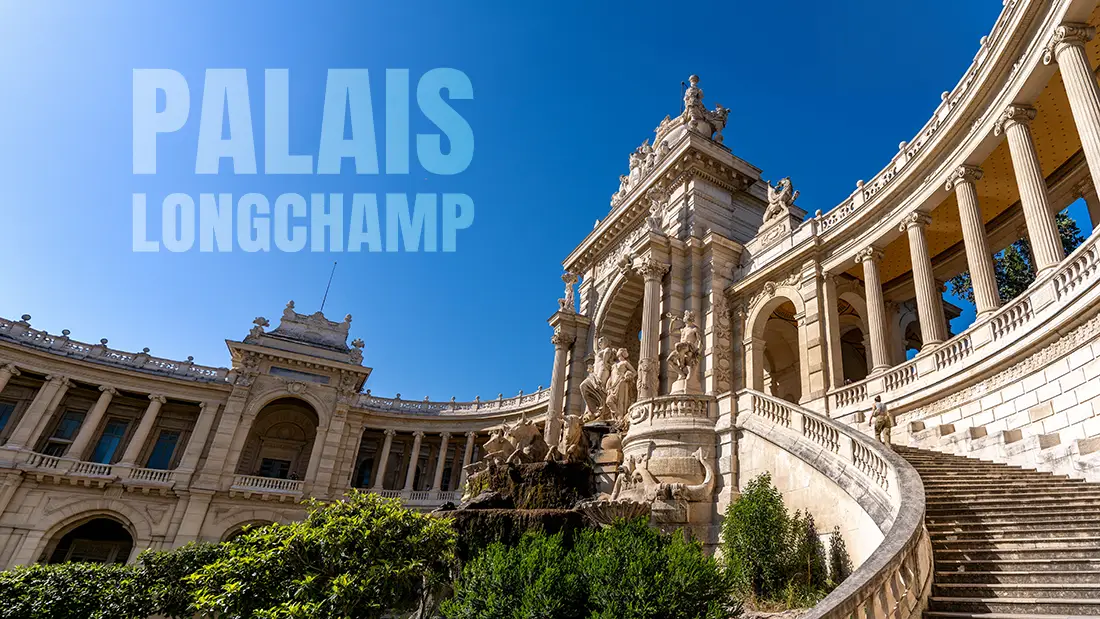
Marseille is a city whose history has always been inseparably connected with the sea. The Old Port smells of fish and boats, MUCEM and Fort Saint-Jean rise almost directly from the waterfront, while the Basilica of Notre-Dame de la Garde, standing high above the city, reminds us that Marseille’s story has always been closely linked with sailors. So, when I first saw the beautiful and monumental Palais Longchamp, with its enormous colonnade, waterfalls, sculptures and broad staircases, I assumed it must once have been the residence of an exceptionally wealthy Marseille aristocrat whose fortune had been built on maritime expeditions. Everything looks as though a duke in a top hat might emerge from the palace at any moment, climb into a carriage and set off for dinner.
In reality, Palais Longchamp was never a royal or even an aristocratic residence. It was created primarily as a monument to water, or more precisely to an event that virtually saved nineteenth-century Marseille from disaster. And it is this story that makes Palais Longchamp considerably more interesting than its postcard photographs might suggest. In the article below, I will tell you about the history of the monument and its original purpose, which may well surprise you.
Palais Longchamp and the water Marseille desperately needed
As I discovered while reading about the history of Marseille, the city’s problems with its water supply did not suddenly appear in the nineteenth century. Marseille had long been growing more rapidly than its natural resources could support, and several centuries earlier people had already considered bringing water to the city from the River Durance. By the nineteenth century, however, the situation had become particularly serious. The population was increasing, the port and industry were expanding, while existing wells and local springs were simply no longer sufficient.
Sanitation was another major problem. In 1834–1835, the region suffered first from a severe drought, then torrential rain and flooding, followed by a cholera epidemic. At that point, the authorities realised that providing Marseille with permanent access to large quantities of clean water was no longer simply a matter of convenience. It had become essential for public health and for the city’s future development.
The breakthrough came in 1838, when Marseille was granted permission to draw water from the Durance. Preparations began for an undertaking that, looking at it today, probably impresses me even more than Palais Longchamp itself. Water had to be transported over an enormous distance, crossing hills, valleys and the uneven landscape of Provence. Canals, tunnels, siphons, and aqueducts had to be constructed along the way.
The design and construction of the Canal de Marseille were primarily the responsibility of engineer Franz Mayor de Montricher. Work began in 1839 and, after around ten years, water from the Durance finally reached Marseille. For residents, this was a genuinely transformative event. The city finally received something it had needed for generations – a much more reliable source of water.
Interestingly, the idea of creating a monumental termination for the canal appeared almost as soon as construction began. The authorities wanted a grand château d’eau to stand on the Longchamp plateau: a monumental reservoir and water pavilion that would simultaneously serve as a memorial to the entire engineering project.
The laying of the foundation stone by the Duke of Orléans in 1839 was a grand ceremonial event, but more than twenty years would pass between this symbolic beginning and the construction of the Palais Longchamp we know today. For over two decades, Marseille simply could not decide what the monument should actually look like.
Money and the enormous scale of the project were the main problems. Marseille did not want an ordinary water reservoir. The structure was intended to be a monument to the Durance, a representative entrance to the gardens and, at the same time, a home for cultural institutions. A succession of architects therefore submitted proposals, but initially none of them was built.
The breakthrough finally came in 1861, when the Marseille authorities entrusted the project to the young architect Henri-Jacques Espérandieu. Today, he is regarded as one of the most important architects in Marseille’s history. If you explore the city thoroughly, you will keep coming across his name. He was also responsible for the famous Basilica of Notre-Dame de la Garde and worked on the monumental La Major Cathedral. Palais Longchamp remains one of his most celebrated projects.
Espérandieu was given a very specific task. At an elevation of around 73 metres, he was to create a monumental château d’eau. Great cascades visible from Boulevard Longchamp were to surround it, while the Musée des Beaux-Arts would occupy one side and the Muséum d’Histoire Naturelle the other. Gardens were also included in the overall design.
Construction of Palais Longchamp began in 1862. The project was complicated because the central monument was not merely an empty decorative shell. Palais Longchamp concealed the actual château d’eau, forming part of the system that received water from the Canal de Marseille. Beneath the gardens, two large chambers were also constructed one above the other, allowing water from the canal to be purified by sedimentation before being distributed throughout the city.
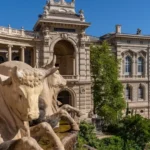
The most important sculptural feature of Palais Longchamp became the monumental Triumph of the Durance, created by Jules Cavelier. The group stands around ten metres high. At its centre is a female personification of the River Durance, accompanied by allegorical figures representing grapes and wheat, symbols of the prosperity brought by water to the land and its inhabitants. The entire group rides upon a chariot drawn by four powerful Camargue bulls, while water pours out between the figures and tumbles down the monumental cascade.
Espérandieu did not create Palais Longchamp entirely on his own. Several well-known sculptors contributed to its decoration. Alongside Jules Cavelier, important elements were created by Eugène-Louis Lequesne, who was responsible for, among other things, the tritons blowing conch shells and some decoration of the central pavilion.
At the entrances, meanwhile, you can see groups of animals by the celebrated Antoine-Louis Barye. In 1869, he created four compositions depicting scenes including a lion attacking a mouflon, a tiger with a doe, a lion killing a wild boar and a tiger with a gazelle. As a result, Palais Longchamp became something resembling an enormous open-air sculpture gallery.
After seven years of intensive work, Palais Longchamp was finally completed. Construction ended in 1869, with financial restrictions influencing the pace of the final stages. The ceremonial inauguration took place in August 1869, and the monument was opened to residents the following day. The date was not accidental, as it coincided with the feast day of Emperor Napoleon III.
Thirty years after the symbolic laying of the first stone, Marseille finally had the monument it had been waiting for.
The great fountain is the most spectacular part of Palais Longchamp
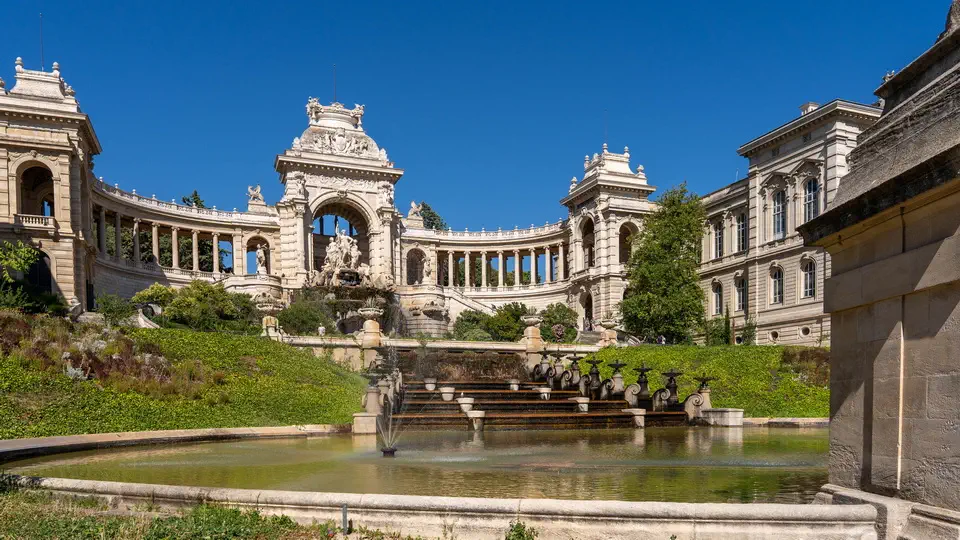
Palais Longchamp made the greatest impression on me when seen from Boulevard Longchamp. From here, the building looks rather like the set of a monumental opera. Semicircular colonnades extend along both sides, a tall central pavilion rises between them, and in front of it water tumbles down a series of cascades into an enormous basin. Water, of course, is the most important element of the whole composition.
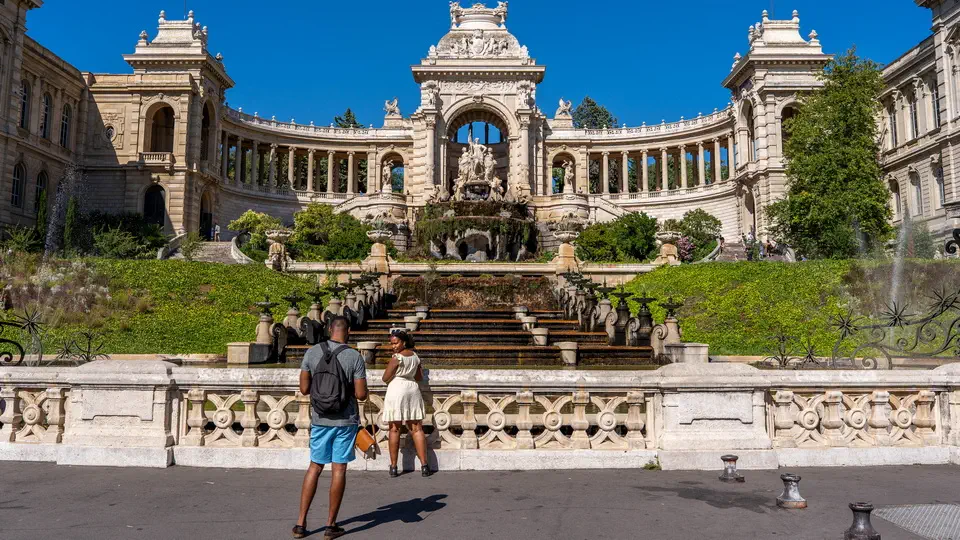
At the centre stands the monumental fountain by Jules Cavelier, symbolising the arrival of the waters of the Durance in Marseille. The sculptural composition includes three female figures and powerful bulls, creating an extremely theatrical scene filled with rocks, animals, falling water, enormous columns and wide staircases.
On a sunny day, the pale stone almost seems to glow while the water reflects the palace façade. If you enjoy photography, you can easily spend quite a while here because the whole complex changes appearance as you move around it. I particularly liked the side staircases leading towards the colonnade, as only when you get closer do you realise just how many details have been incorporated into the façades.
Palais Longchamp is actually home to two museums
One of the things I like most about Palais Longchamp is that it is not simply a monument to admire from the outside. Both of its wings contain museums.
Musée des Beaux-Arts – Museum of Fine Arts
The left wing of Palais Longchamp houses the Musée des Beaux-Arts, or Museum of Fine Arts. It is the oldest museum in Marseille. Its origins go back to the beginning of the nineteenth century, while its collections focus primarily on painting, sculpture and graphic art from the seventeenth to nineteenth centuries.
If you enjoy classical European art, it is well worth going inside. Importantly, the permanent collection is currently free to visit, although temporary exhibitions may have their admission charges and some rooms can occasionally be closed for technical reasons. These are precisely the sort of museums I like most. You can wander in spontaneously, look around a few galleries and decide for yourself whether you want to stay for half an hour or three hours.
Muséum d’Histoire Naturelle – Natural History Museum
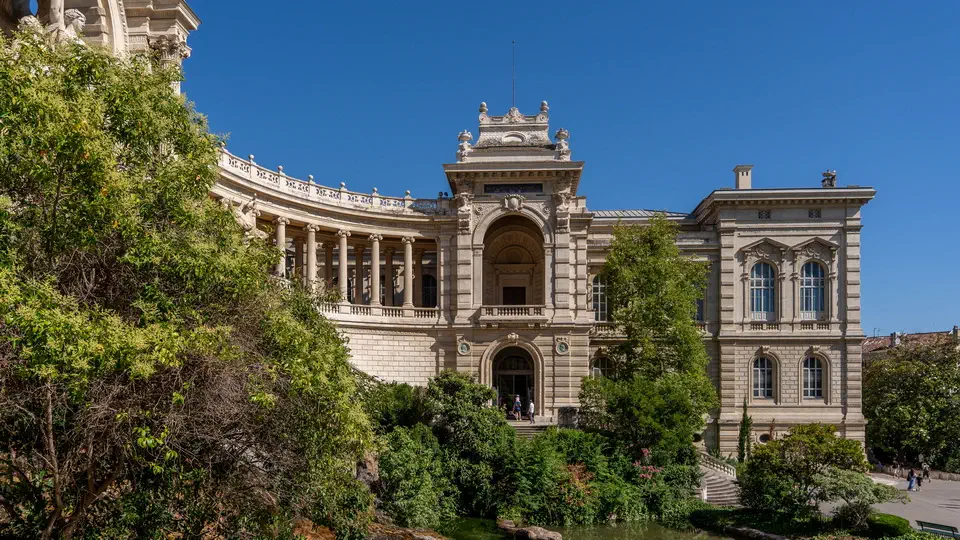
On the opposite side stands the Muséum d’Histoire Naturelle de Marseille, which offers an entirely different experience. Its collections cover zoology, botany, geology and natural history, while some of the exhibits have their origins in old cabinets of curiosities.
If you are travelling with children, this is the museum I would choose first out of the two. It reminds me slightly of the natural history museums we have visited in New York and Oxford, although obviously on an entirely different scale. Another advantage is the price, as the permanent collections are currently available free of charge.
Other attractions at Palais Longchamp that are well worth seeing
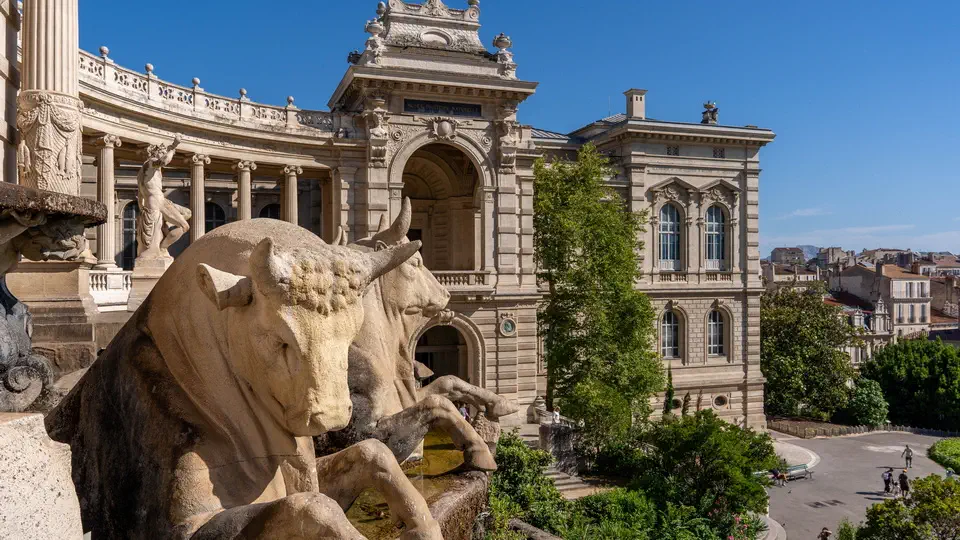
- Parc Longchamp – One of the most common mistakes visitors make is looking at the fountain, taking a photograph and then returning the same way. Don’t do that. Walk beneath the colonnade and continue around the palace. Behind the buildings lies Parc Longchamp, one of the most pleasant green spaces in this part of Marseille. It is certainly not an enormous park like El Retiro in Madrid, but after several hours spent walking around noisy, sun-baked Marseille, the difference is very noticeable. You can sit in the shade, have some water and, for a little while, forget that you are in one of France’s largest cities. The park also hides a rather unusual history, which brings us to the next point.
- The former Palais Longchamp Zoo – For more than a century, the park contained a zoological garden. The zoo opened in 1855 and continued operating until 1987. Today the animals are gone, but fragments of the original infrastructure remain. You can still find old pavilions and enclosures, including a distinctive building once associated with the giraffes. It gives the park a slightly strange atmosphere. You are walking peacefully among the trees when suddenly you come across a structure that very obviously does not resemble an ordinary park pavilion. Once you know the history of the site, all these odd details begin to make sense. Interestingly, after their deaths, some animals from the former zoo eventually entered the collections of the Natural History Museum in one of the palace wings. In a rather peculiar way, their story came full circle.
- Astronomical Observatory – If you have a little more time, it is also worth paying attention to the nearby Observatoire de Marseille. The history of astronomical observation in Marseille is considerably older than Palais Longchamp itself, and today the site performs an important educational role. Astronomy activities, observations, and presentations are organised here. I would not treat the observatory as an essential stop during a short first visit to Marseille, but if you are travelling with children fascinated by space, or simply enjoy astronomy yourself, it is worth checking the current programme before you visit.
Palais Longchamp – practical information for your visit
- How much time should you allow for Palais Longchamp? – If you only want to see the façade and fountain and take a short walk through the park, allow roughly an hour. In my opinion, however, that would be rather a shame. I would set aside around 2–3 hours for a relaxed visit. This allows you enough time to explore the entire complex, sit in the park and visit at least one of the museums. If you are interested in both museums and like to explore exhibitions thoroughly, Palais Longchamp can easily fill half a day.
- Is Palais Longchamp worth visiting with children? – I definitely think it is worth bringing children here. They may not be quite as enthusiastic about nineteenth-century architecture as adults, but the fountains, park, and Natural History Museum make up for it. It is also a perfect place to take a break between other attractions. Marseille can become extremely hot in summer and, after several hours of exploring the city centre, every patch of greenery begins to feel like a personal gift from fate.
- How do you get to Palais Longchamp? – Palais Longchamp is located in the Cinq-Avenues district, slightly east of central Marseille. Public transport is the easiest option. There are tram stops nearby as well as the Cinq Avenues – Longchamp metro station. You can also get here by car, but when sightseeing in Marseille I would not recommend driving separately to every attraction. Traffic, parking and one-way streets can rapidly remove much of the pleasure from exploring the city.
- Opening hours and tickets – You need to distinguish between the park itself and the museums, which operate according to their schedules. The museums are generally open from Tuesday to Sunday and closed on Mondays, subject to certain public-holiday exceptions. The standard opening hours given for the Musée des Beaux-Arts are currently 9:00 am–6:00 pm. Permanent collections in both museums are currently free. Before travelling, I would always check the latest information on the museums’ official websites, as opening hours, temporary exhibitions and access to individual galleries may change.
Other attractions in Marseille
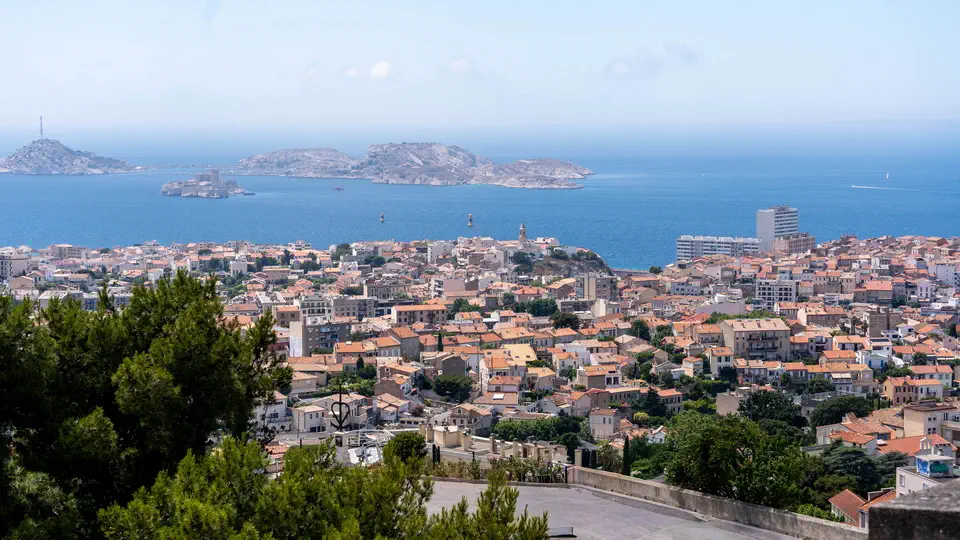
Palais Longchamp lies slightly outside Marseille’s most touristy waterfront area, so I would treat it as a separate part of your sightseeing itinerary. If you have several days in Marseille, you can easily combine it with places we have already described on Get Ready For Adventure.
Beside the sea, I would definitely visit MUCEM and Fort Saint-Jean. Nearby stands the impressive La Major Cathedral, while only a little farther away you will find Cosquer Méditerranée and its reconstruction of the famous prehistoric Cosquer Cave.
I would leave Notre-Dame de la Garde for a separate part of the day. The view from the hill is one of those panoramas that genuinely makes the effort of getting there worthwhile.
A few words to sum things up
I find it rather surprising that when people first search for things to see in Marseille, Palais Longchamp often loses out to the Old Port, Notre-Dame de la Garde or MUCEM. Of course, I understand why. The sea is Marseille’s greatest magnet and I also tend to begin exploring the city at the waterfront, but Palais Longchamp reveals an entirely different side of Marseille.
What I liked most was the paradox behind the place. You look at something resembling a royal residence, only to discover that all this magnificence was created to celebrate the moment when water was finally brought into the city. Yet for the inhabitants of nineteenth-century Marseille, that water was worth considerably more than another palace. It protected the city from shortages, improved living conditions and allowed Marseille to continue developing.
Once you look at Palais Longchamp in this way, its fountains, waterfalls, and sculptures stop being mere decoration. They become the story of one of the most decisive moments in Marseille’s history, while the place itself remains simply beautiful. If I had to choose one attraction to add to an itinerary after seeing the essential sights of Marseille, Palais Longchamp would be very high on my list.
Incidentally, while exploring Marseille, I spent some of my quieter moments between trips reading a rather good book – one of the novels from Jacek Piekara’s I, Inquisitor series. It turned out to be a surprisingly enjoyable read even for someone who considers himself quite a devoted fantasy fan. If you are looking for good books to take on longer journeys, it is always worth packing something capable of making several hours on a train, plane, or ferry pass a little faster.
Palais Longchamp and its legends and mysteries

Palais Longchamp does not have as many ancient legends as Marseille’s medieval castles or churches. However, when I began looking more closely into the history of the place, I quickly realised that it does not really need ghosts invented several centuries ago. The former zoo, abandoned cages, artificial grottoes, hidden water reservoir and old astronomical observatory already create a sufficiently unusual atmosphere.
Importantly, some stories now repeated as the mysteries of Palais Longchamp have very real historical origins.
- The palace that is actually an enormous water tower – The first mystery is hiding in plain sight. Palais Longchamp looks like a grand aristocratic residence, yet it was never built as somewhere for anyone to live. Its monumental architecture primarily concealed infrastructure associated with bringing water from the Durance to Marseille. The central pavilion served as a château d’eau, essentially a reservoir and distribution point for water arriving through the Canal de Marseille. All this splendour was therefore a vast monument celebrating the triumph of engineering over drought. Once I discovered that, I began looking at the fountains very differently. They are not simply decorative features; practically every element of the central composition refers to the water that transformed life in Marseille.
- The hidden grotto and the sleeping women of Palais Longchamp – One of the most mysterious parts of the entire complex is the nymphaeum concealed within the central monument. It contains an artificial grotto and two caryatids with their eyes closed. These are not random decorations; they symbolise underground waters. If you see them without knowing their meaning, it is effortless to invent your story. The stone women look as though they are sleeping inside the palace, waiting for somebody to wake them. I have not found a reliable source confirming a genuine local legend about the sleeping women of Longchamp, so I would not present such a tale as an authentic Marseille tradition. The symbolism itself, however, is real and certainly fires the imagination. You might even say that the architect deliberately created a small mythological world devoted to water beneath the palace.
- Are there mysterious tunnels beneath Palais Longchamp? – Stories occasionally appear about an extensive network of underground passages beneath Palais Longchamp, although this is where it is worth restraining the imagination slightly. I have found no convincing evidence for some vast secret tunnel system running from beneath the palace through Marseille. There is, however, something that may well have inspired such stories. Palais Longchamp formed part of an enormous water system. The Canal de Marseille carried water from the Durance into the city, while the monument’s central section was associated with storing and distributing it. Channels, reservoirs, technical installations and parts of the structure inaccessible to ordinary visitors may sound considerably less romantic than secret tunnels, but they are very real.
- Ghosts of the former zoo – If I had to choose the most unsettling part of Palais Longchamp, it would not be the palace itself. I would head towards the former zoo. Animals were kept here for more than a century, right up until 1987, and old cages, enclosures and pavilions once used for giraffes, elephants, bears, and predators have survived. During the day there is nothing particularly frightening about them. The park is green and filled with walkers and children, but knowing what these structures were originally used for gives them a rather different atmosphere.
- Dead animals did not always leave Longchamp – When animals from the zoo died, some of their bodies were sent to taxidermists before eventually entering the collections of the Muséum d’Histoire Naturelle de Marseille next door. Some specimens later viewed by museum visitors therefore came quite literally from the zoological garden behind the building. I have to admit, there is something rather macabre yet fascinating about that. An animal could live in a cage only a few dozen metres from the museum, die, and then return to Longchamp as a preserved scientific specimen. It is one of those stories that really does not need any legendary embellishment.
- A palace filled with symbols that are easy to miss – Palais Longchamp was designed almost like an enormous story carved into stone. Throughout the monument you can find personifications of rivers, figures associated with fertile land, animals, and symbols of water. The outer sections of the arch even display the names of tributaries of the Durance, including the Verdon, Ubaye, Bléone and Buëch. The central fountain is equally deliberate. Its composition tells the story of water from the Durance bringing fertility, prosperity, and life. This is why I recommend not rushing through Palais Longchamp. From a distance, you see an impressive fountain; up close, you begin reading the building almost like a book.
- Is Palais Longchamp haunted? – Eventually, any building of this age seems to attract questions about ghosts. I looked for reliable accounts of apparitions and could not find a well-documented traditional legend claiming that Palais Longchamp is genuinely haunted. Various stories can be found online, but repeating them as fact would not make much sense. Personally, I do not think Palais Longchamp needs invented ghosts. It already has the abandoned cages of a former zoo, preserved animals that once lived only a few dozen metres away, an artificial grotto containing stone figures symbolising underground water, enormous hydraulic installations hidden behind a façade resembling a royal palace and an astronomical observatory nearby from which people have been looking into the night sky since the nineteenth century. For me, that is considerably more interesting than yet another white lady walking through a wall at precisely midnight.
Palais Longchamp facts, information and interesting details
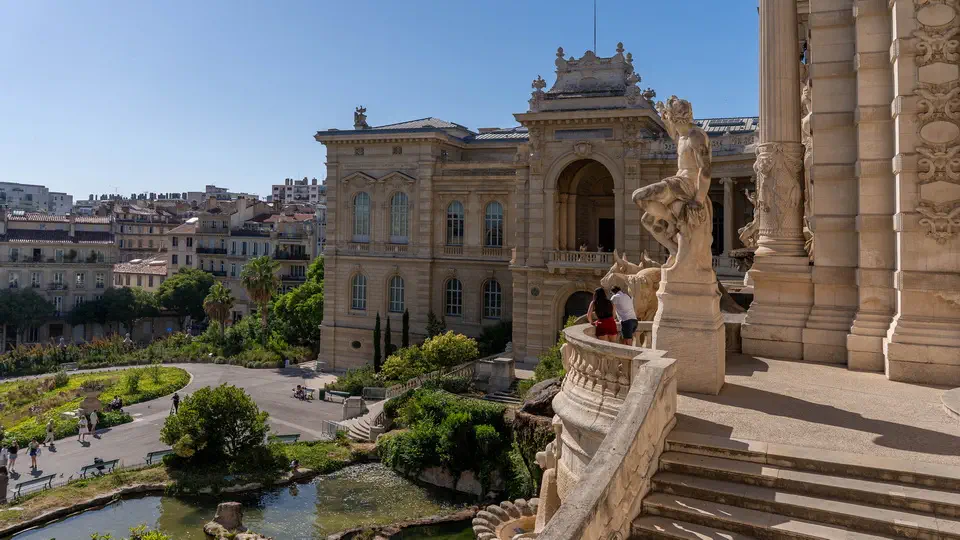
- Palais Longchamp was never built as a royal residence. Its name can be misleading because nobody constructed it as a home for a monarch or an aristocratic family. The complex was created above all to commemorate the arrival in Marseille of water from the River Durance.
- Water was the real reason the entire monument was constructed. Nineteenth-century Marseille was growing rapidly and required far greater quantities of clean water. Palais Longchamp became the monumental culmination of the enormous Canal de Marseille engineering project.
- The palace was completed in 1869. It is therefore relatively young compared with France’s medieval monuments, although the scale and grandeur of its architecture make it seem considerably older. In the same year, the Natural History Museum’s collections were installed there.
- The architect was Henri-Jacques Espérandieu. This is a name worth remembering when exploring Marseille. The same architect played a critical role in the construction of Notre-Dame de la Garde, which is why a similar taste for monumental architecture can be seen in several places around the city.
- The development of the entire complex took many years. It was certainly not a quick municipal project. Constructing the monumental château d’eau, museums, colonnades and surrounding complex required years of work before Palais Longchamp was finally completed in 1869.
- The central section of Palais Longchamp is a monumental château d’eau. In simple terms, behind the palace-like façade lies an extraordinarily elaborate monument to water infrastructure. Once I learnt that, the entire building looked entirely different to me.
- The two wings contain two very different museums. On the left is the Musée des Beaux-Arts, or Museum of Fine Arts, while on the right stands the Muséum d’Histoire Naturelle, the Natural History Museum.
- The Musée des Beaux-Arts is one of Marseille’s oldest museums. Its collections focus mainly on European painting and sculpture from the sixteenth to nineteenth centuries, including works by French, Italian, Flemish and Dutch artists.
- The permanent collections of both museums can currently be visited free of charge. This is one of the things I particularly liked about Palais Longchamp. You can simply walk in for a brief visit without having to wonder whether buying a ticket is worthwhile if you only have limited time.
- The Natural History Museum is older than Palais Longchamp itself. The institution was founded in 1819 and moved into its present home at Palais Longchamp in 1869. In 2019, it therefore celebrated both its 200th anniversary and 150 years at the palace.
- A real zoo operated in the park for more than 130 years. The zoological garden existed from 1855 until 1987 and was one of the earliest major institutions of its kind outside Paris.
- Remains of the old zoo can still be seen today. Not all the cages and pavilions were removed after it closed. While walking through the park, I came across structures that suddenly reminded me that exotic animals once lived here. One of the surviving buildings is associated with the former giraffe enclosure.
- Some zoo animals ended up in the museum after they died. This is one of the strangest stories connected with Palais Longchamp. Certain specimens held by the Natural History Museum originated from animals that had previously lived in the zoological garden just behind the palace.
- In 2013, animals symbolically returned to the old cages. When Marseille became European Capital of Culture, colourful fibreglass animal sculptures were placed around the former zoo. Some remained in the park afterwards.
- Parc Longchamp covers almost eight hectares. Considering its relatively central location in Marseille, it provides a sizeable area of greenery with lawns, mature trees, playgrounds, and places ideal for resting or having a picnic.
- The park has two noticeably different sections. One is associated with the former zoological garden, while the other has a more botanical character. This is another reason to venture beyond the main fountain and explore the whole area.
- There is also an astronomical observatory at Longchamp. The Marseille Observatory adds yet another dimension to the complex and is further proof that Longchamp is much more than a decorative palace with an impressive fountain.
- The fountain was not designed simply for decoration. The entire monumental composition symbolises water bringing life and prosperity to Marseille. This is why the water cascading down the terraces remains the most important element of the whole design.
- Palais Longchamp continues to host cultural events. The park is not merely a historic monument. Concerts, municipal events, festivals, and gatherings take place here, while residents also use Longchamp as an ordinary green space in which to relax.
- For me, the greatest curiosity is the contrast between the building’s appearance and its purpose. Standing in front of Palais Longchamp, I saw colonnades, monumental staircases, sculptures, and waterfalls worthy of a royal residence. Yet all of it was created primarily as a monument to bringing water into the city. That is precisely why I consider Longchamp one of Marseille’s most unusual landmarks.