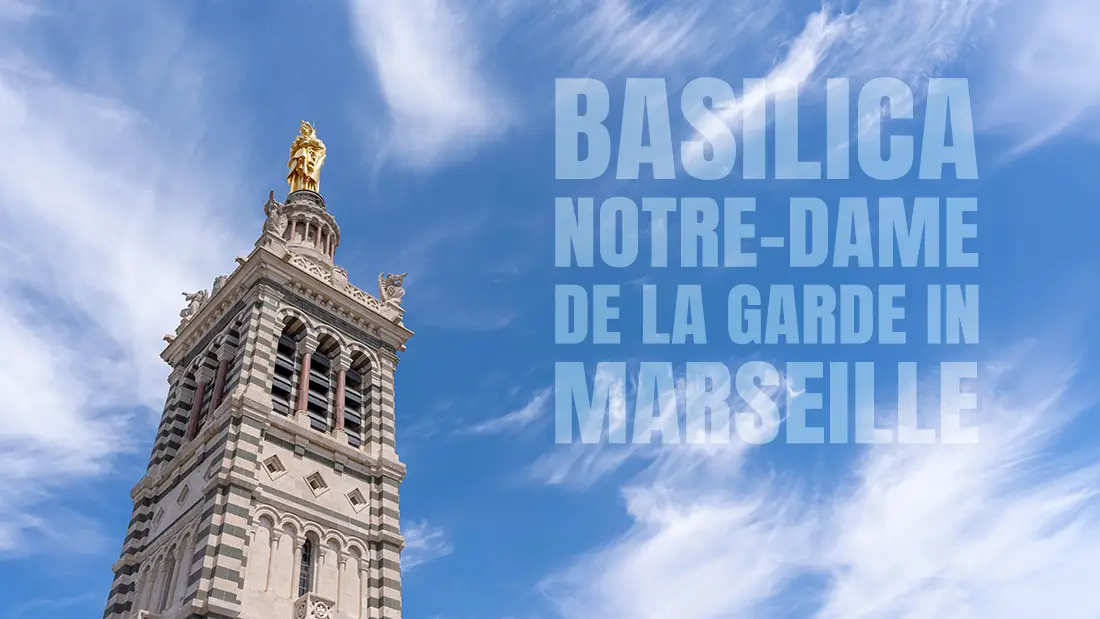
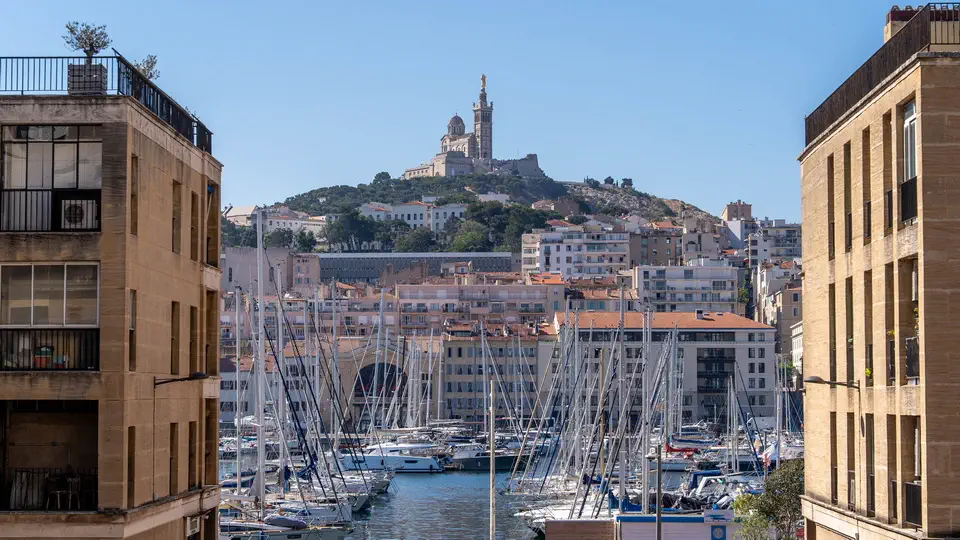
When exploring Marseille, it is actually quite difficult to get completely lost, because high above the city, perched on a rocky hill, stands the Basilica of Notre-Dame de la Garde. Like a lighthouse guiding ships towards the coast, it serves as a landmark for anyone trying to find their bearings. You can see it from the harbour, from streets running along the coast, from rooftops and from countless viewpoints around Marseille. It towers above the city, while the golden statue of the Virgin Mary at the top of the bell tower shines so brightly in the Mediterranean sun that it is almost impossible not to notice.
The first time I looked up at the basilica from below, I had the impression that someone had deliberately placed it in the most theatrical location they could possibly find in Marseille. As it turns out, however, its position is far from accidental. For centuries, La Garde hill served as an observation point and a defensive position before eventually becoming one of the city’s most important places of worship. Even if churches are not usually high on your sightseeing list, Notre-Dame de la Garde is still worth visiting. I would happily climb here again simply for the view over Marseille.
Notre-Dame de la Garde the symbol of Marseille and its history
The people of Marseille call the basilica La Bonne Mère, or the Good Mother, and that nickname says quite a lot about the importance of this place to the city. For generations, the Virgin Mary of Notre-Dame de la Garde has been regarded as the protector of Marseille, its residents, fishermen and, above all, sailors heading out into the Mediterranean. The basilica stands on La Garde hill, around 154 metres above sea level, which allows it to quite literally dominate the skyline.
When I was visiting Mucem and Fort Saint-Jean earlier on my trip, the distinctive silhouette of Notre-Dame de la Garde kept appearing somewhere in the background. The same thing happens around Vieux-Port. After a while, you automatically start using the basilica as a landmark, and I suspect this is precisely how generations of Marseille residents have regarded it.
The monumental basilica we see today is relatively young, but the history of the hill goes back much further. Because of its position, La Garde was an obvious place from which to observe the coastline. Ships approaching Marseille could be spotted long before they entered the harbour, and an observation post continued to operate here in various forms for centuries. The site retained a military role, in one form or another, well into the twentieth century.
The first small chapel dedicated to the Virgin Mary was built on the hill in 1214, supposedly by a priest named Pierre. Over the following centuries, the site became an increasingly popular destination for pilgrims, while at the same time retaining its strategic importance.
In the sixteenth century, the political situation in Europe was, to put it mildly, far from peaceful. Marseille faced the possibility of attack from the sea, so King Francis I of France decided to strengthen the city’s defences. Construction of a fort on La Garde began in 1524. Together with Château d’If, it was intended to protect the approaches to Marseille.
Interestingly, fragments of those old fortifications can still be seen today, and the basilica partly stands on them. If you look carefully at the northern side of the complex, you may spot a salamander – the emblem of Francis I. I love details like this because they suddenly remind you that you are not simply looking at a nineteenth-century church. Instead, you are standing in a place where several entirely different layers of Marseille’s history have been built one on top of another.
Construction of the present-day Notre-Dame de la Garde Basilica
By the nineteenth century, the old chapel at the top of the hill had simply become too small. The number of pilgrims continued to grow, so the decision was made to replace it with a much larger church. The foundation stone of the present basilica was laid on 11 September 1853, and the design was entrusted to architect Henri Espérandieu. The church was consecrated on 5 June 1864.
This was a period of enormous change in Marseille. Grand public buildings were being constructed, streets and port infrastructure were being transformed, and the city was increasingly eager to emphasise its growing importance. The monumental La Major Cathedral in Marseille was built during roughly the same period, and I would definitely recommend visiting it either on the same day or during another walk through the city. The two churches occupy entirely different settings, but architecturally there are plenty of similarities between them.
Notre-Dame de la Garde was built in the Romanesque-Byzantine style. If you have already seen La Major, you will probably notice some familiar elements straight away: alternating bands of coloured stone, arches, domes, mosaics and richly decorated interiors. From the outside, the basilica is immediately recognisable thanks to its stripes of pale and darker stone, while the entire building is dominated by the tall bell tower crowned by an enormous gilded statue of the Virgin Mary.
The statue itself is around 11.2 metres high. Mary faces towards the sea and holds the infant Jesus in her arms, almost as though she were presenting him to the city and the wider world. From street level, the statue looks considerably smaller. It is only when you realise its actual dimensions that you begin to appreciate the scale of the entire building and the challenge faced by the people who constructed it.
Visiting Notre-Dame de la Garde Basilica in Marseille
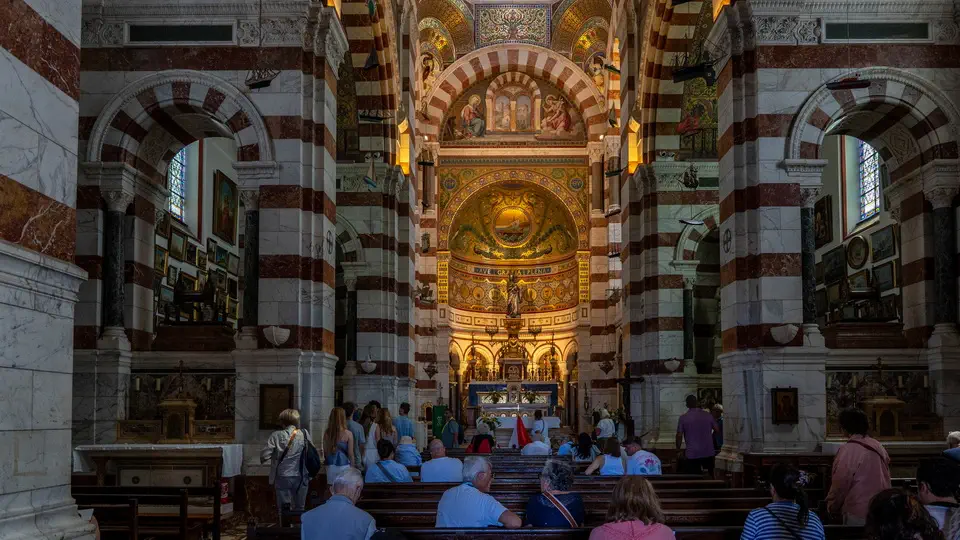
I actually liked the interior more than the façade. This is certainly not an austere or minimalist church; quite the opposite. Inside, there is gold, colour, marble and an extraordinary amount of beautiful mosaic work. Once you look upwards, it becomes difficult to decide where to focus your attention. Golden decoration covers the vaults, elaborate mosaics fill the spaces between them, while the arches are built from stone in contrasting colours.
If you enjoy photographing church interiors, be prepared to spend quite a lot of time walking around with your head tilted upwards. The basilica is divided into two principal sections: the lower church, or crypt, and the upper sanctuary dedicated to the Virgin Mary.
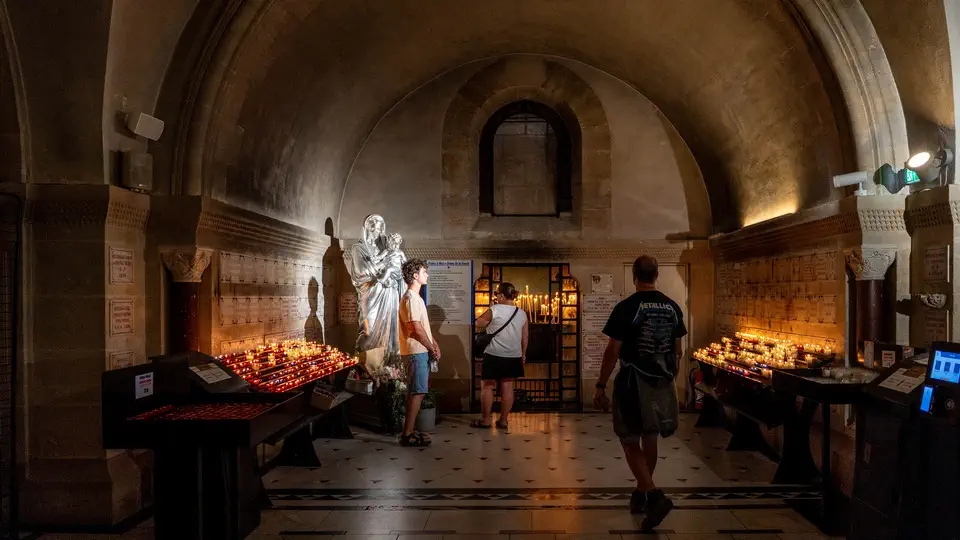
After the splendour of the upper church, the crypt can come as something of a surprise. It is far more restrained, darker and considerably quieter. You will not find anything like the same amount of gold and mosaic decoration as upstairs. I actually enjoyed this contrast enormously. One moment you are surrounded by a spectacular ceremonial interior glowing with colour, and a few minutes later you descend into a much more intimate and subdued space.
It is worth remembering, however, that Notre-Dame de la Garde remains an active place of worship. During Mass or other religious ceremonies, access to some sections of the basilica may be restricted.
One feature that is definitely worth examining more closely is the collection of ex-votos. These are offerings left in gratitude for help received or prayers believed to have been answered. At Notre-Dame de la Garde, many are naturally connected with the sea. You will see model ships suspended from the ceiling, paintings depicting maritime disasters and plaques expressing, thanks.
This is the point where you begin to understand why La Bonne Mère means considerably more to Marseille than an ordinary historic monument. For centuries, sailors came here to pray before setting out to sea, and after returning safely they would climb the hill again to give thanks. In a city that depended for generations on its port, fishing and maritime trade, it is hardly surprising that such a powerful tradition developed.
I was particularly fascinated by the model ships hanging from the ceiling. Inside a church, they initially look slightly out of place, and at first glance you might assume that they are simply decorative references to Marseille’s maritime character. They are not. Many are genuine ex-votos donated by sailors. For me, they are among the most interesting objects inside Notre-Dame de la Garde because they connect the religious history of the basilica directly with the history of the city.
The basilica has three bells, but by far the most impressive is the enormous Marie-Joséphine bourdon, weighing more than eight tonnes. Whenever I come across figures like that, I try to imagine what transporting something of this size up the hill must have involved during the nineteenth century. Today we have powerful lorries, cranes and proper roads. Back then, an operation like this was a major logistical undertaking that could easily fill an entire chapter in the history of the basilica’s construction.
Notre-Dame de la Garde in Marseille and what to see outside
I could talk for a long time about the mosaics, history and ex-votos, but I would be lying if I did not mention what impressed me most during my visit to Notre-Dame de la Garde: the view over Marseille.
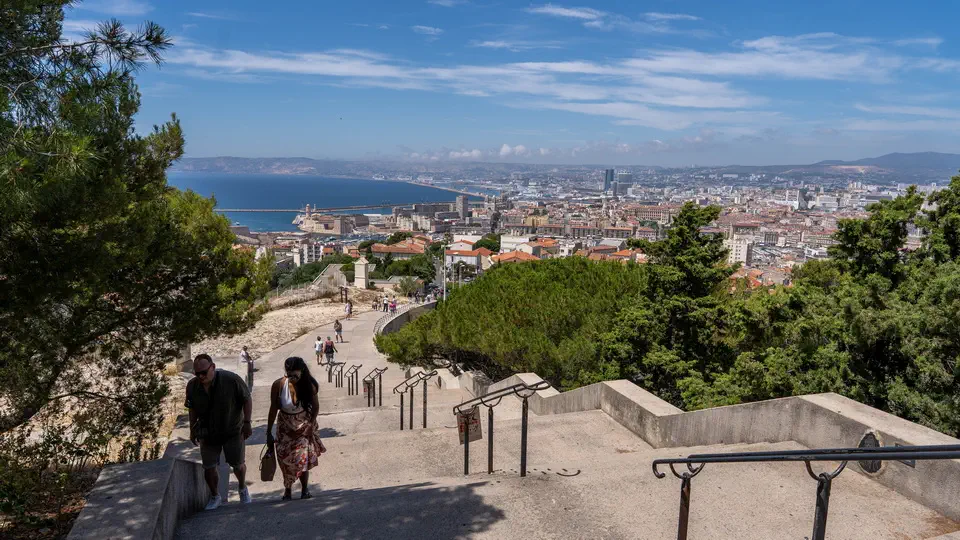
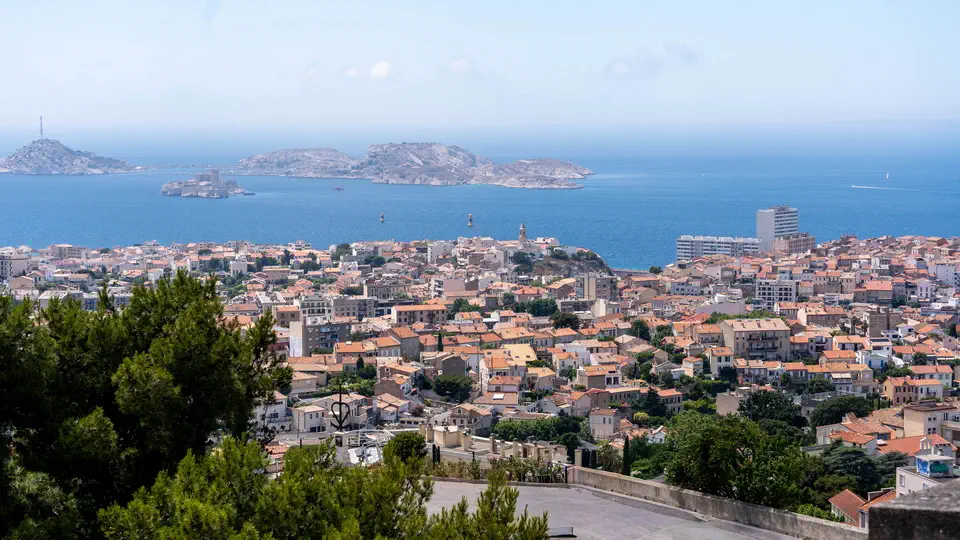
In my opinion, the terraces surrounding the basilica provide some of the finest viewpoints anywhere in the city. You have an almost complete 360-degree panorama. Looking towards the centre, you can clearly see Vieux-Port and Marseille’s densely packed buildings. Beyond them stretch the commercial port, the Mediterranean, Château d’If and the Frioul Islands. In the opposite direction are residential districts and the hills surrounding Marseille. It is only from up here that you really begin to appreciate just how large the city is.
On a clear day, the Frioul archipelago and Château d’If are easy to spot. From this height, the island looks surprisingly small, and it is difficult to believe that such a modest fortress became one of Marseille’s most recognisable landmarks thanks to The Count of Monte Cristo. The sea around the islands can be an extraordinarily intense shade of blue and, on a sunny day, the panorama looks more like a postcard than one of France’s largest cities.
Notre-Dame de la Garde in Marseille practical information for visiting the basilica
Below I have collected a few pieces of information and practical tips which I think will be useful when visiting Notre-Dame de la Garde. The most important piece of good news is that entry to the basilica is free. According to information available from Marseille’s tourist authorities, the sanctuary is generally open every day from 7:00 am until 6:00 pm. I would still check the opening hours shortly before visiting, particularly if you are planning to come during a public holiday or an important religious celebration.
Notre-Dame de la Garde is an active place of worship, so access to parts of the church may be restricted during Mass. Visitors are also expected to dress appropriately and remain quiet in areas reserved for prayer. Animals are not allowed inside the sanctuary complex.
If I were visiting Notre-Dame de la Garde again, there are several things I would do the same way. First, I would come either in the morning or towards the evening. In the middle of a summer day it can become extremely hot, and there is not a great deal of shade on the terraces. I would also bring plenty of water, particularly if walking up.
I would not rush away immediately after seeing the church either. The views from the terraces are a major part of the experience, and it would be a shame to treat them simply as somewhere to take a single photograph before leaving. It is also worth walking around the entire basilica and looking at Marseille from every side. Most visitors understandably concentrate on the panorama over Vieux-Port, but the views towards the coast and surrounding hills are every bit as interesting.
How to get to La Garde hill
During summer, I would not recommend walking up to Notre-Dame de la Garde at midday. Of course you can do it, but why make life unnecessarily difficult? The climb is fairly steep in places, and the Marseille sun can be brutal.
If I wanted to walk, I would choose the morning or late afternoon. You also get much better light for photographs at those times. Towards evening in particular, the panorama looks superb as the light becomes warmer and Marseille’s rooftops begin to take on golden tones.
If you enjoy exploring cities on foot, I would definitely recommend walking at least once. From Vieux-Port, the journey takes roughly 45 minutes, depending on your pace and how often you stop along the way. The final section, however, climbs quite steeply.
Personally, I would treat the walk as part of the sightseeing rather than simply a way of reaching the basilica. Walking slowly through neighbourhoods above the harbour gives you an opportunity to see a very different side of Marseille from the one around the main tourist attractions.
If you have no desire to climb uphill, a much easier option is bus number 60. It runs towards the basilica from areas including Mucem and Vieux-Port, and stops practically below the steps leading to the sanctuary. In my opinion, this is one of the best options during summer, particularly if you are travelling with children or older relatives.
Marseille also has its characteristic little tourist train, the Petit Train. Route 1 runs from Vieux-Port to Notre-Dame de la Garde, passing several interesting places along the way, including Fort Saint-Jean, Fort Saint-Nicolas, Palais du Pharo and Saint-Victor Abbey.
Normally, I am not a giant fan of tourist trains, but in Marseille it actually makes a certain amount of sense. The city is hilly, and once temperatures rise above 30°C, even the most enthusiastic walker can suddenly lose the ambition to conquer every attraction on foot.
You can also drive close to the basilica. The problem is parking. There are relatively few spaces, and during summer or at weekends they can fill up rapidly. If you are already using public transport to explore Marseille, I would personally leave the car alone and take the bus. Driving through central Marseille can provide exactly the kind of excitement I do not particularly need while on holiday.
How much time should you allow?
You could rush through the church itself in half an hour, but I do not really see much point in doing that. I would allow around one to one and a half hours for Notre-Dame de la Garde.
That allows you enough time to see the upper church and crypt, examine the ex-votos, admire the mosaics and walk around the terraces to look at Marseille from every direction. If you are also planning to visit the museum, it is worth adding extra time.
Notre-Dame de la Garde Museum
The complex also contains a museum dedicated to the history of the hill, the basilica, and Marseille itself. Its collections include more than 2,000 documents, photographs and objects, displayed across two floors. If you have only one day in Marseille, I would not describe the museum as essential. If you are particularly interested in the history of the city, however, it is certainly worth a look.
Notre-Dame de la Garde with children
If I were visiting with children, I would choose either the bus or the Petit Train. Younger travellers are likely to enjoy the panoramic views, the enormous golden statue on the tower and the model ships hanging inside the church. A long uphill walk during the summer heat, on the other hand, could rapidly destroy the mood of the entire family.
I know that a kilometre or a kilometre and a half can look completely harmless on a map. Marseille quickly teaches you that one kilometre uphill is an entirely different unit of measurement from one kilometre on flat ground.
Notre-Dame de la Garde and other attractions in Marseille
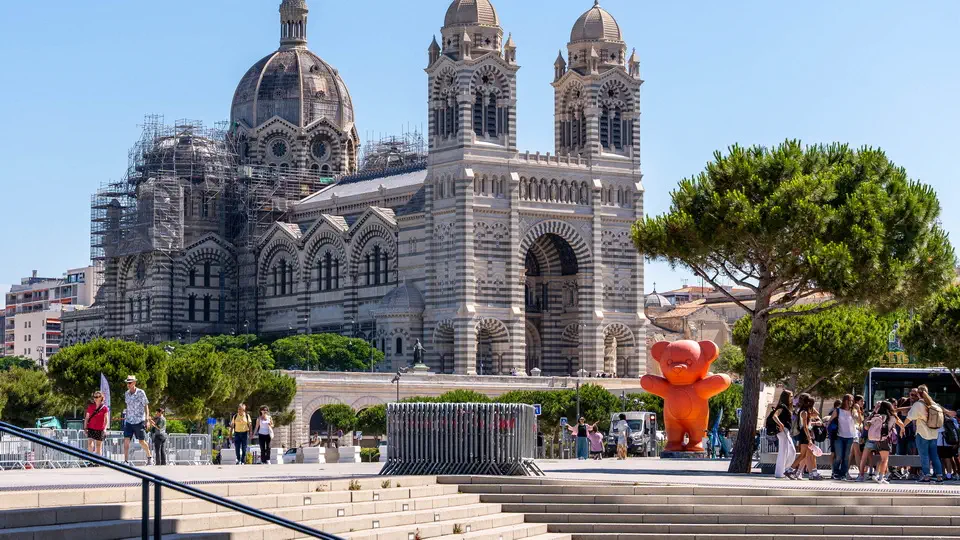
If you are planning your Marseille itinerary, Notre-Dame de la Garde can easily be combined with several other attractions. The most logical route leads through Vieux-Port before continuing towards the waterfront. This is where you will find Mucem and Fort Saint-Jean, which in my opinion are among the most interesting places in Marseille. Nearby stands the monumental La Major Cathedral, another place well worth adding to your itinerary.
If you preferred something wholly different from churches and museums, I would also recommend the Cosquer Cave replica in Marseille. This was one of those attractions that initially struck me as perhaps a little too touristy, but turned out to be much more interesting and impressively executed than I expected.
Legends, mysteries and unusual stories connected with Notre-Dame de la Garde in Marseille

There is something about Notre-Dame de la Garde that cannot be reduced entirely to dates, architectural styles and lists of historic features. As I walked through the interior and looked at the little ships hanging from the ceiling, I realised that practically every one of them must hide a story.
Occasionally that story can still be reconstructed from documents. In other cases, all that remains is a family tale about a storm, an illness, or an accident from which someone supposedly survived thanks to the protection of the Good Mother. And perhaps this is where you can best see the difference between an ordinary historic building and a place around which legends have accumulated for hundreds of years. Below are a few of the stories that I found particularly interesting.
La Bonne Mère – the Good Mother who watches over Marseille
The most important legend surrounding the basilica is also the foundation of its extraordinary position within the city. The people of Marseille call Notre-Dame de la Garde La Bonne Mère – the Good Mother. According to a centuries-old tradition, the Virgin Mary of the sanctuary overlooking the city protects Marseille and, in particular, people connected with the sea: sailors, fishermen and their families.
This connection is not simply a modern story created for tourists. Notre-Dame de la Garde is still widely regarded as the protector of Marseille’s sailors, fishermen, and residents.
Ships hanging from the ceiling – gifts of gratitude for survival
When visiting Notre-Dame de la Garde, look upwards, and you will see model ships hanging beneath the vaults. At first glance, they might look like decorations chosen to suit the character of a port city. In reality, many of them are ex-votos, offerings left in gratitude for help or deliverance. Some of the most moving stories associated with Notre-Dame de la Garde are connected with these objects.
Many depict vessels caught in storms or maritime disasters. Others are scale models of ships whose crews eventually returned safely to port. An old Marseille tradition went something like this: when a storm became so violent that survival seemed unlikely, sailors would pray to Notre-Dame de la Garde and make a promise. If they survived, they would carry an offering to the sanctuary after returning home.
Sailors climbing the hill barefoot
One of the most evocative old stories concerns sailors who, after surviving a storm at sea, supposedly climbed to the chapel barefoot, carrying a handmade model of their ship. Historical accounts describe similar practices. Nineteenth-century travellers visiting the sanctuary commented on the extraordinary number of small ships hanging from the ceiling and on the incredibly strong relationship between the sanctuary and Marseille’s maritime community.
It is not difficult to imagine such a return. A ship enters port with broken masts, its crew exhausted and perhaps convinced only hours earlier that they would not survive the night. Then the French coastline appears, followed by La Garde hill rising above Marseille. Once ashore, someone builds a model of the vessel and carries it up to the sanctuary.
Pirates, corsairs, and sailors’ prayers
Today, the Mediterranean is associated mainly with holidays, beaches, ferries, and cruise ships. For centuries, however, it was a considerably more dangerous place. Ships faced threats not only from storms but also from pirates and corsairs. Old accounts connected with the sanctuary mention offerings left by people who believed that the Virgin Mary had saved them not only from shipwreck but also from attack.
Nineteenth-century descriptions portrayed Notre-Dame de la Garde as a sanctuary filled with offerings from sailors grateful for escaping terrible wrecks or violence at the hands of corsairs. Today, such stories sound almost like scenes from an adventure novel. Several centuries ago, they were part of everyday maritime life.
The mysterious salamander of Francis I
If you examine the surviving sections of the old fortifications carefully, look out for a salamander. It was the emblem of King Francis I, during whose reign the defences on La Garde hill were strengthened in the sixteenth century.
The salamander itself carried fascinating symbolism. Medieval and Renaissance legends credited the creature with the ability to survive in fire and, according to some traditions, even extinguish flames. Francis I used it as a symbol of resilience and strength. In other words, this is not simply a random lizard carved into an old wall; it is effectively a royal signature left behind on La Garde.
Are there secret tunnels beneath the basilica?
As with many great churches standing on former fortifications, Notre-Dame de la Garde has accumulated stories about underground passages, sealed rooms and secret military corridors. I have not, however, found reliable evidence supporting the more dramatic tales about a vast network of hidden tunnels stretching from the hill to other parts of Marseille.
This is a good example of how urban legends develop. You have an old fort, massive walls, a crypt, and a place with many centuries of history. Add a little imagination and a secret underground tunnel practically invents itself. That does not mean there are no old underground spaces associated with the fortifications beneath the complex. It simply means we should be careful not to turn intriguing possibilities into historical facts.
The greatest mystery of Notre-Dame de la Garde
For me, however, the greatest mystery of Notre-Dame de la Garde has nothing to do with underground tunnels or hidden chambers. It is about the people. As you walk through the interior, you see hundreds of traces left by people who have been dead for generations. A small ship hanging from the ceiling may mean that several centuries ago somebody survived a night at sea they probably should not have survived. A painting showing a storm might be the final surviving record of a crew whose ship’s name has long since been forgotten.
A small marble plaque bearing a simple Merci might represent the most important event in someone’s entire life. The ex-votos show how devotion to Notre-Dame de la Garde extended far beyond the immediate city. Even today, people come here to ask for help or to give thanks.
You do not have to share their faith to appreciate the atmosphere of this place. Personally, I see Notre-Dame de la Garde above all as an enormous archive of human hope, fear, and gratitude. And it is precisely these stories that make La Bonne Mère far more interesting than simply a beautiful church occupying the best viewpoint in Marseille.
Notre-Dame de la Garde in Marseille facts, information and interesting details
- Notre-Dame de la Garde stands on a hill approximately 154 metres high. This allows the basilica to dominate Marseille and makes it visible from many parts of the city, harbour, and sea. From the hill, you can enjoy a panorama taking in central Marseille, the Frioul Islands, Château d’If and a large section of the coastline.
- The people of Marseille call the basilica La Bonne Mère, or the Good Mother. This is much more than an affectionate nickname. Notre-Dame de la Garde has been regarded for generations as the protector of Marseille, its sailors, fishermen, and people whose lives are connected with the sea.
- The first chapel on the hill was built as early as the thirteenth century. A place of worship existed here from 1214, more than six centuries before the present basilica was completed. The religious history of La Garde hill is therefore considerably older than the monumental building standing there today.
- La Garde hill served as an observation point for centuries. Its location made it possible to monitor the sea and spot ships approaching Marseille. Remarkably, the site’s observation function continued in various forms until 1978.
- The basilica stands on the remains of an old fortress. In the sixteenth century, King Francis I ordered La Garde hill to be fortified as part of efforts to improve Marseille’s defences. Fragments of those fortifications remain visible today, making Notre-Dame de la Garde both a religious monument and a place connected with the city’s military history.
- The present basilica dates from the nineteenth century. The monumental church was constructed during a period of major transformation in Marseille and completed in 1864. At the time, numerous grand public buildings were being erected to reflect the growing importance of the port city.
- Notre-Dame de la Garde was built in the Romanesque-Byzantine style. Domes, multicoloured stone, gilding and extensive decorative mosaics are among its most characteristic features. As a result, the interior looks very different from many of France’s more austere churches.
- The golden statue of the Virgin Mary at the top is around 11.2 metres high. From the streets below it appears much smaller, but its actual dimensions are impressive. Standing on top of the tall tower, it has become one of the most recognisable elements of Marseille’s skyline.
- The Virgin Mary faces the sea rather than looking towards the infant Jesus. The composition is deliberately symbolic. Mary appears to present the child to the world while at the same time looking towards Marseille’s harbour and the Mediterranean.
- The golden statue needs to be restored periodically. Its surface is gilded, but exposure to intense sunshine, wind, and salty Mediterranean air gradually damages the finish, which means the gold covering has to be renewed from time to time.
- Model ships hang inside the basilica. They are not ordinary decorations. Many are ex-votos donated by sailors giving thanks for surviving storms, shipwrecks or particularly dangerous voyages.
- Some ex-votos are model aircraft. Over time, the tradition of leaving votive offerings expanded beyond sailors and fishermen. Models of aircraft have also been left by pilots, particularly following wars or dangerous incidents in the air.
- The ex-votos form a kind of historical record of everyday life in Marseille. Alongside model ships, you can find paintings, letters, plaques and other objects connected with illnesses, accidents, and escapes from danger. Together they reveal the fears and hopes of generations of local people.
- The collection of ex-votos eventually spread beyond the main church. So many offerings accumulated over the centuries that they began to appear in other parts of the complex, including the crypt. This gives some idea of just how important the sanctuary became.
- Notre-Dame de la Garde offers an almost 360-degree view. From the terraces, you can see not only historic central Marseille but also the harbour, Frioul Islands, Château d’If, coastline and the hills surrounding the city. In my opinion, it is one of the best viewpoints in all of Marseille.
- You can walk from Vieux-Port to the basilica in around 45 minutes. The distance is not particularly great, but the final section climbs noticeably uphill. During summer, walking in the middle of the day can be exhausting, so morning or late afternoon is a better option.
- Bus number 60 runs to the basilica. It is a very convenient solution if you do not fancy walking uphill. The bus stops close to the steps leading towards the sanctuary and is one of the easiest ways to reach La Garde.
- You can also reach the hill on Marseille’s Petit Train tourist train. The route starts near Vieux-Port and passes several important sights along the way, including Fort Saint-Jean, Fort Saint-Nicolas and parts of Marseille’s waterfront.
- Entry to the basilica itself is free. Considering that Notre-Dame de la Garde is one of Marseille’s most important attractions, this is excellent news. You can visit the interior, admire the mosaics and ex-votos and enjoy the viewing terraces without purchasing an admission ticket.
- Notre-Dame de la Garde is one of Marseille’s most recognisable symbols. Its silhouette can be seen from Vieux-Port, Mucem, Fort Saint-Jean and the Frioul Islands. For residents, it is far more than a historic monument: it is a landmark and an important part of Marseille’s identity.