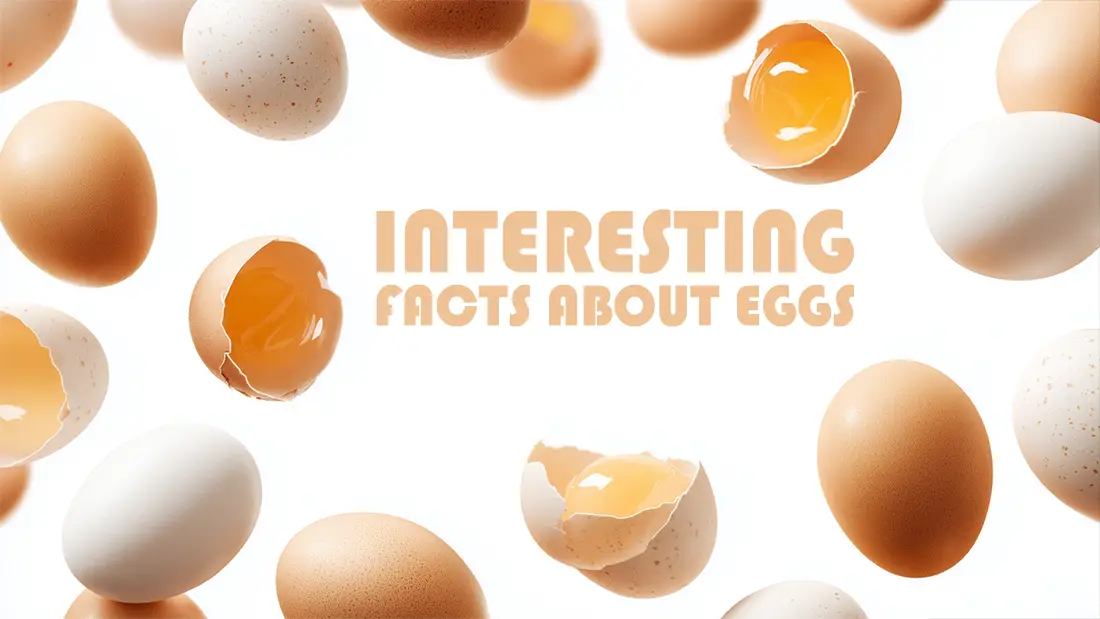
Interesting facts about eggs are another part of our series of articles exploring the objects, phenomena, and creatures that surround us.
An egg looks rather unremarkable. It is small, fragile, usually white or brown and so ordinary that, while making breakfast, we rarely stop to think about what we are actually holding in our hand. Yet beneath the shell lies a surprisingly complex biological ‘package’, designed by nature to protect developing life for many days.
Interesting facts about eggs – 100 surprising facts you probably didn’t know
Eggs have been part of the human diet for thousands of years. We boil, fry and bake them, and use them to make mayonnaise, pasta, cakes, sauces and desserts. They have also found their way into religion, art, superstition, language, and even scientific experiments and Guinness World Records.
Interestingly, even something as familiar as a hen’s egg is surrounded by plenty of myths. A brown egg is not necessarily healthier than a white one, a darker yolk does not automatically mean a better-quality egg, and a small blood spot certainly does not mean that a chick has started developing inside. Below, I have collected 100 interesting facts about eggs, covering everything from their biology and structure to cooking, history, records and a special section prepared for children.
Interesting facts about eggs and their remarkable structure
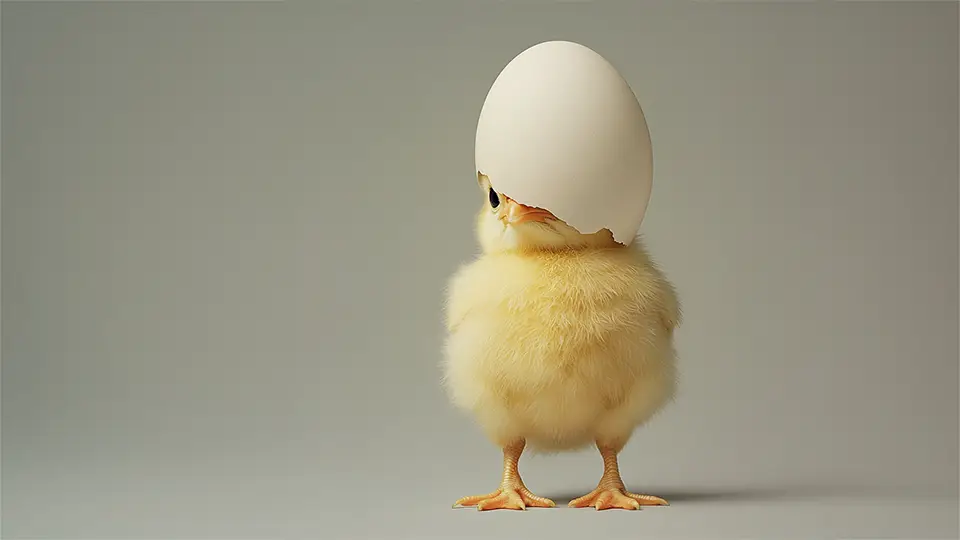
- An eggshell is not completely sealed. Looking at a hen’s egg, you might imagine that its shell forms a solid, ceramic-like barrier. In reality, it contains an enormous number of microscopic pores, which allow gases to pass between the inside of the egg and the surrounding air.
- An egg ‘breathes’. This is, of course, a simplification, but it describes the process quite well. Oxygen, carbon dioxide and water vapour pass through the pores in the shell, which is particularly important in fertilised eggs because a developing embryo needs oxygen.
- Most of the shell is made from calcium carbonate. A hen’s eggshell consists primarily of calcium carbonate. This mineral makes it strong enough to protect the contents while remaining fragile enough for a chick eventually to break through.
- The colour of the shell depends mainly on the breed of hen. A white egg does not come from an inferior hen, just as a brown egg is not naturally more organic or nutritious. Shell colour is primarily a genetic characteristic associated with the breed, and there are no significant nutritional differences between white and brown eggs.
- Naturally blue and green eggs really do exist. Not every hen lays white or brown eggs. Certain breeds, including the Araucana, can produce shells in shades of blue and green. This is not the result of dyeing; the pigment is produced naturally by the bird’s body.
- The colour of the shell tells us nothing about the colour of the yolk. You can crack open a snow-white egg and find an intensely orange yolk inside, or experience exactly the opposite. Wholly different factors determine these two characteristics.
- The colour of the yolk depends mainly on what the hen eats. The more yellow and orange pigments there are in the bird’s diet, the deeper the colour of the yolk can become. Maize and other natural plant pigments in the feed can make a considerable difference.
- A dark yolk does not always mean a ‘farm-fresh’ egg. This is one of the most common myths surrounding eggs. An orange yolk may indeed come from a hen that has been free to forage for grass and insects, but a similar colour can also be achieved by carefully adjusting the bird’s feed.
- The white strings attached to the yolk are completely natural. These twisted structures are called chalazae. Their job is to keep the yolk roughly in the centre of the egg. They are particularly visible in fresh eggs and gradually become less pronounced as the egg ages.
- The yolk is not always positioned exactly in the centre. In a fresh egg, the chalazae help to hold it there, but as time passes the white becomes thinner and the structures supporting the yolk weaken. In an older egg, the yolk may therefore sit closer to the shell.
- Fresh egg white can look cloudy. This may appear suspicious, but it is often a good sign. The white of a very fresh egg can be slightly milky or cloudy, becoming increasingly transparent as the egg ages.
- There is an air cell inside an egg. You will usually notice it at the wider end of a hard-boiled egg. It forms as the egg cools after being laid and gradually grows larger because moisture escapes through the shell while more air enters.
- The older the egg, the larger its air cell becomes. This is why older eggs are more likely to float in water. It does not automatically mean that the egg has gone bad, because the familiar water test tells us far more about an egg’s age than its safety.
- A blood spot does not mean a chick has started developing. Small red or brown spots occasionally visible on the yolk are usually caused by the rupture of a tiny blood vessel during ovulation. They do not indicate that the egg has been fertilised.
- An egg can contain two yolks. Double-yolk eggs are more common in young hens whose reproductive systems have not yet settled into a completely regular rhythm. Two yolks may then be released and enclosed within a single white and shell.
- Eggs without yolks also occur. They are much rarer and usually very small. In the past they were sometimes called ‘cock eggs’, because people had no idea how they were formed. In reality, they result from a disturbance in the egg-forming process.
- A hen can lay an egg without a cockerel. A male bird is not required for hens to produce the eggs we eat. A cockerel is only necessary when the egg is to be fertilised and potentially develop into a chick.
- An egg takes many hours to form. Although a good laying hen can produce almost one egg per day, the process certainly does not take just a few minutes. Forming the yolk, white, membranes and shell is complex and occupies a substantial part of the day.
- Hens begin laying before they are six months old. Depending on the breed and conditions in which they are kept, the first eggs usually appear at around five months of age, although the exact timing varies from bird to bird.
- A productive laying hen can produce several hundred eggs a year. Under favourable conditions, efficient breeds may lay around 250–300 eggs annually. It is an impressive figure, particularly when you consider how many minerals are required simply to produce all those shells.
Interesting facts about eggs in the kitchen
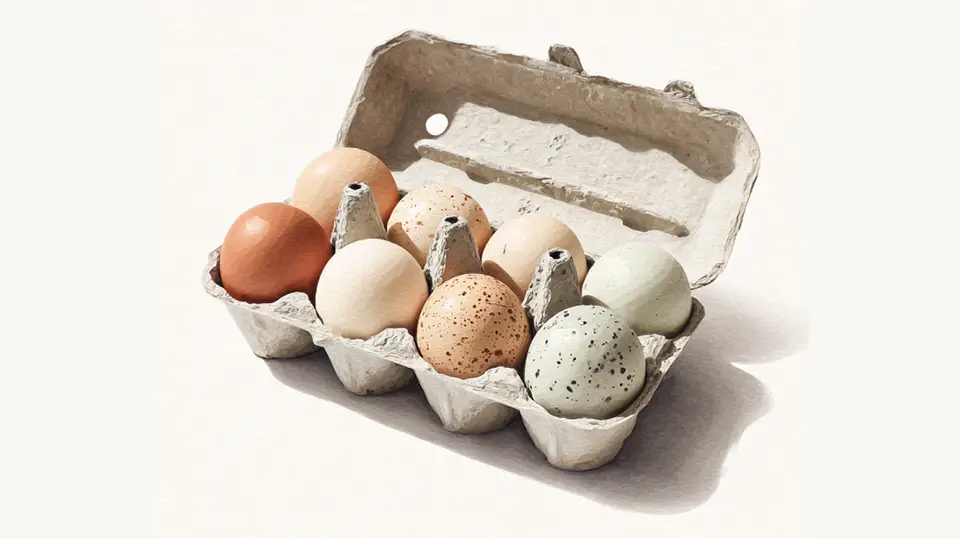
- Eggs are among the most versatile foods in the kitchen. They can be boiled, fried, baked, whipped, pickled and dried. Eggs thicken sauces, bind meat mixtures, aerate sponge cakes and make it possible to create emulsions such as mayonnaise.
- Mayonnaise owes its texture to egg yolk. Oil and water normally refuse to mix properly. Lecithin in the yolk acts as an emulsifier, however, allowing the two to combine into a stable, thick mixture.
- Egg white can increase enormously in volume. Whisking introduces millions of tiny air bubbles into it. Proteins surround and stabilise those bubbles, creating the light foam used for meringues, soufflés, and sponge cakes.
- Fat makes egg whites more difficult to whip. Even a tiny amount of yolk in the bowl can significantly affect the result. This is why it is worth separating eggs carefully and using clean utensils when whisking whites.
- A little acid can help stabilise whipped egg whites. A few drops of lemon juice or a small amount of cream of tartar can make the foam more stable. It is one of those small kitchen tricks that genuinely works.
- A greenish ring around the yolk does not mean an egg has gone bad. A grey-green layer sometimes appears around the yolk after an egg has been cooked for too long. It results from a reaction between sulphur and iron compounds and, although it may look unappetising, it does not in itself indicate spoilage.
- Hard-boiled eggs are often easier to peel after they have been stored for a few days. The shell of a very fresh egg can cling stubbornly to the membrane beneath it. As the egg ages, changes inside make the shell easier to remove.
- Temperature has an enormous effect on the consistency of an egg. The white and yolk contain different proteins, which set at different temperatures. This is why it is possible to prepare an egg with fully cooked white but a beautifully runny yolk.
- You can cook an egg without boiling water. All you need is the right temperature maintained for a suitable length of time. This principle is used in sous-vide cooking, where both the white and yolk can be prepared with remarkable precision.
- A poached egg does not need its shell. The raw egg is cracked directly into hot water, where the white sets around the yolk and creates its own natural covering. The finished result can look extremely elegant, although first attempts often resemble a rather unfortunate white jellyfish.
- Vinegar can help when making poached eggs. A small amount of acid lowers the pH of the water and encourages the white to set more quickly. This makes it easier for the egg to retain a compact shape rather than spreading throughout the saucepan.
- A raw egg spins differently from a boiled one. Try spinning both on a table. A cooked egg turns much more smoothly because its inside has become an almost solid mass, whereas the liquid white and yolk inside a raw egg keep moving and interfere with the rotation.
- Egg is a natural culinary ‘glue’. When heated, its proteins coagulate and bind other ingredients together. This is why eggs are commonly added to meatballs, stuffing, pâtés and baked dishes.
- Eggs help give baked goods a golden finish. Brushing pastry or bread with beaten egg before baking creates an attractive shine and rich colour. The exact result varies depending on whether you use a whole egg, yolk alone or just the white.
- Yolks and whites perform different jobs in baking. Yolks contribute fat and emulsifiers, while whites provide much of the structure. Changing the proportion of eggs in a recipe can therefore completely alter the texture of the finished bake.
- Eggs can also be turned into powder. The food industry uses dried eggs as well as liquid egg products in commercial baking, confectionery, ready-made sauces and many foods produced on a giant scale.
- Pasta can contain a surprising number of eggs. Some traditional Italian recipes for fresh pasta use roughly one egg for every 100 grams of flour. The yolks give the dough its characteristic colour, flavour, and elasticity.
- Eggs can be pickled. Particularly popular in Britain and the United States, pickled eggs are stored in vinegar with herbs and spices. Their flavour is certainly distinctive and will not appeal to everyone.
- Chinese ‘century eggs’ are not actually a hundred years old. Pidan are usually made by preserving duck, chicken, or quail eggs in an alkaline mixture for a period measured in weeks or months. The name sounds considerably more dramatic than the real process.
- Eggs appear in countless dishes around the world. French omelettes, Spanish tortillas, Japanese tamagoyaki, North African shakshuka, Turkish menemen and British Scotch eggs show just how differently the same basic ingredient can be used.
Interesting facts about eggs, history, and culture
- People ate eggs long before they began keeping chickens. Our ancestors collected the eggs of wild birds thousands of years before agriculture developed. They were relatively easy to obtain and provided a valuable source of nutrition.
- Domestic chickens descended from wild birds in Asia. One of the most important ancestors of the modern domestic chicken is believed to be the red jungle fowl, which still lives in South and South-East Asia.
- For thousands of years, the egg has symbolised life. It is not difficult to understand why. A seemingly lifeless, sealed object can suddenly produce a living creature, and to ancient people this must have seemed an extraordinarily powerful image.
- The idea of a cosmic egg appears in many mythologies. Different cultures developed stories in which the world, the universe, or the gods emerged from a great egg. Similar concepts can be found in traditions from ancient India and China as well as among some European peoples.
- The egg became an Easter symbol long before chocolate eggs existed. Its meaning was associated with rebirth and new life, and over time it became closely connected with Christian celebrations of Easter.
- Decorated Easter eggs are far older than modern dyeing kits. The tradition of decorating eggs has a very long history and was practised throughout many parts of Europe. In Poland, numerous regional styles and techniques developed over the centuries.
- Not every decorated Easter egg is made in the same way. Eggs can be painted, scratched, covered with paper or rushes, or decorated using wax-resist techniques. Regional differences are enormous and form an exceptionally rich folk tradition.
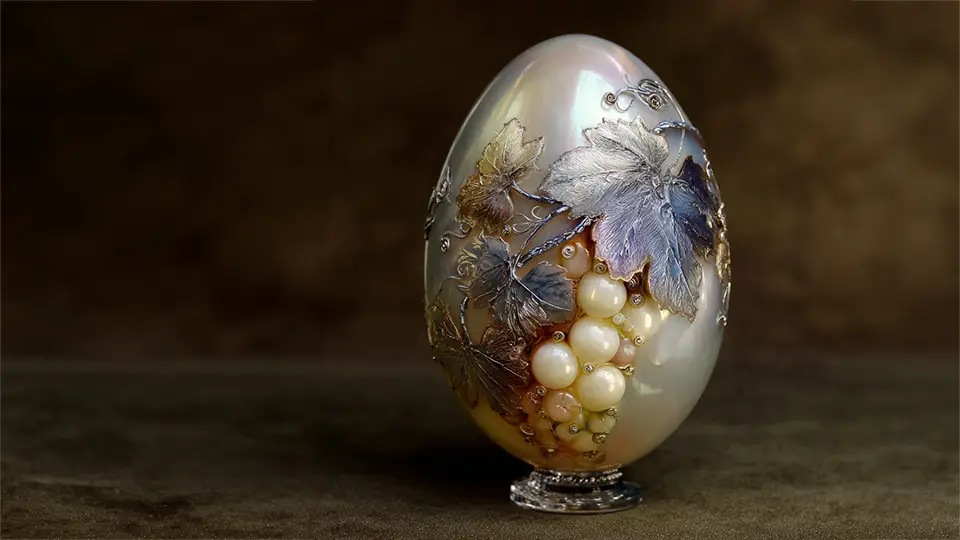
- Fabergé turned eggs into some of the world’s most famous works of jewellery. Russian jeweller Peter Carl Fabergé created magnificently decorated eggs for the Imperial family. Their interiors often concealed elaborate miniature surprises.
- Original Fabergé eggs are now worth fortunes. These are far more than simply elaborate golden ornaments. The finest examples rank among the world’s most valuable pieces of decorative art and are held by major museums and important private collections.
- Eggs have found their way into countless sayings. English alone gives us expressions such as ‘walking on eggshells’, ‘putting all your eggs in one basket’ and, of course, the famous question, ‘Which came first, the chicken or the egg?’ It shows just how deeply the ordinary egg has become embedded in language.
- The chicken-and-egg question is much older than the internet. Philosophers were discussing the problem in antiquity. Modern evolutionary biology adds another interesting element: eggs existing hundreds of millions of years before the first chickens appeared.
- Biologically speaking, the egg came first. Egg-laying animals existed long before birds. If, however, we specifically mean the first ‘chicken egg’, it would have been laid by an animal almost identical to a chicken, from which the first true chicken eventually hatched.
- Eggs once had particular significance during religious fasting. At different points in Christian history, restrictions associated with Lent included eggs as well as meat and other animal products. One consequence was the accumulation of eggs around the Easter period.
- Eggs used to be much more seasonal. Modern lighting, selective breeding and controlled farming conditions allow production to continue throughout the year. In the past, daylight hours and the changing seasons had a far greater influence on egg laying.
- Eggs have been used in painting for centuries. In egg tempera, yolk acts as the binder that holds pigment together. The technique was widely used by artists for hundreds of years before oil paint became dominant.
- Some medieval paintings literally contain egg. This does not, of course, mean that whole yolks are hidden beneath the surface. Components of eggs were mixed into the painting medium and could become extraordinarily durable once dried.
- Eggs have even been used in historical construction. Organic substances, including egg whites, were sometimes added to mortars and plasters in different parts of the world. They were never a basic building material, but could be included as additives intended to alter the properties of the mixture.
- Throwing eggs became a form of public protest. Eggs are relatively cheap, break easily and create a tremendous mess, which is why they have long been thrown during demonstrations or at public figures. For the person being hit, the result is usually more humiliating than dangerous.
- The Egg of Columbus represents an ingeniously simple solution. According to a famous story, Christopher Columbus managed to stand an egg upright by slightly crushing one end. The historical truth of the tale is uncertain, but the expression survived as a description of a solution that seems obvious only after somebody demonstrates it.
- Eggs appear in art more frequently than you might imagine. One particularly famous example can be found in a painting by Piero della Francesca, where an ostrich egg hangs above the figures. Its precise meaning is still debated by art historians.
Extraordinary facts, records, and myths about eggs
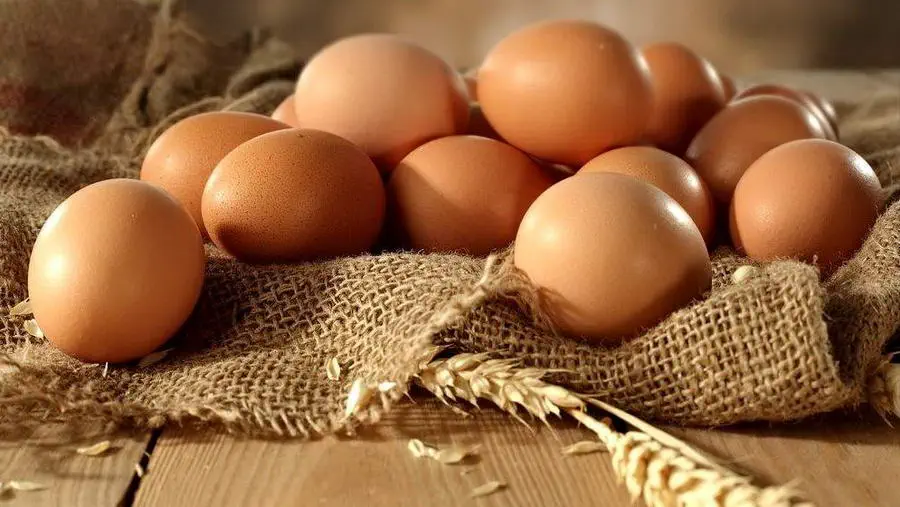
- Chickens are not the only birds whose eggs people eat. Duck, goose, quail, and ostrich eggs are also used in cooking. In different parts of the world, eggs from other bird species may be eaten as well, although collecting the eggs of many wild species is illegal.
- The ostrich lays the largest egg of any living bird. A single egg can weigh more than a kilogram and has a volume roughly equivalent to several dozen ordinary hen’s eggs.
- The largest egg is not necessarily the largest proportionally body size. The ostrich wins in absolute terms, but its egg is relatively small compared with the enormous mass of the adult bird.
- The kiwi produces a gigantic egg in relation to its body. A female kiwi can lay an egg representing a remarkably large proportion of her total body weight, making it one of the most extreme examples of parental investment in a single egg among birds.
- An ostrich egg takes a very long time to boil. Eight or ten minutes will certainly not do the job. Hard-boiling an entire ostrich egg may take around an hour and a half.
- An ostrich eggshell is remarkably strong. It has to withstand considerably more pressure than the thin shell of a hen’s egg. Once emptied, the shells are often used to make ornaments, vessels and decorative carvings.
- Eggs do not all have to be oval. Their shapes vary from species to species. Some are almost spherical, others elongated, while still others taper noticeably at one end.
- The shape of an egg may help birds that nest on cliffs. More pointed eggs have a tendency to roll in a tight circle when disturbed rather than travelling in a straight line. For birds nesting on narrow rocky ledges, this can provide an important safety advantage.
- Birds are not the only animals that lay eggs. Fish, amphibians, reptiles, insects, spiders and countless other organisms reproduce this way as well. From an evolutionary perspective, the hen’s egg is simply one version of a biological invention that is vastly older than chickens themselves.
- Some mammals lay eggs. The platypus and echidnas belong to a group of mammals known as monograms and lay eggs instead of giving birth to live young. Being a mammal does not therefore automatically mean giving birth.
- Dinosaurs laid eggs too. Fossilised dinosaur eggs and nesting sites have been discovered in many parts of the world. This should perhaps not surprise us because modern birds are descended from one branch of the dinosaurs.
- Some dinosaurs brooded their eggs in ways that resembled modern birds. Fossils have been discovered with adult animals positioned directly above their nests. This is one of many pieces of evidence showing that behaviour we associate with modern birds has remarkably ancient evolutionary roots.
- The world produces an enormous quantity of eggs. Annual production is now measured in tens of millions of tonnes, the overwhelming majority of which are chicken eggs. This shows just how important eggs remain as a food product worldwide.
- Asia is the world’s largest egg-producing region. It accounts for the greatest share of global production. Its enormous population combined with a highly developed poultry industry allows the region to dominate international statistics.
- China is one of the world’s largest producers of eggs. The scale of production there is enormous and far exceeds that of most other countries. Eggs are also important ingredients in numerous Chinese dishes.
- Egg production has increased dramatically over the past few decades. Developments in poultry farming, specialised breeds, controlled lighting and improved nutrition mean that modern production is many times higher than it was in the middle of the twentieth century.
- Brown eggs can be pricier without being any better. Some breeds that lay brown eggs are larger and require more feed. Historically, this could make production pricier, while consumers gradually began associating the higher price with superior quality.
- Egg washing is handled differently in Europe and the United States. Commercial eggs in the US are normally washed and then kept refrigerated. In many European countries, a different system is used, with greater emphasis placed on preserving the shell’s natural protective coating.
- This is why eggs in European supermarkets are often displayed outside the fridge. To someone accustomed to American supermarkets, this can look rather strange. The difference results mainly from the different ways eggs are prepared for sale and subsequently stored.
- An egg slowly ‘dries out’ as it ages. Water and carbon dioxide escape through the microscopic pores in the shell. The white becomes thinner, the yolk flatter and the air cell larger, which is why a fresh egg and an older egg behave differently when cracked open.
Interesting facts about eggs for children
- A chick does not grow inside every egg. The eggs you buy in an ordinary supermarket will not suddenly turn into chickens. For a chick to start developing, the egg first has to be fertilised.
- A hen does not need a cockerel to lay an egg. A male bird is needed for fertilisation, but the hen can regularly produce eggs without one being present.
- Eggshells have tiny holes. They are far too small to see without magnification, but gases and water vapour can pass through them.
- An egg has its own little ‘safety cushions’. Thin membranes beneath the shell help protect the contents, while a small air cell forms at the wider end.
- The yolk is held in place by something like strings. On either side of it are spiral structures known as chalazae. They look a little like twisted white cords and help keep the yolk where it belongs.
- Eggs can really be blue. Nobody needs to paint them first. Certain breeds of hen naturally lay eggs with blue or greenish shells.
- A brown hen does not always lay brown eggs. Feather colour is not a simple guide to the colour of the shell, which depends mainly on the breed of bird.
- The largest bird egg belongs to the ostrich. A single egg can weigh more than a kilogram. If you wanted to make scrambled eggs with one, you would need a seriously large frying pan.
- One ostrich egg can replace a great many chicken eggs. Depending on its size, it may contain roughly the same amount as several dozen ordinary eggs, producing enough scrambled egg to feed an entire family.
- A hen does not lay a dozen eggs a day. Even the most productive laying hen needs many hours to create a single egg, so an average approaching one egg per day is already an impressive achievement.
- Dinosaurs hatched from eggs. Long before humans appeared, animals walking across the Earth began their lives inside eggs. Palaeontologists have even discovered fossilised dinosaur nests.
- Birds are the living relatives of dinosaurs. When you look at a chicken, you are looking at a very distant descendant of theropod dinosaurs. A hen will not turn into a Tyrannosaurus rex, of course, but the evolutionary connection is real.
- The platypus is a mammal that lays eggs. It sounds like a mistake in a school textbook, but it is true. The platypus has fur and feeds its young with milk, yet its babies still hatch from eggs.
- You can check whether an egg is raw without breaking it. Carefully spin it on a flat table. A hard-boiled egg will rotate smoothly, while a raw one is likely to wobble because the liquid inside continues moving.
- An older egg may float in water. As the egg ages, its air cell grows larger, making it more buoyant. The water test mainly tells you something about age, however, and cannot guarantee whether an egg is safe to eat.
- Egg white does not have to be completely transparent. In a very fresh egg it can look slightly cloudy or milky. This is perfectly natural, and fresh eggs may actually appear less transparent than older ones.
- A green ring around a cooked yolk does not turn the egg into poison. If an egg has been boiled for too long, a greenish layer may appear on the surface of the yolk. It results from a chemical reaction and does not by itself mean that the egg has gone bad.
- You can use an egg for a simple chemistry experiment. Leave a raw egg in vinegar and the acid will gradually react with and dissolve the shell. After a while, you will be left with a soft egg surrounded only by its flexible membrane.
- A shell-less egg can even bounce slightly. After the vinegar experiment, the remaining membrane is surprisingly elastic. If you drop the egg very gently from a small height, you may see it deform and bounce, although dropping it from too high usually turns the experiment into a cleaning job.
- An egg is a small miracle of nature. Beneath its thin shell are water, fats, proteins, vitamins, and minerals and, in the case of a fertilised egg, everything the embryo needs during the early stages of development. It is difficult to find a better example of just how much nature can fit into such a simple package.
Eggs are far more interesting than they look
I have to admit that the more you read about eggs, the harder it becomes to think of them simply as something you crack into a frying pan in the morning. The structure of the shell, the way the yolk is suspended inside and even the gradual changes that take place during storage show just how sophisticated this natural construction really is.
Then there is the history. Humans were collecting wild birds’ eggs long before the first cities appeared; later they began keeping chickens, decorating Easter eggs, placing eggs in myths and symbols, using yolks in painting and eventually producing tens of millions of tonnes of eggs every year.
According to FAO data, global egg production reached around 100 million tonnes in 2024, with chicken eggs accounting for approximately 94 per cent of the total. Perhaps nothing demonstrates better that, despite thousands of years of history, we still have not found a product capable of completely replacing the ordinary egg.
So the next time you are preparing scrambled eggs, take a moment to look at the egg in your hand. Its shell contains thousands of microscopic pores, the yolk is suspended on special little ‘strings’, and the entire design of this tiny capsule has been refined over millions of years of evolution. That is quite a lot going on inside something that is about to end up in a frying pan.