El Jem in Tunisia.
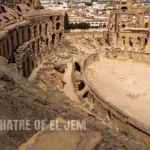
Deep in Tunisia, far from the coastal resorts, lies a place capable of astonishing even those who have already visited Roman monuments in Italy or Spain. I am talking about the Roman amphitheatre of El Jem, one of the best-preserved monuments of the Roman Empire anywhere in the world. When I first stood in front of its monumental walls, I had the feeling that someone had transported a fragment of ancient Rome to African soil.
Although it is sometimes referred to as a Roman theatre, it is actually an enormous amphitheatre, where gladiatorial battles, hunts involving wild animals and spectacles attracting tens of thousands of spectators once took place. Its history is full of mysteries, legends and extraordinary events, which I will explore in this article.
The History of the Roman Amphitheatre of El Jem – How and Why Was It Built?
The story of the amphitheatre of El Jem begins in the 3rd century AD when the present-day town was known as Thysdrus. It was one of the wealthiest cities in the Roman province of Africa. Its prosperity came primarily from the production and trade of olive oil, which was transported to almost every corner of the Roman Empire. As a result, Thysdrus became one of the richest settlements in North Africa.
It was during this period of great prosperity that the decision was made to construct a monumental amphitheatre. The building dates from around AD 238 and was probably commissioned or supported by Emperor Gordian III. Some sources suggest that construction may have been initiated by the local elite associated with Gordian I, who was proclaimed emperor in Thysdrus during the turbulent Year of the Six Emperors.
Why build such an enormous structure? The answer is relatively simple: the inhabitants wanted to demonstrate their importance and wealth. Throughout the Roman Empire, monumental buildings were symbols of prestige, and the more prosperous the city, the more impressive its public buildings were expected to be. The amphitheatre at El Jem was designed to accommodate approximately 30,000–35,000 spectators, making it one of the largest in the entire empire. Only the Colosseum in Rome and the amphitheatre at Capua were larger.
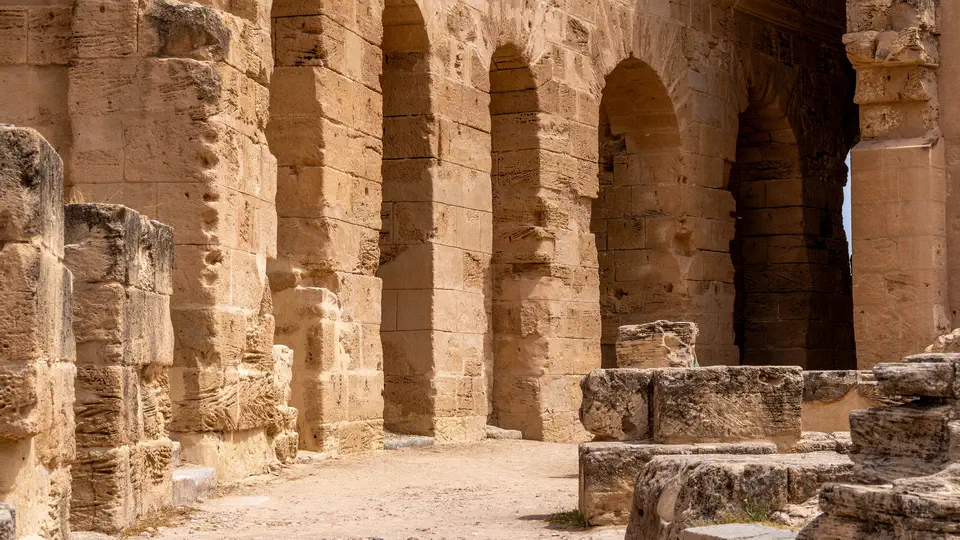
The structure was built almost entirely from blocks of stone. Remarkably, it was constructed without conventional foundations, demonstrating the exceptional skills of Roman architects. It reached a height of 36 metres, and its elliptical shape continues to impress visitors with the precision of its design.
Beneath the arena was an extensive system of underground passages. This was where gladiators and wild animals were kept before appearing in the arena. Special mechanisms allowed cages to be raised directly to the surface, enabling spectators to witness the dramatic entrances of lions, leopards, and bears. Interestingly, there is evidence to suggest that the construction may have never been completed. Political unrest and the crisis of the 3rd century probably brought some building work to a halt. Nevertheless, the amphitheatre remains one of the finest examples of Roman architecture outside Italy.
Over the following centuries, the amphitheatre served several purposes. During the Middle Ages, it was used as a fortress and a refuge for local inhabitants. It was besieged on numerous occasions, and some sections of its walls were destroyed during conflicts in the 17th century. Despite everything, it has survived for almost two thousand years and remains one of Tunisia’s greatest historical treasures.
Visiting the Amphitheatre of El Jem – My Impressions
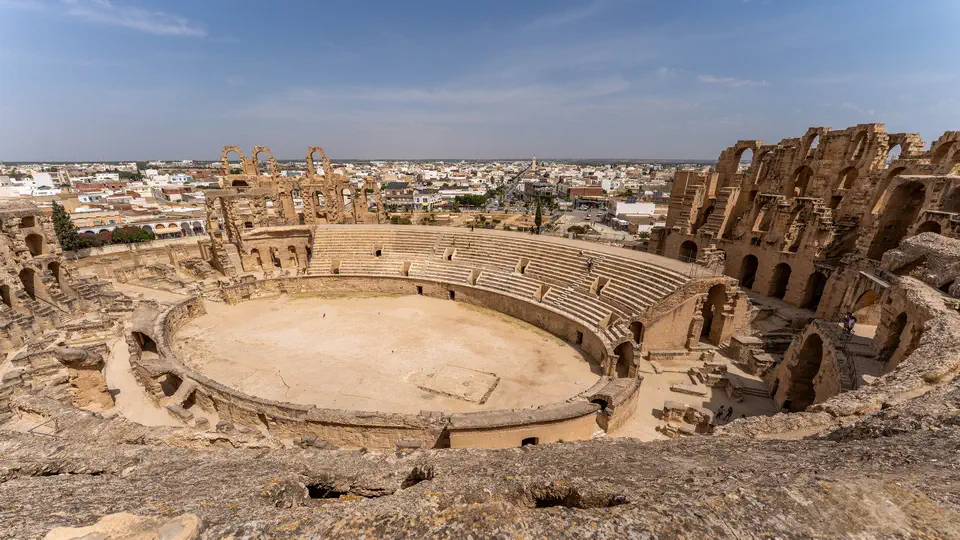
When I arrived in El Jem, I could already see the enormous silhouette of the amphitheatre rising above the town’s buildings. My first thought was, naturally, the Colosseum. However, as I approached, I quickly realised that this monument has a distinctive character of its own. If you decide to visit, prepare yourself for a genuine journey back in time. Walking beneath the monumental arches, I almost expected to hear the roar of the crowd and the clash of gladiators’ swords.
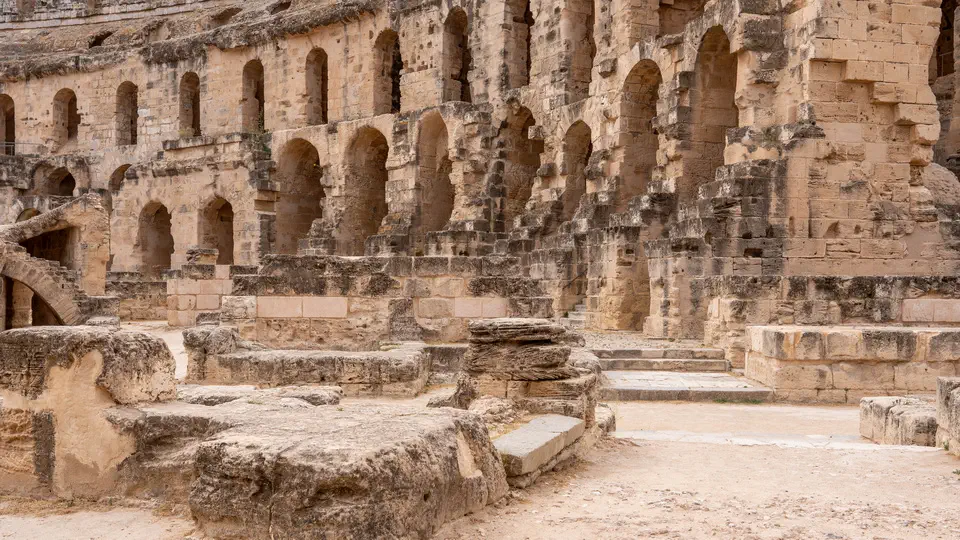
What impressed me most was the freedom to explore almost the entire structure. You can climb to the highest accessible levels of the seating area, walk through numerous corridors and descend into the underground chambers. At many European historical sites, similar areas are closed to visitors, whereas here you can genuinely appreciate the scale of the building. As I walked around the arena, I tried to imagine what a day of the great games must have looked like: thousands of people seated on stone tiers, traders selling food, musicians performing and gladiators waiting for their turn. All it takes is a moment of silence for your imagination to take over.
I particularly recommend exploring the underground passages. They remain cool even on the hottest days. This was where the animals were kept and the participants in the spectacles prepared for their appearances. Fragments of the original rooms and mechanisms have survived in some places. It is also worth climbing to the highest accessible levels. The view from above helps you understand the ingenuity of Roman architects. Only from there can you fully appreciate the perfect proportions of the structure and the sheer size of the arena.
As you explore the site, pay attention to the traces of its turbulent past. One section of the outer wall is visibly damaged, bearing witness to military operations and sieges in later centuries. These scars make the amphitheatre feel even more authentic, reminding visitors of its remarkable history. For me, it was one of the most fascinating attractions in Tunisia, even more interesting than the famous Bardo Museum in Tunis. This is not simply an ancient ruin; it is a living history lesson that you can quite literally touch and sit on.
The Roman Amphitheatre of El Jem – Mysteries and Legends
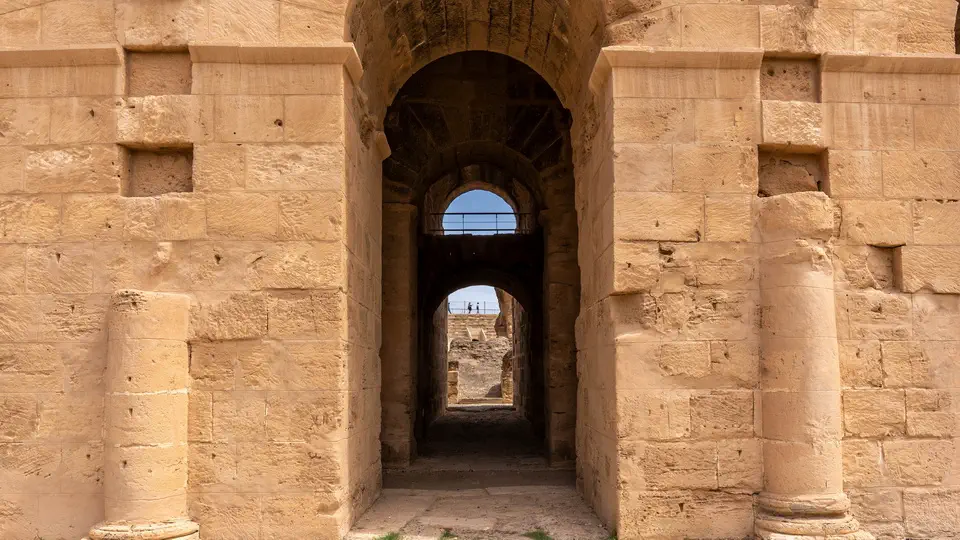
Like every great monument of antiquity, the amphitheatre at El Jem has inspired numerous legends. The best-known story concerns the Berber queen Al-Kahina. According to local tradition, she used the amphitheatre as a fortress during her struggles against the Arab invaders in the 7th century. Historians disagree about whether this really happened, but the legend remains alive among the inhabitants of the region.
Another tale speaks of hidden underground tunnels supposedly extending far beyond the town. According to the story, they were used either to help gladiators escape or to transport wild animals. Archaeologists have discovered some of the underground passages, but most of these stories remain firmly in the realm of legend. Local people also discuss the ghosts of gladiators appearing in the arena at night. According to these accounts, on still, windless evenings, it is possible to hear the sounds of fighting and the cries of the crowd. There are also stories of hidden treasures left behind by the inhabitants during successive invasions. So far, however, no legendary treasure has ever been found.
The Legend of Queen Al-Kahina and the Amphitheatre of El Jem
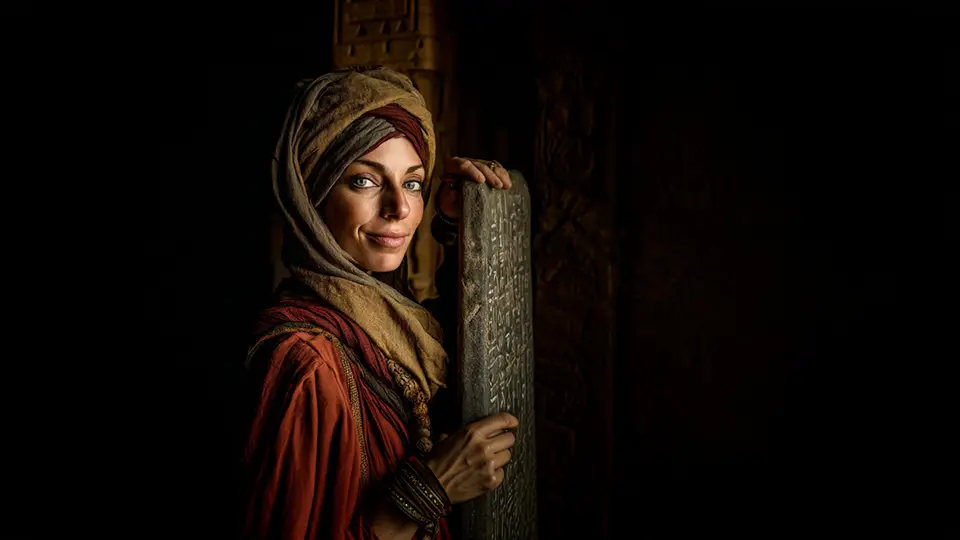
For centuries, the people of El Jem in Tunisia have passed down a legend about an extraordinary woman who supposedly found refuge within the mighty walls of the Roman amphitheatre. Her name was Al-Kahina, a Berber queen and warrior also known as Dihya. According to local tradition, she lived in the 7th century, when Arab armies began conquering the lands of North Africa. Al-Kahina is said to have united numerous Berber tribes and led the resistance against the invaders. She was not only a courageous warrior but also a woman of remarkable wisdom. Local people believed that she could predict the future, which is where her nickname, meaning ‘the Prophetess’, supposedly came from.
Legend has it that during one of her military campaigns, Al-Kahina arrived at the enormous Roman amphitheatre in El Jem. By then, the structure was already several centuries old and towered above the surrounding landscape like a mountain of stone. The queen supposedly recognised it as an ideal fortress. Its thick walls, towering arches and underground passages could provide shelter for both her warriors and the inhabitants of nearby settlements. It is said that the amphitheatre served as her secret headquarters for many months. Food supplies and weapons were stored in the underground passages, while guards watched the surrounding countryside from the highest levels of the building. Whenever enemies approached, fires lit on top of the walls warned the local population of the danger.
The most extraordinary part of the legend, however, concerns a hidden treasure. Al-Kahina supposedly knew that she would not be able to hold back the advancing armies forever, so she ordered her most trusted warriors to hide chests filled with gold, silver and precious stones somewhere inside the amphitheatre. The treasure was said to have been concealed in one of the underground tunnels leading far beyond the town. When the Arab armies eventually approached the fortress, Al-Kahina allegedly disappeared without a trace. Some claimed that she had fallen in battle, while others believed she had escaped through a secret passage beneath the amphitheatre. Ever since, neither the queen nor her treasure has ever been found.
Older generations of El Jem residents used to tell another story. On moonless nights, the silhouette of a woman wearing a long cloak supposedly appeared on the highest arches of the amphitheatre. She would gaze towards the desert, as if still waiting for her warriors to return from battle. Some even claimed that during particularly strong winds, her voice could be heard echoing against the ancient stone walls.
Historians have found no evidence confirming that Al-Kahina ever stayed in El Jem, but the legend has survived for centuries. For many Tunisians, the Berber queen remains a symbol of courage, freedom, and the struggle to defend one’s homeland. Meanwhile, the monumental amphitheatre continues to be a place where the distant past blends with stories passed down from one generation to the next.
The Amphitheatre of El Jem Today
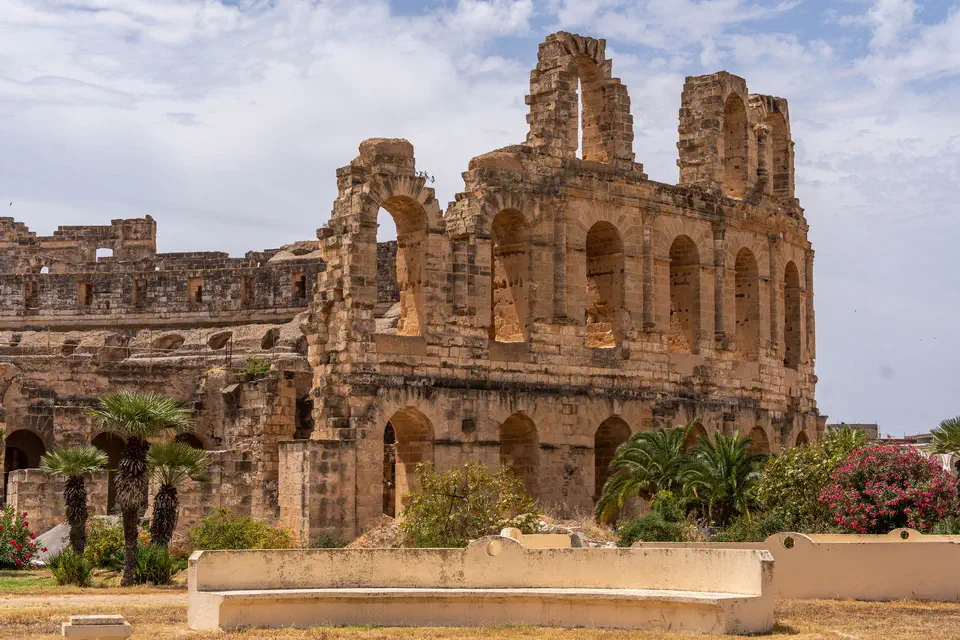
Today, the amphitheatre is considered one of the best-preserved Roman monuments in the world and has been included on the UNESCO World Heritage List since 1979. Numerous conservation projects have been carried out over recent decades. Some damaged sections have been restored, the structure has been protected against further erosion, and additional parts of the monument have been opened to visitors. Particular attention has been paid to preserving the underground passages and the exterior arches. Thanks to these efforts, modern visitors can admire the building in a condition that gives a good impression of its former grandeur.
For many years, the amphitheatre has also hosted the International Festival of Symphonic Music in El Jem. Concerts held within the ancient walls have a remarkable atmosphere and attract performers from around the world. In 2024, El Jem also hosted another edition of its Roman Days, featuring historical re-enactments, parades, and performances inspired by the times of the Roman Empire.
The amphitheatre has also featured in the famous film Gladiator, with the monument used during the production of some scenes depicting Roman spectacles. As a result, millions of viewers around the world have had the opportunity to admire its extraordinary architecture. The site is also associated with Gordian I and Gordian III, two figures who played important roles in the history of the Roman Empire.
Practical Information for Visitors
- How to get there: El Jem is located approximately 200 kilometres south of Tunis. You can reach it by car, bus or train.
- Tickets: Admission prices change periodically, but they are generally very reasonable compared with similar historical attractions in Europe. It is worth checking the latest prices before setting off.
- What to bring: Water, a hat or other sun protection, high-factor sunscreen, comfortable shoes, a camera and a little cash in the local currency for souvenirs and refreshments.
- Best time to visit: Spring and autumn are the most comfortable seasons. During summer, temperatures frequently exceed 35°C.
- How much time should you allow? At least two to three hours. History enthusiasts could easily spend half a day exploring the monument.
A Few Final Thoughts on the Roman Amphitheatre of El Jem in Tunisia
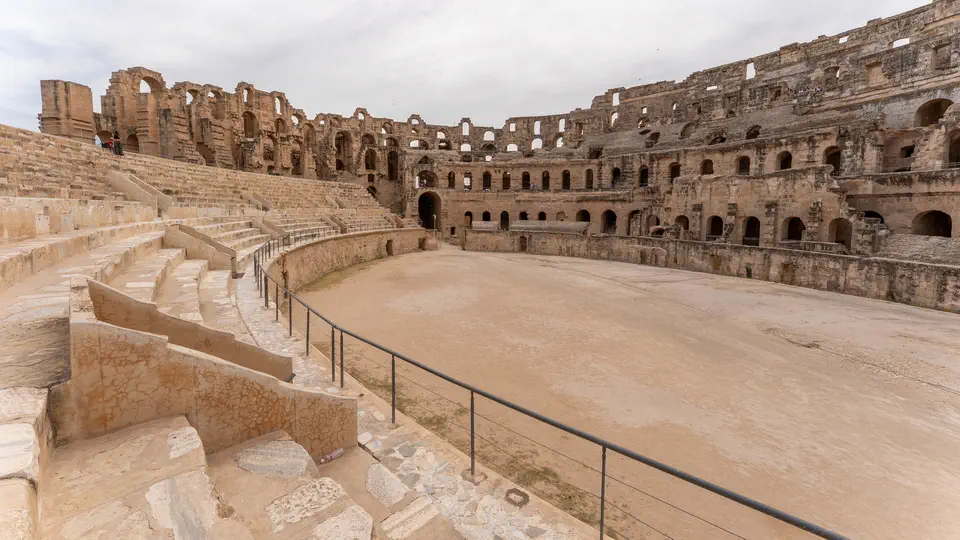
To conclude, I would like to return to one important point. Although the amphitheatre is undoubtedly beautiful and historically valuable, similar Roman monuments can be found throughout the territories once ruled by Rome. So what makes El Jem special? First, its enormous size and excellent state of preservation, but perhaps even more importantly, the freedom it offers visitors to explore the building. You can enter almost every accessible part of it, from the highest galleries and monumental arches to the extensive underground chambers and corridors beneath the arena.
As you walk around, you will probably notice thousands of inscriptions, signatures, and dates scratched into the ancient stones over different periods. I found one inscription dating back to the 8th century, although apparently some are even older. You might be tempted to add your name to the collection, but remember that the Tunisian authorities take the protection of this monument very seriously. Damaging it can have unpleasant consequences, so admire the inscriptions without adding to them.
I wholeheartedly recommend visiting this monumental structure, particularly as Tunisia has relatively few attractions of this kind to offer. This makes the Roman Amphitheatre of El Jem one of the country’s most valuable historical treasures. If you are planning a wider journey through the country, you might also enjoy my article about Tunis, the capital of Tunisia, as well as my account of visiting the remarkable Bardo Museum in Tunis.
The Amphitheatre of El Jem – Information and Interesting Facts
- The Roman Amphitheatre of El Jem is full of fascinating details that reveal just how remarkable this ancient structure really is. Here are some interesting facts worth knowing before visiting.
- It is larger than most Roman amphitheatres – In terms of size, it is surpassed by only a handful of buildings from the Roman Empire. Even today, its dimensions leave visitors astonished.
- It could accommodate approximately 35,000 spectators – This is comparable to the capacity of a modern football stadium. For a town of this size, the project was truly enormous.
- It was built without conventional foundations – Roman engineers created a freestanding structure on relatively flat ground, which was an extraordinary technical achievement.
- It is more than 1,800 years old – Despite the passage of almost two millennia, a substantial part of its original structure has survived.
- It was the third amphitheatre built in Thysdrus – Two smaller structures had previously existed in the town, but they were no longer sufficient for its growing population.
- The building was constructed from enormous blocks of stone – Thousands of tonnes of material, transported from nearby quarries, were used in its construction.
- There was an elaborate system of tunnels beneath the arena – It was similar to the arrangements found in the Roman Colosseum and allowed spectacular events to be staged.
- Animals were raised into the arena using special lifts – These mechanisms operated through human power, ropes, and pulley systems.
- It has been on the UNESCO World Heritage List since 1979 – The monument has enjoyed special international protection since then.
- It can be seen from a considerable distance – Its enormous silhouette dominates the surrounding landscape and has served as a local landmark for centuries.
- It was once used as a fortress – Following the fall of the Roman Empire, local inhabitants used the building as a place of refuge during conflicts.
- Parts of its walls were blown apart – The damage visible today is partly the result of military operations carried out during the 17th century.
- Its acoustics are still impressive – During concerts, sound travels through the structure in a way that recalls the building’s original purpose.
- It is frequently compared with the Colosseum – Many visitors consider it the best-preserved Roman equivalent outside Italy. You can read more about its famous counterpart in my article about the Colosseum in Rome.
- It was built during a period of crisis in the Roman Empire – Construction began during one of the most turbulent periods in Roman history.
- Some researchers believe it was never fully completed – Certain architectural features suggest that construction work may have been interrupted before the project was finished.
- It was used during the production of the film Gladiator – Its appearance in the famous film helped make the monument even better known around the world.
- Historical re-enactments are organised here – These events allow visitors to experience something of what Roman spectacles might have looked like.
- It is one of Tunisia’s most recognisable landmarks – Images of the amphitheatre appear in guidebooks, promotional materials and tourism campaigns.
- Visitors can explore almost every part of the building – Few ancient monuments offer such freedom to explore. It allows you to experience something of the atmosphere of the Roman Empire at first hand.