Guadalest is one of those places on the Costa Blanca that clearly proves this part of Spain has far more to offer than beaches, promenades and seaside resorts. All you need to do is leave Benidorm behind, head into the mountains and, after just a few dozen minutes, you find yourself in an entirely different world. High-rise hotels give way to rocky slopes, small villages, olive groves and winding roads climbing steadily higher into the hills.
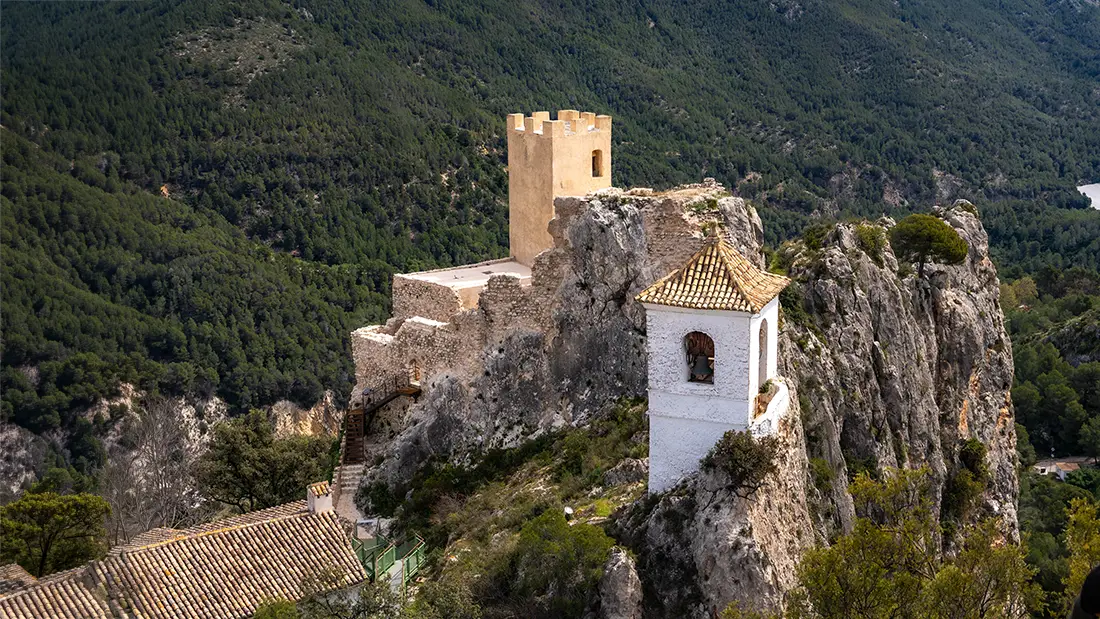
This is the setting of El Castell de Guadalest, usually known simply as Guadalest. The tiny town has been squeezed between the rocks, while its oldest part stands on top of a high rocky ridge. The remains of a medieval castle rise above the houses, and far below you can see the intensely turquoise waters of the Guadalest reservoir.
I have to admit that the view is far more impressive in person than it appears in photographs. The town itself is small, and you could walk through it rapidly, but I would not recommend rushing. Guadalest is best enjoyed slowly, when you have time to stop at the viewpoints, climb to the castle ruins and simply look out across the surrounding mountains. If you are planning a holiday in this part of Spain, I would definitely add Guadalest to your list of places to see. It is also one of the attractions worth including in a longer tour of the Costa Blanca and its attractions.
Guadalest and its fascinating history
The history of Guadalest reaches back to the period when much of the Iberian Peninsula was under Muslim rule. It was during this time, probably in the 11th century, that the first fortifications were built on the high rock. The location was extremely well-chosen, as the valley, mountain passes and roads running through the surrounding hills could all be controlled from above. Guadalest therefore played an important defensive role and remained difficult to capture for many years.
After the Christian conquest of the area, the settlement gradually passed into the hands of successive noble families. Among those closely associated with Guadalest were the Sarrià and Cardona families. The Marquisate of Guadalest was established in the 16th century, further underlining the town’s importance in the region. Buildings around the castle also expanded during this period, although the extremely difficult terrain placed obvious limits on how much the settlement could grow.
The greatest destruction, however, came not from warfare but from natural disasters. In 1644, a powerful earthquake seriously damaged the castle and part of the town. Another blow came during the War of the Spanish Succession, when sections of the fortifications were destroyed in 1708. Several decades later, in 1748, Guadalest was struck by another earthquake.
Despite these disasters, the settlement was never abandoned. Its inhabitants rebuilt their homes, adapting them to the rocky terrain and making use of whatever remained of the older structures. This is precisely what makes modern Guadalest so interesting: ruined castle walls, later houses, narrow passages and buildings almost attached to the rock can all be seen side by side. Tourism became increasingly important during the 20th century, and in 1974 Guadalest was declared a Historic-Artistic Site, helping to protect its most important monuments.
Today, El Castell de Guadalest is a tiny but extremely popular town. Its history is still clearly visible in the street layout, the ruins of San José Castle, the Alcozaiba tower and the stone tunnel leading into the old part of the settlement. It is this combination of a medieval past and extraordinary location that makes Guadalest one of the most distinctive places in the entire province of Alicante.
Guadalest is a perfect alternative to the sandy beaches of the Costa Blanca
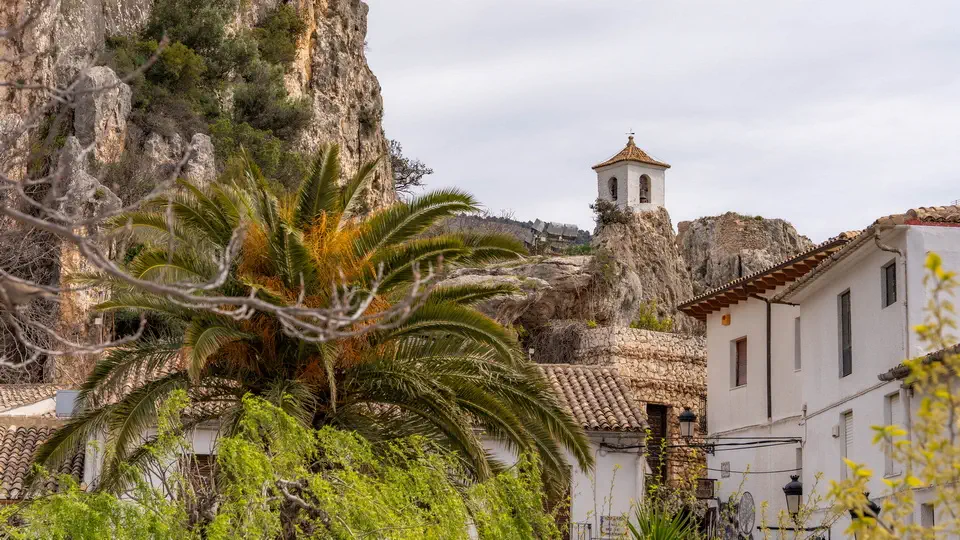
Guadalest lies in Alicante Province, in the Marina Baixa region, roughly 20 kilometres as the crow flies from the Mediterranean coast. The town is surrounded by the Aitana, Serrella and Xortà mountain ranges, giving it a landscape that looks wholly different from the tourist resorts along the coast.
The most popular starting point is, of course, Benidorm. Driving from there usually takes around half an hour, although the final section follows a winding mountain road with plenty of bends, which is in itself an enjoyable and memorable part of the trip. The further you travel from the coast, the more dramatically the scenery changes. Buildings gradually disappear, the mountains close in and the road passes through small villages and terraced farmland.
The first surprise may come before you even enter the old town. Guadalest really is tiny, yet it is one of the best-known tourist attractions in Alicante Province. The town’s official website describes El Castell de Guadalest as one of the most visited municipalities in Spain, and during the summer this popularity is certainly effortless to notice.
The main street can become crowded, restaurant terraces quickly fill up and small souvenir shops receive entire coachloads of visitors from the coast. This does not take away Guadalest’s charm, but I would definitely recommend arriving in the morning. Around midday, particularly in July and August, this peaceful mountain village begins to feel like one of the Costa Blanca’s most popular tourist attractions.
The most important attractions in Guadalest you should not miss
Guadalest is small, which means its main attractions can easily be explored during a leisurely walk. That certainly does not mean there is little to see. Quite the opposite: within a tiny area you will find castle ruins, a historic house, a church, viewpoints, several unusual museums and the characteristic passage cut directly through the rock. The greatest attraction, however, remains the town’s location itself. From almost every elevated spot you can admire the surrounding mountains and the intensely turquoise waters of the Guadalest reservoir. Below are the places I would definitely not miss during a visit.
The tunnel leading into Guadalest’s old town
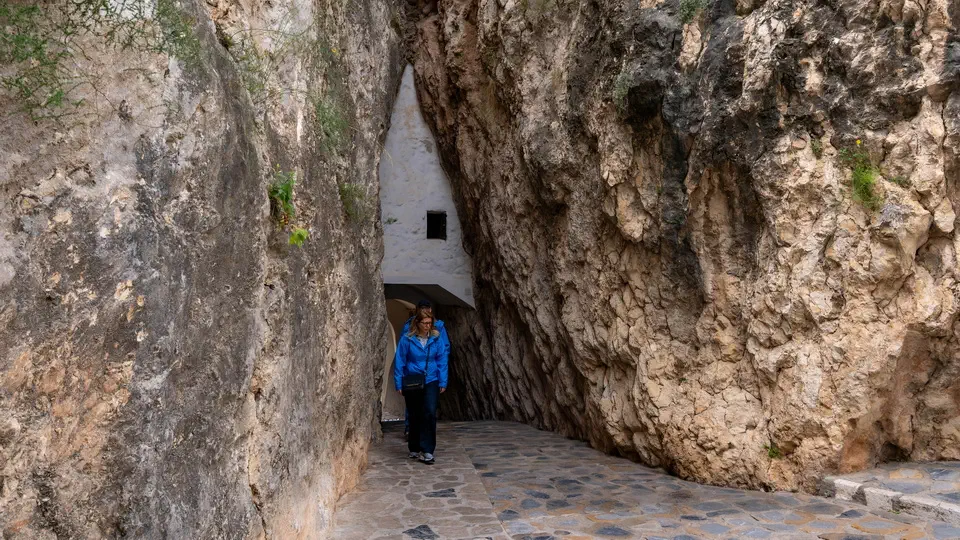
One of the most characteristic features of Guadalest is the entrance to its historic centre. You reach it through a tunnel cut directly into the rock. In the past it served as a naturally protected gateway into the fortified settlement, while today practically every visitor heading towards the castle passes through it. It creates a wonderful introduction to the atmosphere of the place.
On one side, you leave behind the relatively modern buildings, restaurants, and car parks. You walk through the rock and, moments later, emerge among old houses standing high on the rocky ridge. Do not expect a vast medieval town. Guadalest’s old quarter really is tiny, but here its location matters far more than its size.
Castillo de San José – Guadalest Castle
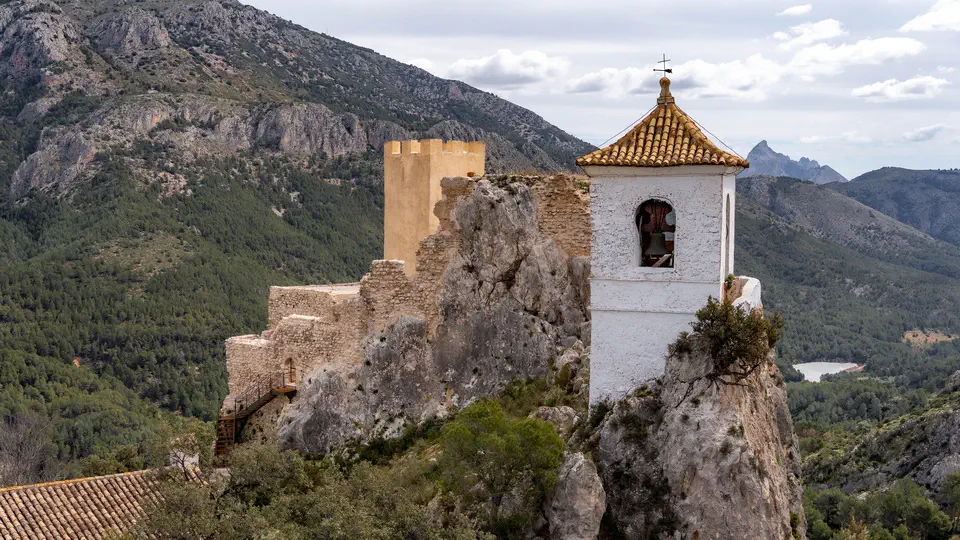
The most important historic monument in the town is the remains of Castillo de San José, or San José Castle. The fortress was built by the Muslims in the 11th century, and its location was certainly no coincidence. From the high rocky ridge, it was possible to control the entire valley and the roads running through the surrounding mountains. The castle played an important role throughout the Middle Ages and during later centuries, although unfortunately very little of it has survived.
Enormous damage was caused by the earthquakes of 1644 and 1748, with further destruction following in 1708 during the War of the Spanish Succession. I therefore would not travel to Guadalest solely in the hope of seeing a perfectly preserved fortress. If you are expecting walls comparable to those found in Spain’s greatest castles, you may be slightly disappointed. I prefer to think of the ruins as a spectacular viewpoint with a fascinating history, and for that reason, I strongly recommend climbing all the way to the top. The panorama is magnificent.
On one side, Guadalest and its little tiled-roof houses lie beneath your feet. On the other, the vast valley and reservoir open up before you, with further mountain ranges stretching into the distance. In good weather, you can happily stand here for a very long time. It is one of those views a photographer is unlikely to grow tired of.
Castillo de la Alcozaiba
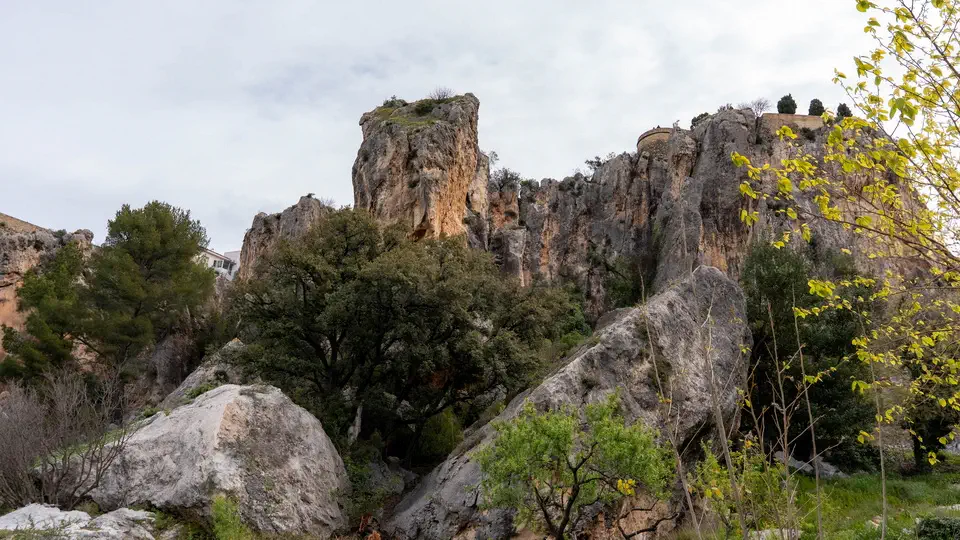
Guadalest had not one but two fortresses. The second was Castillo de la Alcozaiba, also dating from the 11th century and likewise built by the Muslims. What survives today is mainly the characteristic tower standing on the rock. Its silhouette has become one of the most recognisable elements of Guadalest’s skyline. The structure itself is small, but combined with the rocks, white houses and surrounding mountains it looks wonderfully picturesque.
Casa Orduña – the home of a wealthy family
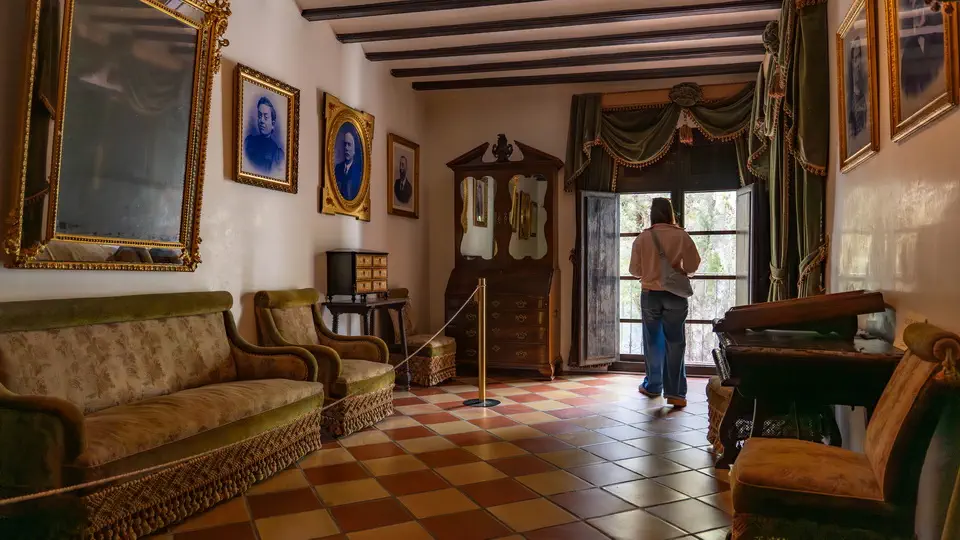
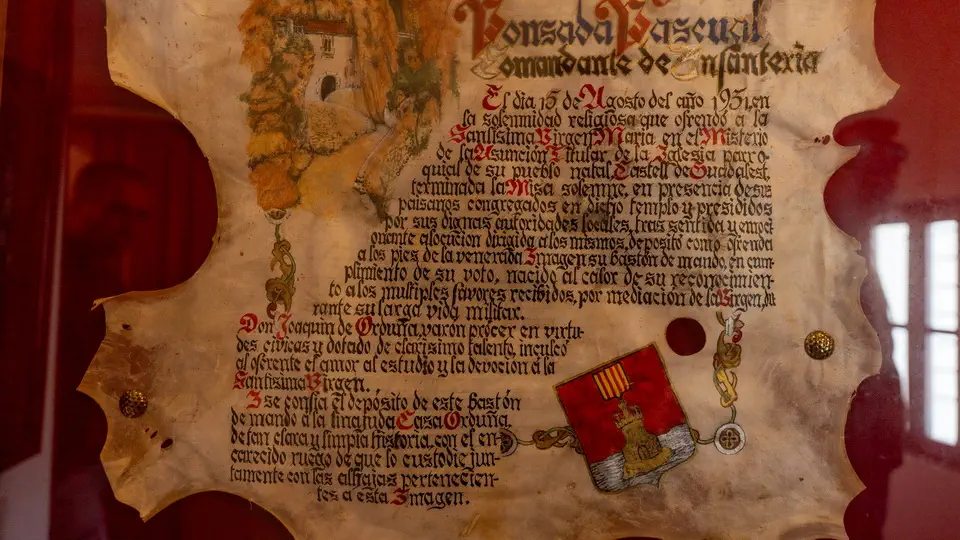
Right beside the castle stands Casa Orduña, one of Guadalest’s most interesting historic buildings. The house was built after the devastating earthquake of 1644 for the Orduña family, who were closely connected with the local marquises for generations and served as administrators of both the fortress and the entire marquisate. Today, the building houses a museum.
Inside you can see a former kitchen, dining room, bedrooms and reception rooms, as well as paintings, antique furniture, family documents, weapons, and a small art collection. What interested me most, however, was the library. It contains 1,265 volumes, while the catalogue of its oldest section, covering books published between 1500 and 1800, includes 589 titles.
Casa Orduña is also important for a practical reason: access to San José Castle passes through its grounds. According to the information available when this article was prepared, the museum is open every day. During high and mid-season it operates from 10:15am until 7pm, while outside the main season it closes at 6pm. On Thursdays and Sundays there is a break between 2pm and 3pm. Even so, I would check the latest timetable on Guadalest’s official website before visiting, as opening hours can change.
Church of Nuestra Señora de la Asunción
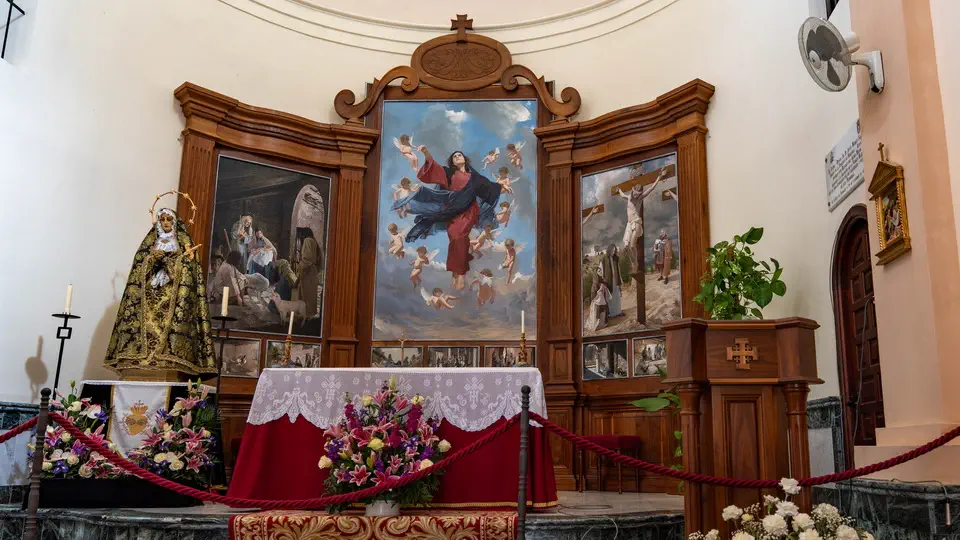
In the centre of the old town stands the Church of Nuestra Señora de la Asunción. It was built between 1740 and 1753 on the site of an earlier church dating back to the 13th century. The building suffered serious damage during the Spanish Civil War and was subsequently altered. During works carried out in 1962, the church was shortened, and its original layout was changed.
It may not be the most spectacular church you will ever see in Spain, but it is worth having a look inside, particularly as it stands practically on the main sightseeing route.
The old prison
An old prison has also survived beneath the town hall. It is another example of how the limited space available in historic Guadalest was used by its inhabitants, with buildings and rooms adapted to the rocks rather than the rocks being forced to accommodate the architecture.
This is one of the things that makes walking around the town so interesting. Every few moments you notice another house leaning against a rocky wall, a passage cut into stone or a staircase leading somewhere that, only moments earlier, you had not even realised was there.
Museums in Guadalest – there are surprisingly many of them
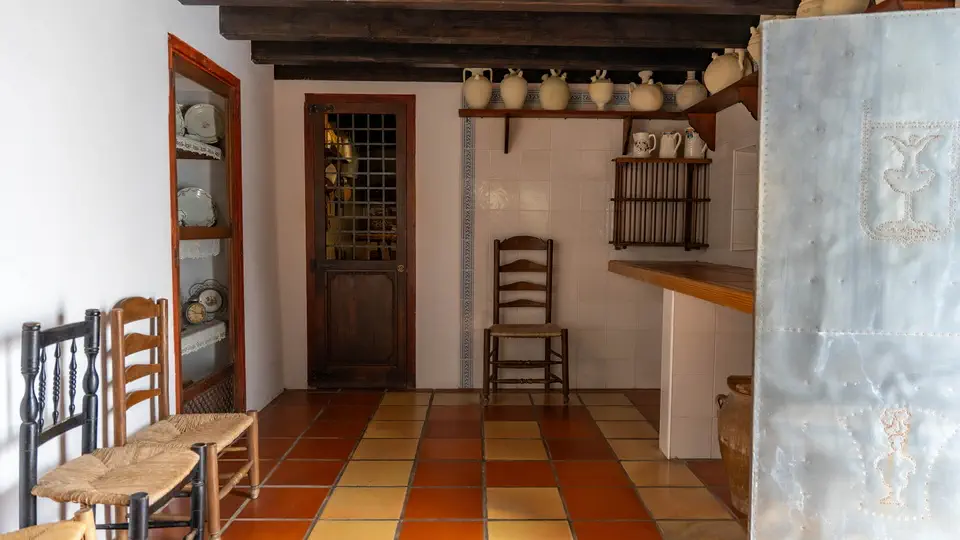
One of Guadalest’s greatest curiosities is the number of museums, which genuinely surprised me. In a settlement with only a few hundred inhabitants, there are several of them, and some cover remarkably unusual subjects. In addition to Casa Orduña, you can visit a museum of miniatures, a museum of historic vehicles, an ethnological museum, a collection of dolls’ houses and even a museum devoted to medieval instruments of torture. The region’s official tourist information mentions eight different museums, although I managed to count only six. Below are two that I visited myself and would recommend seeing.
Museo Microgigante
One of the strangest is Museo Microgigante, where the miniatures are so tiny that some of them have to be viewed through magnifying lenses. Exhibits include a bullring created on the head of a pin, a self-portrait carved into a grain of sand and minimal objects placed on a single hair.
It is certainly not an essential stop, but if you are travelling with children or simply enjoy unusual collections, it can be an entertaining addition to your visit.
Museum of Dolls’ Houses
Another option is Museo Belén y Casitas de Muñecas, where you can see a collection of miniature houses, toys, and a nativity scene created by Antonio Marco. These small and unconventional museums are precisely what can turn a two-hour visit to Guadalest into something approaching a full day..
Guadalest Reservoir – a turquoise lake beneath the town
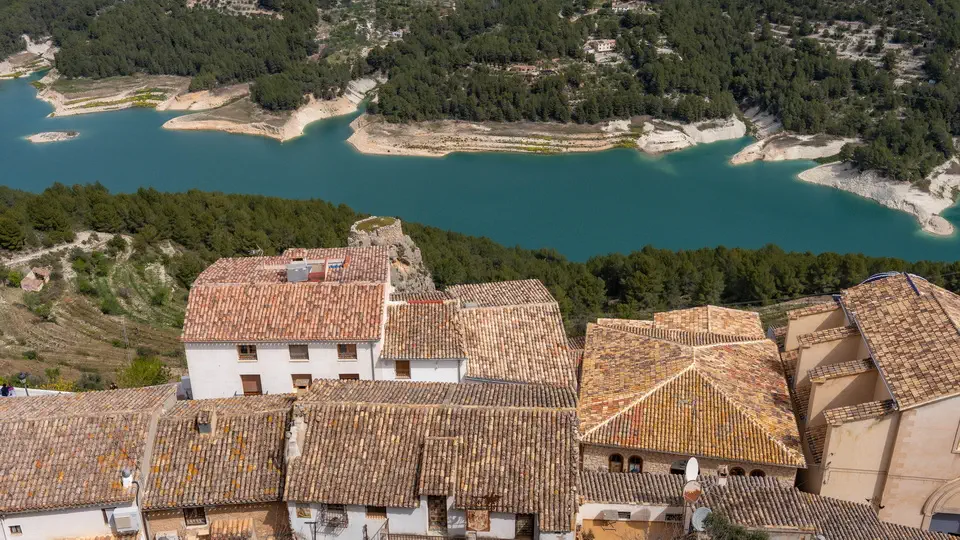
The greatest impression on me during the visit was made not by the castle itself but by the Embalse de Guadalest visible below. Its water has a distinctive blue-turquoise colour that contrasts beautifully with the pale rocks and green mountain slopes. Seen from above, it looks almost unreal. It is worth remembering, however, that this is an artificial reservoir, although that does not mean you should limit yourself to admiring it from the castle.
If you have more time, you can walk or drive down towards the reservoir and explore the surrounding area. The regional tourism organisation recommends walking routes around the water. If you enjoy landscapes like this, there are several other reservoirs and wild inland areas worth discovering as part of a wider Costa Blanca itinerary.
Walking and cycling routes run around the reservoir, attracting hikers, cyclists, and anyone who enjoys spending time outdoors. I would not, however, treat a walk around the water as a quick extension of your visit to the old town. If you want to follow one of the longer routes, allow additional time and, most importantly, take plenty of water. Summer temperatures in this part of Spain can be extremely high, while many sections of the trails offer little meaningful shade. In July and August, I would definitely choose either the early morning or late afternoon.
Guadalest – practical information and my advice for visiting the town
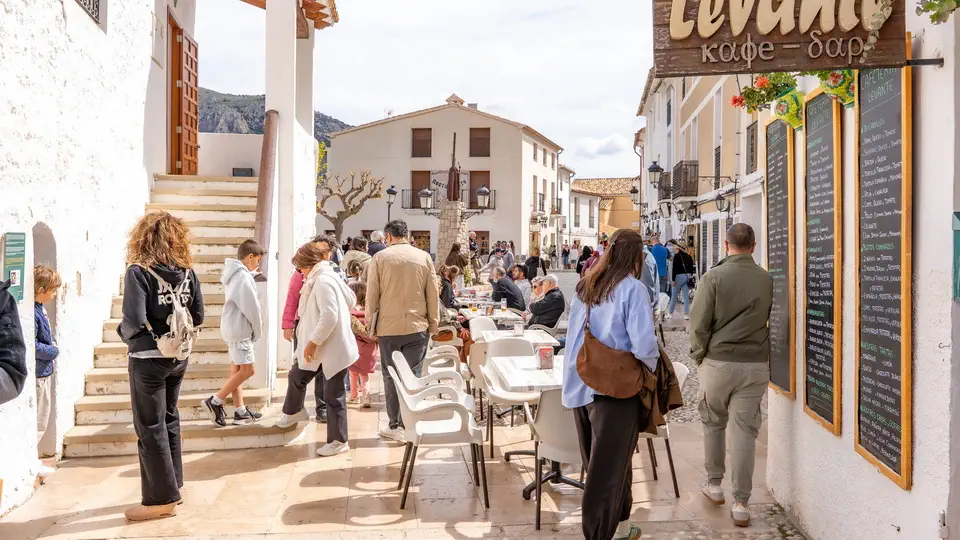
- How much time do you need to visit Guadalest? – If you are mainly interested in the old town, Casa Orduña and the castle, I would allow around three hours. You can see the most important places more quickly, but in my opinion there is little point in rushing. You come here for the views as much as for the monuments. If you want to visit several museums, have a relaxed lunch and head down towards the reservoir, you could easily spend most of the day here. I would plan my visit roughly like this:
- spacer przez nowe Guadalest i wejście do starego miasta,
- Casa Orduña,
- Castillo de San José,
- punkty widokowe,
- kościół,
- jedno z niewielkich muzeów,
- obiad,
- później przejazd nad zbiornik Guadalest.
- When is the best time to visit Guadalest? – In my opinion, spring and autumn are the most pleasant seasons. Temperatures are much better for walking and there are fewer visitors than during the height of summer. Guadalest is still beautiful in summer, but you need to be prepared for both heat and crowds. If you are visiting in July or August, I recommend arriving as early as possible, ideally shortly after the main attractions open. Winter is quieter, but Guadalest lies high in the mountains and temperatures can be considerably lower than on the coast. Do not assume that because you can sit in the Benidorm sunshine wearing a T-shirt, the weather will be the same several hundred metres higher.
- Where can you park in Guadalest? – You can drive almost all the way to the historic centre. There are car parks beside the main road, while the tourist information point is located near the car park on Avenida de Alicante. During the main season, I would arrive early partly because of parking. Later in the day, the number of cars and coaches increases quickly and finding a free space can become a matter of luck. Once you start exploring the old town, you will no longer need your car. The historic centre is tiny and all the main attractions are close together.
- Guadalest with children – Guadalest can be a superb destination for a family day out. Children often enjoy simply walking through the tunnel in the rock, climbing towards the castle and exploring unusual museums filled with miniatures, dolls or historic vehicles. You do, however, need to watch out for steps, uneven surfaces and areas close to steep rocks. Some sections may be inconvenient with a pushchair. If you are travelling with a very young child, a baby carrier may be considerably more practical. For more ideas, have a look at my wider guide to things to see and do on the Costa Blanca, where I have collected destinations suitable for both short trips and full-day excursions.
- What should you eat in Guadalest? – You will have no difficulty finding restaurants and bars catering to tourists, although it is worth remembering that we are in the mountainous interior of Alicante Province. Alongside typical tapas, I would therefore look for dishes with stronger connections to local cooking. Rice dishes, meat, vegetables, sausages, and stews are all popular in the region. A good choice might be arroz al horno, oven-baked rice, or one of the local meat dishes. If you mainly fancy tapas, remember that Alicante cuisine is strongly associated with fish, seafood, rice, and vegetables. I have collected many more regional suggestions in my guide to Spanish tapas and what to try in different parts of Spain. As in most popular tourist destinations, I would not automatically choose the first restaurant beside the busiest viewpoint. Sometimes walking just a few minutes away from the main tourist flow is enough to find somewhere quieter.
- What can you see near Guadalest? – Guadalest is easy to combine with other attractions on the Costa Blanca. One of the most natural combinations is Callosa d’en Sarrià and Fonts de l’Algar, allowing you to plan a full-day route combining mountains, small towns and waterfalls. If you are exploring more of the southern Costa Blanca, I would also recommend Torrevieja, Tabarca Island and the extraordinary Tetería Carmen del Campillo. The last of these is wholly different from Guadalest. Instead of a medieval castle, you will find Oriental gardens, fountains, and interiors inspired by Moorish architecture. Both places, however, demonstrate perfectly that some of the Costa Blanca’s greatest surprises can be found well away from the beach.
- There are also a few simple rules worth remembering when exploring places like Guadalest:
- Wear comfortable shoes. The historic part of Guadalest is small, but there are plenty of stone surfaces, stairs, and slopes.
- Take water in summer. This is particularly important if you intend to walk outside the town centre.
- Arrive in the morning. It is the easiest way to avoid the biggest crowds.
- Do not restrict yourself to the main street. The finest views begin a little higher up.
- Check museum opening hours before you arrive. Guadalest has several privately run museums and their opening times may change with the season.
- Allow plenty of time for the viewpoints. Rushing from one monument to another makes little sense here.
- Do not forget about the reservoir. Many visitors photograph the lake from above and then leave. If you have a few additional hours, it is worth seeing the surrounding landscape from water level as well.
- Current information can be checked on the official El Castell de Guadalest website.
Summary and a few of my thoughts
Guadalest, in my opinion, is one of those places that deserves a place on any Costa Blanca itinerary. Not because it has an enormous number of historic monuments, nor because its castle is the best-preserved fortress in Spain – there are certainly larger and historically more impressive places. What makes Guadalest special above all else is its location.
The tunnel through the rock, castle ruins standing high above the valley, tiny white houses, mountains surrounding the settlement and turquoise reservoir below combine to create a landscape that is difficult to find anywhere else on the Costa Blanca. What I like most, however, is the contrast. In the morning you can be sitting on a Mediterranean beach, and an hour later you can be walking among the ruins of a Muslim castle high in the mountains. This is precisely what I enjoy most about the Costa Blanca.
The beaches are wonderful, but it is only when you leave the main coastal roads behind and begin exploring the interior of Alicante Province that you realise just how varied this part of Spain can be. Guadalest is one of the finest examples.
Guadalest – facts, information and interesting details
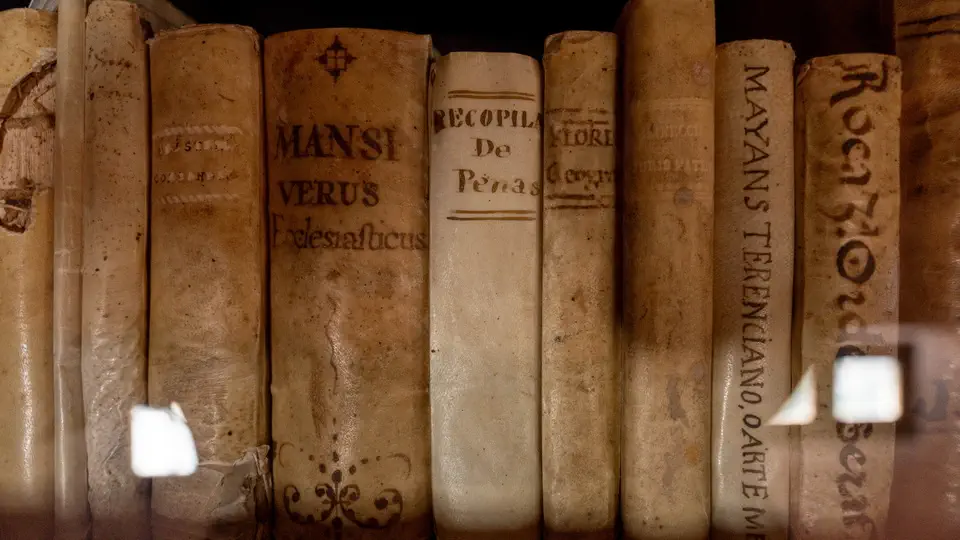
Guadalest is so small that, during a first visit, it can be difficult to believe how much history and how many unusual places have been squeezed into such a limited area. Behind the walls of the old town you will find the remains of two Muslim castles, the former home of a wealthy family, a church, an old prison and a surprisingly large collection of small museums. Add earthquakes, wars, family connections with Christopher Columbus and the turquoise reservoir visible from almost every viewpoint, and Guadalest becomes much more than simply a pretty mountain village.
- Guadalest has Muslim origins. The settlement already existed during the period of Muslim rule over this part of the Iberian Peninsula. Its position high on the rock made it an excellent place from which to control the valley and the routes running through the mountains.
- San José Castle was built as early as the 11th century. Guadalest’s principal fortress was constructed by the Muslims on the highest section of the rocky hill. Throughout the Middle Ages and later into the early modern period, it retained considerable strategic importance.
- Guadalest had two Muslim fortresses. In addition to Castillo de San José, the town was also home to the 11th-century Castillo de la Alcozaiba. Of this second stronghold, it is mainly the characteristic tower standing on the rock that has survived.
- You enter the old town through a tunnel cut into the rock. It is probably one of the most unusual entrances to a town anywhere on the Costa Blanca. The historic passage leads directly into Guadalest’s fortified quarter and has retained much of its historic character.
- In 1293 Guadalest passed into the hands of the Sarrià family. King James II granted the castle to Bernardo de Sarrià. His family controlled the fortress and surrounding area for the next 42 years, until 1335.
- Guadalest became a marquisate in the 16th century. In 1543, Sancho de Cardona received the hereditary title of Marquis of Guadalest. The Cardonas were among the most influential families of their time and also held, among other titles, that of Admirals of Aragon.
- Guadalest’s history has an unexpected connection with Christopher Columbus. Sancho de Cardona, the first Marquis of Guadalest, married María de Colón y Toledo, a granddaughter of the famous explorer. It is one of the lesser-known details in the town’s history.
- In 1609 the Moriscos were expelled from Guadalest and the surrounding area. They had previously made up the majority of the valley’s population. Their forced removal caused severe depopulation, which led to efforts to resettle the area from 1611 onwards.
- The year 1644 was particularly disastrous for Guadalest. On 22 June, a powerful earthquake badly damaged the castle and other buildings. As though this were not enough, another strong earthquake struck in December of the same year.
- Earthquakes returned in later years. Further tremors were recorded in 1748 and 1752. Although they were not as destructive as the disasters of 1644, they caused additional damage to Guadalest’s already weakened fortifications.
- Nature was not the only force to damage the castle. During the War of the Spanish Succession, Castillo de San José was partially blown up in 1708. The explosion caused serious damage to the western section of the fortress, which was never restored to its former state.
- Casa Orduña was also burnt in 1708. During the same fighting, the historic residence was set on fire and looted. The building nevertheless survived and today remains one of the most important places open to visitors in the historic centre.
- Casa Orduña was built after the catastrophic earthquake. The residence was constructed after the destruction of 1644 for the Orduña family, who for almost three centuries served as administrators of the fortress and Marquisate of Guadalest.
- The Orduña family originally came from the Basque Country. They arrived in the Kingdom of Valencia in the entourage of Infante Fortún of Navarre and later built their career through connections with the powerful Cardona family. Eventually, the Orduñas became one of the most important families in Guadalest’s history.
- The historic centre was divided into two sections. The higher, walled section was known as La Villa, while a suburb, or arrabal, developed below. Fragments of the 16th-century walls can still be seen today.
- An old prison lies beneath the town hall. One of Guadalest’s more surprising attractions is the former prison in the lower part of the Ayuntamiento building. Spain’s official tourist information dates the prison to the 12th century.
- Guadalest stands more than 500 metres above sea level. Its elevated position provides magnificent views from the historic centre across the valley, mountains, and reservoir far below.
- The town is surrounded by three distinctive mountain ranges. Aitana, Xortà and Serrella dominate the landscape around Guadalest and are largely responsible for the scenery looking so different from that of the Costa Blanca’s seaside resorts.
- The turquoise ‘lake’ beneath Guadalest is man-made. Construction of the reservoir began in 1953 and was not completed until 1971. Today, the Embalse de Guadalest is one of the most recognisable features of the local landscape.
- Guadalest has an extraordinary number of museums for such a small town. The regional tourism organisation lists eight different museums. Their subjects range from history and ethnology to dolls, miniatures and historic vehicles.
- One museum presents the world on a microscopic scale. Museo Microgigante is devoted to extraordinarily tiny artworks and miniatures. Unusual collections such as this have helped Guadalest stand out from other historic villages on the Costa Blanca.
- Guadalest even has a museum of torture instruments. Museo Histórico Medieval occupies a building with a basement and three additional floors, while its collection includes more than 70 objects associated with historical punishments, torture, and methods of execution.
- In 1974 Guadalest was formally declared a Historic-Artistic Site. The designation helped protect the town’s unusual architecture, remains of its fortifications and characteristic old-town layout. Today, its most important historic elements are protected as a Bien de Interés Cultural.
- Guadalest was receiving tourism awards long before mass tourism on the Costa Blanca reached its present scale. In 1980, the town received the Bronze Plaque for Tourism Merit, while a year later it took third prize in a national competition devoted to the beautification of Spanish towns and villages.
- Guadalest is officially recognised as one of Spain’s most beautiful villages. In 2015, it joined the Los Pueblos más Bonitos de España association, which brings together particularly valuable and picturesque settlements. A year later, it also became part of an international federation representing some of the world’s most beautiful villages.
- It is therefore worth remembering that Guadalest is far more than a beautiful viewpoint overlooking a turquoise reservoir. Within a minimal area you can discover Muslim and Christian influences, stories of powerful noble families, catastrophic earthquakes and traces of old wars. This is why, while exploring the town, it is worth occasionally turning your attention away from the panorama and looking more closely at Guadalest itself – practically every rock and old wall seems to have a story of its own.