Interesting facts about Football are part of our section in which we share interesting information about the world around us.
Football may seem like a sport based on a basic idea: two teams try to put the ball into their opponent’s goal. However, once we begin exploring its history, rules and records, we quickly discover a world filled with surprising events, remarkable figures and regulations that even some devoted supporters may not know.
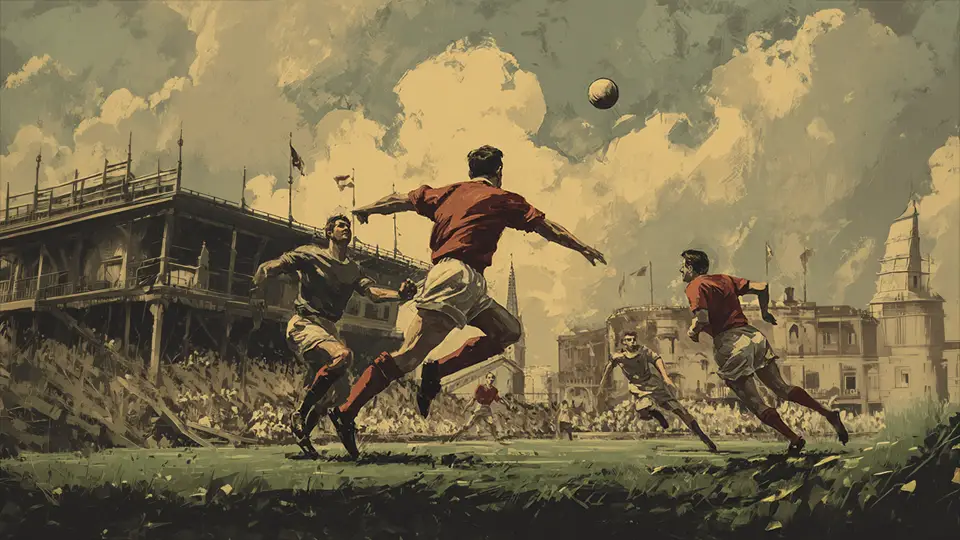
Modern football was born in nineteenth-century England, although games involving kicking a ball had been played much earlier. Over the following decades, players’ kits, pitch dimensions, the appearance of goals, offside rules and even the number of points awarded for a victory all changed. The World Cup, European club competitions, television broadcasts and the VAR system gradually became part of the sport.
Interesting facts about football
I have divided the following football facts into four groups. They include information about the history of the game, its rules, records and major tournaments. Each point has been explained in greater detail, so the list is more than simply a collection of random numbers and famous names.
Interesting facts about football – the history of the game
- Games resembling football were known in ancient China. A sport called cuju involved kicking a leather ball towards a small opening. It was played, among others, by soldiers as a way of improving their physical fitness.
- Other civilisations also developed their own ball games. Different versions were known in Ancient Greece, Rome, Japan and Mesoamerica, although they cannot be considered direct predecessors of modern football.
- Medieval matches could involve entire towns and villages. Teams were sometimes made up of hundreds of residents from neighbouring settlements or districts, and the aim was to carry the ball to a designated point that could be several kilometres away.
- Early matches did not take place on clearly marked pitches. People played in streets, squares, fields and between buildings. A church door, city wall or another previously agreed landmark could serve as the goal.
- Rulers repeatedly tried to ban ball games. English monarchs considered them dangerous, noisy and likely to distract men from archery practice, which was far more important during wartime.
- Modern football began to take shape in English schools. However, each school followed its own rules. In some, the ball was mainly kicked, while in other players were allowed to pick it up and run with it.
- The separation of football and rugby resulted from these differences in the rules. Supporters of a kicking-only game created association football, while schools that allowed players to carry the ball developed the sport now known as rugby.
- The English Football Association was founded in 1863. It created a common set of rules that allowed teams from different schools and clubs to compete under the same regulations.
- The word “soccer” also originated in Britain. It developed as an abbreviation of association football. Only later did it become particularly associated with the United States and other countries that had their forms of football.
- Sheffield FC is recognised as the world’s oldest football club still existing. It was founded in England in 1857. Although the club does not compete at the highest national level today, it played an important role in the development of organised football rules.
- The FA Cup is the oldest club football competition. Its first edition was played during the 1871–1872 season. Wanderers won the trophy after defeating Royal Engineers in the final.
- The first official international match took place in 1872. Scotland played England in Partick, and the match ended in a goalless draw, although the two teams followed noticeably different tactical approaches.
- Footballers were not initially paid. The sport was supposed to remain amateur, but a growing number of clubs secretly paid their best players. The English Football Association legalised professionalism in 1885.
- The world’s first football league was founded in England. The Football League began in 1888 and originally consisted of twelve clubs. The first champions were the unbeaten Preston North End.
- FIFA was established in Paris in 1904. Its founding members included the football associations of France, Belgium, Denmark, the Netherlands, Spain, Sweden, and Switzerland. England joined the organisation later.
- Football appeared at the Olympic Games before the creation of the World Cup. Tournaments were held at the beginning of the twentieth century, although they initially featured mainly club sides and amateur teams.
- The first World Cup took place in Uruguay in 1930. Thirteen national teams entered the competition. In the final, the host nation defeated Argentina 4–2 and became the first world champions.
- Travelling to the first World Cup took many days. European teams sailed to Uruguay by ship. The long journey and high costs meant that only four European nations agreed to participate.
- Shirt numbers were not part of football from the beginning. They only became widely used during the first half of the twentieth century, making it easier for referees, journalists and supporters to identify individual players.
- The earliest televised football matches reached only a small number of viewers. Over time, television transformed football into a global spectacle, increasing club revenues, the popularity of players and the value of broadcasting rights.
Interesting facts about football – rules, the pitch, and equipment
- A football match consists of two halves lasting 45 minutes each. However, the referee may add time lost because of substitutions, injuries, VAR checks, goal celebrations and other interruptions.
- Football pitches do not all have to be the same size. The Laws of the Game define an acceptable range for their length and width. Stricter limits apply during official international matches.
- A goal is 7.32 metres wide and 2.44 metres high. These measurements come from the imperial system and are equal to eight yards in width and eight feet in height.
- The lines form part of the areas they mark. This means that a foul committed on the penalty-area line is treated as an offence inside the area and may result in a penalty kick.
- The whole ball must completely cross the whole goal line. If even a small part of it remains above the line, a goal cannot be awarded. In major competitions, goal-line technology helps officials make this decision.
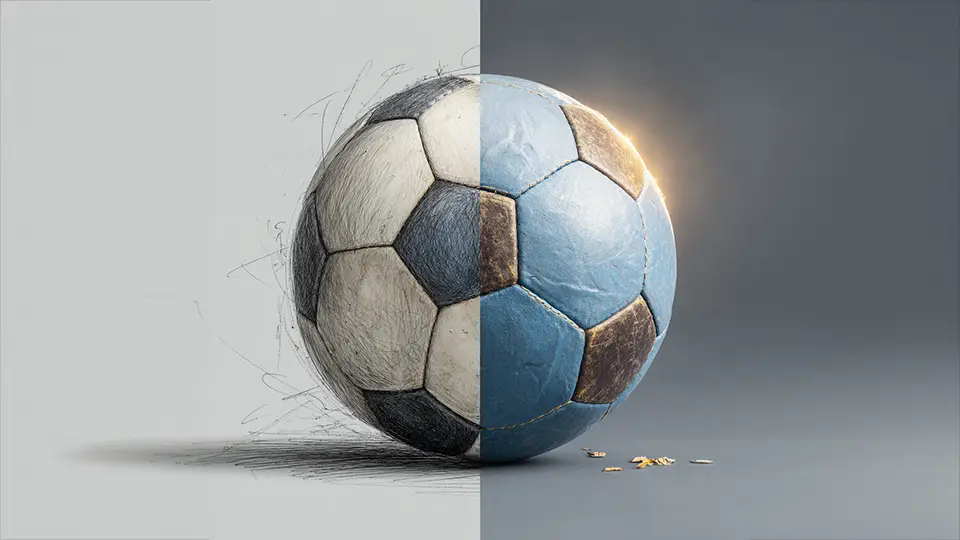
- A full-size football should have a circumference of between 68 and 70 centimetres. The rules also specify its weight, which should be between 410 and 450 grams at the start of the match.
- A team begins a match with eleven players. One of them must be the goalkeeper. A match cannot start or continue if a team has fewer than seven players.
- The captain does not have any special rights under the Laws of the Game. They are responsible for the team’s behaviour and represent it in certain situations, but they are not allowed to challenge the referee’s decisions without consequences.
- A goalkeeper may handle the ball only inside their penalty area. Outside it, they are subject to the same restrictions as every other player and may be punished for deliberately handling the ball.
- A goalkeeper is not allowed to pick up a deliberate back-pass made with the foot by a team-mate. This rule was introduced in 1992 to reduce time-wasting and encourage teams to play more actively.
- Not every contact between the ball and a player’s hand or arm is an offence. The referee considers factors such as the position of the arm, the player’s movement, whether the body has been made unnaturally bigger and whether the contact directly led to a goal.
- Simply standing in an offside position is not an offence. A player is penalised only when they become actively involved in play, interfere with an opponent or gain an advantage from their position.
- A player cannot be offside directly from a throw-in. The same rule applies to a goal kick and a corner kick, allowing attackers to position themselves closer to the opponent’s goal.
- Yellow and red cards were introduced after the 1966 World Cup. Inspired by traffic lights, the system was designed to communicate disciplinary decisions clearly to players who spoke different languages.
- A player shown a red card cannot be replaced. Their team must continue the match with fewer players unless the number of players falls below the minimum allowed.
- A penalty kick is taken from a distance of 11 metres. Until the ball is kicked, all other players must remain outside the penalty area, behind the ball and at least 9.15 metres away from it.
- An indirect free kick requires the ball to touch another player before a goal can be scored. If the taker kicks it directly into the opponent’s goal, the goal is disallowed and play restarts according to the rules.
- A goal can be scored directly from a corner kick. This is sometimes known as an Olympic goal. However, a player cannot score directly into their own goal from a corner.
- A throw-in must be taken with both hands from behind and over the head. The player must face the pitch, and part of each foot must remain on the touchline or on the ground outside it.
- VAR does not review every decision made by the referee. It is used for goals, penalty decisions, direct red cards and cases of mistaken identity. The final decision always belongs to the referee.
Interesting facts about football – records and remarkable achievements

- Brazil are the only nation to have appeared at every men’s World Cup since 1930. The team have won the tournament five times, becoming one of the greatest symbols of international football.
- Pelé is the only footballer to have won the World Cup three times. The Brazilian triumphed in 1958, 1962 and 1970, although injury forced him to miss most of the matches at the second of those tournaments.
- Pelé became a world champion at the age of just 17. He scored twice against Sweden in the 1958 final and quickly became one of football’s first truly global stars.
- Just Fontaine holds the record for the most goals scored at a single World Cup. The French striker found the net 13 times at the 1958 tournament despite playing only six matches.
- Miroslav Klose is the leading goalscorer in the history of the men’s World Cup. The German striker scored 16 goals across four tournaments held between 2002 and 2014.
- The biggest victory in the history of the men’s World Cup is 10–1. Hungary defeated El Salvador by that score in 1982, although the impressive result was not enough to take them through to the next round.
- The fastest goal in the history of the men’s World Cup was scored after around 11 seconds. Hakan Şükür struck for Turkey against South Korea in the third-place play-off at the 2002 tournament.
- Oleg Salenko holds the record for the most goals scored by one player in a single World Cup match. The Russian scored five times against Cameroon in 1994 and finished as the tournament’s joint top scorer.
- Cristiano Ronaldo is the leading goalscorer in the history of the European Championship finals. The Portuguese forward has scored 14 goals and appeared at a record number of tournaments, beginning his run of appearances in 2004.
- Michel Platini scored nine goals at a single European Championship. The Frenchman achieved the feat in 1984, playing just five matches and leading the host nation to their first European title.
- Lamine Yamal became the youngest player and the youngest goalscorer in European Championship history. The Spanish international set both records during Euro 2024 before his seventeenth birthday.
- Real Madrid are the most successful club in the history of the European Cup and Champions League. Following their triumph in 2024, they had won Europe’s most prestigious club competition fifteen times.
- Real Madrid won the first five editions of the European Cup. The club triumphed in every season from 1955–1956 to 1959–1960, with Alfredo Di Stéfano as one of the team’s greatest stars.
- The 1960 European Cup final remains one of the most spectacular in the competition’s history. Real Madrid defeated Eintracht Frankfurt 7–3, while Ferenc Puskás scored four goals.
- Archibald Stark holds one of the most remarkable goalscoring records in top-level league football. The American scored 67 goals for Bethlehem Steel during the 1924–1925 season, although comparing competitions from different eras is difficult.
- Pelé’s career goals total depends on how matches are counted. His club, Santos, included friendly and exhibition games, while modern statistics usually separate them from official competitive fixtures.
- Lionel Messi had won eight Ballon d’Or awards by 2023. The prize, presented by France Football, made him the most decorated player in the history of the award.
- Lev Yashin remains the only goalkeeper to have won the Ballon d’Or. The Soviet Union international received the award in 1963 and is still widely regarded as one of the greatest goalkeepers of all time.
- Some of the highest scores in football history were caused by protest rather than sporting superiority. In 2002, AS Adema won 149–0 because players from SO l’Emyrne deliberately scored own goals.
- Not every world record can be compared easily. In the past, teams played more friendly matches, league formats were different and records were not always complete, so various statistical lists may produce different results.
- FC Barcelona are one of the best-known football clubs in the world. The International Federation of Football History and Statistics has repeatedly ranked the club among the greatest teams in the history of the sport.
Interesting facts about football – tournaments, clubs, and football culture

- The first World Cup trophy did not look like the one used today. It was known as the Jules Rimet Trophy, named after the FIFA president who played an important role in establishing the World Cup.
- Brazil were allowed to keep the Jules Rimet Trophy permanently in 1970. They became the first national team to win the World Cup three times, fulfilling the condition set out in the tournament regulations.
- The Jules Rimet Trophy was stolen in Brazil. The theft took place in 1983, and the trophy was never recovered. It is widely believed that it was melted down.
- The trophy had also been stolen before the 1966 World Cup. It was discovered by a dog named Pickles, who discovered a parcel hidden beneath a hedge during a walk in London.
- The current World Cup trophy remains the property of FIFA. The winning team receives it during the presentation ceremony, but later returns the original and keeps a gold-plated replica.
- Uruguay won the first World Cup as the tournament hosts. The final against Argentina was played at the Estadio Centenario, and the 4–2 victory became an important part of the country’s national history.
- Two different balls were used during the first World Cup final. Argentina and Uruguay could not agree on which one to use, so each team supplied the ball for one half of the match.
- The World Cup was not held in 1942 or 1946. The Second World War and its consequences made it impossible to organise a safe international tournament.
- India withdrew from the 1950 World Cup, but not simply because the players wanted to compete barefoot. Travel expenses, the team’s preparation and the football association’s attitude towards the competition also influenced the decision.
- The first Women’s World Cup final was played in 1991. The tournament took place in China, where the United States defeated Norway to win the inaugural title.
- The first European Championship had a very short final tournament. Only four national teams competed in France in 1960, and the Soviet Union won the title after defeating Yugoslavia in the final.
- Denmark won the European Championship in 1992 despite failing to qualify originally. They replaced the excluded Yugoslav team and unexpectedly defeated Germany 2–0 in the final.
- Greece produced one of the greatest surprises in football history. At Euro 2004, they defeated Portugal in both the opening match and the final to claim their first European title.
- Spain became the first national team to win three major international tournaments, succeeding. They triumphed at Euro 2008, the 2010 World Cup and Euro 2012, dominating opponents with a style based on keeping possession.
- The decisive match of the 1950 World Cup was not officially a traditional final. Brazil and Uruguay met in the last game of the final group stage, but the result determined which team would become world champions.
- Brazil’s defeat by Uruguay in 1950 was given its name. The term Maracanazo became a symbol of national disappointment after the 2–1 loss at the Maracanã Stadium.
- The colours worn by national teams do not always come directly from their flags. Italy play in blue as a reference to the House of Savoy, while the Netherlands wear orange because of their connection with the House of Orange-Nassau.
- Brazil changed the design of their kit after the 1950 World Cup. The team had previously played mainly in white shirts, but after the Maracanazo, the famous yellow shirt with green details was introduced.
- In the past, shirt numbers were closely connected with playing positions. The goalkeeper usually wore number 1, the centre-forward number 9 and the playmaker number 10. Today, footballers have far more freedom when choosing their numbers.
- Supporters’ chants are often based on well-known tunes. Popular songs, religious hymns and old military melodies are given new lyrics and gradually become distinctive features of the atmosphere at particular stadiums.