Santo Domingo College (Colegio Diocesano de Santo Domingo) is a historic school and monastery in Orihuela, and one of the most interesting monuments in the city.
When exploring Orihuela on the Costa Blanca, it is easy to notice that this is a city with an exceptionally rich past. Its narrow streets, historic churches, palaces and monumental buildings recall the days when it played an important role in the political, religious and cultural life of the region. However, right in the heart of the city, there is one particular place that attracts the attention of anyone interested in history and architecture. This is Santo Domingo College, known in Spanish as Colegio Diocesano de Santo Domingo.
The sheer scale of the building is impressive. Construction of this extensive complex began in the 16th century, and it combines several architectural styles. Renaissance cloisters stand alongside Baroque decorations, while the former monastic rooms recall a time when one of the most important universities in the old Kingdom of Valencia operated within these walls. This is no ordinary school or just another historic monastery. Over the centuries, it housed educational institutions, a library, and even a royal university. Every part of the building has a slightly different story to tell, which is why, when visiting, it is worth looking beyond the impressive façade and discovering what lies behind its walls.
I particularly enjoy visiting historic buildings such as Santo Domingo College in Orihuela, places where an old school and centuries-old monastery tell the story not only of the town but of the entire region. What I enjoy most is being able to explore when there are hardly any people around, allowing me to wander through even the darkest corners of an ancient building without being disturbed. On this occasion, I was incredibly lucky when visiting the old monastery in Orihuela, as Magda and I were the only people inside the entire complex. The lady looking after the monument let us in, closed the door behind us and simply asked us to let her know when we had finished. Imagine how wonderful it was to wander through the empty corridors of an old school, the cloisters, former monastic cells and the beautiful Church of Santo Domingo. It was quite an experience. Below, I will tell you more about Santo Domingo College and explain why it is worth setting aside an hour or two to visit this fascinating place.
The history of Santo Domingo College in Orihuela
Santo Domingo College is sometimes referred to as El Escorial de Levante, or the Escorial of the Levant. This comparison with the famous monastery-palace complex near Madrid is no coincidence. Both places share a monumental scale, a strong religious character and close links with the history of Spanish education. The origins of the complex date back to the early decades of the 16th century. In 1510, Dominican friars settled in the area of what is now the college, establishing their community in connection with the hermitage of Nuestra Señora del Socorro. Two years later, Pope Julius II approved the foundation of the monastery. This marked the beginning of the history of a complex that would eventually become one of the most important religious and academic centres in this part of Spain.
Fernando de Loazes, a clergyman born in Orihuela, played a particularly important role in its development. He was an influential figure who, among other positions, served as Archbishop of Tarragona. In 1546, he decided to establish a college intended to educate Dominican friars and promote learning and education.
The institutional history of Colegio de Santo Domingo began in 1547. Papal approval for the foundation was obtained shortly afterwards, and in 1553 work began on extending the complex. The architectural design was entrusted to Jerónimo Quijano, while Juan Inglés was among those responsible for overseeing the construction. Following his death in 1563, the work was continued by other architects, including Agustín Bernardino.
The most important moment in the history of the college came in 1569, when Pope Pius V granted it the status of a pontifical university. This was a considerable distinction, placing Orihuela among Spain’s important academic centres. The university began teaching in 1610, and in 1646 King Philip IV granted it the status of a royal university. Students could study theology, canon law, civil law, philosophy, and medicine within its walls. For a long time, it was one of the most important educational institutions in the region, with an influence extending far beyond the city itself, attracting students and lecturers from different parts of the country.
However, nothing lasts forever. During the 19th century, as a result of reforms and the closure of some smaller universities, the institution gradually lost its former standing. The university finally ceased operating in 1835. Further adjustments followed in the years afterwards. Once the building had been taken over by the Church authorities, the complex returned to its educational role. In 1872, the Jesuits settled here and established their college. Their work had a considerable influence on the social and religious life of Orihuela. In 1956, the building came under the administration of the diocese and has operated as Santo Domingo Diocesan College ever since.
Today, it remains an active educational institution, while also being one of the city’s most important historic monuments. In 1933, the complex was declared a National Monument, and it is now protected as a Bien de Interés Cultural (BIC), a designation given to properties of particular cultural significance.
Santo Domingo College in Orihuela – the façade, three entrances and three different stories
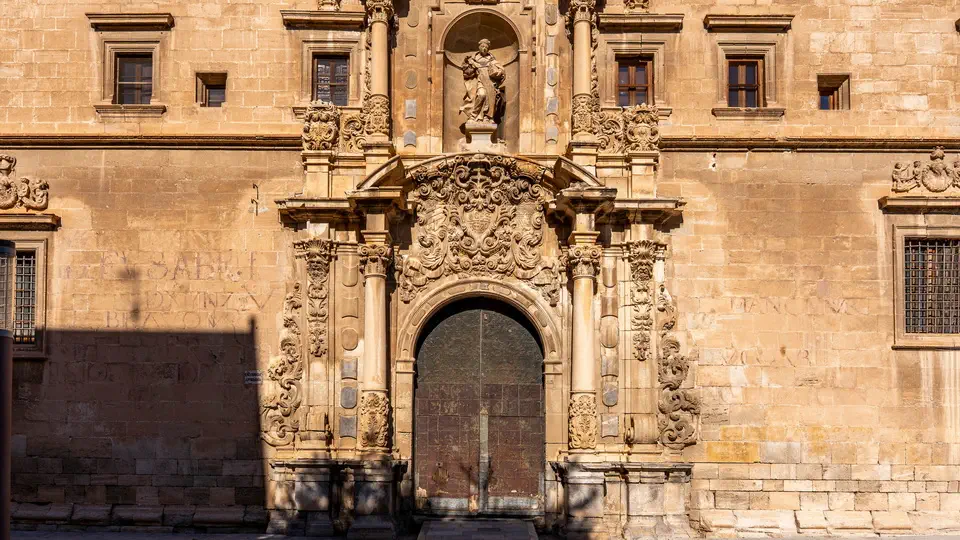
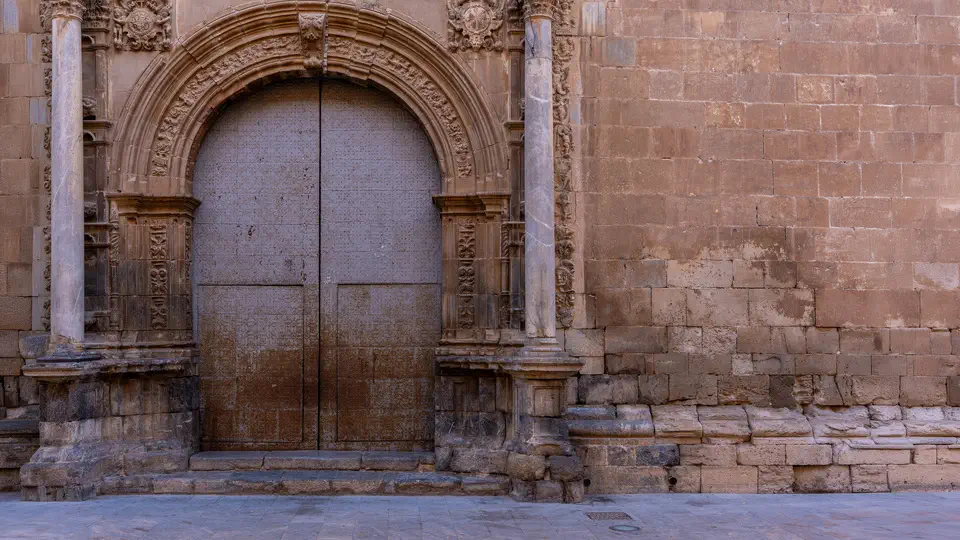
Before going inside, it is worth spending a little time looking at the main façade. It is one of the most distinctive parts of the entire complex. Its broad, horizontal composition is broken up by three monumental portals, each of which once led to a different section of the building: the church, the monastery, and the university.
The first portal, which provides access to the church, was completed in 1561 and represents the Renaissance style. Its design is relatively restrained, based on classical proportions and a carefully balanced architectural rhythm. It is a reminder that the architects of the complex drew inspiration from the Italian Renaissance, which had a tremendous influence on Spanish architecture during the 16th century.
The second entrance led to the monastic section and was completed in 1578. It is particularly interesting for its classical arrangement of three storeys, each featuring a different architectural order. This is a fine example of Renaissance attention to symmetry and proportion. The most decorative of the three is the university portal, created in the 18th century. Designed in 1723, it looks quite different from the other two entrances. This is unmistakably Baroque architecture, with its elaborate forms, sculptural details and rich symbolism.
At the top is an allegorical figure representing Wisdom, associated with Saint Thomas Aquinas and the symbolism of the Holy Spirit. The composition reminds us that the university was not simply a place where people acquired knowledge. Learning here remained closely connected with religion and Christian philosophy. The three portals are, in themselves, a small lesson in architectural history. Simply comparing their appearance reveals how artistic tastes and possibilities changed over the centuries.
The Great Cloister – the Renaissance heart of Santo Domingo College
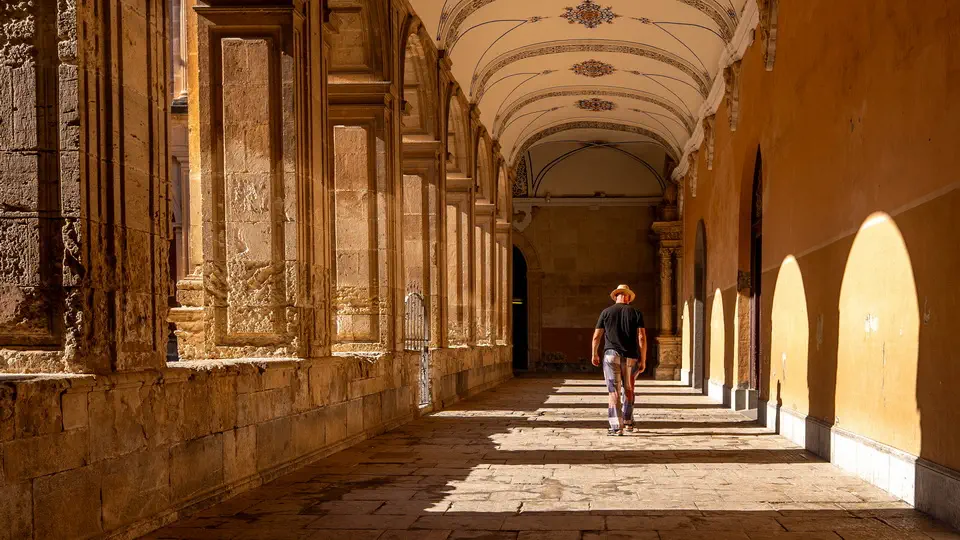
Once you pass through the entrance, the internal layout of the complex is what immediately catches your attention. The building was designed around two main courtyards, or cloisters. This was a typical arrangement for large monasteries and historic educational institutions. It made it possible to separate the different aspects of monastic and academic life while providing convenient access to the most important rooms.
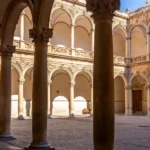
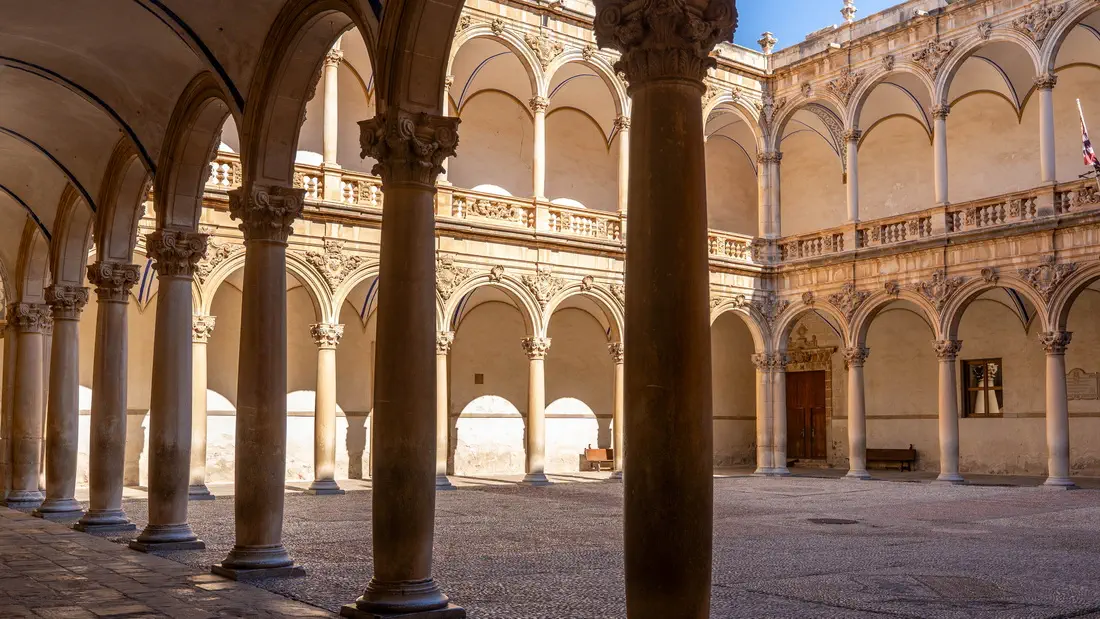
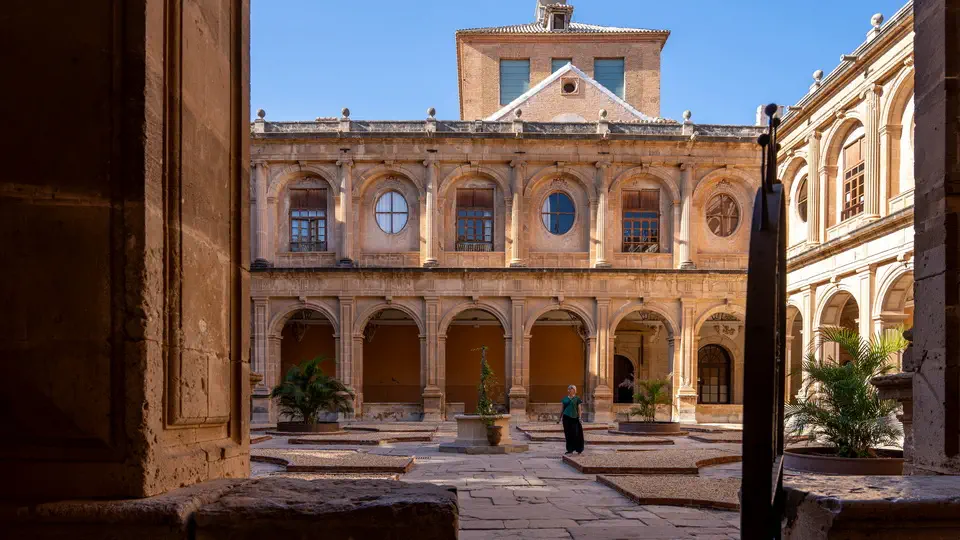
The first is known as Claustro Mayor, or the Great Cloister, and is also referred to as the College Cloister. It was built between 1602 and 1614 under the supervision of Agustín Bernardino. It is an example of Renaissance architecture, in which symmetry, proportion and the repetition of architectural elements play a particularly important role. The lower level features massive pillars with attached pilasters, while the upper floor has a somewhat lighter appearance. Here, half-columns with Ionic capitals stand between semicircular arches.
The cloister served as a passageway, but it was also an important part of everyday life for the monastery’s residents. It provided access between different rooms and offered somewhere to rest from daily duties and enjoy a moment of peace. In the university, the courtyard naturally formed the centre of the entire complex.
I like architectural arrangements such as this because they help us understand how historic institutions actually functioned. A modern school is usually associated with corridors and classrooms. In an old college, however, much of everyday life revolved around the courtyard, which connected the different parts of the building.
Santo Domingo College in Orihuela – The refectory the former dining hall of the Dominican friars
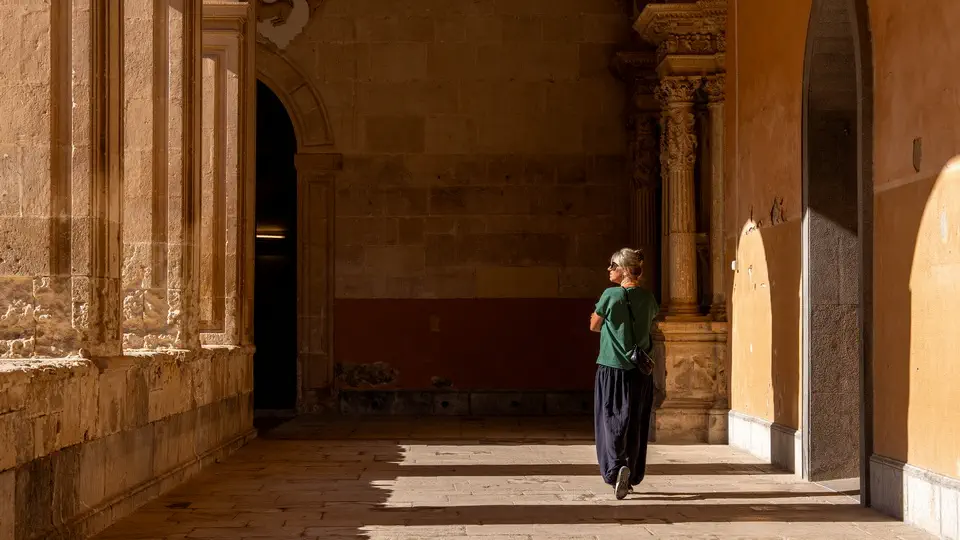
One of the most interesting rooms accessible from the Great Cloister is the refectory, the former dining hall of the monks. It was built towards the end of the 16th century and takes the form of a large rectangular room covered by ribbed vaults. In monasteries, the refectory was a place of particular importance. Communal meals formed part of the daily rhythm of monastic life and were governed by clearly defined rules. It was much more than an ordinary dining room: it was a space closely connected with religious discipline, prayer, and community life.
In Orihuela, one of the most striking features is the decorative dado covered with traditional Valencian ceramic tiles dating from the 18th century. The colourful tiles contrast with the relatively austere architecture of the room. They are an interesting example of local craftsmanship, which played an important role in decorating religious and representative interiors at the time.
When visiting, it is worth looking closely at both the ceramic decorations and the ceiling. Details such as these are what give the room its distinctive historic character and make it easier to imagine the everyday lives of the Dominican friars several centuries ago.
Santo Domingo College in Orihuela – The sacristy the architectural setting for church ceremonies
Another room connected with the church is the sacristy, which consists of two adjoining rectangular spaces. One of them is distinguished by a barrel vault decorated with coffers featuring distinctive diamond-shaped motifs. The architectural treatment of the entrance is particularly interesting. It resembles a triumphal arch and is decorated with motifs referring to the Annunciation, together with the heraldic symbols of Fernando de Loazes.
It is worth paying attention to the founder’s coat of arms. It is one of the details that reminds us of the man without whom the entire complex might never have taken the form we see today. The sacristy was not intended for all those who used the college. It served the clergy as a place to prepare for services and store liturgical vestments and objects used during religious ceremonies. Its richer decoration emphasised the importance of the church and the role of the liturgy in the life of the Dominican community.
The beautiful Church of Santo Domingo – a Baroque interior behind a Renaissance entrance
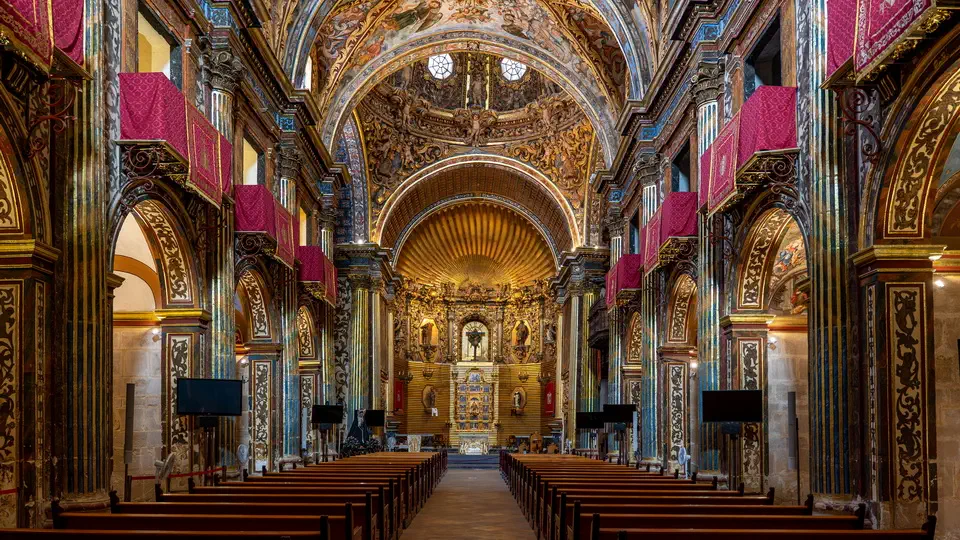
The church is one of the most important parts of the entire complex and deserves particular attention during a visit. From the outside, its entrance has a Renaissance character, but the interior tells a slightly different story. Here, older architectural features are combined with rich Baroque decoration.
The church has a single nave, chapels positioned between the buttresses, a transept and a polygonal presbytery. The nave is covered by a barrel vault with lunettes, while a dome on pendentives rises above the crossing of the nave and transept. The presbytery, meanwhile, has a distinctive conch-shaped vault. The church was remodelled during the second half of the 17th century, which is when its interior acquired a more elaborate and representative character.
The paintings of Bartolomé Albert
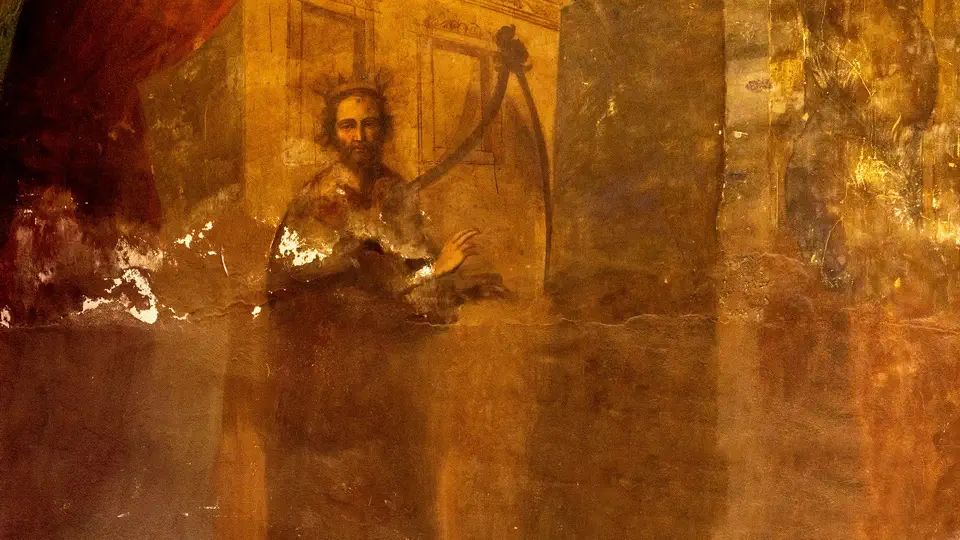
Among the interior decorations are wall paintings adorning the vaults, attributed to Bartolomé Albert. These paintings form an important part of the church’s artistic character and demonstrate how much attention was paid to the decoration of religious interiors. It is worth looking upwards and taking a moment to appreciate the entire ceiling. When visiting churches, it is easy to concentrate on the altars and paintings at eye level, but some of the most interesting decorations are often found directly above our heads.
The Altarpiece of the Mysteries of the Rosary
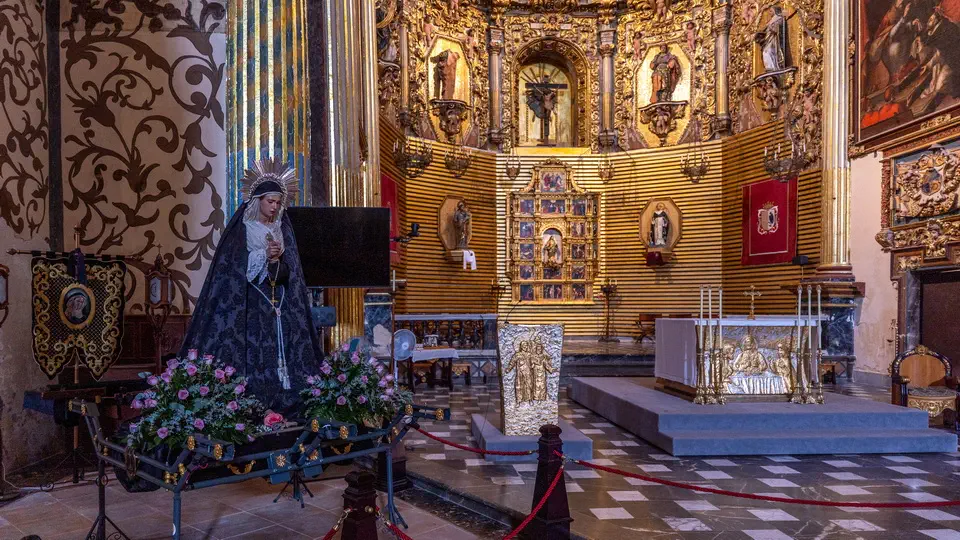
The presbytery contains one of the college’s most important artistic treasures: the altarpiece depicting the Mysteries of the Rosary, associated with the work of Nicolás Borrás. The artist was active in the 16th century and was one of the important religious painters working in Valencia. His paintings combined Renaissance traditions with the religious subjects characteristic of Spanish art at the time.
The altarpiece was probably created between 1565 and 1575. Its subject is centred on the Mysteries of the Rosary, which played an important role in Dominican spirituality. This choice was no coincidence. The Rosary was one of the most significant elements of the religious tradition of the order.
The Chapel of the Rosary
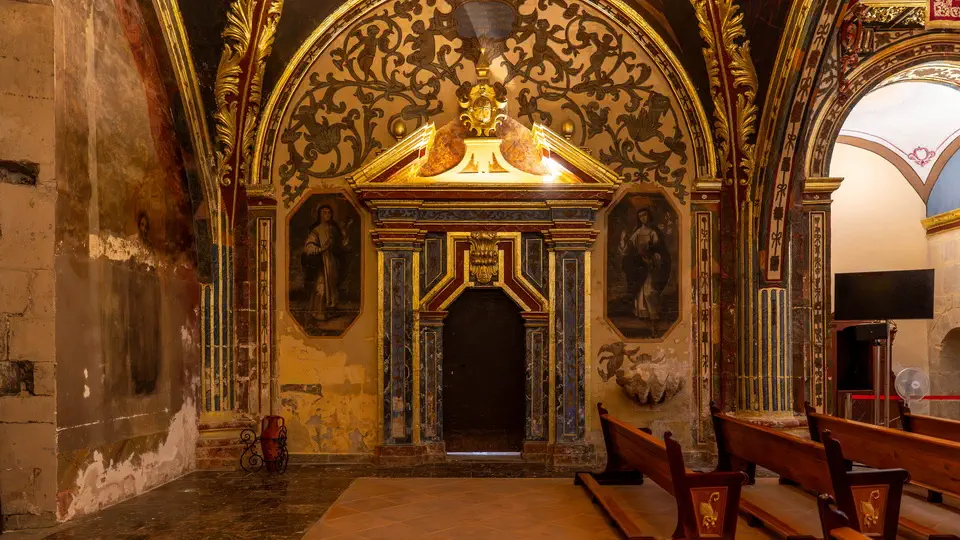
One of the arms of the transept contains the Chapel of the Rosary, built between 1680 and 1701. It is a separate, richly designed space with a Latin cross layout. A dome with a lantern rises above the crossing, while the presbytery ends in a polygonal apse. The interior features a decorative vaulted ceiling and its own altar, created towards the end of the 17th century by Antonio Caro and Laureano Villanueva.
The chapel was associated with the Brotherhood of Our Lady of the Rosary. Its construction demonstrates just how important Marian devotion was in the religious life of Orihuela. It is also a good example of the Baroque tendency to create separate, richly decorated spaces dedicated to particular forms of religious worship.
The Baroque University Cloister
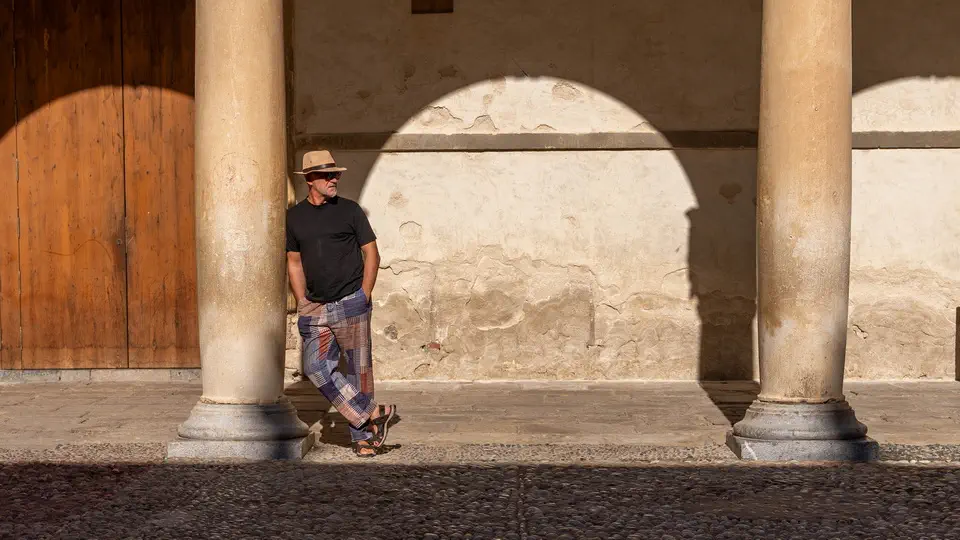
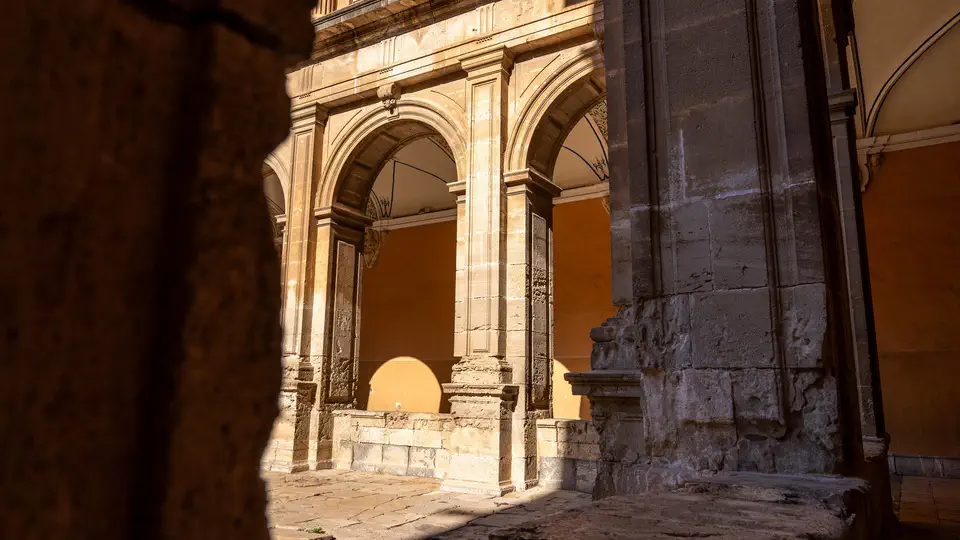
The second of the complex’s main courtyards is known as Claustro de la Universidad, or the University Cloister. It was built considerably later than its Renaissance counterpart. Construction took place between 1727 and 1737, following a design by Father Francisco Raymundo, who was associated with the Trinitarian Order.
Here, the architectural character changes noticeably. Instead of the restraint of the Renaissance, we find much more elaborate decoration, giving the entire courtyard a distinctly Baroque appearance. The cloister has two storeys, with semicircular arches resting on columns. The spaces between the arches are decorated with heraldic elements, emphasising the prestigious character of the former university.
It is best to explore both courtyards one after the other. Only then does the difference between 17th- and 18th-century architecture become particularly clear. The first is more restrained and harmonious, while the second is considerably more decorative. They are, in effect, two different approaches to architecture contained within a single historic complex.
The college tower and museum hall – reminders of the past
The monumental complex is complemented by a tower constructed between 1738 and 1739. It was originally built of brick, then plastered and painted. Its design fits perfectly with the Baroque character of the later parts of the complex. It is not a separate structure dominating the city skyline, but an important element of the overall architectural composition. Together with the extensive façades and three portals, it gives the college its distinctive silhouette.
The tower also serves as a reminder that the construction of the complex took place in several stages. It was never built according to a single, unchanging plan. Over successive generations, it was extended, remodelled and adapted to meet new requirements.
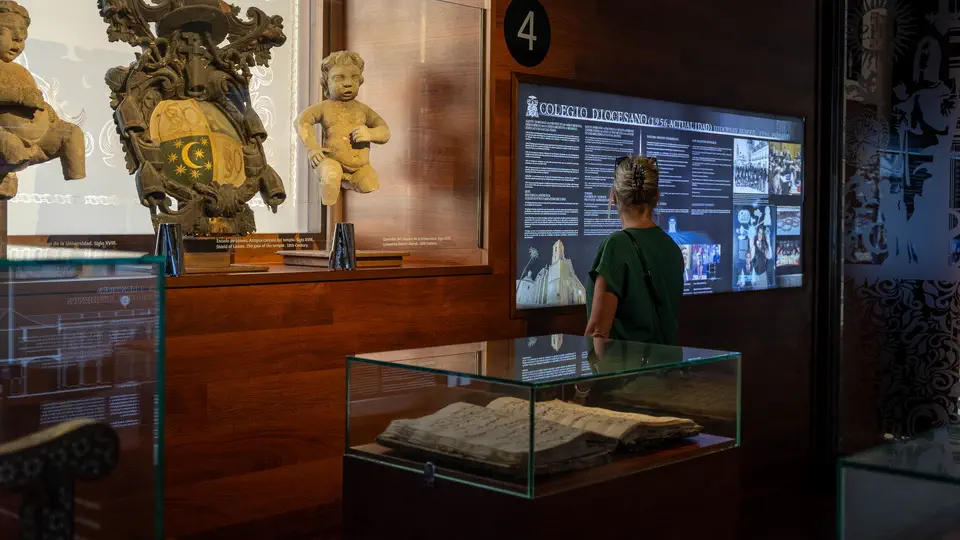
The college also has its own small museum space, which provides a better understanding of its centuries-old history. Admittedly, it is essentially a single room filled with documents, objects connected with the college and mementoes of the people who once lived here. The Aula Museística was opened to visitors in 2018. Its purpose is to display items associated with the history of the institution and the historic complex itself.
The collection includes objects recalling the activities of the Dominican friars, the former university and the later history of the school. The room has an educational purpose, so the experience is not limited to looking at exhibits. Visitors can also learn about the history of a place that shaped the intellectual life of Orihuela for centuries.
When the museum room opened, a documentary film about the history of the college was also presented. I recommend sitting down for a while, taking a break and watching this rather interesting film. It is a good way to bring together everything you have learnt about the different stages in the development of the building.
A college that changed its purpose over the centuries
The history of Santo Domingo did not end with the Dominicans and their university. During the 19th and 20th centuries, the building changed hands several times, and its rooms were put to a variety of different uses. After the university closed, the complex retained its educational role. In 1872, the Jesuits began working here, running a school and developing its educational facilities. Over time, the complex acquired physics and chemistry laboratories, a natural history museum, a library and sports facilities, among other additions.
It is worth mentioning the Jesuit Julio Furgús, who played an important role in developing archaeological interests in Orihuela. His activities included establishing archaeological and prehistoric collections. These collections represented an important stage in the development of local museums and helped establish a tradition of research into the region’s ancient past.
The building also experienced some difficult periods. During the Spanish Civil War, between 1936 and 1939, the complex was occupied and some of its furnishings were destroyed. Among the items damaged were elements of the church’s decoration and the cenotaph of the founder, Fernando de Loazes.
In 1956, the Jesuits left the college, and the building came under the administration of the diocese. Since then, it has operated as Colegio Diocesano de Santo Domingo. The former university never regained its academic status, although its educational traditions remain an important part of the city’s history. The complex is also associated with the Archbishop Loazes Chair at the University of Alicante.
A few final thoughts after visiting Santo Domingo College
In my opinion, this is one of those historic monuments that helps you understand the history of an entire city. Orihuela has plenty of interesting churches, palaces and museums, but Santo Domingo stands out because of its scale and diversity. What we see here is not simply an old building. It is several historical worlds brought together within a single complex. There is the Renaissance architecture of the Dominican friars, the Baroque setting of the former university, a church containing valuable works of art and rooms that recall the everyday lives of monks and students.
One of the most interesting aspects is the contrast between the two cloisters. The Renaissance and Baroque courtyards show just how much architectural tastes changed over the course of a few generations. Then there is the refectory with its Valencian tiles, the sacristy, the Chapel of the Rosary and the monumental entrance portals. If you are interested in history, religious art or the history of universities, I would recommend allowing plenty of time for your visit. I certainly would not limit it to admiring the façade and taking a few photographs. The interiors are just as fascinating, and it is really only once you step inside that you begin to appreciate the true richness of this place.
While exploring Santo Domingo, I would particularly recommend paying attention to three things: the former burial place of Fernando de Loazes, the story of the painting by Velázquez and the traces of destruction left by the Spanish Civil War. These stories provide perhaps the best illustration of what makes the former college so extraordinary. This is not a monument that has survived unchanged throughout the centuries. On the contrary, for five hundred years it has witnessed religious, political, scientific and social transformations.
For me, the greatest mystery of Santo Domingo is how many stories are hidden behind its monumental walls. A former monastery, university, library, museum, and modern school combine to create a story that cannot be reduced to a handful of dates. If you find yourself in Orihuela, make sure you allow enough time to explore this place. Afterwards, I would definitely recommend taking a walk through the city’s historic centre. Nearby, you will find El Salvador and Santa María Cathedral, as well as several palaces that recall the former importance and prosperity of this part of Valencia.
Santo Domingo College in Orihuela – Practical information
The college is located at Calle Adolfo Clavarana 51, in the historic part of Orihuela. It is easy to combine a visit with a walk around the city’s most important monuments.
- Opening days and visiting hours:
- Tuesday–Friday: 10:00–11:00, 12:00–13:30 and 16:00–19:00
- Saturday: 10:00–14:00 and 16:00–19:00
- Sunday and public holidays: 10:00–14:00
- Santo Domingo College is closed to visitors on Mondays.
- Admission prices:
- Standard ticket: €2.
- Pensioners, students, and teachers with valid identification: €1.
- Groups of more than 15 people: €1 per person.
- Groups of more than 25 people: €0.50 per person.
Website: Colegio Diocesano Santo Domingo, Phone: +34 965 300 240.
Santo Domingo College is one of the most important historic landmarks in Orihuela. If you are visiting the city, do not leave this place off your itinerary. Its history demonstrates just how significant Orihuela once was and how many traces of that period have survived to the present day. For me, these are precisely the kinds of historic buildings I find most interesting: not only architecturally beautiful, but above all full of stories waiting to be discovered as you move from one room to another.
Legends and mysteries of Santo Domingo College in Orihuela – a lost tomb, hidden treasures and traces of a former university
Old monasteries and historic universities have something about them that captures the imagination. Thick walls, enclosed cloisters, chapels and rooms where successive generations lived for hundreds of years provide the perfect setting for stories about ghosts, secret passages and forgotten treasures. Santo Domingo College in Orihuela has its own mysterious side, too.
However, I am not going to add stories about the ghosts of monks whose presence I have been unable to confirm through reliable historical accounts. This place has more than enough genuine mysteries of its own. The lost tomb of its founder, the extraordinary history of a valuable painting by Velázquez, the former archaeological collections and the turbulent events of the Spanish Civil War create a story that at times sounds almost like the plot of a historical novel.
The mystery of Fernando de Loazes’s tomb
One of the most intriguing stories connected with the college concerns the man to whom it owes its existence. Fernando de Loazes was a clergyman from Orihuela who enjoyed an impressive ecclesiastical career. Among other positions, he served as Archbishop of Tarragona and later Archbishop of Valencia. He was a wealthy and influential man who decided to devote part of his fortune to establishing an educational institution in his home town.
In the foundation documents, he included a very specific wish. He wanted his body to be laid to rest in the main chapel of the college after his death. This was no arbitrary decision. The founder intended the institution he had created to become his mausoleum as well. Loazes died in Valencia on 29 February 1568. His body was transported to Orihuela and buried in the main chapel, initially in a grave in front of the altar. It was not until 1725, more than 150 years after his death, that an impressive tomb was created. And this is where the most mysterious part of the story begins.
The tomb did not survive the Spanish Civil War. During the conflict, the founder’s cenotaph was destroyed, and some sculptures in the presbytery were damaged or mutilated. The original monument no longer exists in its former form. Today, there is a memorial to Fernando de Loazes, but it is not the same monument that was created in the 18th century.
There is also the question of what happened to the founder’s remains. Historical documentation confirms that he was buried in the college, but the destruction of the tomb does not automatically mean that the grave itself was destroyed. These are two different events and should not be confused. This is precisely what makes the story of the tomb so fascinating. The man who planned his eternal resting place here left behind a monumental institution, yet the original burial site was affected by events that continue to raise questions.
The painting by Velázquez that remained in the college for three centuries
This is one of the most extraordinary artistic stories associated with Santo Domingo College in Orihuela (Colegio Diocesano de Santo Domingo). For approximately three centuries, the college housed a painting attributed to Diego Velázquez, depicting the Temptation of Saint Thomas Aquinas – La tentación de Santo Tomás de Aquino.
Imagine a work by one of the greatest painters of Spain’s Golden Age being kept for generations within the walls of a former Dominican monastery. It was not simply a decorative painting. It depicted a saint whose philosophy and theology were of enormous importance to the Dominican Order.
The subject itself is particularly interesting. Saint Thomas Aquinas, one of the most outstanding thinkers of the Middle Ages, is shown instantly of spiritual trial. According to tradition, after resisting temptation, he received supernatural confirmation of his purity and faithfulness to his vocation.
The painting remained in the college for a long time, but the events of the Spanish Civil War changed its fate. The work was transferred to the Museo Nacional de Orihuela and, after the war, eventually found its way to the Diocesan Museum of Sacred Art.
Its history demonstrates that historic colleges and monasteries were not only places of prayer and learning but also important repositories of art. Some works kept there survived because they were moved to safer locations at the right moment. It is worth remembering that the painting and its journey are not simply a legend. This is a documented episode in the history of the college, illustrating just how many valuable objects were once kept behind its walls.
A church turned into a warehouse – an extraordinary episode of the Civil War
Another story reveals just how dramatically the purpose of this place changed during the Spanish Civil War, between 1936 and 1939. The college was occupied, and its rooms began to serve entirely different purposes. Perhaps the most surprising example concerns the church itself. The building where generations of worshippers had attended religious services was turned into a seed warehouse by the Agricultural Workers’ Collective (Colectividad de Obreros Agrícolas).
It is difficult to imagine a more striking contrast. A place created for prayer, contemplation, and education became a warehouse used for agricultural purposes. This was not merely a change in how the building was used. During the war, the cenotaph of Fernando de Loazes was destroyed, sculptures in the presbytery were damaged and some furnishings disappeared. Many elements of the original decoration were lost for good.
This episode is particularly important because it helps explain why some parts of the college look different today from what we might expect of such a monumental historic building. Not all the damage is the result of the passage of time. Some of it bears witness to specific historical events and the negligence of successive building administrators. We know from our history how beautiful castles and palaces sometimes ended up under state administration, with little concern shown for preserving their original appearance.
The mysterious world of the former archaeological collections
Few people associate Santo Domingo College with the beginnings of local archaeology, yet some of the region’s most important collections of antiquities and prehistoric artefacts were developed here. A major role was played by Julio Furgús, a Jesuit and researcher with a particular interest in archaeology. When the Jesuit Order returned to Orihuela in the 19th century, scientific facilities began to develop within the college. These included physics and chemistry laboratories, a natural history museum and archaeological collections.
Furgús was particularly interested in the prehistoric past of the southern part of Alicante province. He conducted research at archaeological sites and collected objects documenting the lives of the area’s ancient inhabitants. Among the finds were artefacts associated with the Argaric culture, one of the most important Bronze Age cultures on the Iberian Peninsula. Its people inhabited the south-eastern part of what is now Spain several thousand years ago.
The former college collections became one of the foundations for the development of archaeology in Orihuela. Their history is connected with the subsequent growth of local museums, including the Museo Arqueológico Comarcal de Orihuela.
There is something fascinating about this. In a building that we primarily associate with the Dominicans, theology and a former university, scientific interests also developed around a much older chapter in the region’s history. Long before medieval towns and monasteries appeared, communities lived in these lands, leaving behind tools, pottery, and traces of ancient settlements. It is an entirely different chapter in the history of the college, but every bit as interesting.
Are there secret passages beneath the college?
With such an extensive complex, it is tempting to imagine stories about underground corridors, secret passages and hidden chambers. Santo Domingo occupies a considerable area, and its history stretches across several centuries. It is hardly surprising that stories of this kind naturally emerge around places like this.
However, I have not found reliable evidence of an extensive network of secret tunnels connecting Santo Domingo with other historic monuments in Orihuela. Nor is there any sound basis for presenting stories about underground Dominican treasure chambers as historical fact.
There is, however, something that may have encouraged such speculation. The original plans for the complex included considerably more rooms than visitors can see during an ordinary tour. Architectural documentation mentions, among other things, an infirmary for the sick, a hospice for guests, stables, servants’ quarters, kitchens and various service facilities.
In many respects, this was a self-sufficient world. Monks lived here, teachers worked, students studied, guests were welcomed and meals were prepared. It is therefore hardly surprising that the complex contained numerous rooms whose original purpose might not be immediately obvious to a modern visitor. If you come across a quieter corridor or an unusually arranged room during your visit, remember that it does not necessarily conceal a mystery. Occasionally all it takes is a little knowledge of the building’s former purpose to understand its architecture.
The mystery of the first library and its forgotten books
Another fascinating aspect of the college’s history concerns its library. Santo Domingo was an important academic centre, and the university needed access to books, manuscripts and other materials used by lecturers and students. Over time, a public library also operated within the complex, and its documentary collections were important to the entire city.
Historical records relating to Fernando de Loazes, the college and the former university are now kept at the Archivo Histórico de Orihuela, the city’s historical archive.
One particularly interesting fact is that these documents did not remain forever in the place where they were created. Until 1941, some archival material was kept at the college, where the public library operated. It was subsequently transferred to the Teodomiro Palace and later to Palacio de Pinohermoso, where the historical archive is now located.
This is where we should look for documents that help reconstruct the history of the former university. It is easy to imagine how many stories are hidden in these old books: the names of students, decisions made by university authorities, records relating to the monastery’s property, wills, and correspondence. Each document has the potential to shed new light on the lives of the people who shaped Santo Domingo over the centuries.
This is not a mystery in the supernatural sense. Rather, it is a fascinating world of historical documents, many of which reveal events from several hundred years ago only after careful examination.
Is Santo Domingo College haunted?
With such a long history, it is tempting to imagine a story about the ghost of a former monk wandering through the cloisters after dark, or perhaps a professor who cannot bring himself to leave an old lecture room. After all, a university operated here for more than three centuries, preceded by the Dominican monastery.
However, I have been unable to find reliable local accounts confirming stories of this kind. There is no well-documented legend about the ghost of Fernando de Loazes or mysterious apparitions appearing in the former university rooms.
Of course, this does not mean that residents have never told such stories. Tales of this kind are often passed down orally and never make it into official historical publications. Nevertheless, I would not want to attribute legends to Orihuela without being able to confirm that they actually exist.
The place itself has more than enough mysteries to capture the imagination. Especially when you think about all the people who walked through these same cloisters over the centuries. Dominican friars, students, professors, Jesuits, and schoolchildren – each of them left something behind.
Santo Domingo College in Orihuela information and interesting things to know
Santo Domingo College in Orihuela (Colegio Diocesano de Santo Domingo) is one of the most important historic monuments in the city. Over the centuries, it served as a Dominican monastery, college, pontifical university and royal university. Today, it continues to operate as an educational institution. Here are 25 interesting facts that reveal some lesser-known aspects of this remarkable complex.
- Santo Domingo College is known as the Escorial of the Levant (El Escorial de Levante). This nickname refers to the monumental monastery-palace complex of El Escorial near Madrid.
- The origins of the college date back to 1510, when Dominican friars associated with the hermitage of Nuestra Señora del Socorro settled in the area.
- The founder of the complex was Fernando de Loazes, a clergyman born in Orihuela who enjoyed an impressive ecclesiastical career and eventually became, among other positions, Archbishop of Valencia.
- In 1569, Pope Pius V granted the college the status of a pontifical university. This was one of the most important distinctions in its history.
- In 1646, King Philip IV granted the institution the status of a royal university, further increasing its prestige.
- The university began teaching in 1610, although its foundation and efforts to obtain the necessary privileges had started considerably earlier.
- Students at the former university could study theology, philosophy, medicine, canon law and civil law.
- The university ceased operating in 1835, following 19th-century reforms and the closure of several Spanish educational institutions.
- The college has three monumental portals leading to different parts of the complex: the church, the monastery and the former university.
- The oldest of the three portals dates from 1561 and represents the Renaissance architectural style.
- The university portal is considerably younger. It was created in the 18th century, based on a design prepared in 1723. Its elaborate decoration is characteristic of Spanish Baroque architecture.
- At the top of the Baroque university portal is an allegorical figure representing Wisdom, referring to the symbolism of learning and Christian philosophy.
- The complex has two main cloisters. One represents the Renaissance, while the other is Baroque. Comparing them provides an opportunity to see how Spanish architecture changed over successive centuries.
- The Great Cloister (Claustro Mayor) was built between 1602 and 1614 under the supervision of Agustín Bernardino.
- The University Cloister (Claustro de la Universidad) was constructed between 1727 and 1737. Its design is attributed to Father Francisco Raymundo of the Trinitarian Order.
- The former refectory, or dining hall of the monks, was decorated with Valencian ceramic tiles dating from the 18th century. The colourful tiles form a decorative dado around the room.
- In the sacristy, visitors can admire a barrel vault with coffers featuring distinctive diamond-shaped details. Its decoration also includes references to the founder of the college.
- The Church of Santo Domingo has a single nave, side chapels, a transept and a polygonal presbytery. Its interior combines Renaissance architectural features with later Baroque decoration.
- The presbytery contains an altarpiece depicting the Mysteries of the Rosary, associated with the work of Nicolás Borrás, an important painter active in 16th-century Valencia.
- The Chapel of the Rosary was built between 1680 and 1701. Its construction was connected with the activities of the Brotherhood of Our Lady of the Rosary.
- For approximately three centuries, the college housed a painting attributed to Diego Velázquez, depicting the Temptation of Saint Thomas Aquinas. The work is connected with the history of Orihuela’s religious art collections.
- During the Spanish Civil War, the church was used as a seed warehouse by the Agricultural Workers’ Collective. This was one of the most unusual episodes in the history of the building.
- In the 19th century, the Jesuits settled in the college. They developed educational, scientific and museum activities here. One of the figures associated with their work was the Jesuit and archaeologist Julio Furgús.
- The former college collections included archaeological objects associated with the Argaric culture, one of the most important Bronze Age cultures in the south-eastern part of the Iberian Peninsula.
- In 1933, Santo Domingo College was declared a National Monument. Today, it continues to operate as a diocesan school, retaining its educational character despite more than five centuries of history.
- Santo Domingo College is one of those historic monuments that demonstrate how many layers of history can be hidden within a single building. From a Dominican monastery, through a pontifical and royal university, to a modern school, every period has left its mark here.
Related articles on Get Ready For Adventure
If you are planning a visit to this part of Spain, you may also find these guides useful:
- Orihuela – a historic city worth visiting on the Costa Blanca – a guide to the city’s history, cathedral, churches, palaces and most interesting attractions.
- Attractions on the Costa Blanca – what to do and what to see – inspiration for discovering more of this fascinating region.
- Torrevieja on the Costa Blanca – what to see and how to spend your time – a useful guide if you are staying on the coast and planning day trips inland.