Holy Trinity Church in Kościerzyna is one of the city’s historic landmarks and a place worth adding to your list of attractions.
As you probably know, I have little in common with the Church as an institution. However, I do enjoy visiting churches because old walls often conceal local history and preserve traces of the events that shaped a particular place. ….
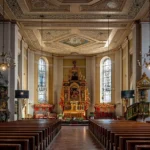
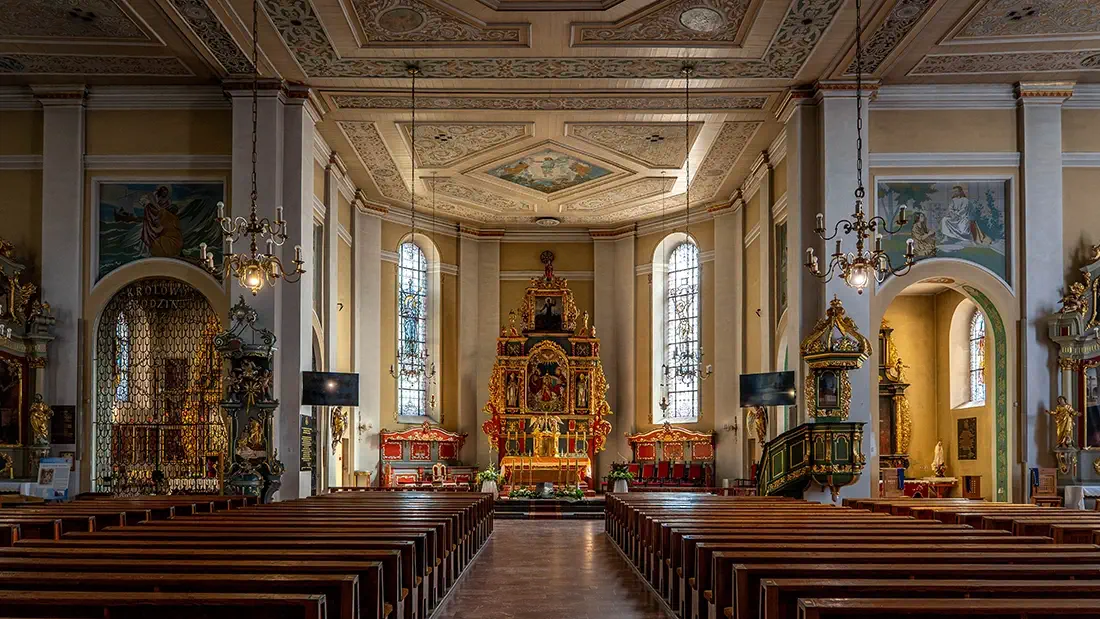
The Holy Trinity Church in Kościerzyna immediately catches your attention with its distinctive Neo-Baroque architecture and tall tower, but the real treasure can be found inside. The present church was built at the beginning of the 20th century, yet its interior contains furnishings that came from earlier churches which stood here several hundred years ago. This means that during a single visit you can see historic works from several different periods.
The church is also an important centre of Marian devotion. It houses the image of Our Lady of Kościerzyna – Queen of Families, and since 1997 the church has held the title of the Shrine of Our Lady of Kościerzyna – Queen of Families. In the article below, I will tell you about our visit to the church and its fascinating history. I will also answer some common questions and share plenty of interesting information and unusual facts connected with this remarkable building.
Holy Trinity Church in Kościerzyna and its remarkable history
The history of Holy Trinity Church in Kościerzyna is much older than the present Neo-Baroque building. Today’s church dates only from the beginning of the 20th century, but the history of the parish reaches back to the Middle Ages. This centuries-old story is precisely what makes it worth looking not only at the architecture when visiting the church, but also at the surviving furnishings. In many cases, these are historic objects that came from earlier churches which stood on this site before the present building.
The first known mention of the parish in Kościerzyna dates from 1210. From the beginning of its existence until 1826, it belonged to the Diocese of Włocławek. It was then incorporated into the Diocese of Chełmno, based in Pelplin, and at the same time became the seat of a deanery. Unfortunately, there is not enough surviving information to reconstruct the appearance of the first medieval church. We do know, however, that the church in Kościerzyna remained a wooden building for a long time. This is confirmed, among other things, by a report from a bishop’s visitation in 1583, which records the existence of a wooden church.
The church did not have a particularly peaceful history. It was destroyed by fire several times. Parish sources mention fires in 1463 and 1626. Each such disaster meant that the building had to be reconstructed, and sometimes its appearance was changed as well. In the 17th century, the people of Kościerzyna finally had a masonry church. A new building was erected in 1642, replacing the earlier wooden structure. This was an important moment in the history of the parish because some of the furnishings from this church can still be seen today.
The present main altar dates from this period and stylistically belongs to the transitional period between the Renaissance and Baroque. Some side altars, choir stalls and paintings from the former church have also survived. Thanks to them, the history of the 17th-century church has not been completely erased by later rebuilding. It is worth keeping this in mind when visiting. The present church may look like a single, unified building from the beginning of the 20th century, but its interior is actually a combination of several different periods.
Another tragic chapter came at the beginning of the 18th century. In 1709, the church was once again destroyed by fire. It was an exceptionally difficult period for the town itself. The years 1709–1711 brought not only destruction caused by warfare, but also epidemics and the movement of troops through the region. After the disaster, it was decided to build another church. The new building was erected in 1724 and consecrated in 1769. It was a Late Baroque church which served the people of Kościerzyna and the surrounding area for several decades.
Interestingly, this building was not demolished because it was in poor technical condition. The main reason was simply that it was too small. The parish was growing and the old church could no longer accommodate all the worshippers.
At the turn of the 19th and 20th centuries, Kościerzyna was becoming an increasingly important regional centre. The town was expanding, the population was growing and, with it, so were the needs of the parish. Eventually, it was decided that instead of carrying out another small-scale extension, the town needed a large and representative church that would match its growing importance. The old 18th-century church was therefore demolished and construction of the present building began on the same site. The new church was built between 1914 and 1917.
This is a particularly interesting period in the history of the building because construction began during the First World War. Despite the extremely difficult political and economic circumstances, the project was successfully completed. The result was a large three-nave brick church built on a stone foundation. A tower topped with a distinctive Baroque-style cupola rises above the building. The church was designed in the Neo-Baroque style, meaning that its architecture deliberately refers to forms characteristic of the Baroque period, although the building itself was created at the beginning of the 20th century.
One of the most fascinating aspects of the present church is the way the furnishings from the previous building were treated. Constructing a new and much larger church did not mean completely breaking with the past. Many elements from the earlier churches were transferred into the new building. As a result, works from several different periods can now be found side by side inside. The oldest historic object is the Late Gothic painting The Crucifixion, dating from the beginning of the 16th century. It is therefore around four hundred years older than the present church.
The main altar mentioned above dates from the 17th century, while most of the remaining historic furnishings come from the first half of the 18th century. The church also contains a Rococo baptismal font and a Baroque pulpit. The pulpit is particularly interesting because it features a depiction of the former 18th-century church. Today, this is an unusually valuable trace of a building that no longer exists.
The history of the church is, of course, closely connected with the turbulent history of Kościerzyna itself. Following the First Partition of Poland in 1772, the town became part of the Prussian state. During the 19th century, Kościerzyna developed into an important regional centre, while the Catholic Church played a significant role in the life of the local community.
Kościerzyna also became one of the important centres of Polish social and national life in Pomerania. During the second half of the 19th century, Polish organisations, reading societies and social initiatives developed here. The town’s parish church was one of the places that helped maintain the local Catholic community. The new church was completed in 1917, and only a few years later Kościerzyna, together with part of Pomerania, returned to Poland.
The Shrine of Our Lady of Kościerzyna
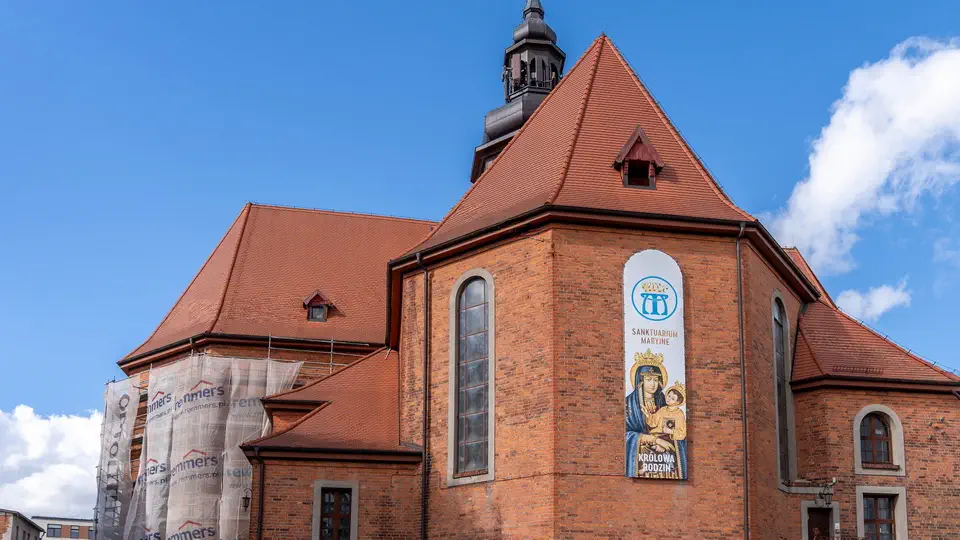
The cult of Our Lady of Kościerzyna also occupies an important place in the history of the church. One of the side chapels contains a 17th-century painting of the Virgin Mary and Child. It is a copy of the Roman image of Our Lady of the Snows – Salus Populi Romani. According to the tradition associated with the painting, its history in Pomerania dates back to the beginning of the 17th century.
The image currently kept in Kościerzyna was probably created after 1642, during the period when the earlier masonry church was being built. Research into the painting indicates that its composition was connected with the furnishings of that church.
In 1970, Bishop Kazimierz Kowalski of Chełmno established a Marian shrine at Holy Trinity Church. Another important moment came in 1997, when the church was granted the title of the Shrine of Our Lady of Kościerzyna – Queen of Families. A year later, on 16 May 1998, the image was solemnly crowned with papal crowns.
Holy Trinity Church in Kościerzyna today
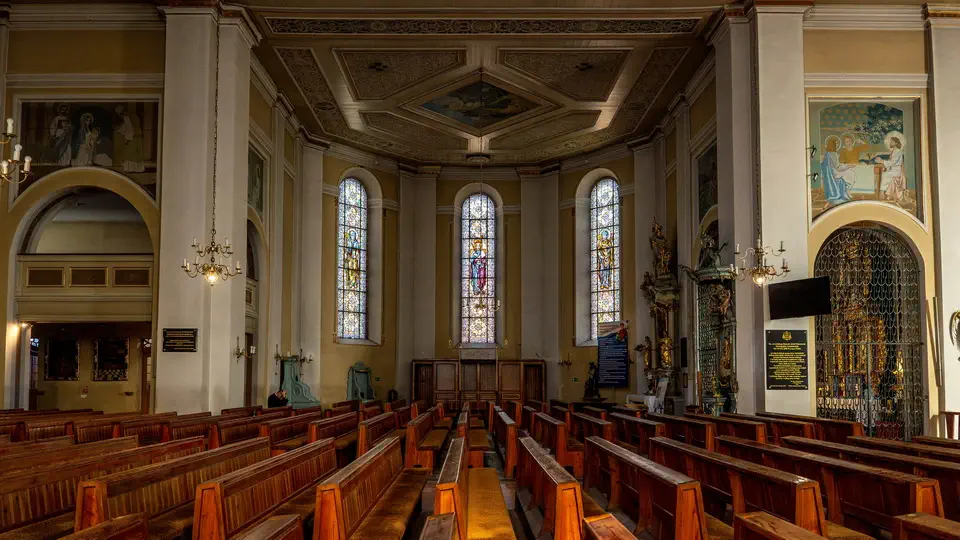
The present church therefore has a relatively short history as a building – just over a century – but the history of the site and parish is many times older. You could say that the present church is simply the latest link in a chain of churches that have stood on this same site for centuries.
What I like most about this place is precisely the combination of 20th-century Neo-Baroque architecture with historic objects inherited from earlier churches. When you step inside, you can see works created in the 16th, 17th and 18th centuries, even though the present building was only erected between 1914 and 1917.
The church, together with the site of the former churchyard and its stone wall, was entered into the register of historic monuments of the Pomeranian Voivodeship in 2007. For this reason, I would not treat Holy Trinity Church simply as another architectural landmark when exploring Kościerzyna. It is a place where you can see several layers of the town’s history particularly clearly – from the medieval parish and the earlier wooden and masonry churches to the large Neo-Baroque building we see today.
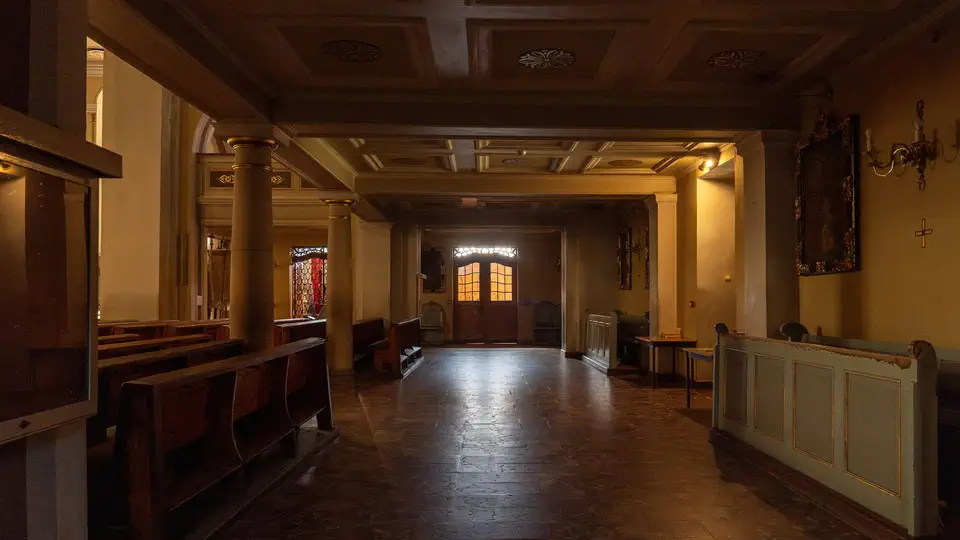
The present church is a large brick structure built on a stone foundation. It has three naves and its floor plan is based on the form of a Greek cross. The entire building is dominated by a tower topped with a distinctive Baroque-style cupola. The interior is covered by a wooden ceiling. The Neo-Baroque form of the church refers to earlier architectural traditions, but the building itself was created in the 20th century. It therefore combines a style inspired by the Baroque with the architectural character of an early-20th-century place of worship.
Holy Trinity Church in Kościerzyna and its historic furnishings
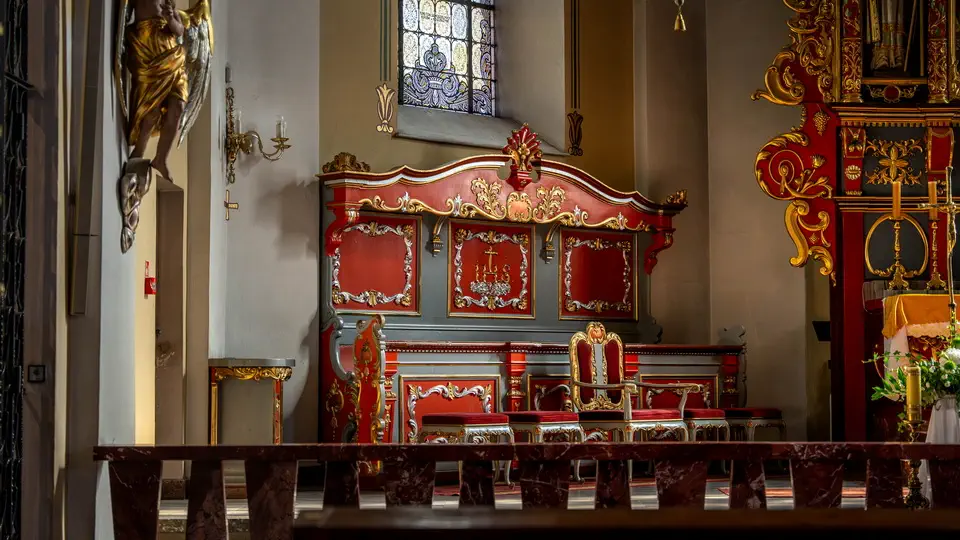
The interior of Holy Trinity Church is particularly interesting for anyone who enjoys historic buildings and religious art. Most of the historic furnishings date from the first half of the 18th century, although there are also considerably older works. Below are the objects that particularly caught my attention, and I would encourage you to stop and take a closer look at them when visiting.
- The main altar – One of the most important pieces of furnishings is the monumental main altar dating from the first half of the 17th century. Its form represents the transitional period between the Renaissance and Baroque. The altarpiece contains a relief depicting the Coronation of the Blessed Virgin Mary. The altar is therefore several centuries older than the present church and is a perfect example of how much of the earlier furnishings have survived.
- The painting The Crucifixion – Particular attention should be paid to the Late Gothic painting The Crucifixion, located in the right-hand side altar. It is considered the oldest historic object currently kept in the church. The painting dates from the beginning of the 16th century, meaning that it was created before the Reformation. This is one of those works that is worth spending a little more time looking at rather than simply passing by as another piece of church furniture.
- The Rococo baptismal font – The historic furnishings also include a Rococo baptismal font. Its presence is a reminder that the church was, for centuries, a place where the everyday religious life of the people of Kościerzyna took place, rather than simply a representative historic building.
- The Baroque pulpit – The church has also preserved a Baroque pulpit featuring a painted representation of the former 18th-century church in Kościerzyna. This is a particularly fascinating piece because it allows us to look at the history of the church from a slightly different perspective. It is not only a work of religious art, but also a kind of visual record of the earlier building.
- Our Lady of Kościerzyna – Holy Trinity Church is also an important centre of Marian devotion. One of the side chapels contains an image of the Virgin Mary and Child painted by an unknown 17th-century artist. The image refers to the Roman painting of Our Lady of the Snows, known as Salus Populi Romani. A Marian shrine was established in the church in 1970. In 1997, the church was granted the title of the Shrine of Our Lady of Kościerzyna – Queen of Families. The most important event in the recent history of the shrine was the coronation of the image with papal crowns on 16 May 1998. As a result, the church is today not only a historic monument but also a pilgrimage destination.
Holy Trinity Church in Kościerzyna – practical information
Holy Trinity Church is located practically in the centre of Kościerzyna, making it easy to combine a visit with a walk around the town’s main attractions. I would treat a visit to the church as part of a larger sightseeing route through Kościerzyna rather than as a separate stop. Several other interesting places are within easy walking distance and can comfortably be seen during the same outing.
- Where is the church? – Holy Trinity Church is located at 5 Kościelna Street in Kościerzyna. The church is close to the historic town centre, so getting there should not be difficult whether you are arriving by car or using public transport.If you are travelling by car, bear in mind that finding a parking space in the very centre can be more difficult on days when religious celebrations or town events are taking place. It may be more convenient to park a little further away and walk the final part of the route.Can you visit the church? – Yes. The building is primarily an active church and shrine, so visitors should remember the character of the place. It is best to come outside Mass times. During Mass or other religious ceremonies, sightseeing should naturally take a back seat.It is worth checking the current Mass and service times before travelling, as they can change. This is particularly important on Sundays, public holidays and dates connected with celebrations at the shrine.How much time should you allow for a visit? – Around 20–30 minutes is enough to have a look around the church, but if you are interested in religious art and history, I would stay a little longer. I would allow around 40 minutes, as there are quite a few details worth examining more closely. I would pay particular attention to:
- the historic main altar,
- the Late Gothic painting The Crucifixion,
- the image of Our Lady of Kościerzyna,
- the Baroque pulpit,
- the Rococo baptismal font,
- the remaining furnishings inherited from earlier churches.
- For me, the greatest curiosity is precisely the fact that some furnishings are considerably older than the present church.When is the best time to visit? – If your main aim is to see the interior in peace and take photographs, I would choose a weekday outside service times. On Sundays, the church is naturally more closely connected with the life of the parish and shrine, so there may be considerably more people around.It is also worth planning your visit to Kościerzyna so that the church is one of several stops on your route. The town is not particularly large, so many of its most interesting places can be explored during a single walk.
What else is worth seeing in Kościerzyna?
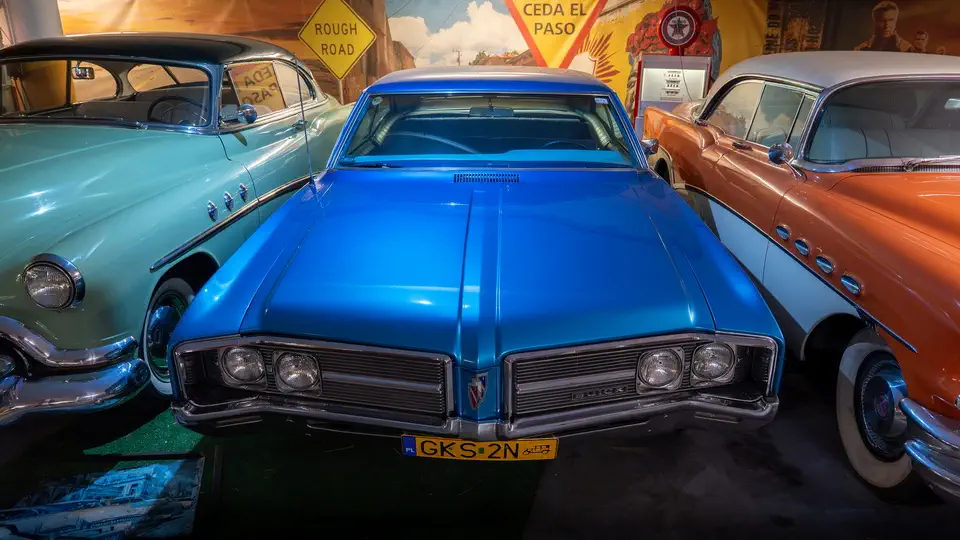
Kościerzyna is one of those towns in Pomerania that works particularly well as a destination for a day trip. There is no single enormous attraction that would take up an entire day. Instead, you will find several smaller but very different places.
- American Old Cars Museum in Kościerzyna – the American Old Cars Museum in Kościerzyna, home to a collection of classic American cars, is a great place for anyone who loves beautiful automobiles with enormous engines. You can also read our English-language article about the American Old Cars Museum.
- Franciszek Treder Kashubian Museum – this is another place I would definitely add to your sightseeing itinerary. The museum presents the history and culture of Kashubia, with collections including old everyday objects, tools, traditional clothing and furnishings from Kashubian homes. If this is your first visit to Kashubia, this is one of the places where you can really begin to understand what makes the region distinctive.
- Kościerzyna Railway Museum – an attraction I particularly recommend to families and anyone interested in railways. The museum occupies the site of a former locomotive depot, where you can see historic locomotives, carriages, and equipment associated with the railway.
- The Remus Monument – the monument to Remus stands in Kościerzyna’s market square. Remus is the hero of Aleksander Majkowski’s novel Żëcé i przigodë Remusa (The Life and Adventures of Remus). The character has become one of the symbols of Kashubian culture and identity. For me, this is one of those places worth stopping at for a few minutes, especially if you want to learn more about Kashubian culture during your trip.
- Accordion Museum – this is one of the more unusual attractions in Kościerzyna. The museum contains a collection of instruments from different periods and countries. It is not a particularly large museum, so it is easy to include in a walk around the town centre. If you enjoy unusual attractions, it is definitely worth a look.
- Church of the Resurrection – another interesting church in the town is the Church of the Resurrection, formerly a Protestant church. It was built in the 19th century and represents a wholly different architectural style from the Neo-Baroque Holy Trinity Church. In my opinion, it is worth seeing both churches because together they demonstrate the diversity of Kościerzyna’s religious architecture.
Of course, these are only some of the many attractions in Kościerzyna. If you know of another place in the town that deserves an article, let us know and we will be happy to add information about it to our website.
Holy Trinity Church in Kościerzyna – facts, information and curiosities
- The history of the parish is much older than the present church. The first known mention of the parish in Kościerzyna dates back to 1210. The present church is therefore only a little over 100 years old, while the history of the site reaches back to the Middle Ages. You can find works here separated by several centuries – from the Late Gothic period through the Renaissance and Baroque to Rococo. In this sense, Holy Trinity Church is almost a small lesson in the history of sacred art in Pomerania.
- Several earlier churches stood on this site. The present building is the latest in a long succession of religious structures in Kościerzyna. Earlier churches were destroyed by fires and subsequently rebuilt.
- A wooden church stood here in 1583. This information comes from documents connected with a bishop’s visitation. It shows that even in the 16th century the parish’s principal church was a wooden structure.
- The church suffered damage in several fires. The history of the parish records, among others, fires in 1463 and 1626. For centuries, fire was one of the greatest threats to wooden churches.
- A masonry church was built in 1642. This represented an important change in the history of the parish, as the masonry structure replaced the earlier wooden church.
- Not everything from the earlier churches disappeared. Some historic furnishings from the previous buildings survived and are still housed in the present church. As a result, visitors can see objects that are considerably older than the building itself.
- Another church was built in 1724. Following the fire of 1709, a new church was commissioned and subsequently consecrated in 1769.
- The present church is younger than many of the historic objects inside it. The building was constructed only between 1914 and 1917, while some of its furnishings date from the 16th, 17th and 18th centuries.
- Construction of the present church began during the First World War. It is quite remarkable that such a large building project was successfully carried out during a period of war and the economic difficulties that accompanied it.
- One of the reasons for constructing the new church was the insufficient capacity of the old building. As Kościerzyna expanded, a larger church was needed to accommodate the growing number of worshippers.
- The church is Neo-Baroque in character. This means that its architecture was created in the 20th century but consciously refers to Baroque forms. This can be seen particularly clearly in the overall shape of the building and the design of the tower.
- The oldest historic object in the church is the Late Gothic painting The Crucifixion. The work dates from the beginning of the 16th century, meaning that it was created around four hundred years before the present church was built.
- The main altar dates from the 17th century. It was created during the first half of that century and is therefore a surviving element from an earlier church.
- The main altar represents the transitional period between the Renaissance and Baroque. It is an interesting example of changing artistic styles in religious art, with elements characteristic of both periods visible in its decoration.
- The main altar contains a scene depicting the Coronation of the Blessed Virgin Mary. It is one of the most important elements of the church’s historic furnishings.
- The church contains a Baroque pulpit with an unusual representation. A painting of the former 18th-century church in Kościerzyna is shown on its surface. The pulpit is therefore not only a historic object but also a valuable visual source of information about a building that no longer exists.
- A Rococo baptismal font has survived inside the church. It is another piece of furnishings that recalls the church’s 18th-century history.
- The church is a Marian shrine. It houses the image of Our Lady of Kościerzyna – Queen of Families. The Marian shrine was established in 1970, while in 1997 the church received the title of the Shrine of Our Lady of Kościerzyna – Queen of Families.
- The image of Our Lady of Kościerzyna is associated with the Roman image Salus Populi Romani. The depiction of the Virgin Mary and Child refers to the famous image of Our Lady of the Snows kept in the Basilica of Santa Maria Maggiore in Rome.
- The image of Our Lady of Kościerzyna was crowned with papal crowns. The solemn coronation took place on 16 May 1998 and was one of the most important events in the recent history of the church and shrine.