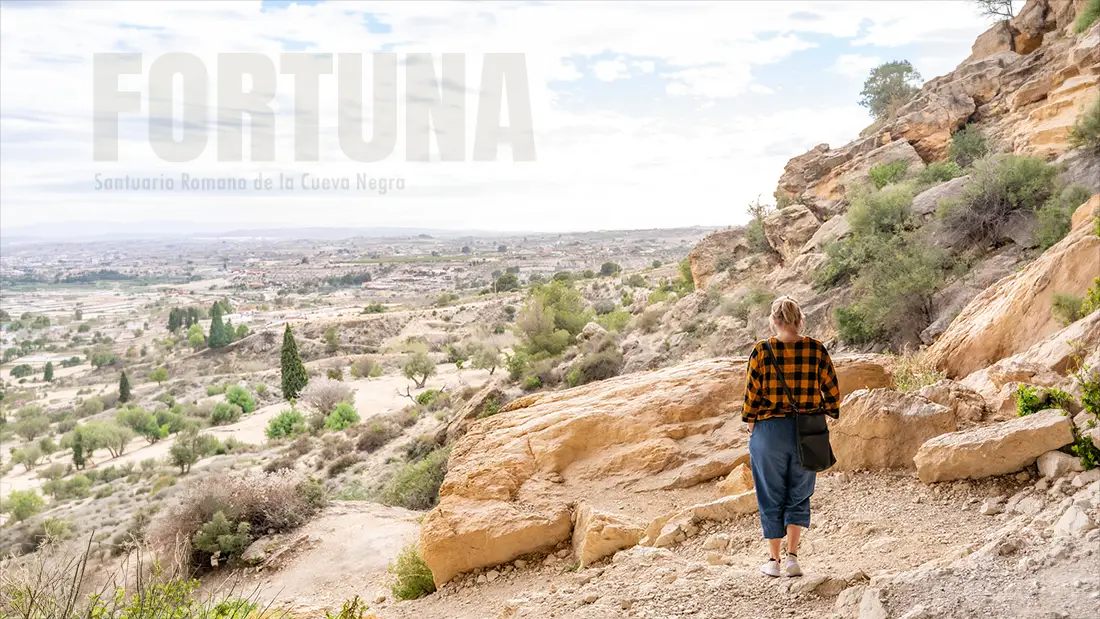
Santuario Romano de la Cueva Negra, or the Black Cave, is part of a Roman sanctuary located a few kilometres from the town of Fortuna in Spain.
The complex of caves and rock shelters, together with the ruins of Los Baños situated only 3 kilometres from the Black Cave, is one of the most important archaeological sites in this part of Spain. A significant feature of the cave is the spring of cool, fresh water that flows from within it. In the article below, I will tell you the story of this place, mention some legends connected with it, and also share a few tips and pieces of advice that may be useful during your visit.
Cueva Negra – the Black Cave near Murcia in Fortuna: a few useful tips

The archaeological site of Cueva Negra (the Black Cave) lies in the Sierra del Baño mountain range, just a few kilometres from the town of Fortuna and Thermal Baths (Balneario de Leana Complex), where the trail leading to the foot of the cave begins. Getting there is straightforward, and the path is clearly marked, so you should have no trouble finding your way.
Beneath the mountain you will find a car park which, unfortunately, is not huge. Especially in summer, when the Costa Blanca is crowded with tourists eager for attractions, you may have to look for parking spaces in the streets of the nearby village. For this reason, during that period, I suggest setting off early in the morning. Not only will you avoid the crowds, but you will also arrive before the scorching sun, which in this dry region can be quite exhausting.
The route from the car park to the caves leads uphill and winds between rocks. The climb is not particularly difficult, but keep in mind that it may be challenging for people with limited mobility or for older visitors.
Cueva Negra – the Black Cave and its history
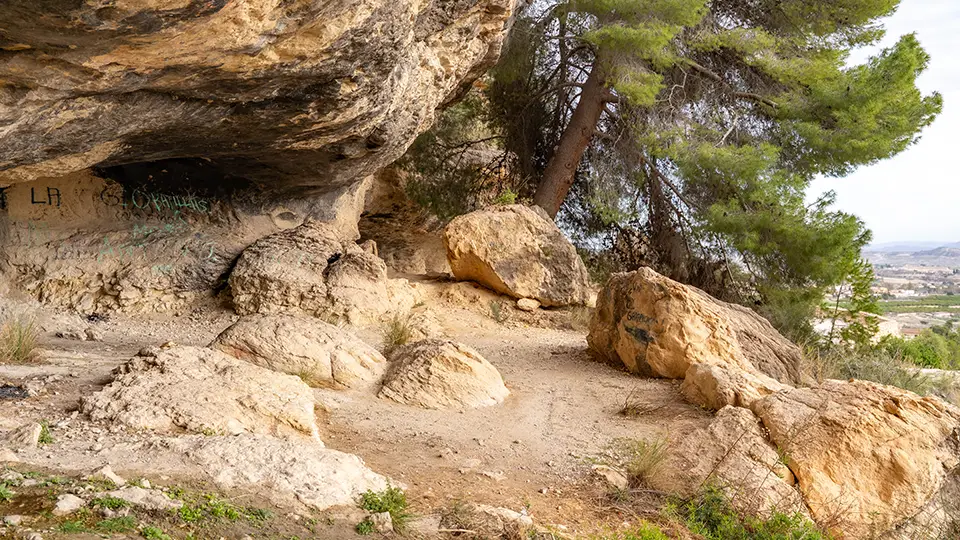
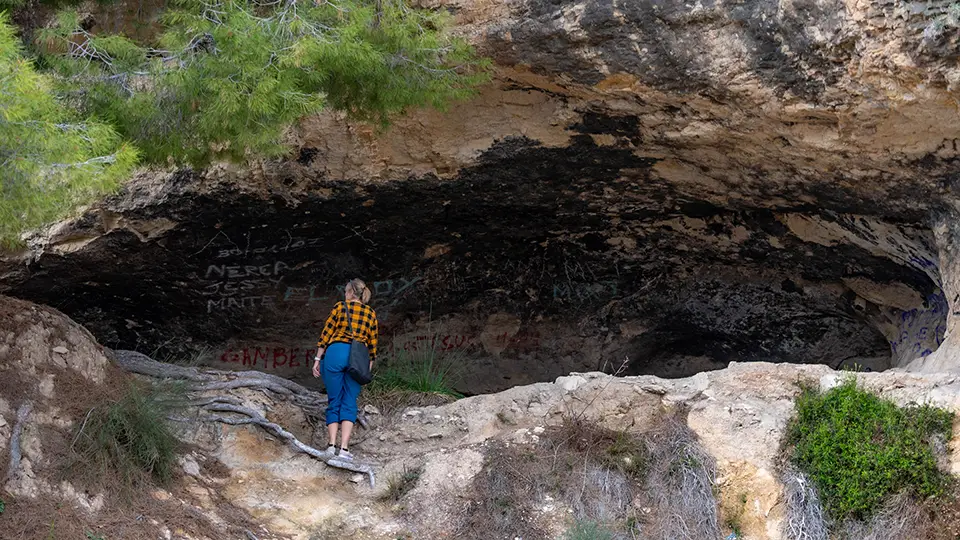
The name Cueva Negra, meaning Black Cave, is not accidental. Most of the walls inside the caves and rock shelters are dark due to layers of paint applied over time, as well as the presence of numerous fungi and lichens growing on them. The stone walls were already being painted during the time when the Romans occupied the Iberian Peninsula. The oldest surviving texts and symbols date from that period, and most of the inscriptions come from the first centuries AD. Over the years, scientists have carefully removed successive layers of paint, gradually revealing ever older writings.
Archaeological research around the Black Cave has uncovered the remains of Roman buildings, as well as roads, built by the Romans. Moreover, in deeper layers of soil, traces of earlier cultures have been discovered, suggesting that the caves must have had either religious or practical significance for those people. It is easy to imagine ancient travellers arriving at Cueva Negra to pray to long-forgotten gods and to wash themselves in the spring flowing inside the cave. They likely did so until the Romans appeared on the shores of present-day Spain, replacing the older beliefs and establishing their cult.
Cueva Negra – the scientific value of the Black Cave and the Roman Sanctuary in Fortuna
The rock shelters of Cueva Negra near Fortuna became an extraordinary focus of interest for scientists from many fields after a collection of Latin texts carved into the cave walls was discovered there in 1981. These texts were written over the course of many centuries, and their transcription and interpretation continue to this day. The research is officially conducted by the University of Murcia, but the inscriptions are also studied by scholars from around the world, including philologists, historians, and archaeologists.
In the area surrounding the cave, the remains of humanoids nearly one million years old have been discovered, believed to be direct ancestors of Neanderthals. The study of these remains has helped deepen knowledge about the climate as well as the flora and fauna of that period. Alongside the remains, traces of some of the earliest hearths lit by prehistoric humans were also found. These are believed to be among the oldest-known hearths discovered in Europe.
Cueva Negra – visiting the Black Cave in Fortuna
We visited Cueva Negra thanks to a fortunate coincidence. We came to Fortuna, or more precisely to Balneario de Leana, a spa and thermal complex with hot springs that were already known in antiquity, a little earlier than planned. In the town itself there is not much happening beyond the thermal baths and nearby hotels. We decided not to waste time and to explore other attractions in the area, and that is how we ended up at Cueva Negra.
February is an excellent time to explore southern Spain. As long as it is not raining or windy, the temperature usually stays somewhere between 16 and 20 degrees Celsius, which, as you will agree, provides ideal conditions for hiking. Moreover, there was literally no one around except residents barbecuing beneath the mountain where the path to the caves begins. Visiting the sanctuary in solitude, as you can imagine, was a real pleasure. The path to the caves climbs gently uphill and is not difficult even for older people or children.
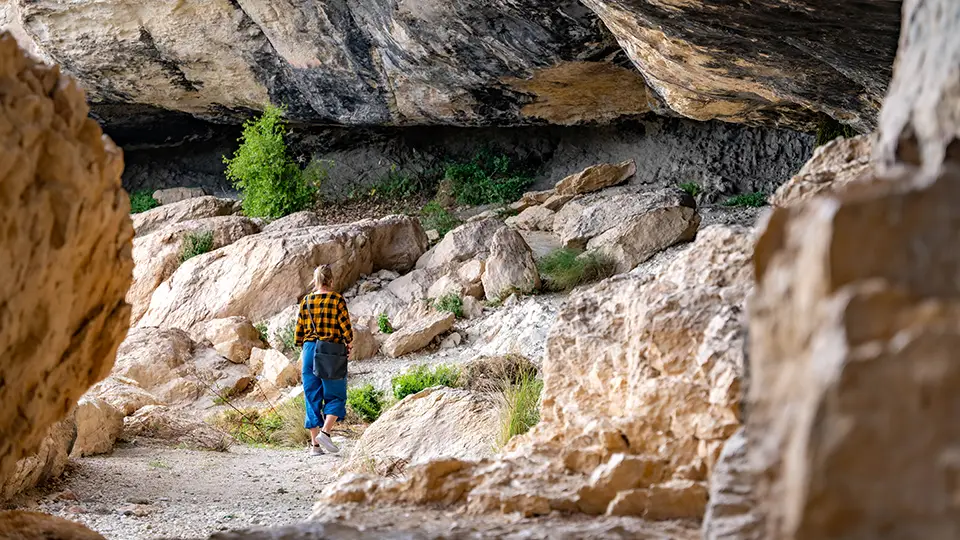
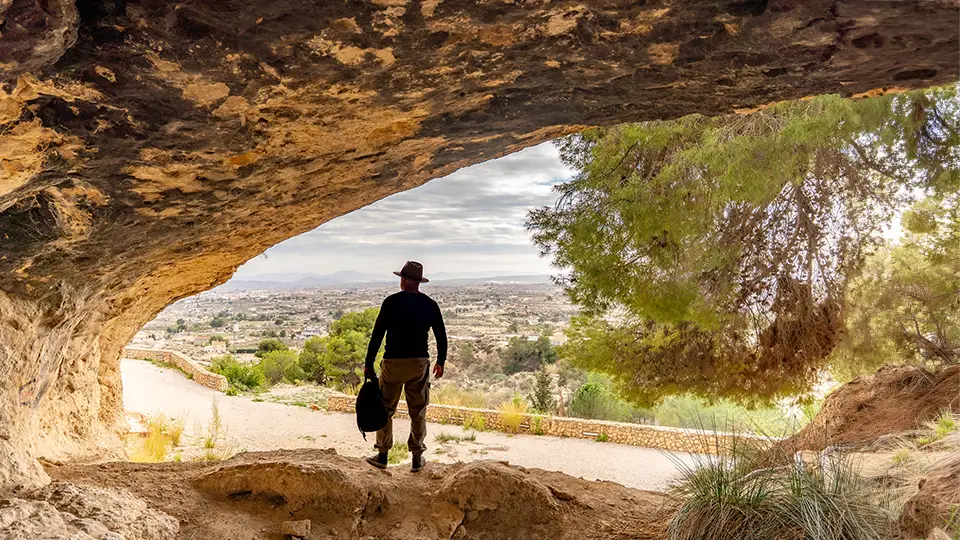
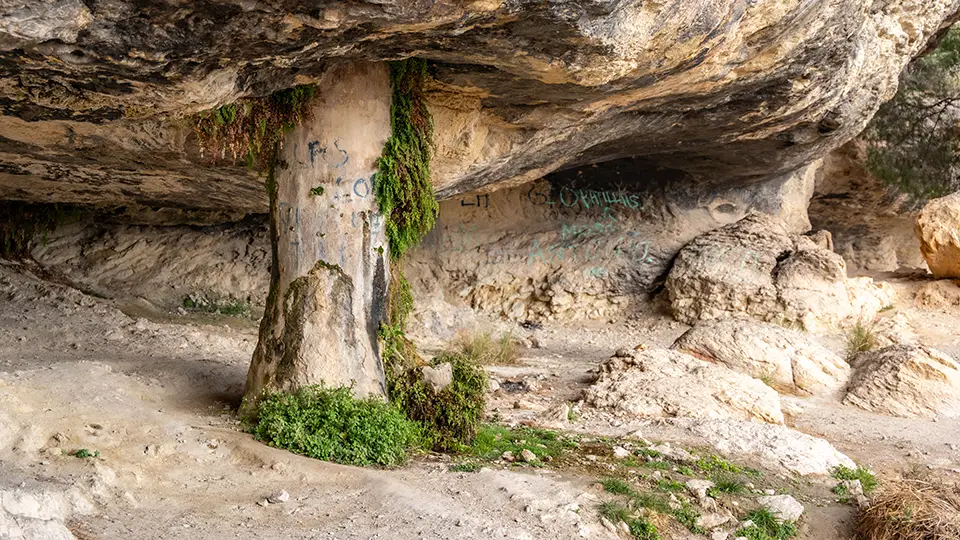
At the top you will find a spacious terrace offering a wonderful view of the surrounding area. It looks particularly impressive at sunset. The caves themselves lie a little higher, and to reach them you need to cross several scattered boulders. The name Black Cave is slightly exaggerated, as in reality these are recesses in the rock, technically known as rock shelters. I must admit that I am not surprised that in ancient times many merchants and pilgrims chose to camp in this very place. The hollow in the rocks is large enough to shelter quite many people from rain and bad weather, and it is also relatively easy to keep the area safe.
In the central part of the cave there is a small spring that in antiquity was believed to have healing properties. The water from the spring is said to be drinkable, although I did not dare to try it myself. If you happen to be brave enough, be sure to let me know whether it tastes good. Visiting the caves does not take very long. Of course, you may bring a picnic and enjoy the incredible views from the terrace below the cave, or even join the people barbecuing at the bottom. We had a great time, and I believe this place is perfect for a day trip, especially since a visit to the caves can easily be combined with other nearby attractions, such as the famous Spanish desert Desierto de Abanilla.
Legends, stories, and mysteries connected with the Black Cave in Fortuna
- According to one of the oldest legends, a huge snake or dragon once lived in the cave and would come out at night to drink milk from goats grazing on the mountain slopes.
- Residents of nearby villages believed that on Midsummer’s Night, a strange light emerges from the cave, guiding people to a hidden treasure.
- Another legend says that beneath the cave there is an extensive network of underground tunnels leading all the way to the nearby Roman baths in Fortuna.
- Local stories claim that the water flowing from the cave possesses magical properties and can cure skin diseases and joint pain.
- In the past, people believed that water nymphs lived in the cave, guarding the spring and helping only those with pure hearts.
- There is also a legend that anyone who desecrates the cave or takes a stone from it will bring bad luck upon themselves.
- Old tales tell of a Roman soldier who left gold in the cave and never returned to reclaim his treasure.
- Some residents claim that in the silence of the cave, one can hear the whispers of ancient pilgrims who prayed there centuries ago.
- According to legend, new signs and symbols sometimes appear on the cave walls that no one has ever seen before.
- There is a story about a mysterious hermit who supposedly lived in Cueva Negra for many years and healed people using water from the spring.
- People once believed that ancient books or tablets left by Roman priests were hidden inside the cave.
- According to one tale, strange sounds resembling singing or echoes of ancient prayers can be heard from the cave during storms.
- Some people claim that at night faint figures can be seen near the cave, disappearing when someone approaches.
- Among local shepherds, there is a story that anyone who spends a night in the cave in complete silence may see a vision of the future.
- One legend speaks of a hidden treasure belonging to a Roman priest that was sealed within the rocky wall of the cave.
- Older residents of the region used to say that during the Middle Ages the cave was a place for secret rituals.
- Another story claims that strange lights sometimes appear near the cave, floating above the ground before vanishing without a trace.
- Some people believe that the echo inside the cave can repeat words that no one has spoken, which was once considered a sign of the presence of spirits.
- There is also a legend that stones from Cueva Negra bring good luck to travellers if they are taken with respect.
- According to the oldest story, the cave was once a gateway to the world of the gods, and ancient pilgrims came here to communicate with deities associated with water and nature.
Caves in Fortuna – facts, information and interesting details
- The oldest biface in Europe – a triangular stone tool used for scraping and cutting skins and other materials – was discovered in Cueva Negra.
- The Black Cave is approximately 12 metres wide.
- Cueva Negra lies about 3 km from the town of Fortuna in the Sierra del Baño mountain range and is one of the most important archaeological sites in the Murcia region.
- It is not a single cave but a group of three rock shelters facing south, which together form a natural place of worship.
- In antiquity, a religious sanctuary stood here, visited by pilgrims who used the nearby hot springs and Roman baths in Fortuna.
- Inside the cave there is a natural water spring that was considered healing in ancient times.
- The Iberians may already have used this place as a sanctuary before the arrival of the Romans.
- The cult reached its greatest development during the Roman period (1st–3rd century AD), when the site functioned as a sacred sanctuary.
- Dozens of Latin inscriptions painted on the cave walls have been discovered, known as tituli picti.
- Some of these texts are fragments of Virgil’s “Aeneid”, making them among the oldest surviving fragments of this work.
- It is one of the hardly any places in Europe where Roman texts painted on rock have survived; similar discoveries have only been made in Turkey.
- The authors of the inscriptions were probably educated pilgrims or visitors to the baths, who left prayers, dedications, or poetry in the cave.
- The deities most frequently mentioned are water nymphs associated with the cult of healing water.
- The texts also mention gods such as Bacchus, Venus, Cybele and Attis, showing the blending of various religious traditions of the Roman Empire.
- Visitors to the Roman baths in Fortuna often came to the cave to make offerings and thank the gods for healing.
- Modern scientific research began only in 1981, when the Latin inscriptions were discovered and photographed.
- The discovery of these texts initiated systematic archaeological research in the Fortuna region.
- The name “Cueva Negra” (Black Cave) comes from the dark colour of the rocks, partly caused by soot from fires as well as the activity of fungi and lichens.
- In the twentieth century there was a local tradition of a priest blessing the cave’s water during Lent, which shows the continuity of the site’s sacred character.
- Today Cueva Negra is regarded as one of the most important archaeological monuments in south-eastern Spain and is protected as a cultural heritage site.
- When visiting Fortuna, it is also worth taking a trip to nearby Murcia, where attractions such as the historic casino and the famous Cathedral of Murcia await.