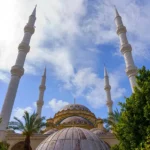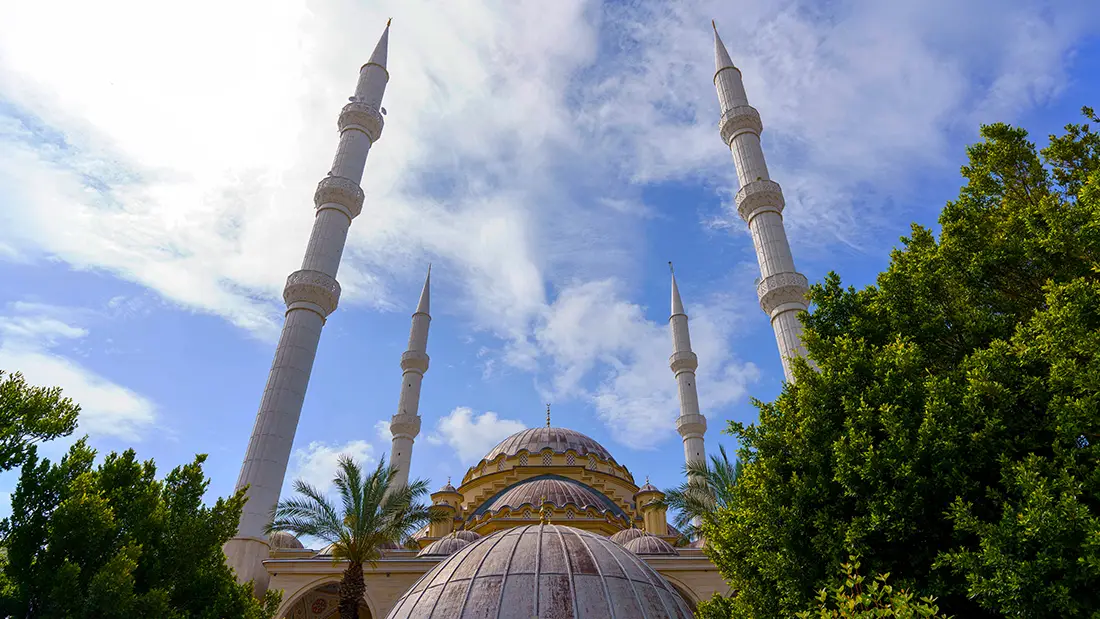
The mosque in Manavgat, on the Turkish Riviera, is one of the attractions you should not miss when visiting this part of Turkey.
During a holiday on the Turkish Riviera, it is worth taking a break from hotel swimming pools and sandy beaches to discover a different side of the region. One place worth including in your sightseeing itinerary is Merkez Külliye Camii in Manavgat. This impressive building, inspired by traditional Ottoman architecture, stands out with its domes, tall minarets and richly decorated interior.
Manavgat is best known for its popular bazaar, river, Manavgat Waterfall and proximity to the famous resort of Side. However, in the town centre, you will find a religious building that offers a more profound understanding of contemporary Turkish culture and religion. It is not a monument dating back to the time of the sultans, but a relatively modern structure that draws on centuries of Ottoman religious architecture.
The Mosque in Manavgat – Essential Information at a Glance
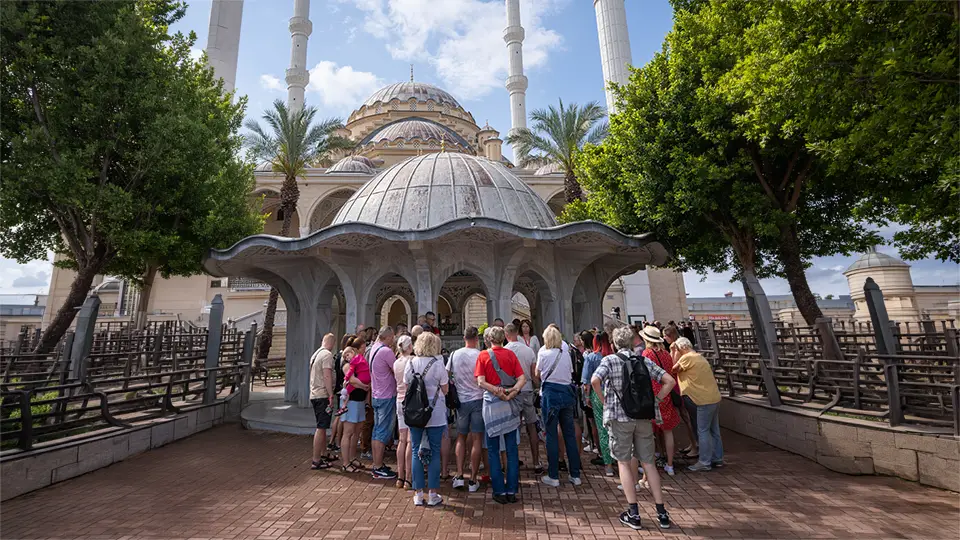
- Merkez Külliye Camii is located in Manavgat, on the Turkish Riviera, not far from the popular resort of Side.
- Construction of the mosque began in 2002 and was completed in 2004. It is therefore a relatively modern building, although its architecture draws inspiration from centuries of Turkish tradition.
- The mosque was built as an important place of worship for the local Muslim community. Over time, it also became an attraction for tourists visiting the Antalya region.
- The name külliye refers to traditional religious complexes which, during the Ottoman period, consisted of a mosque surrounded by other buildings and facilities serving the local community.
- The architecture of Merkez Külliye Camii is inspired by historic Seljuk and Ottoman mosques. Its most distinctive features include a central dome, smaller surrounding domes and four tall minarets.
- The main dome is approximately 30–35 metres high, while the minarets rise to around 60 metres. This makes the mosque one of the most recognisable landmarks in Manavgat.
- Large quantities of concrete and steel were used during construction. Traditional craftsmanship was also incorporated, including decorative wooden doors made using the kündekâri technique.
- The interior is decorated with ornamental patterns, arches, calligraphy and elaborate architectural details. One of its most important features is the mihrab, a niche indicating the direction of Mecca.
- In the first few years after its opening, the mosque attracted considerable interest from international visitors. Tours were organised to introduce guests to the basic principles of Islam and explain the significance of the various elements of the building.
- Merkez Külliye Camii remains an active place of worship. Visitors should remember to dress appropriately, remove their shoes before entering the prayer hall and show respect for those attending religious services.
The History of Merkez Külliye Camii Mosque
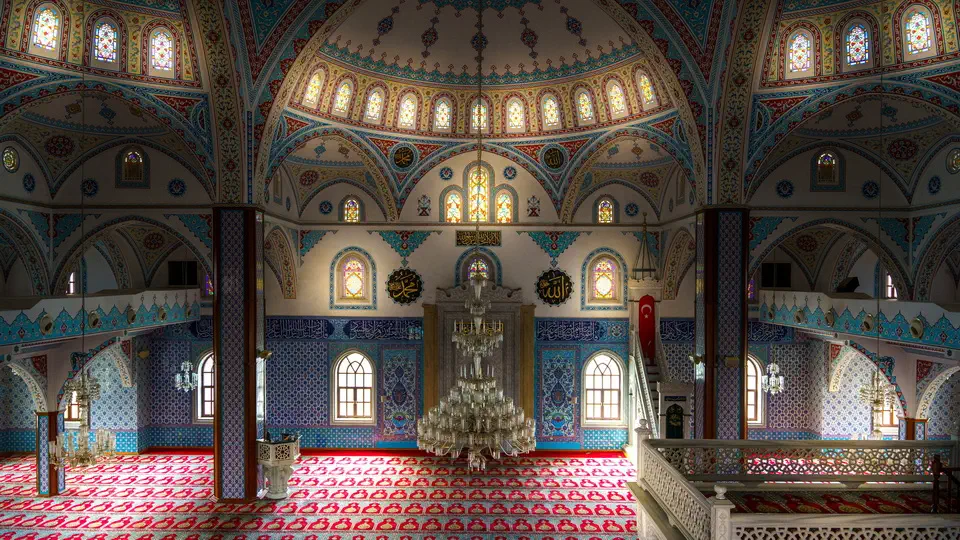
When you look at Merkez Külliye Camii in Manavgat, it is easy to imagine that it has stood here for generations. It has a gigantic dome, four tall minarets and a richly decorated interior reminiscent of famous Ottoman-era buildings, such as the Blue Mosque in Istanbul. However, the history of this particular place is much shorter than its appearance might suggest. Construction began in 2002, and just two years later, in 2004, the building was completed and opened to worshippers.
If I were telling you the story of this mosque during a walk through Manavgat, I would start with precisely this contrast. On the one hand, we have a modern building constructed at the beginning of the 21st century. On the other, its appearance refers to traditions that developed in Anatolia over hundreds of years. This was no coincidence. The people behind the project wanted to create a place of worship that would serve contemporary residents while reminding them of Turkey’s rich architectural heritage.
To understand why such an impressive mosque was built, it is worth looking first at the history of Manavgat itself. Today, the town is associated primarily with tourism, bazaars, nearby Side and holiday resorts along the Mediterranean coast. However, the region has much older roots. Over the centuries, it came under the control of various states and dynasties, and its history was connected, among other things, with the expansion of the Seljuk Turks and the subsequent development of the Ottoman Empire.
In successive historical periods, mosques became important focal points for local communities. They were not used exclusively for prayer; social, religious and educational life also developed around them. Manavgat is home to older places of worship too, including Selime Hatun Camii, whose origins date back to the 19th century. Merkez Külliye Camii, however, represents an entirely different period. It was built in a town that was increasingly developing through tourism, and its architecture was intended to emphasise the importance of the local Muslim community.
Work on Merkez Külliye Camii began in 2002. This was not a small neighbourhood mosque but an ambitious undertaking intended to create one of the most recognisable religious buildings along this part of the Turkish coast. Even today, the scale of the investment is impressive. According to published information, the plot covers approximately 9,000 square metres, while the building itself occupies around 1,500 square metres. Construction involved approximately 250 tonnes of steel, 65 tonnes of lead and 500 cubic metres of concrete. These figures give you an idea of the considerable engineering work behind the building’s impressive appearance.
Construction was completed in 2004, and the mosque began serving its religious purpose. From that moment onwards, it provided a place of worship for residents of Manavgat and people arriving from other parts of Turkey. Over time, it also became a destination for international visitors interested in learning about Islam and seeing Turkish mosque architecture at close quarters.
This is one of the things that stands out most during a visit. Merkez Külliye Camii does not attempt to embrace modern architectural styles. On the contrary, its designers drew inspiration from solutions associated with Seljuk and Ottoman traditions. The central dome, four minarets, smaller domes surrounding the main structure and elaborate decorations create a composition easily associated with the great historic mosques of Turkey.
The main dome rises approximately 30 metres above the ground, although some tourist descriptions give its height as around 35 metres. The four minarets are approximately 60 metres tall, and each has three balconies known as şerefes. The entire structure can be seen from a considerable distance, making the mosque one of Manavgat’s most distinctive landmarks.
It is also worth paying attention to the handcrafted details. The decorative wooden doors made using the kündekâri technique are particularly noteworthy, with their production reportedly taking craftsmen around a year. Much of the decoration also consists of handmade ceramic tiles or decorative stone tiles, depending on the source description. These details are a reminder that traditional craftsmanship can play an important role even in a modern building.
The history of Merkez Külliye Camii does not end with its construction. In the following years, the mosque also became a place where visitors to the Turkish coast could learn about local culture and religion. As early as 2007, local media reported considerable interest from international tourists. The following year, organised visits were described in which guides explained the principles of Islam and the meaning of the various architectural elements. This also illustrates how much Manavgat has changed. The town has become an important holiday destination, attracting people from many countries. The mosque, originally built primarily for the local community, gradually took on an additional role as a place where visitors could discover Turkish traditions.
Today, Merkez Külliye Camii remains an active mosque. Prayers are held here, and the building continues to form part of the town’s religious life. At the same time, its architecture attracts people interested in history, art and Turkish culture. If you find yourself near Side during your holiday and have a little time to spare, I recommend stopping by. You will discover that an interesting monument does not necessarily have to be several hundred years old. Occasionally, a contemporary building can tell us just as much about the traditions of the place where it was created.
The Mosque in Manavgat and Its Architecture
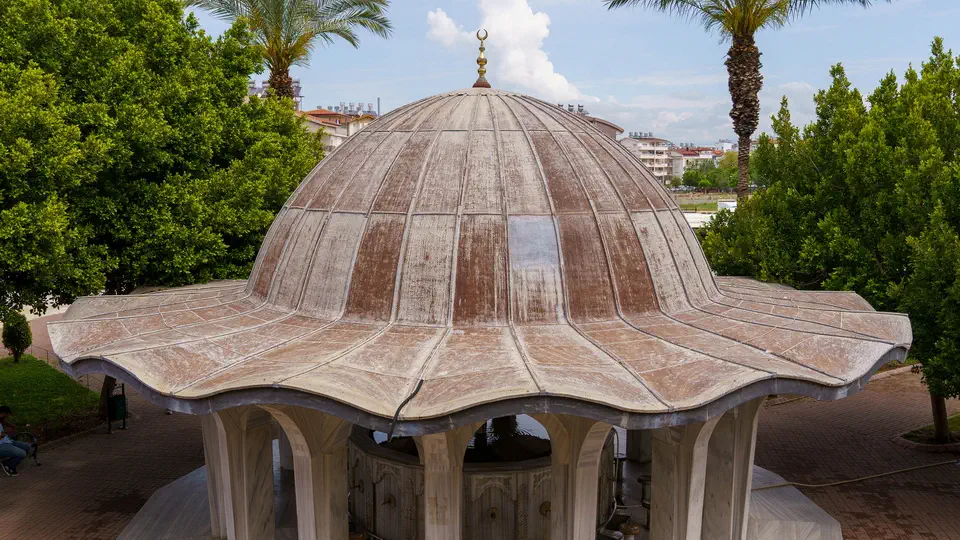
Even from the outside, Merkez Külliye Camii makes a considerable impression. The building is dominated by a central dome, accompanied by smaller domes and four slender minarets. Its pale façade contrasts beautifully with the southern Turkish sky, while the symmetrical composition gives the entire complex a monumental appearance. According to tourist information, the main dome rises approximately 35 metres, while the minarets reach around 60 metres. The scale of the building is genuinely impressive, particularly when you see it from close up.
Minarets are the distinctive towers of mosques, traditionally used to call worshippers to prayer. Today, their function is often also connected with loudspeaker systems, but they remain one of the most recognisable features of Islamic architecture. It is also worth looking at the arrangement of the domes. They are not simply decorative features on the roof; they help create a spacious prayer hall and form an important part of traditional mosque architecture. At Merkez Külliye Camii, historic architectural solutions have been combined with modern construction techniques, giving the building an imposing appearance while retaining its classical character.
The Interior of the Mosque in Manavgat – Colours, Ornaments and Beautiful Vaults
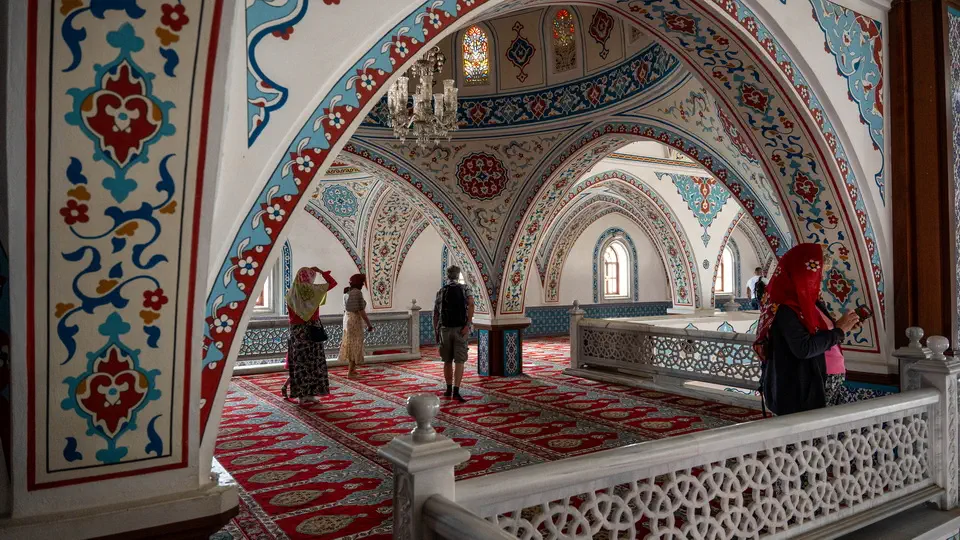
In my opinion, the interior is one of the most interesting parts of this place. Once you step inside, your eyes are drawn towards the high ceilings, decorative arches and enormous dome. The prayer hall also features patterned carpets, elaborate decorations and lighting that brings out the architectural details. One particularly important feature is the mihrab, a decorative niche in the wall indicating the direction of Mecca. This is the direction in which Muslims face during prayer. Nearby, you will also find the area reserved for the imam who leads the service.
Geometric patterns, floral motifs and Arabic calligraphy play an important role in the mosque’s decoration. In traditional Islamic art, such ornamentation has particular significance because it allows artists to create elaborate compositions without depicting God in human or figurative form. During your visit, it is worth taking a moment to look carefully at the details. In buildings of this size, it is easy to concentrate only on the overall impression, but many interesting features are actually above your head, on the arches and around the dome.
Can You Visit the Mosque as a Tourist?
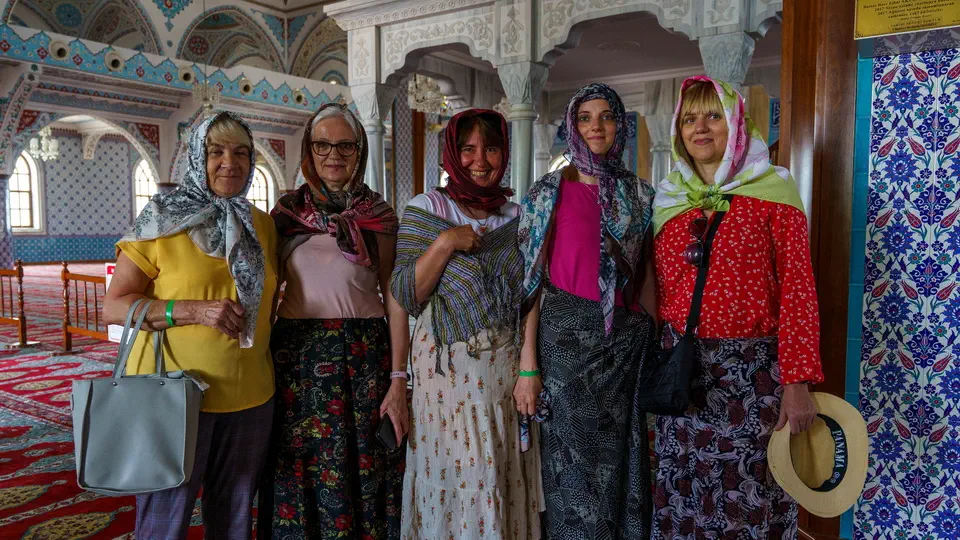
Yes, Merkez Külliye Camii is also visited by tourists who want to learn more about Turkish culture and religion. However, it is important to remember that this is primarily an active place of worship rather than a museum. Worshippers always take priority, so access to individual parts of the complex may depend on the time of day and whether religious services are taking place. Before visiting, I recommend keeping a few basic rules in mind:
- Appropriate clothing: Wear clothes that cover your shoulders and knees. Women should be prepared to cover their hair with a headscarf.
- Removing your shoes: You must take off your shoes before entering the prayer hall.
- Respect for worshippers: Remain quiet, avoid disturbing people who are praying and do not photograph anyone without their permission.
- Prayer times: Before setting off, check whether the mosque is open to visitors.
- Behaviour inside the mosque: Follow the instructions of the people responsible for the mosque and pay attention to signs indicating which areas are accessible.
If this is your first visit to a mosque, you do not need to know every principle of Islam. Respect, quiet behaviour and a willingness to follow local customs are quite sufficient.
Where Is the Mosque and How Do You Get There?
Merkez Külliye Camii is located in Manavgat, in Antalya Province, on Turkey’s southern coast. It is a convenient destination for a short trip if you are staying in nearby Side or one of the holiday resorts along this part of the Turkish Riviera. You can reach the town by car, taxi or local minibus, known in Turkey as a dolmuş. From Side, the most convenient option is to take public transport to central Manavgat and then continue to the mosque, either by another local connection or on foot if the distance from your stop is manageable.
Before setting off, it is worth checking the exact location of the mosque on a map, as local minibus routes and stops can change. I would allow approximately 30–60 minutes for the visit. This should be enough time to admire the architecture, explore the parts of the interior that are open to visitors and appreciate the decorative details, provided that conditions on the day allow sightseeing.
What Else Is Worth Seeing in Manavgat and the Surrounding Area?
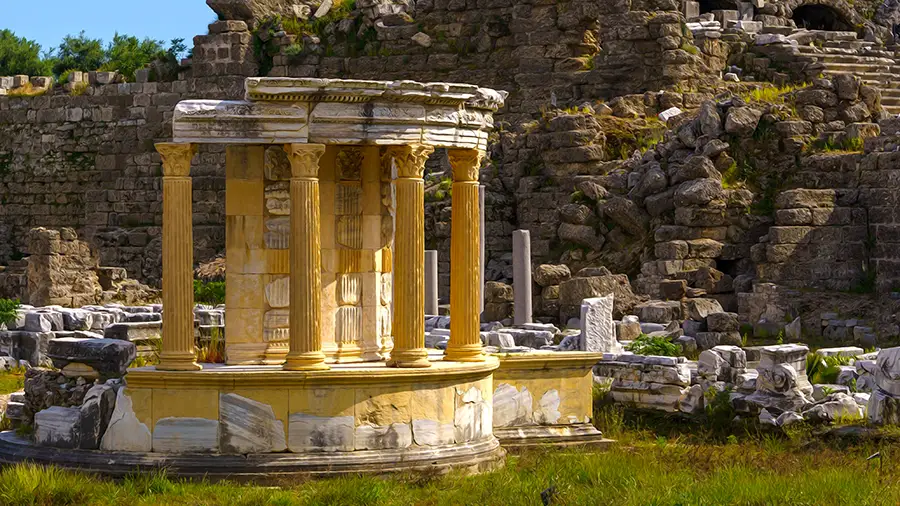
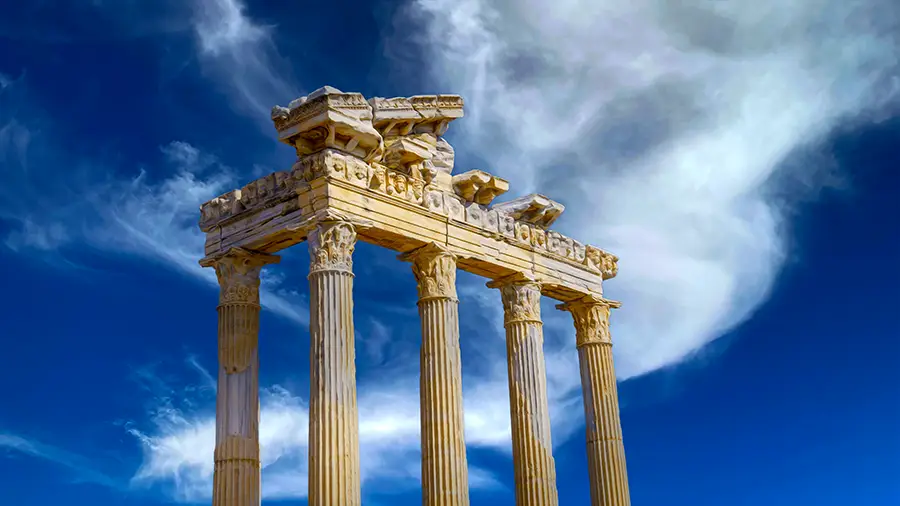

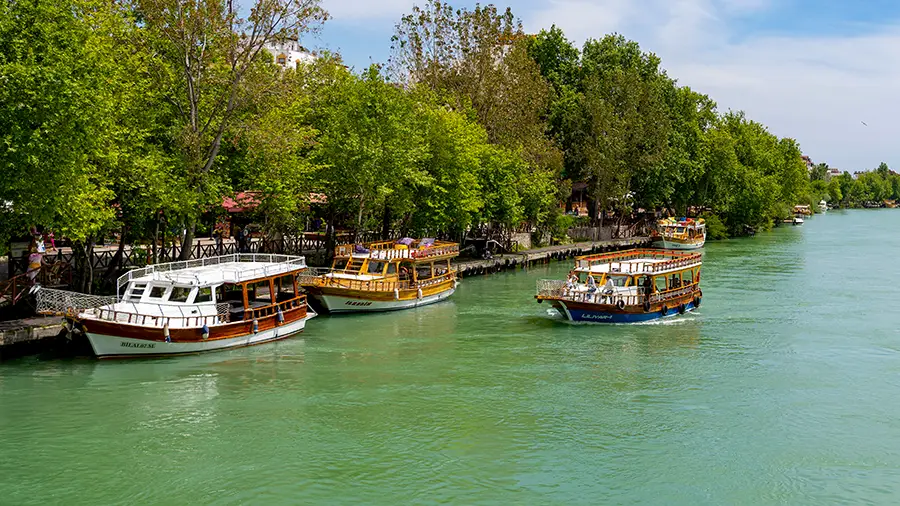
I would treat the mosque as one of several stops when exploring the town rather than as the main purpose of a separate full-day excursion. Manavgat and its surroundings offer several attractions that can easily be combined into one trip.
- Manavgat Bazaar – This is an excellent place to experience everyday life in the town, browse spices, local produce and souvenirs. You can find much more information in our article about this lively Turkish market.
- Ancient Side – If you are interested in history, make sure you visit this ancient city, with its remains of temples, theatre and old streets. Our guide covers the most important attractions and historic sites in Side.
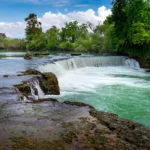
- Manavgat Waterfall – This popular natural attraction lies close to the town. A visit to the river and waterfall makes a pleasant change after exploring historic buildings and walking through busy streets.
- Aspendos – One of the most interesting archaeological sites in the region, famous above all for its impressive Roman theatre.
- If you are only just planning a holiday in this part of Turkey, have a look at our other travel guides covering the country’s attractions and practical travel advice. They will help you choose the right resort and plan some sightseeing during your stay on the Mediterranean coast.
Is the Mosque in Manavgat Worth Visiting?
In my opinion, yes, particularly if you enjoy discovering places that go beyond the usual all-inclusive holiday itinerary. Merkez Külliye Camii is not an ancient monument, and you should not expect to find centuries-old ruins here. Its value lies elsewhere: it offers an opportunity to see how traditional Ottoman architecture continues to exist within a contemporary Turkish town.
The most impressive features are the monumental structure, four minarets and richly decorated interior. Another advantage is that you can easily combine your visit with some shopping at Manavgat Bazaar or a trip to ancient Side. If you are spending your holiday in this part of the Turkish Riviera, it is worth taking a little time to discover the region’s religious and cultural heritage as well. It is a good way to experience Turkey not simply as a beach holiday destination, but as a country with a rich architectural tradition and a fascinating history.
The Mosque in Manavgat – Facts, Information and Interesting Details
- Merkez Külliye Camii is located in Manavgat, in Antalya Province in southern Turkey. It is close to the popular resort of Side, making it an easy place to visit during a holiday on the Turkish Riviera.
- The mosque was built in the 21st century. Construction began in 2002 and was completed in 2004. Although it looks like a historic Ottoman-era place of worship, it is actually a relatively young building.
- The name külliye has a special meaning. In Turkish tradition, the term describes a complex centred around a mosque, which could also include religious schools, kitchens, public baths and other buildings serving the local community.
- The mosque is distinguished by its four tall minarets. These slender towers can be seen from a considerable distance and give the building its monumental appearance. Minarets are among the most recognisable elements of traditional Islamic architecture.
- The minarets are approximately 60 metres high. Their size makes the mosque stand out against the surrounding buildings in Manavgat. Each tower has balconies known in Turkish architecture as şerefes.
- The main dome attracts attention even from outside the building. Tourist descriptions give its height as approximately 30–35 metres. It is accompanied by smaller domes, which together create the building’s distinctive multi-level silhouette.
- The architecture of the mosque refers to the Ottoman period. The designers used solutions found in historic Turkish places of worship, giving this modern building the appearance of monumental mosques from centuries past.
- Huge quantities of construction materials were used during the project. Available descriptions mention hundreds of cubic metres of concrete and dozens of tonnes of steel and lead. These figures illustrate the scale of an undertaking completed in just two years.
- The mosque contains examples of traditional craftsmanship. Particularly noteworthy are the decorative wooden doors made using the kündekâri technique, which traditionally involves precisely fitting individual wooden elements together without using nails.
- The interior is decorated with ornamental patterns and calligraphy. Rather than concentrating on figurative representations, the decorators used geometric designs, floral motifs and decorative Arabic script. These techniques have a long history in Islamic art.
- Approximately 4,000 people can pray in the mosque at the same time. This considerable capacity makes Merkez Külliye Camii one of the largest mosques in the region. The building is designed to accommodate a large congregation during important religious celebrations.
- The mosque has one main dome, four semi-domes and 27 smaller domes. Their arrangement creates an elaborate architectural composition, making the building impressive both from the outside and when viewed from within.
- Merkez Külliye Camii is sometimes referred to as the Sultanahmet of Manavgat. This informal name refers to the famous Blue Mosque in Istanbul. The resemblance is mainly due to the monumental silhouette, domes and minarets rather than the age of the two buildings.
- Before prayer, Muslims perform a ritual washing. There is a designated ablution area within the mosque complex, where worshippers can cleanse themselves before prayer. This is an important part of religious practice and offers visitors a better understanding of everyday Muslim traditions.
- The mosque is visited by tourists from many countries. During the holiday season, people exploring Manavgat as part of trips around Antalya Province often stop here. The building is an interesting destination for anyone wishing to learn more about Turkish culture and architecture.
- Visitors can also learn basic information about Islam inside the mosque. The building welcomes people who are not Muslims, and information materials in different languages have been made available to visitors. It is an opportunity to discover more about the principles of the religion and the importance of prayer.
- Merkez Külliye Camii is situated in the Örnek district of Manavgat, close to the road connecting Antalya and Alanya. This makes it relatively easy to spot when travelling through the town.
- The land allocated to the mosque covers approximately 9,000 square metres. The building itself occupies around 1,500 square metres. The remaining space provides room for the surroundings of the mosque and accommodates visitors.
- The mosque can easily be combined with visits to other attractions in the region. After your visit, you could head to Manavgat Bazaar, see the nearby waterfall or travel to ancient Side. This allows you to discover both contemporary Turkish culture and the remains of ancient civilisations during a single day.
- Despite its relatively recent origins, the mosque has become a symbol of Manavgat. Its four minarets and elaborate silhouette stand out against the town’s skyline. It is a good example of how a building does not have to be several hundred years old to become an important part of local identity and an interesting destination for travellers.
The Mosque in Manavgat – Polish version