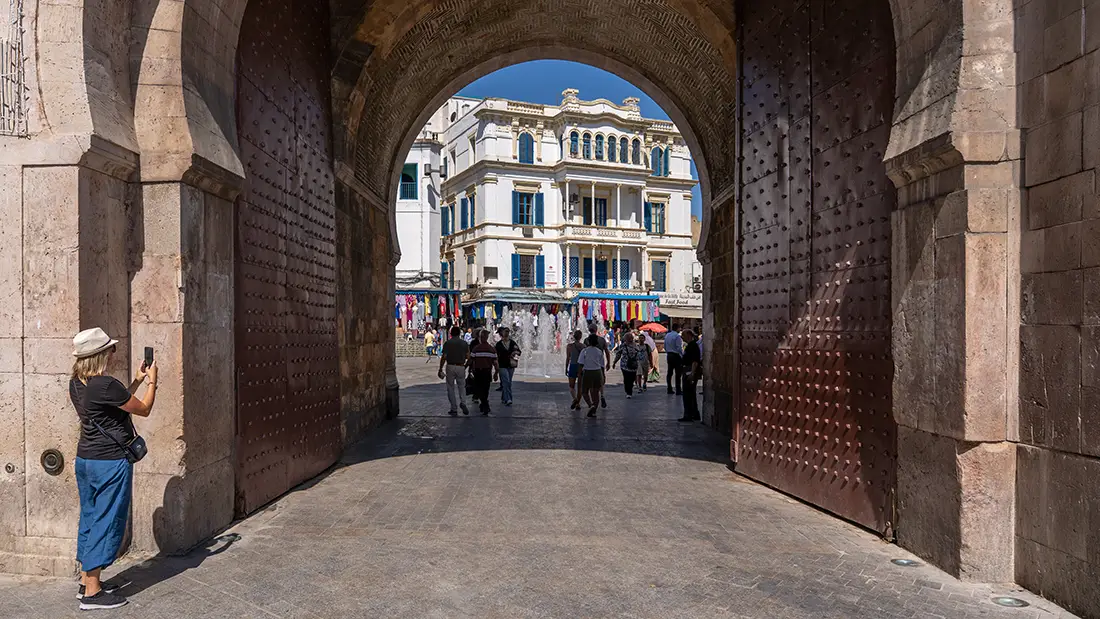
The Medina of Tunis – Over 13 Centuries of Living History
Every old town has its story. Yet, there are places where history has not been locked away behind museum glass but continues to thrive among the people who live there. That is precisely what you will find in the Medina of Tunis. Simply walk through one of its ancient city gates and leave the modern streets of Tunisia’s capital behind. Within moments, you enter a world that has changed far more slowly than the rest of the city over the past thirteen centuries.
The Medina is far more than a historic monument. It is the true heart of Tunis. Every day, hundreds of small shops open their doors, craftsmen hammer copper by hand, the aroma of freshly baked bread drifts from traditional bakeries, and the call to prayer echoes from towering minarets. Today, the Medina covers around 270 hectares and forms a maze of more than seven hundred narrow streets. It is home to hundreds of historic buildings, including palaces, mosques, madrases, fountains and former caravanserais. In 1979, it was inscribed on the UNESCO World Heritage List, becoming one of the best-preserved historic city centres in the Arab world.
Tunis Before the Medina Was Built
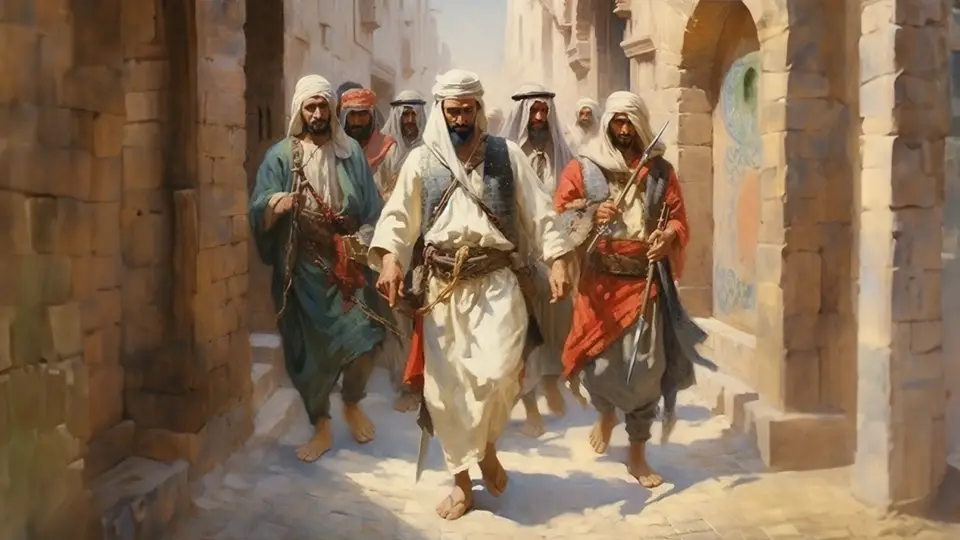
The story of this remarkable place began long before the birth of Islam. Small Berber settlements once occupied the area surrounding present-day Tunis, while nearby stood one of the greatest cities of the ancient world – Carthage. After the Romans destroyed Carthage in 146 BC, the region remained inhabited. The Romans rebuilt the city, which once again became one of the most important centres in North Africa. Tunis itself, however, remained little more than a modest settlement until the seventh century.
Everything changed in 698 when Arab forces captured Carthage. The new rulers quickly realised that the great coastal city was vulnerable to attacks from the Byzantine fleet. They needed a new administrative centre located further inland. Thus, Tunis was born.
The first buildings of the Medina were constructed around the Great Mosque of Ez-Zitouna. The mosque became the focal point from which the city gradually expanded. Initially, the settlement consisted of simple sun-dried brick houses and modest marketplaces, but it soon began to grow at an impressive pace.
During the ninth century, the Aghlabid dynasty took control of the region. They launched an ambitious programme of expansion, building the city’s first defensive walls, drainage systems, reservoirs and additional mosques. Trade also flourished. Tunis occupied a perfect position along major trade routes. Caravans arrived carrying gold from sub-Saharan Africa, silk from the Middle East, spices from India and finely crafted goods from Al-Andalus. Before long, Tunis had become wealthier than most cities across the Maghreb.
At the beginning of the tenth century, the Fatimids assumed power. Although they moved their capital to Mahdia, Tunis continued to prosper as a centre of commerce and learning. New residential quarters, madrases, and artisan workshops appeared throughout the growing city. Its distinctive street layout, still visible today, was established during this period. Craftsmen were grouped according to their professions: blacksmiths worked beside other blacksmiths, leather workers occupied their district, and spice merchants traded along dedicated streets. Even today, visitors can still recognise this centuries-old organisation while wandering through the Medina.
The city’s greatest period of prosperity came between the thirteenth and sixteenth centuries when the Hafsid dynasty made Tunis its capital. Most of the magnificent buildings admired today date from this golden age. Grand palaces, elegant madrases, libraries, hammams, bustling souks, caravanserais and luxurious merchants’ residences transformed the city into one of the leading cultural centres of the Islamic world.
Scholars travelled to Tunis from Cairo, Córdoba and Damascus, while the university attached to the Ez-Zitouna Mosque earned a reputation as one of the most prestigious centres of learning of its time. During this remarkable era, the population exceeded one hundred thousand inhabitants, making Tunis one of the largest cities on the Mediterranean.
The Medina of Tunis – A City of Merchants and Travellers
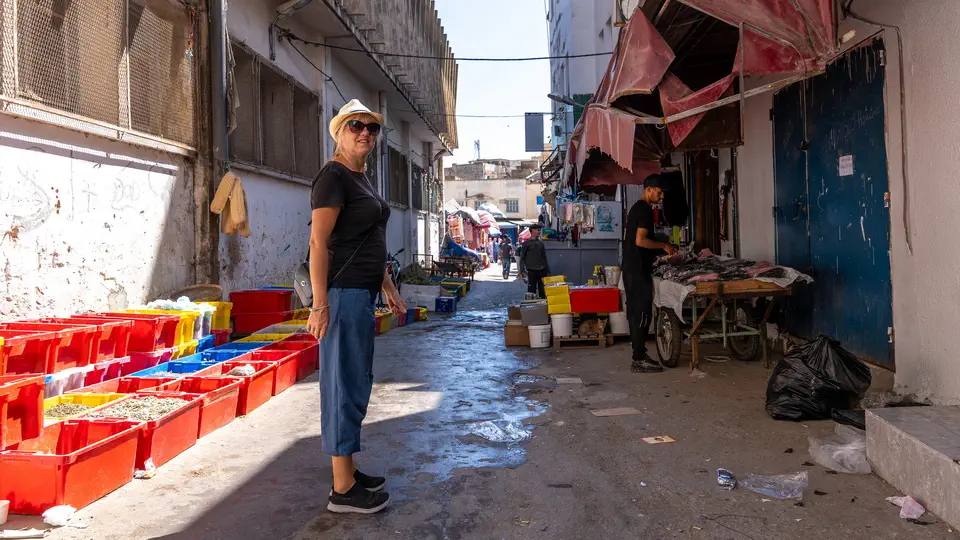
As you wander through today’s winding streets of the Medina, it is easy to forget that, for centuries, thousands of merchants from almost every corner of the known world passed through these very lanes. They brought amber from the Baltic, timber from Europe, gold from Mali, slaves from Africa, spices from India, silk from Persia and porcelain from China. Every visitor left behind a small piece of their culture, which perhaps explains why the architecture of the Medina is so wonderfully diverse.
Look carefully, and you will discover influences from the Arab world, Al-Andalus, the Ottoman Empire, Italy, and even Spain.
The sixteenth century proved especially turbulent for Tunis. The city repeatedly changed hands between Spain and the Ottoman Empire. Although the fighting caused considerable destruction, each new ruler added their own architectural legacy. After the Ottomans finally secured control, another period of prosperity began. New palaces, fountains and elegant town houses with marble courtyards and colourful ceramic decorations were built throughout the Medina. Many of the beautiful residences that survive today date from this Ottoman period.
In 1881, Tunisia became a French protectorate. Rather than redeveloping the historic city, the French constructed an entirely new European quarter alongside the Medina. As a result, the old city escaped the widespread demolition that altered so many historic Arab cities. Ironically, French rule helped preserve the medieval street plan almost intact, while modern Tunis expanded beyond the ancient walls.
The Medina After Independence and Today
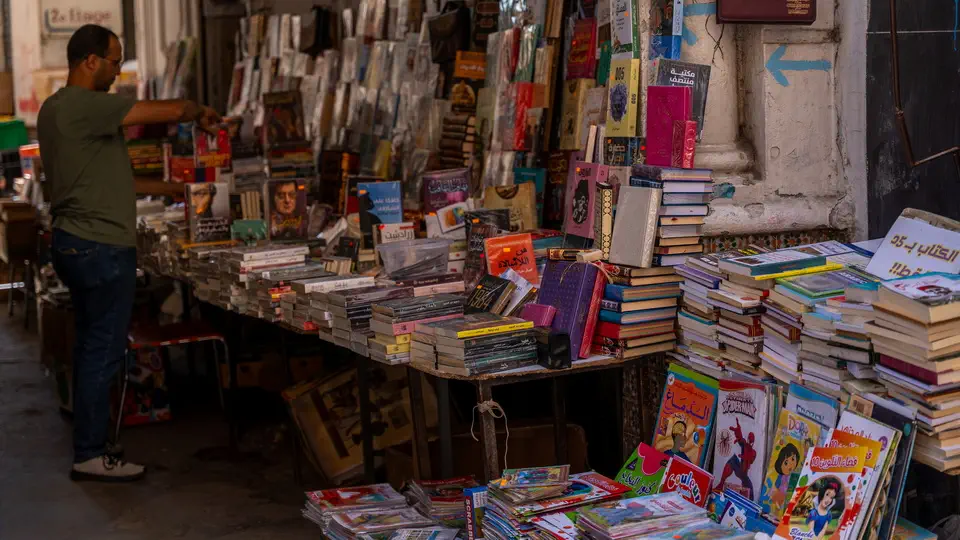
Following Tunisia’s independence in 1956, many wealthy families moved to the city’s modern districts, leaving numerous historic palaces to fall into disrepair. Fortunately, large-scale restoration projects began during the 1970s, culminating in the Medina’s inscription as a UNESCO World Heritage Site. From that point onwards, conservation work accelerated dramatically. Many former palaces were transformed into boutique hotels, art galleries, museums and restaurants, breathing new life into these remarkable buildings.
Today, the Medina remains one of Tunisia’s greatest historic treasures. Tens of thousands of people still live within its ancient walls. Every day, hundreds of shops, workshops, and cafés welcome both locals and visitors. This is not an open-air museum created solely for tourists. It is a living neighbourhood where residents shop, children walk to school and craftsmen continue practising trades that have been passed down through generations.
That is precisely why exploring the Medina leaves such a lasting impression. You are not walking among abandoned ruins but through a place that, despite more than 1,300 years of history, continues to live and breathe.
In the next section, we will discover the Medina’s most remarkable monuments, step inside magnificent palaces and mosques, explore hidden courtyards, and reveal the places that simply cannot be missed while visiting Tunis.
The Medina of Tunis – The Most Beautiful Monuments and Places You Simply Cannot Miss
The history of the Medina is fascinating, but it is only when you wander through its winding streets that you truly understand why it has captivated travellers for centuries. This is not a city designed according to an architect’s master plan. Instead, it evolved naturally over more than thirteen centuries, which means that something new awaits around every corner. One alleyway leads to a bustling spice market, another opens onto a peaceful courtyard with a marble fountain, while the next ends in front of the richly decorated doorway of a former merchant’s palace. It is well worth setting aside at least a full day to explore the Medina, although you could easily spend two or even three days here and still discover places that never appear in most guidebooks.
- The Great Mosque of Ez-Zitouna – The Heart of the Medina – There is no better place to begin your visit. For more than 1,300 years, the Great Mosque of Ez-Zitouna has been the religious, educational and social centre of old Tunis. The first mosque was built around AD 732, although its present appearance is the result of numerous extensions and reconstructions carried out by successive dynasties. The mosque stands on the site of an earlier Christian basilica, and several of the columns used in its construction were taken from Roman buildings. Even from a distance, the massive minaret dominates the skyline of the Medina. As you approach, you will notice the vast courtyard surrounded by elegant arcades and countless finely crafted architectural details. For centuries, one of the Islamic world’s leading universities operated here. Future scholars, judges, and philosophers from across the Maghreb came to study within these walls. Non-Muslim visitors are generally not permitted to enter the prayer hall, but the courtyard and the exterior of the mosque alone make this one of the city’s most impressive landmarks.
- The Souks – A Maze of Colours and Fragrances – Unquestionably, the traditional souks are the greatest attraction of the Medina. This is not one single marketplace but an entire network of streets, each specialising in a particular trade. As early as the Middle Ages, every guild of merchants was assigned its district, and remarkably, many of these specialisations remain unchanged today.
- Souk El Attarine – This is probably the most fragrant corner of the Medina. Since the sixteenth century, merchants here have traded perfumes, essential oils, incense, rose water and traditional oriental cosmetics. Walking through these narrow streets, it is almost impossible to resist the intoxicating aromas of jasmine, amber, musk, and sandalwood.
- Souk Ech-Chaouachine – This marketplace has become one of Tunisia’s enduring symbols. Since the fifteenth century, craftsmen have produced the famous red fezzes once worn by men throughout much of the Ottoman Empire. Today, most customers are tourists, but several workshops still create every fez entirely by hand using traditional methods.
- Souk El Berka – It is difficult to imagine that this elegant square was once the site of slave auctions. After slavery was abolished, the area underwent a complete transformation. Today, it is home to some of Tunisia’s finest jewellers. Display windows glitter with gold necklaces, bracelets and beautifully crafted silver jewellery inspired by traditional Berber designs.
- Souk des Chéchias – One of the oldest commercial districts in Tunis, this souk has been producing felt caps for centuries, exporting them throughout North Africa. Even today, you can still find craftsmen working on old wooden machines, preserving techniques that have changed little over the generations.
- Dar Lasram – A Palace of Tunisian Aristocracy – Anyone wishing to discover how Tunis’ wealthiest families once lived should visit Dar Lasram. Built at the beginning of the nineteenth century for a prosperous merchant family, the palace immediately impresses with its magnificent central courtyard paved entirely in white marble. Colourful ceramic tiles, carved wooden ceilings, intricate stucco decoration and beautifully ornamented windows demonstrate the extraordinary level of craftsmanship achieved by Tunisian architects and artisans. Today, the palace belongs to the Association for the Protection of the Medina, allowing visitors to admire its stunning interiors.
- Dar Hussein – Just a few minutes’ walk away stands another magnificent residence. Dar Hussein dates from the eighteenth century and once belonged to one of the most influential Ottoman families in Tunis. It illustrates perfectly the blend of Arab and Ottoman architectural styles. Stone columns, elegant wooden galleries and marble staircases make the palace resemble an aristocratic residence in Istanbul rather than a traditional North African home. Today, the building houses Tunisia’s National Heritage Institute.
- Dar Othman – One of the Medina’s Oldest Palaces – Dar Othman is a true masterpiece of Hafsid and Ottoman architecture. Built towards the end of the sixteenth century, it has preserved its original layout almost intact. The magnificent arcaded courtyard forms the centrepiece of the residence, while colourful ceramic tiles imported from Al-Andalus create one of the palace’s most striking features.
- Medresy – Universities of the Islamic World – As you stroll through the Medina, you will frequently encounter small Quranic schools hidden among the narrow streets. Among the finest are Madrasa Slimania, Madrasa Bir Lahjar, Madrasa El Bachia and Madrasa Mouradia. Each contains a peaceful courtyard with a fountain, lecture rooms and modest student accommodation. For centuries, these institutions taught astronomy, mathematics, law and philosophy, attracting students from across the Islamic world.
- Tourbet el Bey Mausoleum – This remarkable mausoleum ranks among the finest historic monuments in Tunisia. It serves as the burial place of the Husainid rulers and members of their families. Inside, visitors are greeted by an astonishing display of craftsmanship. White marble, black stone, gilded decoration and colourful ceramic tiles combine to create an extraordinary work of art. The silence within the mausoleum provides a striking contrast to the lively markets only a short distance away.
- Historic Hammams – or centuries, public bathhouses played a vital role in daily life. They were far more than places to wash. People met friends, discussed business, celebrated weddings and relaxed after long days of work. Several historic hammams still operate today, offering visitors the opportunity to experience a traditional Tunisian bathing ritual complete with black soap treatments and relaxing massages.
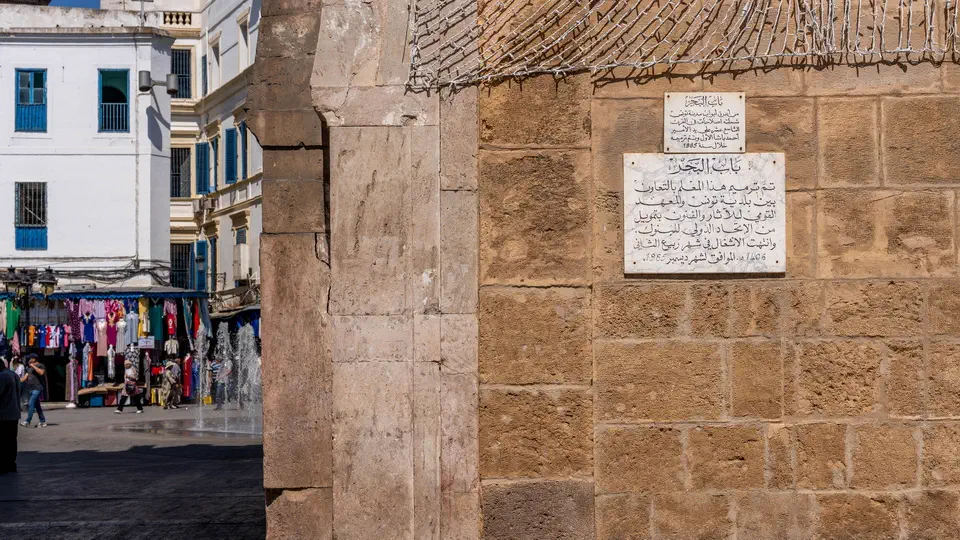
- Bab el Bahr – The Gate of France – The best-known gateway into the Medina symbolises the meeting of two very different worlds. On one side lies modern European-style Tunis, while on the other begins the maze of medieval streets that forms the old city. Passing through this gate feels like stepping between two different eras, making it one of the most photographed places in the Tunisian capital.
Every one of these monuments and attractions is worth seeking among the maze of narrow streets that define the Medina of Tunis. For me, however, the greatest treasures were not the famous landmarks but the hidden alleyways and the extraordinary doors for which the Medina is renowned.
As you explore, you will quickly discover that the most memorable places often cannot be found on any map. If you are patient enough, you will stumble upon tiny flower-filled courtyards, secluded fountains tucked away behind forgotten passages, ancient wells and traditional workshops where craftsmen still use the very same tools their ancestors relied upon centuries ago.
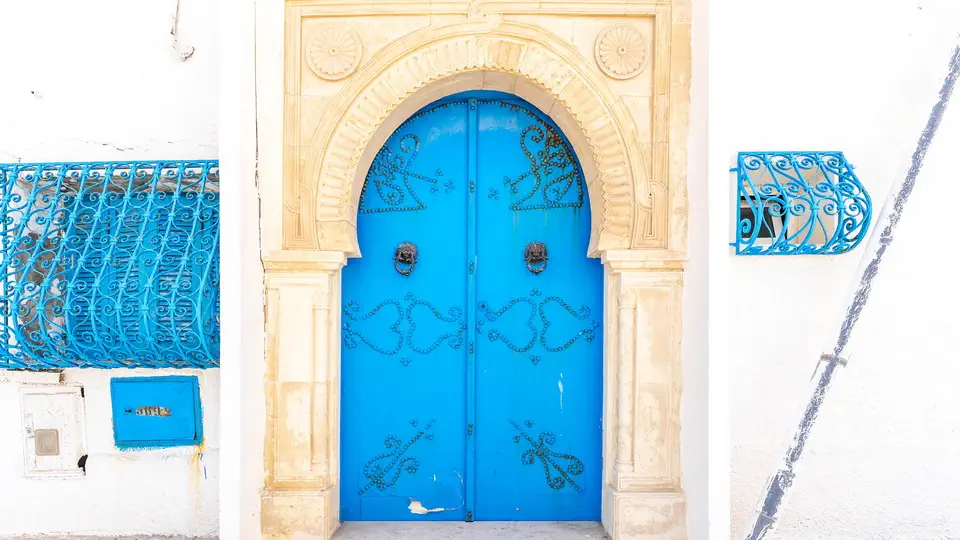
Look up from time to time. Notice the wooden balconies projecting above the streets, admire the famous blue doors decorated with distinctive metal studs, and remember that many of them have stood here for several hundred years.
Where to Stay in the Medina of Tunis
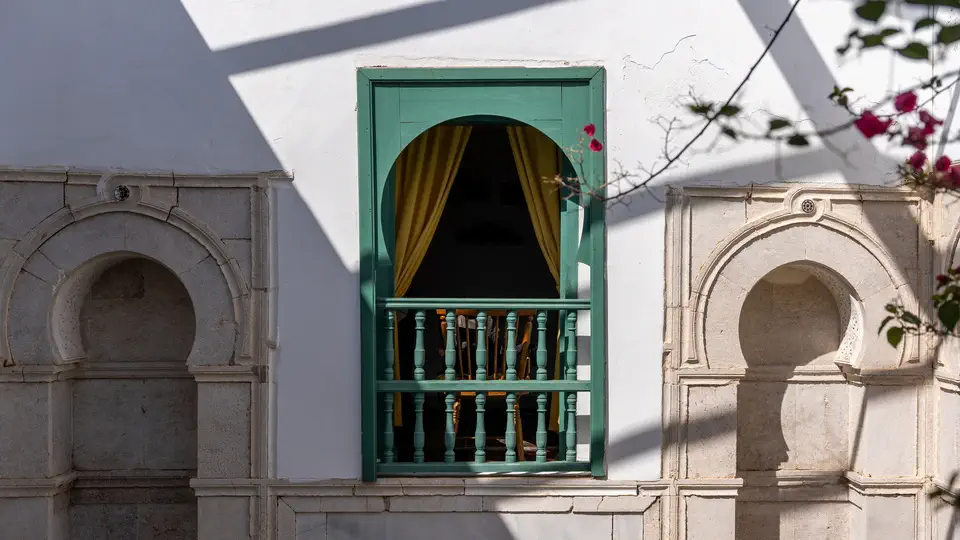
Although most visitors choose hotels in the modern part of Tunis, spending the night inside the Medina offers an entirely different experience. The greatest appeal lies in its beautifully restored palaces, many of which have been transformed into elegant boutique hotels and traditional riads. These unique properties offer rooms set within historic buildings featuring marble courtyards, colourful ceramic tiles and intricately carved wooden ceilings.
Once the day-trippers leave and evening falls, the Medina becomes surprisingly peaceful. It is the perfect time to relax in a quiet courtyard with a cup of coffee or mint tea, chatting with fellow guests or the owners of these charming historic houses.
During our stay, we spent several nights at Dar Zyne – Maison d’Hôte, and we were genuinely pleased with our choice. This beautifully restored merchant’s house has been converted into a small guesthouse with just a handful of rooms arranged around a traditional central patio. Breakfasts are included. They may not be extravagant, but they are more than enough to enjoy a good coffee and a light meal before setting off to explore the streets of Tunis. I would happily recommend staying here.
What to Eat While Exploring the Medina
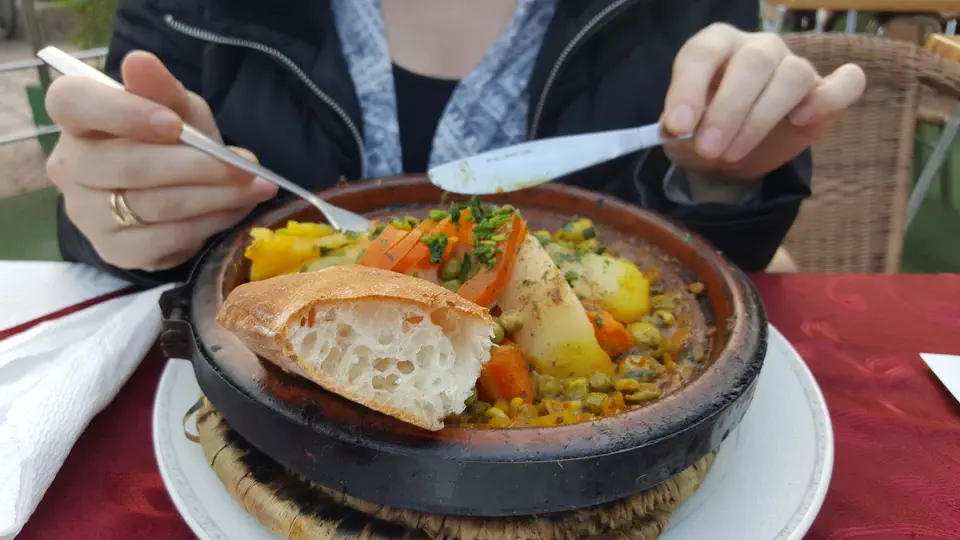
Food is an essential part of any visit to the old city of Tunis. Many restaurants continue to prepare recipes that have been passed down through generations. While exploring the Medina, make sure you try:
- Brik – crispy pastry filled with egg, tuna, potatoes, and parsley.
- Couscous – Tunisia’s national dish, traditionally served with lamb, chicken, or fish.
- Ojja – a rich and flavourful dish made with eggs, tomatoes, harissa and spicy merguez sausage.
- Lablabi – a hearty chickpea soup served with bread, olive oil and harissa.
- Tunisian Tajine – quite different from the Moroccan version, resembling a baked omelette rather than a slow-cooked stew.
- Grilled lamb and spicy merguez sausages.
For dessert, I almost always ordered baklava, makroudh filled with dates or bambalouni, a wonderfully light doughnut dusted with sugar.
To accompany it all, there was always freshly brewed mint tea with pine nuts or a strong Tunisian coffee. The coffee, in particular, is excellent—especially when prepared in the traditional local way rather than trying to imitate Western-style americanos or cappuccinos, which rarely turn out quite as well.
The Medina of Tunis – Practical Information for Visitors
Although the Medina may appear to be an enormous maze, exploring it is actually quite straightforward. The only thing you need to accept is that eventually, you will almost certainly get lost. That, however, is part of its charm. The most fascinating alleyways, hidden workshops and atmospheric cafés are often discovered entirely accidentally.
Looking back on my visits, my favourite memories are not connected with famous landmarks marked on tourist maps. Instead, I remember an elderly craftsman hammering copper trays by hand, a tiny bakery filled with the aroma of freshly baked bread and a hidden courtyard overflowing with flowers that I stumbled upon completely by chance.
If you are planning your first visit, these simple tips will make your experience even more enjoyable.
- How Much Time Should You Allow? – This is one of the questions visitors ask most often. If you simply want to see the main sights, around four hours will be enough. However, that is really only scratching the surface. A full day is highly recommended, giving you time to explore the palaces, mosques, and souks at a relaxed pace, stop for coffee and enjoy a leisurely lunch. If you enjoy architecture, photography and discovering local culture, I would even recommend spending two days here. Your second day allows you to venture into quieter corners that most organised tours never reach.
- When Is the Best Time to Visit? – Tunisia enjoys warm weather for most of the year. The most pleasant months for exploring the Medina are March, April, May, October, and November – Temperatures during these months are ideal for spending hours on foot. During July and August, temperatures frequently exceed 35°C. While the narrow streets offer a little shade compared with the open squares, the heat can still become exhausting.
- What Time of Day Should You Start? – I strongly recommend arriving early in the morning. Around 8:00 am, the shops begin opening, tourist crowds have not yet arrived, the light is perfect for photography and the temperatures remain pleasantly cool. Another wonderful time is late afternoon. After around 4:00 pm, the sun casts a warm golden glow across the old buildings, beautifully highlighting the sandy-coloured walls and the Medina’s famous blue doors.
- How Can You Avoid Getting Lost? – The truth is—you probably won’t. Even after several visits, we still relied on an offline map occasionally, and that is completely normal. The Medina was originally designed as a defensive city. Its winding streets made it difficult for invading armies to navigate. Even today, many alleys end in dead ends or suddenly turn at right angles. Download an offline map before your visit and use one easily recognisable landmark to orient yourself. For me, the Great Mosque of Ez-Zitouna became the perfect reference point. It is also worth paying attention to the main city gates. Even if you lose your bearings, sooner or later you will eventually emerge onto one of the larger shopping streets.
- Is the Medina Safe? – This is another question travellers often ask.
During the daytime, the Medina is generally a very safe place. Throughout our visit, we never felt threatened or uncomfortable. Families, local residents and thousands of tourists fill the streets every day.
As in any large city, however, common sense is important.
A few simple precautions are all you really need:- avoid displaying large amounts of cash;
- keep an eye on your phone and camera;
- avoid completely deserted alleys after dark;
- do not engage in arguments with overly persistent street vendors.
- In the evening, it is best to stay on the main streets.
- What Should You Wear? – Tunisia is a Muslim country, although a relatively liberal one. When exploring the Medina, dressing respectfully towards local customs is always appreciated. Lightweight trousers, a knee-length skirt or dress, a top that covers your shoulders and comfortable walking shoes are ideal. This is not a strict requirement, but such clothing is practical in the warm climate and helps you blend naturally with residents.
- Is It Worth Hiring a Guide? – If history interests you, then absolutely. Many historic buildings appear fairly modest from the outside. Only once you understand their stories do you begin to notice the remarkable architectural details hidden within them. However, if you enjoy exploring independently, the Medina is equally rewarding. Some of my favourite moments came from simply wandering aimlessly through its streets, something I found myself doing every single day.
- Shopping in the Souks – Haggling is an essential part of the shopping experience in the Medina. In fact, most shopkeepers fully expect customers to negotiate. The first price you are offered is seldom the final one. The best approach is to bargain with a smile, stay relaxed and never appear to be rushing. Negotiating here is not a battle to be won, but a friendly ritual that both sides generally enjoy. If the price still seems too high, simply thank the seller politely and walk away. More often than not, you will immediately be offered a better deal.
- What Should You Buy? – The Medina is the perfect place to pick up authentic Tunisian souvenirs. Among the most popular are:
- hand-painted ceramics,
- traditional mosaics,
- handcrafted copper trays,
- Arabic-style lanterns,
- locally blended spices,
- olive oil,
- harissa,
- leather goods,
- Berber jewellery,
- handwoven carpets – If you decide to buy a carpet, make sure it comes with a certificate of authenticity, as imitations are not uncommon.
- Paying for Purchases – Cash is still king throughout much of the Medina. While larger restaurants and hotels usually accept bank cards, many smaller shops only take Tunisian dinars. It is also a good idea to carry plenty of small notes and coins, making shopping and tipping much easier.
- Photographing the Medina – The Medina of Tunis is a paradise for photographers. The finest photographs are usually taken early in the morning or shortly before sunset, when the soft golden light beautifully illuminates the ancient buildings. Don’t focus solely on the famous monuments. Some of the most memorable images can be found elsewhere. Photograph the magnificent old doors—many of which are several centuries old—along with colourful shutters, cats sleeping on staircases, craftsmen at work, piles of fragrant spices, intricate mosaics and beautifully decorated lanterns. Whenever you wish to photograph residents, always ask for permission first. Most people respond warmly, especially if you take a moment to exchange a few friendly words beforehand.
- A Few Tips from a Traveller – After several visits to the Medina, I noticed that most tourists make the same mistake—they try to see everything. That simply isn’t possible. Instead, slow down. Sit for a while in a small café. Chat with the spice seller. Listen to the sounds of everyday life drifting through the narrow streets. Step into a tiny workshop where the same craftsman has been hand-hammering copper bowls for decades. These are the moments that stay with you long after your trip is over, far more vividly than a checklist of famous monuments ever could.
The Medina of Tunis is not a place you can truly experience during a single walk. It is a living chronicle of Tunisia, written not in books but in ancient stone walls, carved wooden doors and winding streets filled with the scent of spices—although, admittedly, not only spices.
Every era has left its mark here, from the first Arab conquerors to scholars and merchants, from Ottoman beys to French architects. Yet the greatest magic of the Medina lies in the fact that, despite more than thirteen centuries of history, it has never become a museum piece. People still live here. Craft workshops continue to operate. Morning coffee and evening mint tea remain part of the city’s everyday rhythm. That is why exploring the Medina is far more than sightseeing. It is a journey through time into a world that still beats to its own unique rhythm.
The Medina of Tunis – Secrets and Legends
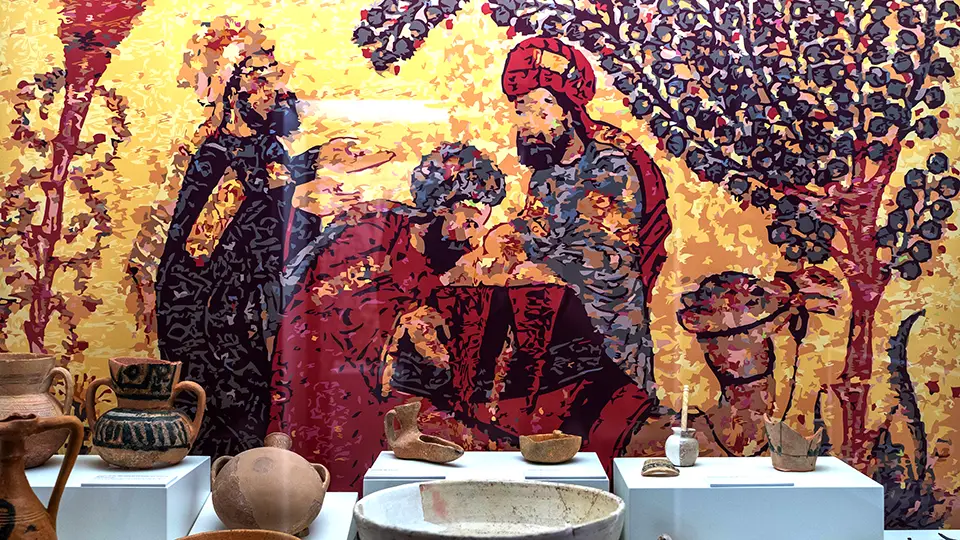
The moment I enjoyed most always came just after sunset, when the Medina revealed an entirely different character. The noise of the markets gradually faded away. Shopkeepers closed the wooden shutters of their stores, while conversations continued to drift from cafés where locals gathered over glasses of mint tea. At times like these, it becomes easy to understand why, for centuries, the old city has fuelled the imagination of merchants, travellers, and chroniclers alike.
Over more than thirteen centuries, countless stories have emerged here—tales of hidden treasure, secret passageways, ghosts of forgotten rulers and mysterious events that no one has ever fully explained. Some have their roots in history. Others are simply beautiful legends passed down from one generation to the next. Below are a few of the stories I heard while sitting in the atmospheric cafés and restaurants hidden within the Medina.
The Secret Tunnels Beneath the Medina
One of the best-known legends speaks of a vast network of underground passages stretching beneath the entire Medina.
According to local tradition, these tunnels connected the palaces of the beys with the city’s most important mosques and even extended beyond the defensive walls. During times of siege, they supposedly allowed rulers to escape unnoticed or move troops in complete secrecy.
Historians have confirmed the existence of underground cisterns, storage chambers and cellars beneath parts of the old city.
However, no evidence has ever been found to support the existence of the enormous tunnel network described in the legends.
Even so, many local residents still claim that behind the sealed walls of certain ancient houses lie forgotten entrances leading into mysterious underground corridors.
The Treasure of the Last Hafsids
When the Hafsid dynasty lost control of Tunisia during the sixteenth century, legend tells that part of the royal treasury disappeared.
Gold coins, precious jewels and priceless manuscripts were supposedly hidden somewhere within the Medina, either beneath the courtyard of an old palace or inside a forgotten residence.
Treasure hunters have searched for it for centuries.
Yet no discoveries have ever confirmed the legend.
Some locals jokingly say that the treasure still awaits the one person with a completely pure heart.
The Ghost of the Guardian
Older residents sometimes tell the story of a night watchman who guarded one of the Medina’s gates hundreds of years ago.
When enemy forces attacked, he refused to abandon his post and died while trying to warn the city’s inhabitants of the approaching danger.
Since then, people claim that, on quiet nights, the echo of his footsteps can occasionally be heard along the ancient stone streets.
According to the legend, his spirit never harms anyone.
He simply continues protecting the city for which he gave his life.
Jinn Living in Abandoned Houses
Belief in jinn—supernatural beings created from smokeless fire—has been part of Arab culture for centuries. According to local folklore, these invisible creatures are particularly fond of the abandoned palaces scattered throughout the Medina.
For this reason, people once avoided entering ruined buildings after dark. Some locals believed that laughing loudly or whistling at night could attract the attention of these unseen inhabitants of the ancient walls.
The Doors That Bring Good Fortune
While strolling through the Medina, it is impossible not to notice the distinctive blue doors decorated with rows of metal studs.
According to local tradition, the arrangement of these studs forms protective symbols designed to shield the household from evil spirits and the envy of others.
This is why many families have preserved the appearance of their front doors for generations, believing they bring good fortune and prosperity to everyone who lives inside.
The Legend of the Olive Tree
The name of the Great Mosque of Ez-Zitouna literally means “The Mosque of the Olive Tree”.
One popular legend claims that the original mosque was built on the site where an exceptionally ancient olive tree once stood.
The tree was said to provide shade for weary travellers and to mark a place blessed with divine favour.
Although historians have found no evidence to support the story, it remains one of the Medina’s best-loved legends.
The Medina of Tunis – Facts and Fascinating Insights
- The Medina of Tunis is over 1,300 years old. Its origins date back to the end of the seventh century, and it has remained continuously inhabited ever since, making it one of the oldest living historic city centres in North Africa.
- More than 700 streets wind through the Medina. Many are so narrow that even the smallest car could never pass through them, helping preserve their medieval character.
- Around 700 historic monuments are located within its walls. These include mosques, madrasas, palaces, fountains, hammams, mausoleums and former caravanserais, creating one of the largest historic urban complexes in the Islamic world.
- The Medina became a UNESCO World Heritage Site in 1979. It was among the first historic quarters in Africa to receive this prestigious recognition.
- Every street once had its speciality. Goldsmiths occupied one district, leather workers another, while spice merchants traded in their own dedicated streets. Much of this centuries-old organisation still survives today.
- Many columns inside the Great Mosque originated from Roman buildings. Builders reused architectural elements from ancient Carthage when constructing the mosque.
- Many houses appear surprisingly modest from the outside. Step through the entrance, however, and you often discover magnificent courtyards decorated with marble, colourful ceramic tiles and elegant arcades.
- The Medina was designed as a natural fortress. Its maze-like streets made it extremely difficult for invading armies to navigate, while allowing residents to defend the city more effectively.
- Many former palaces conceal hidden gardens. Nothing hints at their existence from the street, but beyond heavy wooden doors lie peaceful courtyards filled with fountains and lush greenery.
- Many historic buildings still serve their original purpose. Several mosques and religious schools continue to function just as they did hundreds of years ago.
- The famous blue doors carry symbolic meaning. Throughout Tunisia, the colour blue has long been believed to protect homes from the evil eye.
- Hundreds of domes rise above the rooftops of the Medina. Most belong to mosques, madrases and historic public bathhouses.
- Many workshops have remained in the same families for generations. Traditional skills are often passed from father to son, sometimes for hundreds of years.
- Dozens of historic fountains can still be found throughout the Medina. They once supplied residents with drinking water and served as important meeting places.
- Some streets are so narrow that two people carrying large bags can barely pass one another. This reflects the medieval layout and the limited space available within the city walls.
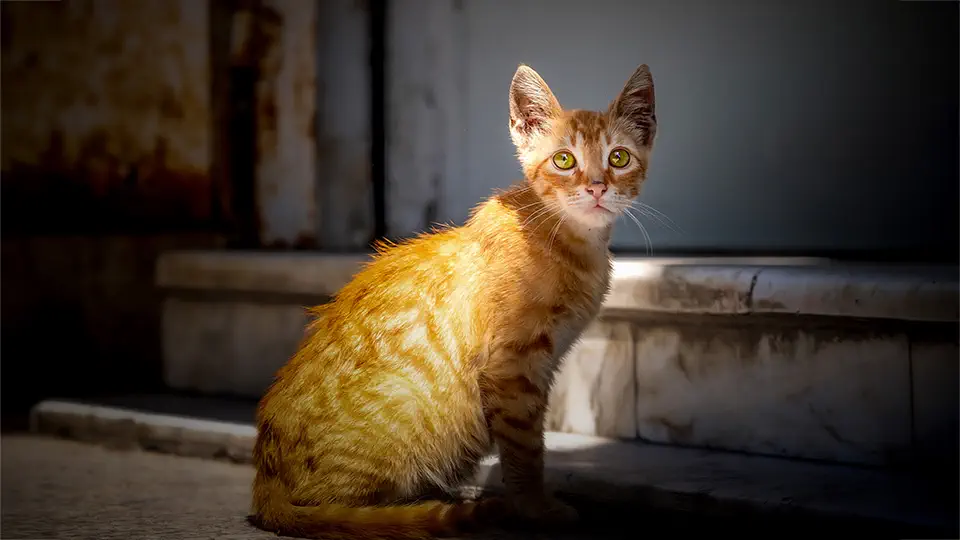
- Tunisian cats have become one of the symbols of the Medina. They can be seen almost everywhere—resting on staircases, rooftops, walls, and even inside cafés.
- Many rooftops are interconnected. Historians believe that residents once used them to move around the city safely during times of danger.
- The Medina has appeared in numerous documentaries and historical productions. Its remarkably authentic architecture provides an ideal setting for recreating the atmosphere of the medieval Arab world.
- No two walks through the Medina are ever the same. With hundreds of twisting streets, even returning visitors continually discover new corners they have never seen before.
- This is not a museum but a living city. The Medina’s greatest treasure is that thousands of people still call it home, while daily life continues much as it has for centuries.