Szymbark in Kashubia – a distinctive and fascinating Kashubian theme park
There is no need to persuade anyone of the appeal of Kashubia and its remarkable Kashubian culture. Ancient pine forests and dense, seemingly impenetrable woodlands filled with rivers and lakes attract visitors from all over Europe and even from further afield. The people of Kashubia have their language, cuisine, and history – a history that could easily serve as the script for more than one Hollywood blockbuster. According to the Kashubians themselves, even the weather here is always a little better than in other parts of the country. I have not been able to verify that claim, however. Beyond its stunning natural landscapes, Kashubia offers many other attractions. Some of them can be found in a place famous for turning a house upside down.
Szymbark in Kashubia – a small village in Kashubia
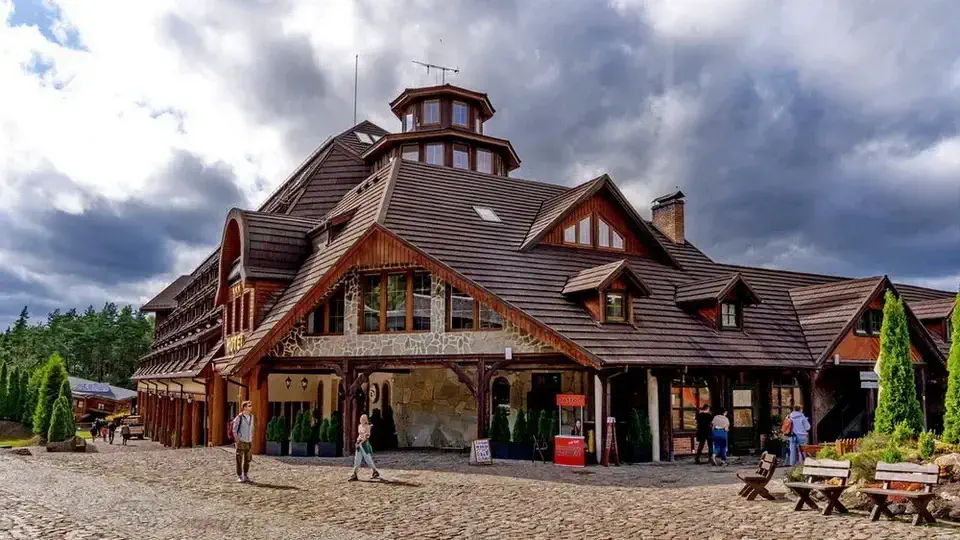
Szymbark is a small village located in Kashubia, in the Pomeranian Voivodeship. Locals call it Szimbark, and although it has just over five hundred residents, it attracts thousands of visitors every year. The village lies in the heart of Kashubian Switzerland and forms part of the Kashubian National Park.
The Centre for Education and Regional Promotion in Szymbark (CEPR)
Szymbark owes its popularity to the Centre for Education and Regional Promotion, which has been operating there since the 1990s. This is a private institution dedicated to promoting Kashubian culture and the history of the region. The site hosts an extraordinary collection of exhibits and objects directly and indirectly connected with Kashubia and its people, creating a kind of open-air museum or heritage park. Below, I will describe what we managed to see in Szymbark and why it is well worth a visit.
Szymbark in Kashubia – an open-air museum and heritage park
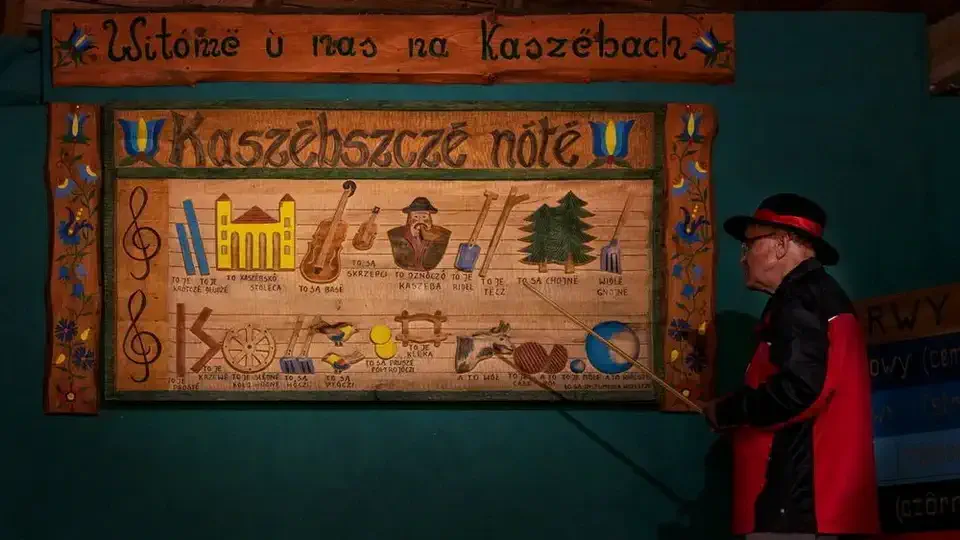
Within the Centre, you will find wooden cottages and historic buildings associated with Kashubia, each with its rich and fascinating history. When purchasing a ticket at the entrance, you have the option of joining a guided tour of the site, which I strongly recommend. The guides speak with genuine passion and affection, not only about the local attractions but also about Kashubia and its unique culture. The guide who accompanied us told captivating stories and spoke – and even sang – fluently in Kashubian. The Kashubian alphabet, known as the Kashubian Notes, sounded particularly beautiful in his performance.
Woodworking exhibition in Szymbark
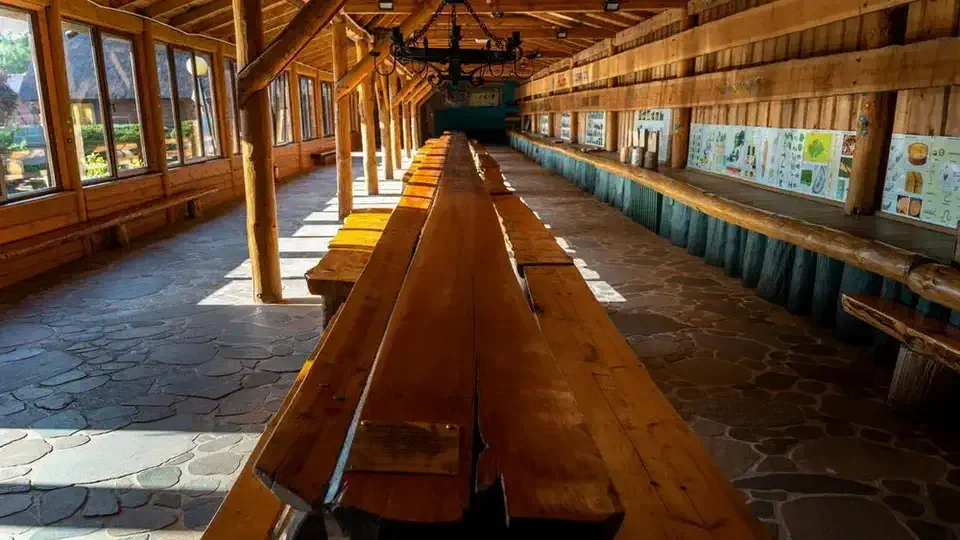
The Centre features numerous attractions, and our visit began with an exhibition devoted to wood and woodworking. The Museum of Carpentry showcases the craftsmanship of Kashubian artisans and carpenters. Thanks to several exhibits, Kashubia has earned a place in the Guinness Book of Records.
- In Szymbark, you can see a board almost 37 metres long, hand-cut from a pine tree over 50 metres tall. Made in 2002, it remained the longest board in the world until 2009.
- Another board measures 46 metres and 53 centimetres. It was cut in 2012 to break the record set by the first board, and still holds the title of the longest board in the world today. Former Polish President Lech Wałęsa and his wife took part in cutting this board.
- There is also the Nobel Laureate’s Table, named after Lech Wałęsa – the largest table of its kind in the world, capable of seating more than 200 people.
Kashubian exhibition
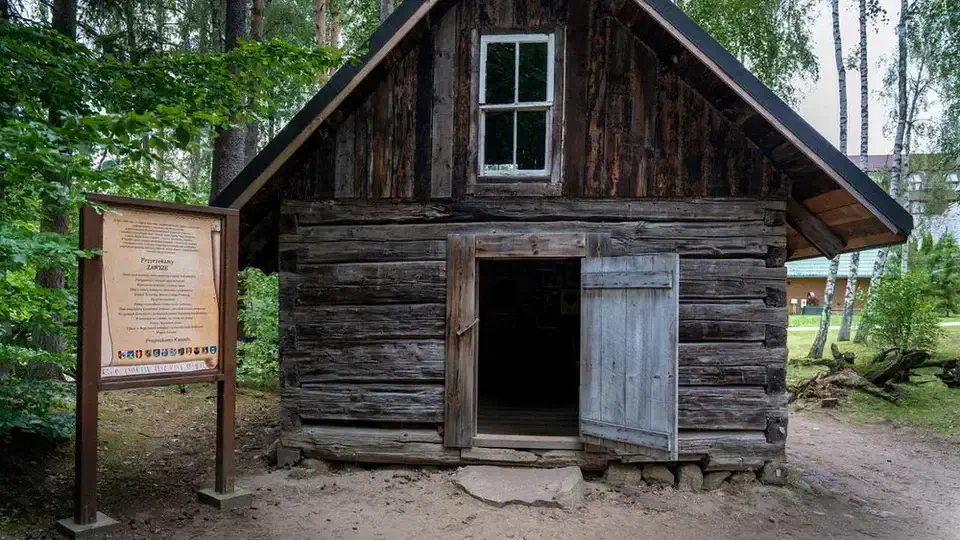
Numerous buildings and structures displayed in Szymbark are closely linked to Kashubia. Here you will see:
- A replica of a manor house brought from the Kashubian village of Salino
- A wooden church built in a style typical of the Kashubian region
- The home of Kashubian emigrants from Canada
- A traditional bread oven where Kashubian bread is baked
- An exhibition of household equipment used in Kashubia, housed in an inn where you can also sample traditional dishes such as bigos, pork knuckle, ruchanki pancakes and local bread
The Siberia exhibition
Several permanent exhibitions in Szymbark tell the story of the often forced journeys of Poles and Kashubians. These began during the partitions of Poland and continued during and after the Second World War. The most dreaded destination was Siberia. In the 18th century, members of the Bar Confederation – a military alliance of Polish nobility that included many Kashubians – were deported deep into Russia. The Confederation was formed to defend the Catholic faith and the independence of the Polish–Lithuanian Commonwealth and opposed both the Russian Empire and King Stanisław August Poniatowski, who cooperated with it. Many historians regard the Bar Confederation as Poland’s first national uprising.
The Siberian Exile Hut
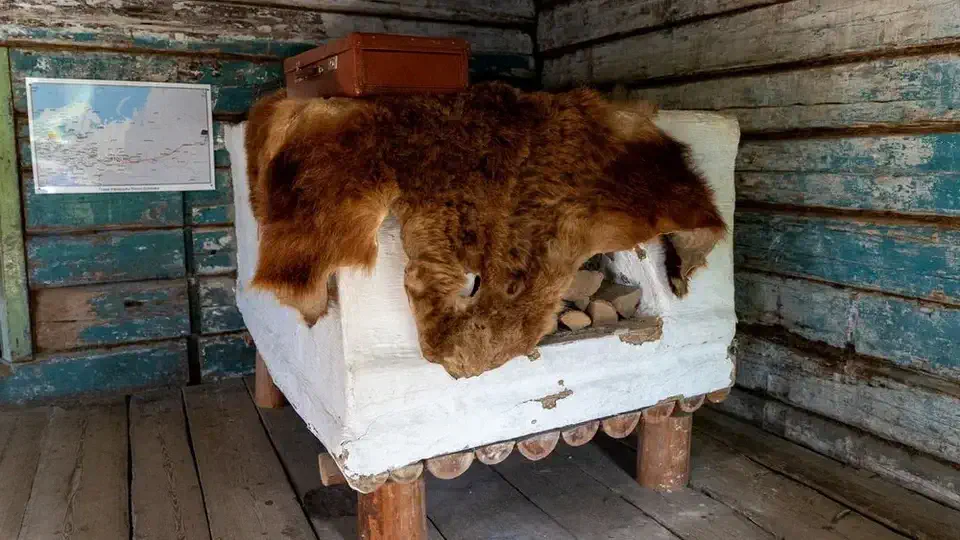
One of the oldest exhibits in Szymbark dates from this period – the House of a Siberian Exile. This wooden hut was inhabited by Polish deportees over 240 years ago and was brought from Zapleskina in the Irkutsk Oblast. Transporting the dismantled structure covered a distance of nearly 8,000 kilometres.
The Borovichi Labour Camp model
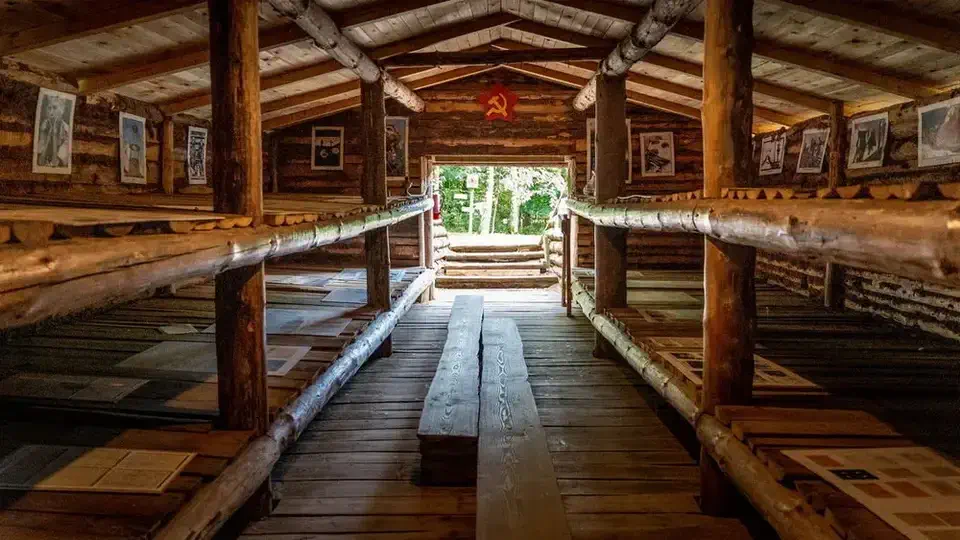
This is a faithful replica of a Soviet labour camp in which soldiers of the Polish Home Army were imprisoned after being deported to Siberia. Photographs displayed on the walls show the nightmare of life – or rather mere survival – endured by Polish soldiers in exile.
The loading ramp with an original steam locomotive
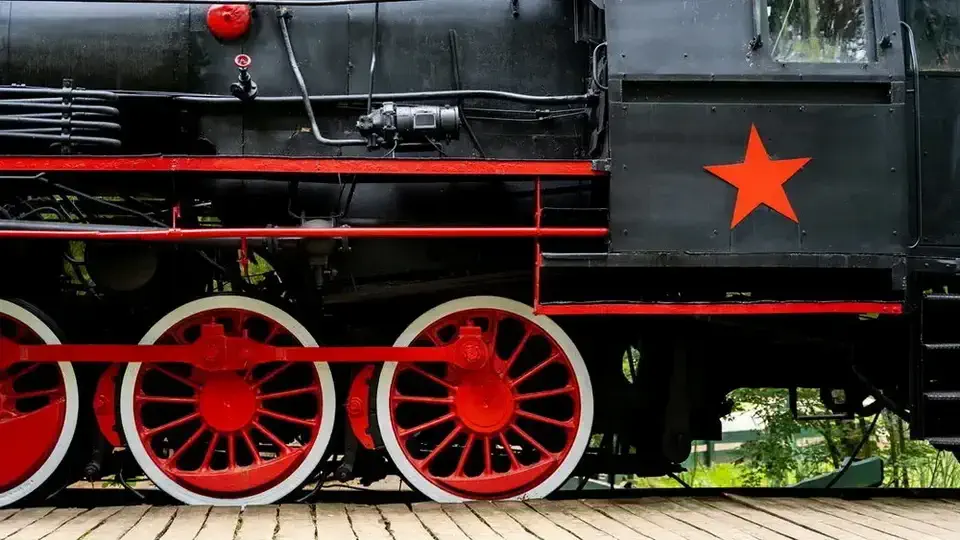
This installation features an original steam locomotive with wagons used to transport people deep into Russia. It symbolises the immense tragedy of thousands of individuals forcibly torn from their homes. Crushed into cattle wagons, they travelled across vast stretches of Russia, only to end up in some of the harshest places on Earth. A true nightmare.
The monument to Wojtek the Bear
The monument to Wojtek the Bear is a major attraction for younger visitors. Here they can learn about his extraordinary story. Wojtek was adopted by soldiers of General Anders’s army marching through Iran in 1941. Under their care, the cub grew into a strong and powerful bear. Over the years, his fate remained closely tied to that of the Polish soldiers. Wojtek took part in numerous battles, including the Battle of Monte Casino, where he became famous for carrying crates of ammunition and supplies on his back. He never lost a single load and was never late. In recognition of his service, he was promoted to the rank of corporal.
After many hardships and a journey across half the world, Corporal Wojtek arrived in Edinburgh with the soldiers, where they were eventually forced to part ways. Wojtek was placed in a zoo and became its greatest attraction. After the war, his former comrades visited him frequently, entering the enclosure without fear to greet their old friend – much to the astonishment of other visitors. Wojtek died on 2 December 1963.
The Gryf Pomorski exhibition
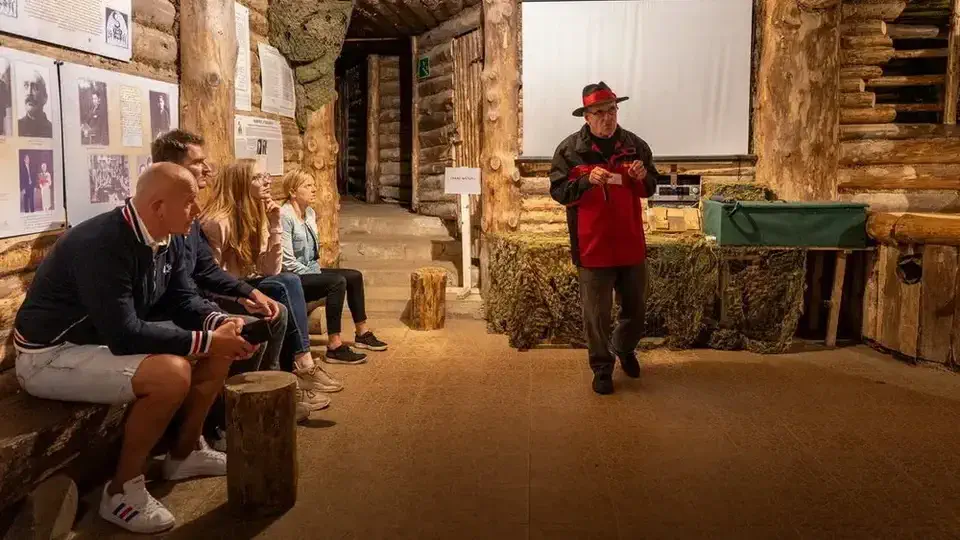
Gryf Pomorski was a Kashubian military organisation formed to fight the occupying forces. Initially known as Gryf Kaszubski, it later changed its name as Poles from outside Kashubia joined its ranks. The organisation was founded on 7 July 1941 with the aim of protecting civilians, helping those in need and defending Pomerania.
Replica of the Gryf Pomorski bunker
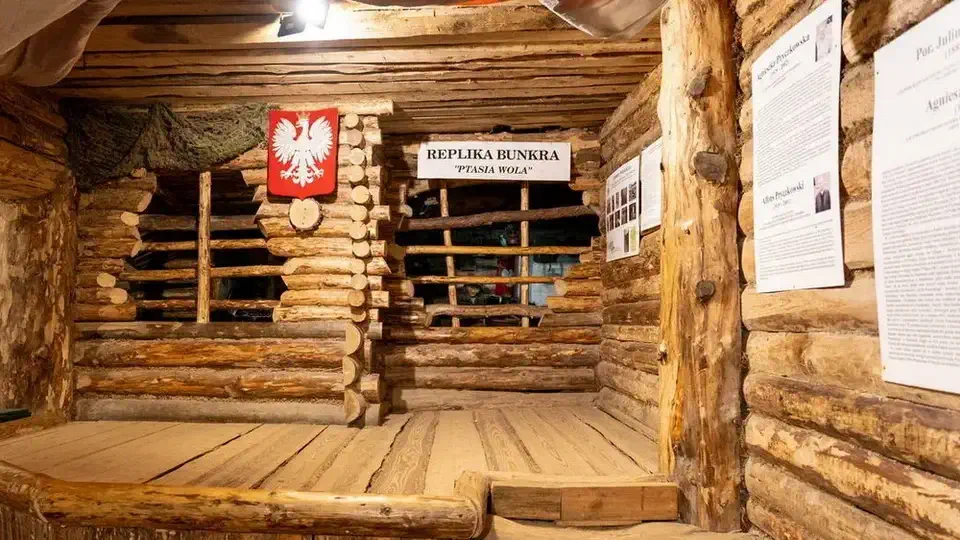
The bunker in Szymbark is an exact replica of an underground command bunker from the Second World War. Its faithful reconstruction allows visitors to learn how partisans remained hidden from the enemy while maintaining control over the organisation’s activities.
The Scout House
Kashubian scouts formed the youth wing of the Gryf Pomorski underground movement. Inside the building, you can see memorabilia left by these brave young people.
Other attractions in Szymbark
This is not all that awaits visitors in Szymbark.
The upside-down house
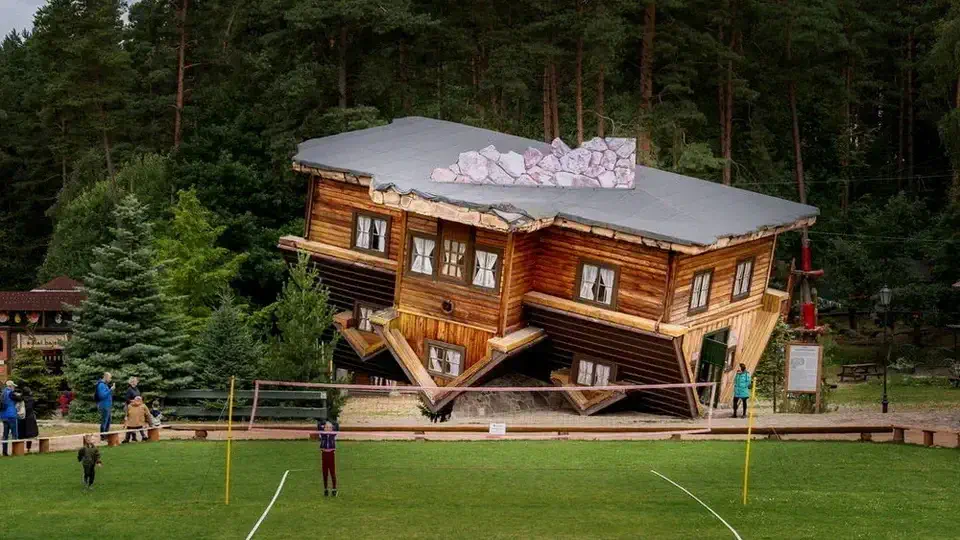
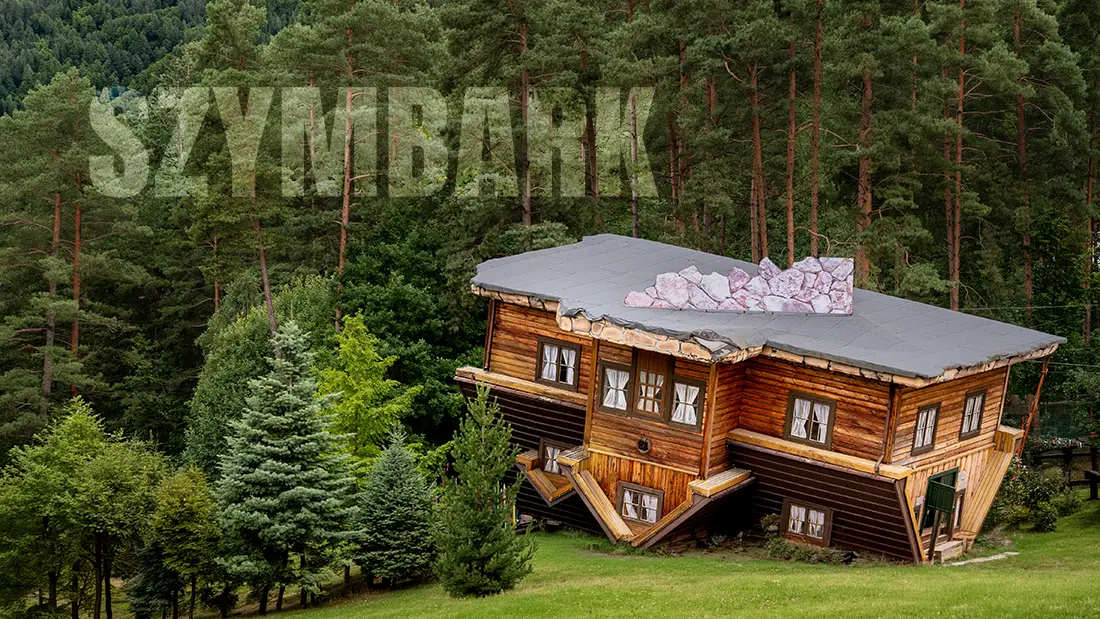
The upside-down house is perhaps the most famous attraction at the Centre. It is a fully furnished house designed to symbolise the absurd reality of life during the communist era, when everything seemed to be turned upside down. Today, it offers visitors a chance to test their senses in unusual conditions. I, personally, felt fairly comfortable, though I must admit that my sense of balance was occasionally taken by surprise. Many people experience significant discomfort, as their eyes perceive one thing while their brain receives conflicting signals.
The world’s largest piano
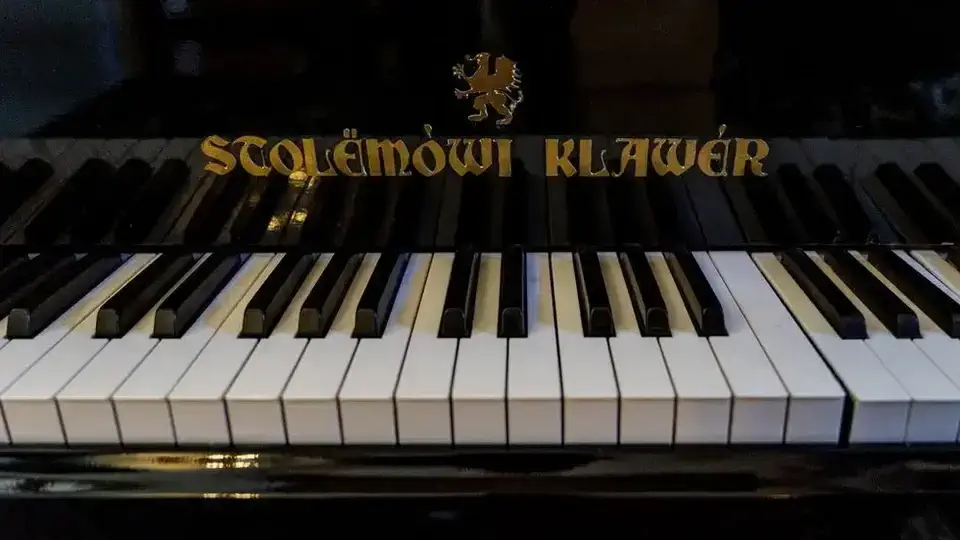
In 2010, the world’s largest piano was installed in one of the hotel’s spacious restaurant halls in Szymbark. Weighing nearly two tonnes and measuring over six metres in length, it is a fully functional instrument frequently used during concerts held on site. Known by its Kashubian name Stolëmòwi Klawér, it is officially recognised by Guinness World Records as the largest concert grand piano in the world. It stands on six legs, each bearing portraits of renowned Polish composers: Fryderyk Chopin, Stanisław Moniuszko, Ignacy Jan Paderewski, Mieczysław Karłowicz, Karol Szymanowski and Henryk Mikołaj Górecki. The instrument consists of hundreds of parts made in different locations and assembled in Szymbark. Artists who have performed on it include Bogdan Czapiewski and Leszek Możdżer.
The Kashubska Korona brewery
Within the complex, there is a traditional brewery producing beer according to old Kashubian recipes. Believe it or not, beer from Szymbark has become one of my favourites. The brewery is open to visitors, allowing you to observe the brewing process. All beers produced here are unpasteurised, unfiltered, and free from preservatives and artificial additives, resulting in a truly distinctive flavour.
Attractions for children
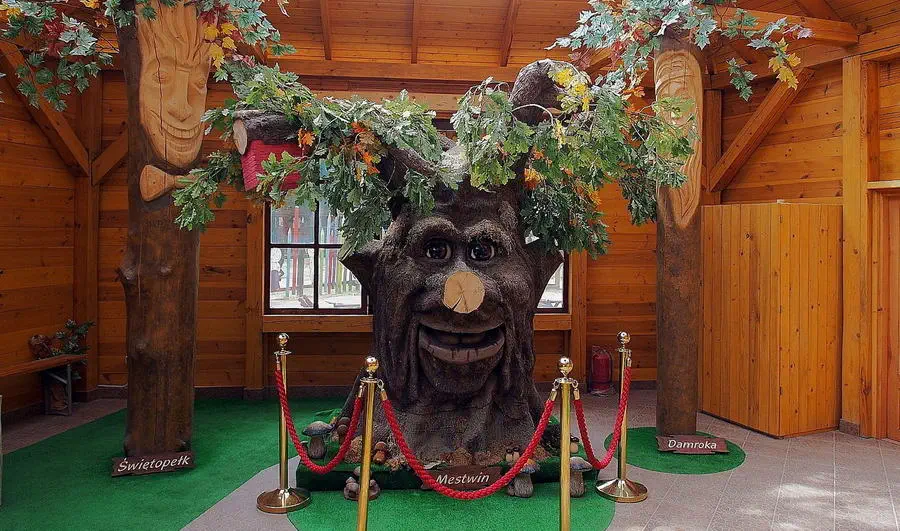
Szymbark is also a great place for children, offering plenty of attractions and activities, including the Kashubian Fairy Tale World and a rope park. This exhibition, open since 2013, is dedicated to fairy tales popular in Poland. These are mainly traditional stories that everyone knows well. Younger visitors will encounter characters such as Little Red Riding Hood, Puss in Boots, Pinocchio, and the Snow Queen. The figures have been created by talented artists, making the place not only interesting but also visually appealing. Admittedly, the passage of time is visible on many of the figures and elements of the display, but the attraction is clearly enjoyed by children, as their reactions show. Unfortunately, access to the Kashubian Fairy Tale World requires an additional fee of 8 zloty on top of the main entrance ticket. This may not seem much at first, but considering that entry to the Szymbark Centre itself costs 35 zloty, the total price becomes quite high. The Fairy Tale World is open every weekend from May to September between 11:00 and 18:00, and daily in July and August during the same hours.
The rope park in Szymbark consists of several aerial courses suspended among the treetops. They are colour-coded by difficulty, from the easiest green route, through white, orange, yellow and red, to the blue route. The last two are available only to teenagers and adults. The courses include ropes, wooden and rope ladders, platforms and bridges. The most challenging sections are set fairly high, up to many metres above the ground. The experience is quite enjoyable, although, much like the Fairy Tale World, the park as a whole feels slightly worn. This is not the only similarity between the two attractions: to enjoy a walk among the treetops, visitors must also pay an additional fee on top of the main ticket.
I am not sure whether you have ever visited a 4D cinema – one where, in addition to a three-dimensional image, the seats move during the screening and sometimes even release scents related to what is happening on the screen. The owners of the cinema in Szymbark claim that the experience they offer takes entertainment to an entirely new level. Whether this is truly the case is hard for me to say – you will have to judge for yourselves. Like the two attractions described above, the cinema is open every weekend from May to September and daily during the summer holidays. A ticket to the XD cinema costs a dozen or so złoty, and if it happens to be your birthday, admission is free.
Szymbark in Kashubia – Center for Education and Regional Promotion
The Centre for Education and Regional Promotion in Szymbark was founded in the 1990s by Mr Daniel Czapiewski. Initially, Mr Czapiewski established the company Danmar, which specialised in the construction of wooden single-family homes. Alongside his business activities, Daniel Czapiewski was deeply passionate about Kashubian culture, and it was his love for his small homeland that ultimately led to the creation of the open-air museum and heritage centre in Szymbark.
Today, the Centre for Education and Regional Promotion reflects precisely what lay at the heart of Mr Czapiewski’s passions. Patriotism, Kashubian traditions and the remembrance of Poles living in exile form the central themes of the museum and open-air exhibitions in Szymbark. Daniel Czapiewski passed away in 2013. Today, both the wooden house-building company and the Centre in Szymbark are owned by Mrs Lidia Czapiewska.
Szymbark in Kashubia – practical information
Address of the Centre for Education and Regional Promotion in Szymbark: ul. Szymbarskich Zakładników 12, 83-315 Szymbark, woj. pomorskie.
Official website of the Centre: www.cepr.pl
For any information, please call: (0048) 58 684-69-33
Opening hours:
- Monday through Saturday from 9:00 AM to 7:00 PM.
- Sundays and holidays from 10:00 AM to 7:00 PM.
To explore the Centre in Szymbark properly, you should allow at least three hours, especially if you plan to eat at the local inn or restaurant. Walking the entire route with a guide takes around an hour and a half, although our tour lasted over two hours and no one felt bored. Beer enthusiasts may want to stay overnight at the hotel and devote the whole evening to tasting the local brews.
Within the Szymbark Centre, there are numerous food outlets offering local treats and traditional Kashubian specialities. I particularly recommend a visit to the banquet hall with its enormous grill and open fire. In addition, you can enjoy ice cream, waffles and traditional Kashubian baked goods. The Centre also has a hotel with accommodation for over a hundred guests.
Szymbark in Kashubia interesting facts
- Szymbark is home to several objects that have made it into the Guinness Book of Records. These include the world’s longest plank, the world’s longest table, and the world’s largest piano.
- Polish President Lech Wałęsa and his wife actively participated in cutting the world’s longest plank in 2012. After the gruelling task, the president reportedly remarked, “My wife and I have never had such a screwing experience.”
- Szymbark is a venue for any special event, from a wedding to a beer evening to a hunting party.
- Within the Szymbark Centre, there’s a full-size upside-down house. It’s meant to symbolise the upside-down reality of the communist era.
- The first object you’ll encounter in Szymbark is the Statue of Światowid Kashubian. It’s shaped like an upside-down tree. Wood plays a critical role in the lives of Kashubians, accompanying them from birth (the cradle) to death (the coffin).
- The walls in the banquet hall are lined with display cases displaying household items used by Kashubian farmers of old. This exhibition is worth checking out, even while you wait for your ordered pork knuckle and beer.
- Annual events related to history are held in Szymbark. The most famous are the World Reunion of Siberians and the St. Nicholas Day reunion on December 6th.
- The Amber Tree Award is presented in Szymbark. It is given to artists and patrons of culture.
- A local brewery, considered one of the most traditional producers of the golden beverage in all of Pomerania, operates within the Centre.