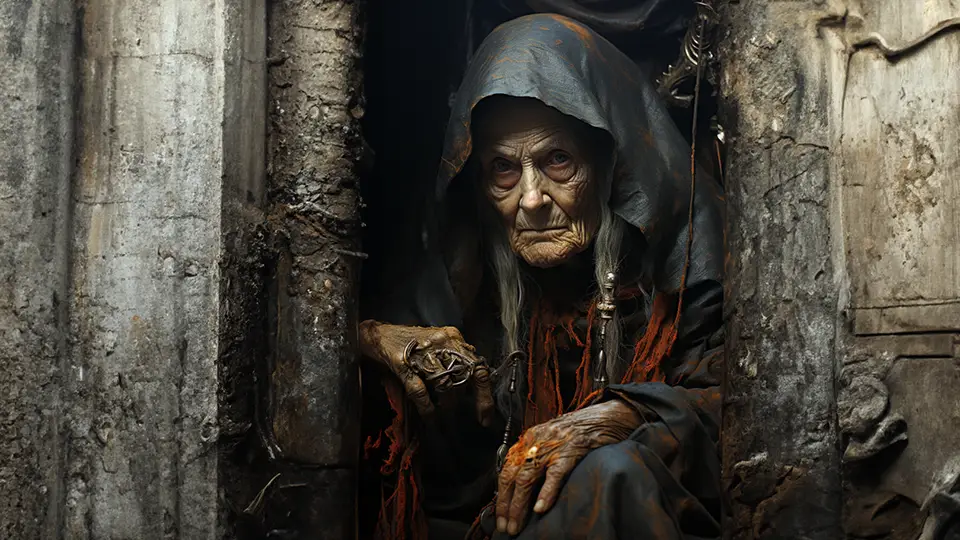
Baba Yaga is probably one of the most recognisable figures in Slavic mythology. An old woman living on the outskirts of a village or alone in the depths of the forest, she appears frequently in the legends and folk tales of our ancestors.
Baba Yaga and Her Role in the World of the Ancient Slavs
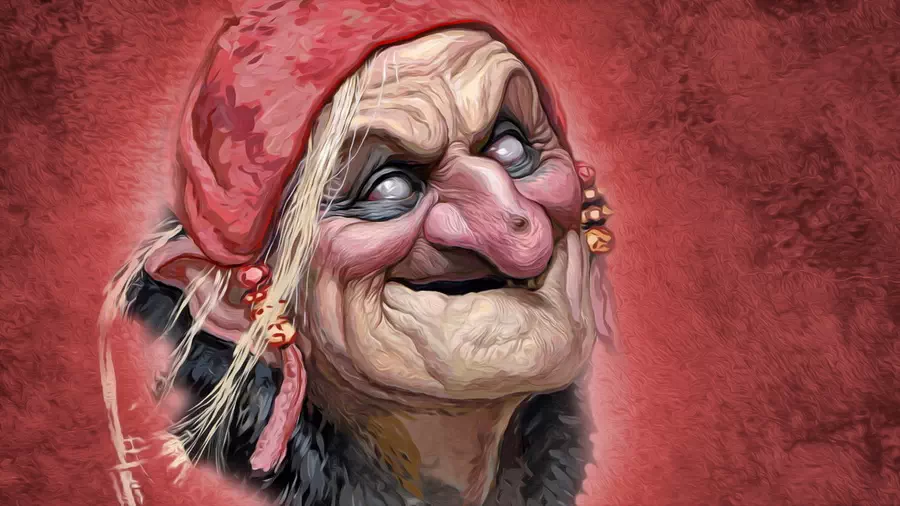
In most tales, Baba Yaga appears as an inherently evil and deceitful figure. However, we do not fully understand her original form, and as a result, her role in Slavic beliefs remains somewhat unclear. There can be little doubt about her character, though. Even her name derives from the Proto-Slavic word jęga, meaning terror, fear, danger, torment, and suffering. It is believed that Baba Yaga was originally responsible for protecting the animals of the forest, which is why her place was deep within the woods.
By analysing old legends, researchers of Slavic mythology have concluded that the early form of the forest witch was connected to the realm of the dead. Baba Yaga herself was believed to oversee mystical rites of passage marking the various stages of human life. She appeared when children entered adulthood, when mature people reached old age, and finally when it was time to leave this world.
It is also believed that the modern image of the hideous and wicked witch is the result of early Christian efforts to demonise female figures from older religions. As we know, the Church was rarely fond of powerful women and assigned them a subordinate role in the new world it sought to establish.
The Black Cat, Owl and Hut on Chicken Legs – Baba Yaga’s Attributes
We know very little about how Baba Yaga was portrayed in pagan times, but we do know how she appears in modern fairy tales. She is usually depicted as an old, deformed woman with cold and malevolent eyes. Far from attractive, her face and body are covered in boils and warts, while deep wrinkles and numerous scars mark her skin. Most striking of all is her large hooked nose adorned with a repulsive wart. The old crone dresses in filthy rags and wears a pointed hat upon her head.
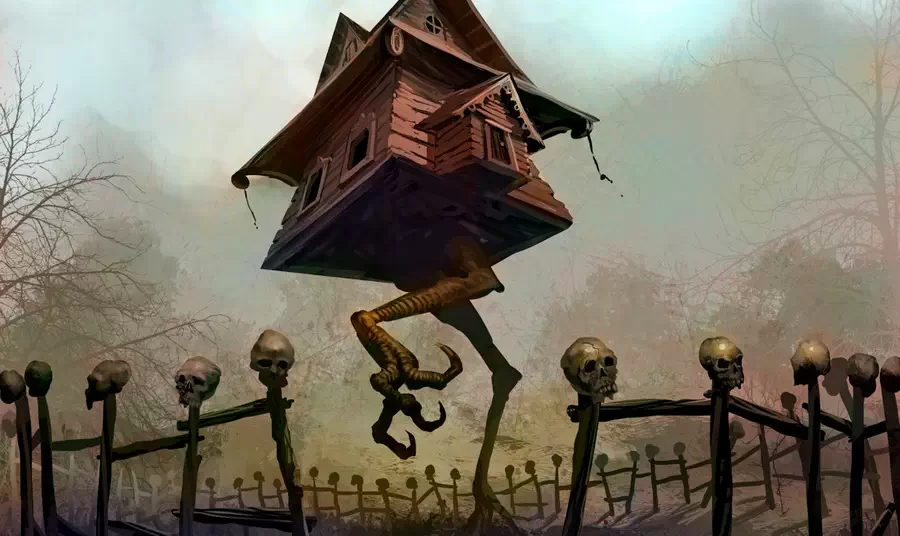
The witch is typically accompanied by a black cat, a raven, sometimes an owl, and of course spiders weaving their webs wherever one looks. She lives in a crooked wooden hut that is itself quite extraordinary. Built from rough planks, the house stands in a forest clearing balanced upon chicken legs. Whenever the witch enters or leaves, the entire hut squats down to make it easier for her.
From the outside, the witch’s home looks shabby and unpleasant. The interior is no better and is said to smell like a grave. Junk lies scattered everywhere alongside jars filled with herbs, poisons, and strange creatures preserved in mysterious liquids. Crude furniture cobbled together from odds and ends fills the corners. Dominating the centre of the room is a giant cauldron with a fire constantly burning beneath it. It is in this vessel that the witch brews the potions used to carry out her dark schemes.
Witches, Sorceresses, and Crone Figures in Different Cultures
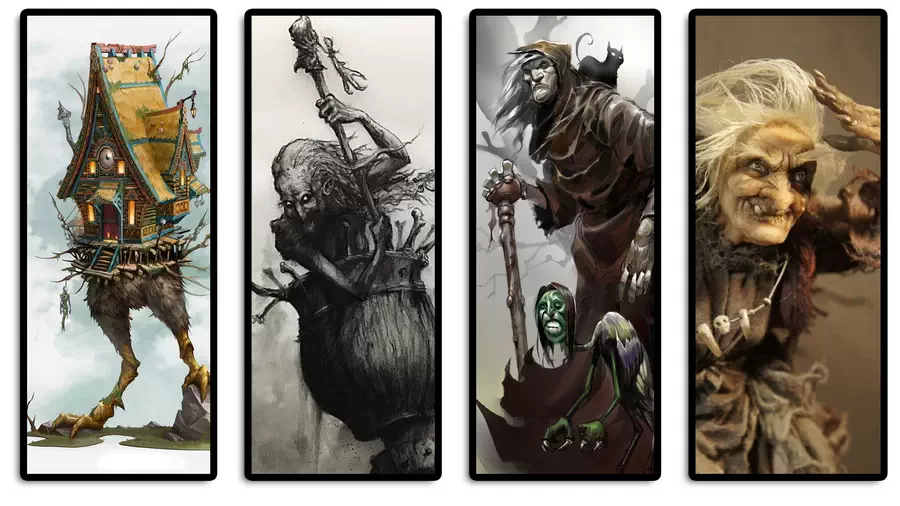
The word jaga carries sinister associations far beyond the Slavic world. In other languages it also has unpleasant meanings. Serbs associate it with horror and fear, while for Czechs it refers to a malicious forest spirit. In Sanskrit, the word is connected with a serpent.
Old Russian legends portray Baba Yaga as a monstrous being that devours humans. According to these tales, she has a particular fondness for children, whom she roasts, boils, and even stuffs before eating. Afterwards, she crushes their bones in a gigantic mortar and uses the resulting powder to feed her hut.
In the Balkans, stories tell of a Baba Yaga who occasionally helps people. Before granting a wish, however, she demands that the petitioner complete a task, sometimes simple and sometimes extremely difficult. If the person succeeds, their wish is granted. If they fail, they end up in her cauldron and their bones are ground in the mortar.
Lithuanian folklore includes a tale in which a little girl lost in the woods asks Baba Yaga for directions home. Surprisingly, the witch helps her and safely guides her out of the dark forest. This example shows that the character of the forest witch is far from straightforward.
Baba Yaga, or beings similar to her, appear in the myths and folklore of many cultures. Germany has Frau Holle, famously described by the Brothers Grimm. In Romania, children are frightened with stories of the evil Vîjbaba, while in Hungary there is the witch Bogorka. Similar nightmare figures can also be found in the folklore of Albania, Uzbekistan, Kazakhstan, and many other countries. Though they take different forms, they all share certain traits: evil, ugliness, malice, and ancient magic.
Baba Yaga – A Legend of the Evil Witch from the Dark Forest
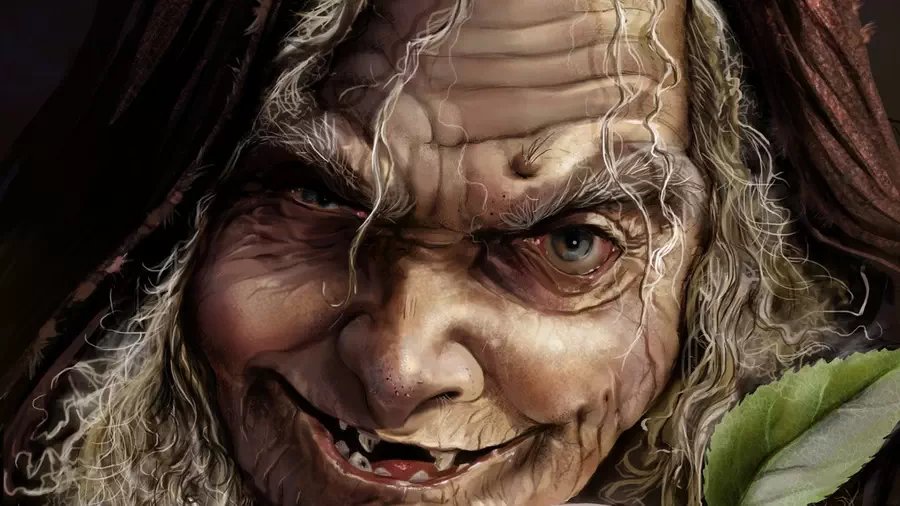
I once heard a rather different tale about Baba Yaga in a village near the border between Hungary and Romania. Unlike the witch from other stories, this Baba Yaga was neither old nor hideous. On the contrary, she was a beautiful and alluring woman who lived alone in the forest.
Deep within a dark woodland near a forgotten village lived a mysterious woman of extraordinary beauty. No one knew when she had arrived or why she had chosen to settle in a strange hut on a forest clearing. One thing was certain – she was stunningly attractive, and nobody truly knew how she spent her days.
From time to time she visited the village, either because she needed something or because someone needed her. She possessed remarkable knowledge of herbs and remedies that eased illnesses and ailments. Villagers whispered that she was surely a witch who practised magic, but since she caused no trouble, they tolerated her presence.
Everything changed when several village women noticed that the menfolk were disappearing into the forest far too often, neglecting their duties for hours at a time. After a thorough investigation involving hiding in bushes along the forest path leading to the clearing, they concluded that the mysterious beauty had seduced half the village.
It was not only the young men. Married husbands and even grandfathers were making regular visits to the forest hut.
The outrage was immense. Jealous wives nearly beat their husbands senseless and forbade them from entering the forest under threat of severe consequences. One particularly furious woman decided that the forest witch would not escape punishment so easily.
For years, hungry wolves had prowled the surrounding countryside. They occasionally attacked villagers and travellers, and many children had disappeared near the nearby river and in the woods. Most believed the wolves were responsible.
The humiliated woman devised a plan. She would dig up old bones from the village cemetery and plant them in the witch’s house. Then she would spread rumours until someone investigated and discovered “proof” that the disappearances were not the work of wolves after all.
One night she crept into the cemetery and unearthed the remains of a long-forgotten child. The following evening she carried the bones into the forest. The moon hung huge and bright above the clearing, illuminating the hut. She saw the witch emerge from the house, wander around briefly, pick up a basket, and disappear among the trees.
“She’s probably off gathering those foul devilish herbs,” the woman thought with a malicious smile.
She quietly approached the hut and slipped inside. A fire burned in the centre of the room. In one corner she noticed a trapdoor leading to a cellar and decided it would be the perfect place to hide the bones.
Chuckling to herself, she opened the hatch. To her surprise, she saw a faint light below. Curiosity got the better of her, and instead of simply dropping the sack, she climbed down.
What she found froze her in place.
Human bones lay scattered across the floor. On a small stove stood a pot filled with thick bubbling soup. She stared in horror as a human leg protruded from the broth and what looked disturbingly like human eyes floated on the surface.
If you watch horror films, you already know what happened next.
The witch appeared silently behind her.
She no longer resembled the beautiful woman from the forest. She was bent and wrinkled, gaunt as a skeleton wrapped in skin. Her elegant dress had vanished, replaced by foul-smelling rags.
The last thing the terrified woman heard was the witch’s hoarse voice, sounding as though it came from a grave.
“If I’d known you were coming, I would have gathered more wild garlic.”
The woman was never seen again.
The witch and her hut vanished as well, leaving no trace upon the clearing. The villagers could only shake their heads and wonder what had happened. Time passed.
Eventually someone noticed something strange.
The wolves had stopped attacking people, and nobody had disappeared for a very long time.
Baba Yaga in Popular Culture
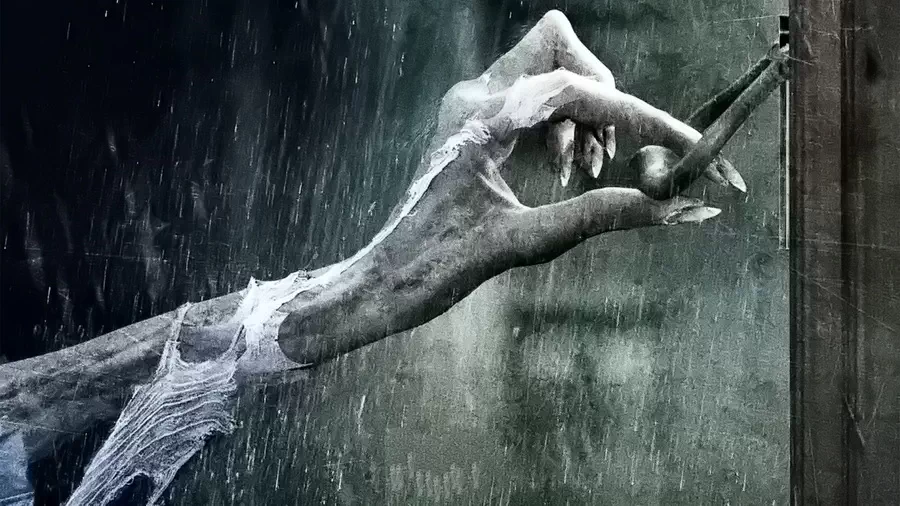
Baba Yaga is a character who appears frequently in literature, music, films, and even video games.
- Hansel and Gretel – The famous fairy tale about two children who find the witch’s house. In the original versions collected by the Brothers Grimm, the story is far darker and far more brutal than modern adaptations.
- Vasilisa the Beautiful and Baba Yaga – A Russian fairy tale in which Baba Yaga appears as a wise, cruel, yet ultimately just figure. The story may have roots in pre-Christian beliefs.
- Enchantment – A novel by Orson Scott Card set in Russia and Ukraine, featuring Baba Yaga as one of its key characters.
- Baba Yaga appears in the comics and films featuring Hellboy.
- As an eastern demon, she appears in the film Don’t Knock Twice.
- The Cuckoo and the Crow by Magdalena Wolff tells a story involving Baba Yaga.
- Deathless by Catherynne M. Valente presents a version of the witch that is both terrifying and fascinating.
- Gifts of the Gods by Witold Jabłoński includes an intriguing reference to Baba Yaga within a story about the Slavs.
- Baba Yaga also appears in The Witcher books and television series.
- In the John Wick films, the main character carries the nickname “Baba Yaga” because, like the legendary witch, he inspires fear and brings death.
- Baba Yaga’s Assistant is a comic book centred on the witch and her search for an assistant.
- Baba Yaga also appears in video games such as Tomb Raider and Smite.
Baba Yaga – Facts and Curiosities
- Baba Yaga is one of the oldest and best-known figures in Slavic folklore.
- In legends and fairy tales, she usually appears as an old and terrifying witch.
- In many stories, only a person with a pure heart can defeat Baba Yaga.
- The Proto-Slavic word jaga is associated with torment, terror, and danger.
- Depending on the culture, Baba Yaga may appear as a witch, goddess, or demon.
- Her earliest form was closely connected with the world of the dead.
- She lived in a hut standing on chicken legs, often surrounded by a fence made from human bones and decorated with skulls.
- Baba Yaga travelled on a broomstick, though some stories describe her flying in a cauldron or a giant mortar.
- The character also appears in music. A famous example is Baba Yaga, a symphonic poem composed by Anatoly Lyadov in 1904.
- Although she is often portrayed as a witch, cannibal, and embodiment of evil, some tales describe her helping those in need.
- Many scholars believe that Baba Yaga became a victim of efforts to suppress the matriarchal elements of ancient Slavic religion. Over time, she evolved into a symbol of feminism and resistance against imposed male dominance in the modern world.
- In our section devoted to monsters, you will find many more creatures from Slavic mythology that continue to haunt our imagination to this day.