The Brooklyn Bridge in New York is, in my opinion, a place you should have on your list of city attractions.
When you ask someone who has visited New York what the symbol of the city is, one of the first answers is the Brooklyn Bridge—right alongside the Statue of Liberty, Times Square, the Empire State Building, and Central Park. Interestingly, research indicates that even people who have never been on the bridge say the same. This is probably because the bridge appears in countless films, TV series, and crime novels. What else makes this structure one of New York’s most recognizable landmarks? We examined it closely from neighbouring bridges and also by walking across its entire length above the East River. The bridge is simply beautiful and fits perfectly into the place where it stands.
Brooklyn Bridge in New York beginning
The Brooklyn Bridge owes its creation to a coincidence of circumstances. Before the decision was made to build a new crossing between the island and the rest of the city over the East River, a ferry service was in operation. Over time, however, as the city’s population grew and traffic increased month by month, the worn-out barges could no longer cope. The city authorities debated for a long time how to deal with the problem, and eventually decided that New York would allocate funds for an additional crossing and purchase several new ferries.
Around the same time, a renowned engineer and bridge builder found himself unfortunately stranded on one of the barges, which had been immobilized on the river after colliding with an ice floe. Many hours spent on the boat angered our protagonist so much that he grabbed a pencil and sketched the preliminary design of a future bridge connecting Manhattan with Brooklyn in his notebook. The engineer’s name was John Roebling, and the Brooklyn Bridge was the last project whose construction he oversaw.
The Brooklyn Bridge and its construction

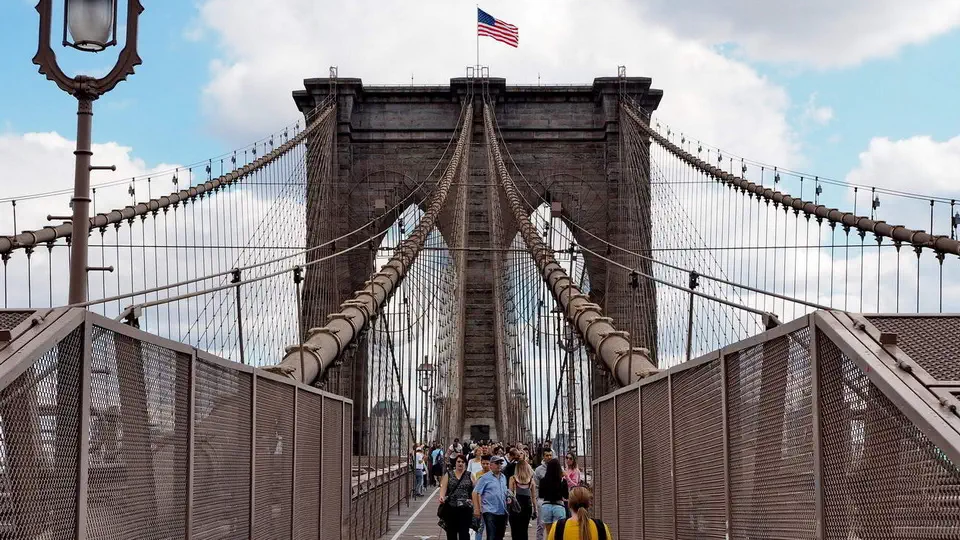
The Brooklyn Bridge was built over a period of 14 years, and these were extremely difficult years, both for the investors and for those responsible for its construction. Costs rose so quickly that by the halfway point the projected budget had already been exceeded. Engineers kept introducing new changes, which, as you can imagine, drove the costs up even further and caused the hearts of the workers and technicians responsible for the project to beat faster. In addition, working conditions were so poor that few labourers stayed on the construction site for more than a few weeks. Safety conditions were similarly dire. During the work, several hundred people lost their lives, and many very dangerous accidents occurred.
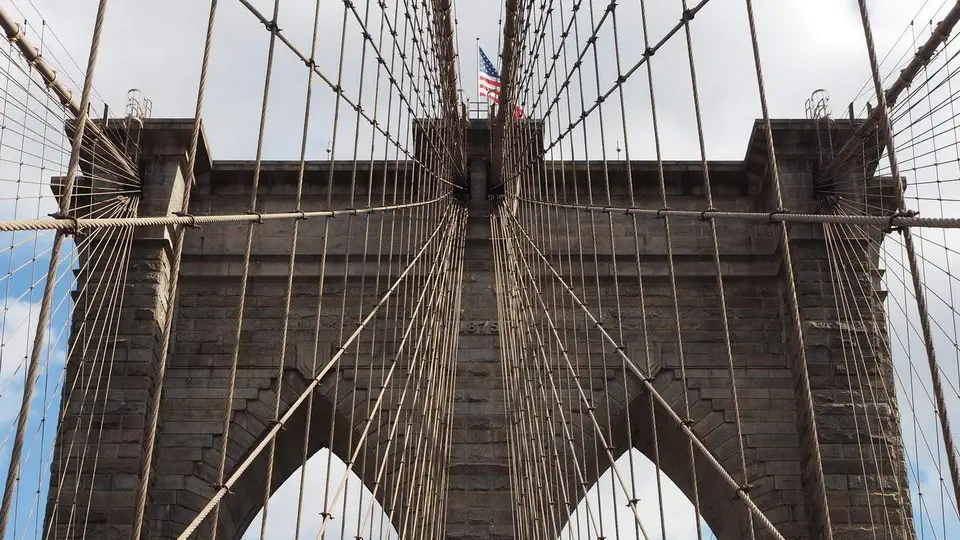
In the end, however, the problems were overcome, and the project was completed. The bridge was built in the Gothic style, with all its intricacy and ornamentation. The main building materials were stone, hard granite, and steel. At the time of its construction, it was the most advanced structure of its kind in the world and also the longest suspension bridge. A new type of steel cable was used in its construction, devised by John Roebling himself—the engineer mentioned earlier.
The Brooklyn Bridge and the extraordinary scope of the project
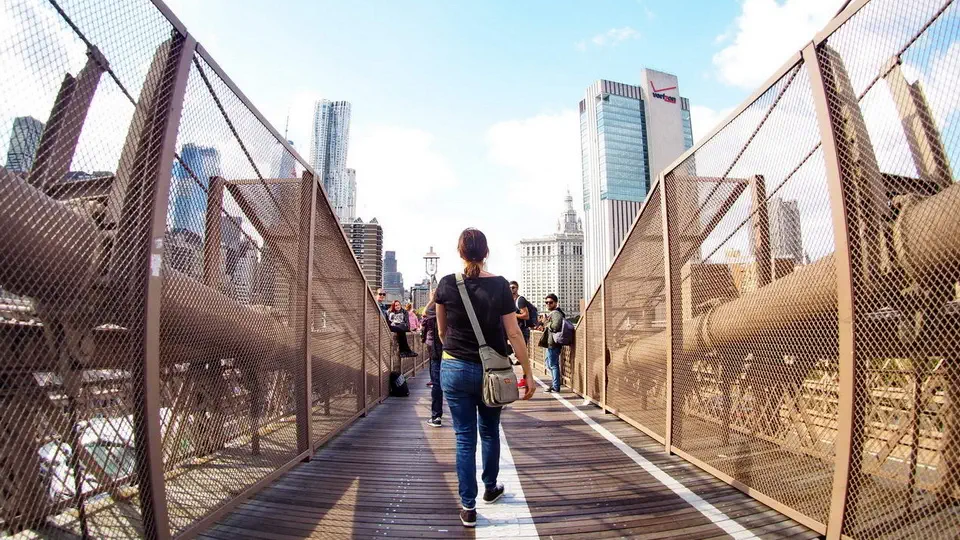
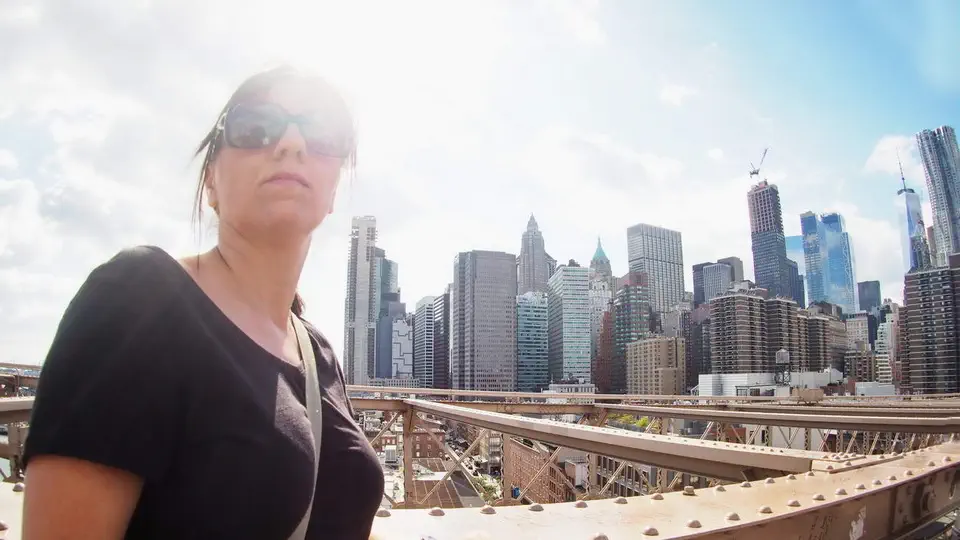
The scale of the project was astonishing for its time. The bridge featured roadways for horse-drawn vehicles, railway tracks in both directions, and tram lines. In addition, pedestrian walkways were not forgotten. It seems to me that modern bridges are rarely built with such grandeur and with the future so clearly in mind. The total cost of the investment amounted to eighteen million dollars, which was an enormous sum at the time.
The dimensions of the Brooklyn Bridge are equally impressive. Its total length is 1,834 meters. The main suspended span is nearly half a kilometre long and hangs above the waters of the East River, supported by two enormous pylons, each rising more than eighty meters above the water. To ensure that the pylons were stable and safe, foundations had to be built to a depth of thirteen meters below the riverbed. The pylon on the Manhattan side is even deeper, reaching as far as twenty-four meters underground.
The four steel cables that support the entire structure are over a kilometre long and have a diameter of 40 centimetres, and their design was the idea of the engineer responsible for the project. Each cable is made up of nineteen bundled strands, with each strand consisting of 278 steel wires. Construction of the bridge began in 1869 and was completed in 1883. The opening took place on May 24 and was a major event for the entire city. On the very first day, more than 150,000 people crossed from Manhattan to Brooklyn. The toll for entering the bridge was one cent.
The Brooklyn Bridge as a symbol of New York
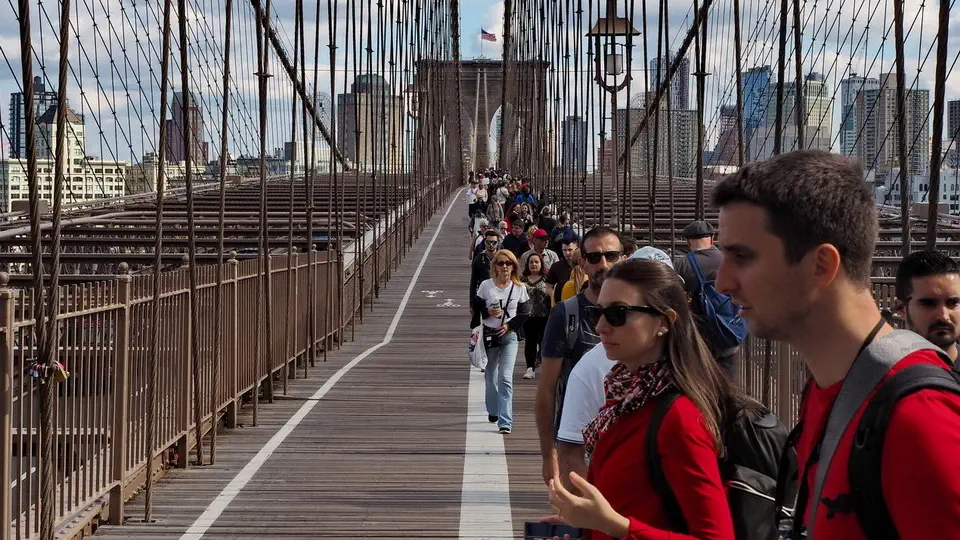
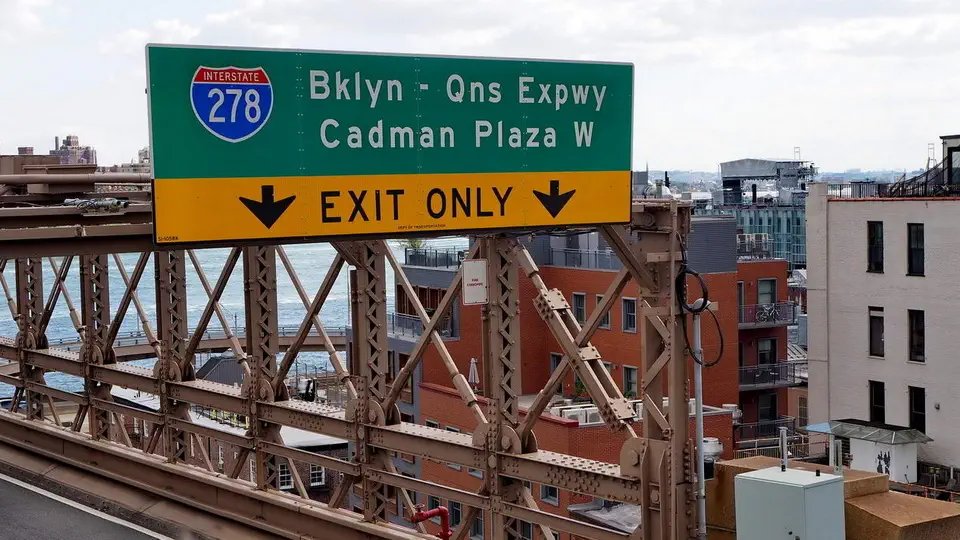
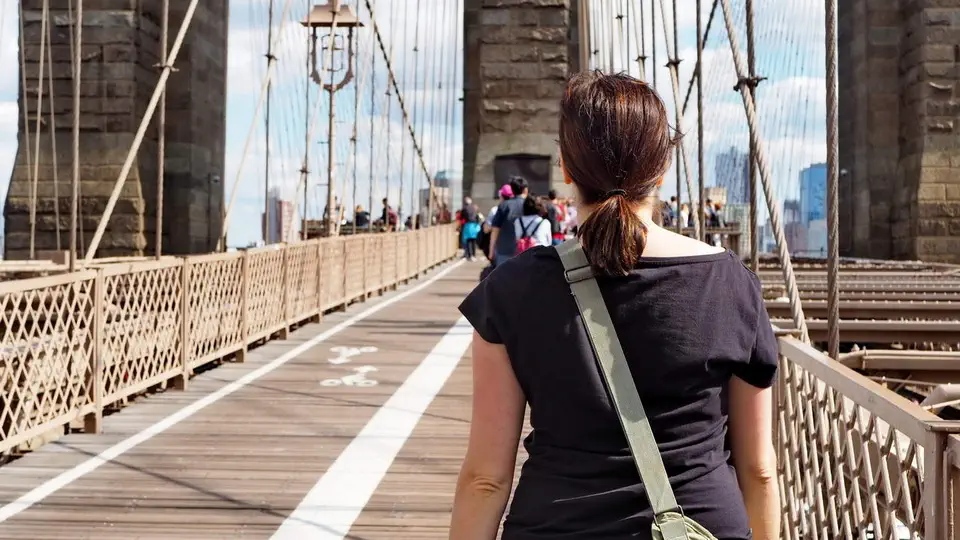
The Brooklyn Bridge quickly became a symbol of the city and remains one to this day. In most postcards and advertisements promoting New York, it is shown alongside Rockefeller Centre, the Empire State Building, or Central Park. Today, only cars and pedestrians are allowed on the bridge. The railway line was taken out of service at the beginning of the 20th century. There are six lanes for vehicles—three in each direction—and pedestrians have a dedicated walkway above the roadway.
We noticed that there is heavy traffic here, mostly generated by tourists, though residents of Manhattan and Brooklyn also frequently use the crossing. On the bridge, you can encounter artists as well as, quite often, scammers trying to sell worthless souvenirs to passing tourists. Nevertheless, there is a very pleasant atmosphere, and the stunning views of Manhattan more than make up for the effort of walking above the waters of the East River.
Brooklyn Bridge information and interesting facts
- The excellence of the Brooklyn Bridge’s design is attested to by the fact that many similar structures have been destroyed by natural forces and accidents, while the Brooklyn Bridge still stands and is in excellent condition.
- The bridge in question has typically changed names. Initially, it was called the Great East River Bridge, the Great East River Suspension Bridge, and then the New York Bridge. Only in 1915 did the city authorities give it the name Brooklyn Bridge.
- The bridge’s architect and construction supervisor was engineer John Augustus Roebling, and the Brooklyn Bridge was affectionately called Roebling’s baby. Unfortunately, he died before construction was completed. His son, Washington Augustus Roebling, also an engineer, took over his duties.
- The cables used to suspend the Brooklyn Bridge’s spans were Roebling’s idea. He also recognized the relatively new material of steel as the metal of the future.
- The young descendant of the architect of the Brooklyn Bridge, after inheriting his father’s legacy, was very dedicated to his duties. He spent hours with the workers on the construction site. While working on the riverbed, he would go underwater, supervising the digging of foundations for the enormous pylons. He spent so much time there that he eventually succumbed to pressure-induced illness and nearly died.
- While the young Roebling was recovering in a Manhattan flat, his wife, Emily Warren Roebling, took over the bridge’s construction. She was also a highly skilled engineer. She was the first woman to graduate from New York University with a degree in engineering, despite the difficulties the male-dominated academic world faced. To this day, Emily is considered the first feminist to fight gender inequality.
- Many historians argue that the Brooklyn Bridge’s beauty is due to Roebling’s wife, who contributed numerous visual improvements to the design. She was also the first person to ride a carriage across the completed bridge, doing so a week before its official opening, beating even the then-president of the United States.
- The Brooklyn Bridge, upon its opening, attracted great attention and admiration. However, it was not without accidents. A few days after its opening, a woman began screaming that the bridge was cracking and would soon collapse into the water. New Yorkers had already seen many structures fail to withstand the forces of nature, and a terrible panic broke out. During the frantic escape, twelve people died, and over thirty were seriously injured.
- After this incident, residents approached the bridge with great caution. Many preferred to make a detour and use other means of crossing the river. The city decided to convince residents that the Brooklyn Bridge was safe. How was this achieved? They enlisted the help of one of the owners of a circus, very popular at the time, and he marched across the bridge accompanied by over twenty elephants. For weeks, the press wrote that if elephants could walk across the bridge, then so could people.
- Large rooms were built in the Brooklyn Bridge’s pylons, located just below the waterline. The thick stone walls ensured a low and constant temperature. It turned out to be ideal conditions for storing wine. Producers and distributors of this distinguished beverage were willing to pay a hefty rent for these spaces.
- After restoration work in 2010, it was decided that it would be a good idea to restore the historic landmark to its original colour. However, it turned out that no one could say what colour the Brooklyn Bridge was on the day it opened. All documents indicated that the bridge was painted in a very modern style. After a lengthy investigation, it was determined that the original colour was likely light brown.
- The Brooklyn Bridge was the longest bridge in the world for over 20 years. In 1903, it was surpassed by only two meters by the Williamsburg Bridge, another bridge in New York.
- The bridge is truly impressive when viewed from a boat on the East River at night. I highly recommend such a cruise, as all of Manhattan is illuminated at night.
- The Brooklyn Bridge is considered one of the most beautiful in the world.