The Basilica in Miechów is not only a valuable and ancient church, but also a replica of the Holy Sepulchre – one of only two such places in the world.
Although I do not feel particularly close to the institution of the Church, I often appreciate the rich history and beauty of its buildings. That is why, during my many travels, I gladly visit cathedrals, basilicas, and even small churches, especially those deeply imbued with local culture, customs, and tradition. Today I would like to tell you about the Basilica in Miechów, whose full name is the Collegiate Basilica of the Holy Sepulchre in Miechów.
The Basilica in Miechów – practical information
The Basilica in Miechów is an active place of worship where the faithful pray, so please show particular respect while visiting and avoid disturbing services, especially during Mass.
The monument stands in the centre of Miechów at the following address: Parish of the Holy Sepulchre, ul. Warszawska 1, 32-200 Miechow.
The Land of Miechów Museum, located next to the church, offers guided tours not only of its exhibitions but also of the Basilica of the Holy Sepulchre. The offer is aimed at tourists, pilgrims, organised groups and school trips. The museum admission ticket costs several złoty, while the fee for a guide depends on the size of the group. Opening hours: Monday to Friday from 8:00 am to 3:00 pm, and on Saturdays from 9:00 am to 2:00 pm.
Group visits take place by prior arrangement with a guide. Bookings can be made by phone on +48 530 766 522 or by email at: biuro@muzeum.miechow.pl.
The Basilica in Miechów and the Order of the Holy Sepulchre
It all began in 1099, when Godfrey of Bouillon established a group of canons at the Basilica of the Holy Sepulchre in Jerusalem itself. Patriarch Arnulf of Rohez granted them the Rule of St Augustine, and thus an order was born whose main mission was to care for the Tomb of Christ and for the pilgrims who – as one might easily guess – arrived in great numbers, often exhausted by their long journeys. This is where Jaksa of the Gryf coat of arms enters the story: a Polish prince of vision and ambition. In 1163, he brought the Order of the Holy Sepulchre to Miechów, turning a small settlement into a place of European importance. The first canon was Martin known as Galus, a Frenchman by origin, who – having obtained the consent of Bishop Mateusz – set about building a church and monastery. The solemn consecration took place in 1186, and from that moment Miechów officially entered the pages of history.
The development was so rapid that by 1290 Miechów had already been granted town rights. Unfortunately, history is rarely idyllic. During Władysław the Elbow-high’s struggles to reunite Poland, the town and monastery were burned down – and not for the last time. The head of the order, Henry of Nysa, together with the brethren, was forced to flee to Hungary. After their return, the king decided to err on the side of caution and ordered that the head of the monastery should henceforth be a Pole – just in case. The following centuries were marked by fire. Between 1379 and 1629 Miechów burned nine times, and with each successive fire, the town paradoxically grew stronger. By the end of the fifteenth century, it already had 70 houses and 16 farmsteads. The Canons of the Holy Sepulchre also founded a school of a high educational standard; suffice it to say that between 1421 and 1429 it was here that John of Kęty, later canonised as a saint, lectured.
In 1457 Miechów gave birth to a true genius – Maciej Miechowita. A priest, physician, astrologer, historian and geographer, a multiple rector of the Cracow Academy, and the author of the first printed Polish medical book. He wrote it with an approaching plague epidemic in mind, which proves that even then people knew that prevention is better than cure. The year 1525 brought a major expansion of the monastery and the construction of a new Chapel of the Holy Sepulchre – a faithful copy of the Jerusalem tomb. It attracted not only ordinary believers but also crowned heads of Europe. From 1624 the town could boast a wooden town hall and a hospice for the elderly and disabled, run by the monks.
The most devastating fire broke out in 1732 and destroyed part of the priceless library. Despite this, Miechów did not lose momentum. By the end of the eighteenth century the town had more than 1,300 inhabitants, and the census recorded almost 200 craftsmen – from woodcarvers to a trumpeter because every respectable town needs a trumpeter. After the third partition of Poland, Miechów found itself under Austrian rule, then – briefly – within the Duchy of Warsaw, and after the Congress of Vienna became part of the Kingdom of Poland. There was even a chance it might become the capital of the Kraków Voivodeship, but there were not enough buildings or materials. History can be merciless. In the nineteenth century, a new road from Warsaw to the south of the country was built through the town, giving further impetus to its development. At the same time, the Miechów monastery became a spiritual link with the Holy Land, especially when Jerusalem fell into non-Christian hands. The Tomb of Christ in Miechów was granted full indulgence privileges and attracted pilgrims from across Europe.
The Canons of the Holy Sepulchre introduced devotions previously unknown in Poland, including the custom of setting up the Tomb of Christ on Good Friday. They cared for the sanctuary until the suppression of the order in 1819. The last Canon of the Holy Sepulchre, Baltazar Chwalbiński, resigned from office in 1852, and the church passed into the care of the diocesan clergy. Although many priceless relics were lost after the suppression, the church survived. Thanks to long-term conservation work and the efforts of successive parish priests, in 1996 Pope John Paul II raised the sanctuary in Miechów to the rank of a Minor Basilica. And so Miechów – a town that burned, was destroyed, rebuilt and never gave up – inscribed its name in gold letters in the history of Poland and Christianity. Not a bad achievement for a place that began with a handful of monks and a great idea.
The history of the Basilica of the Holy Sepulchre in Miechów – from the 12th century to the present day
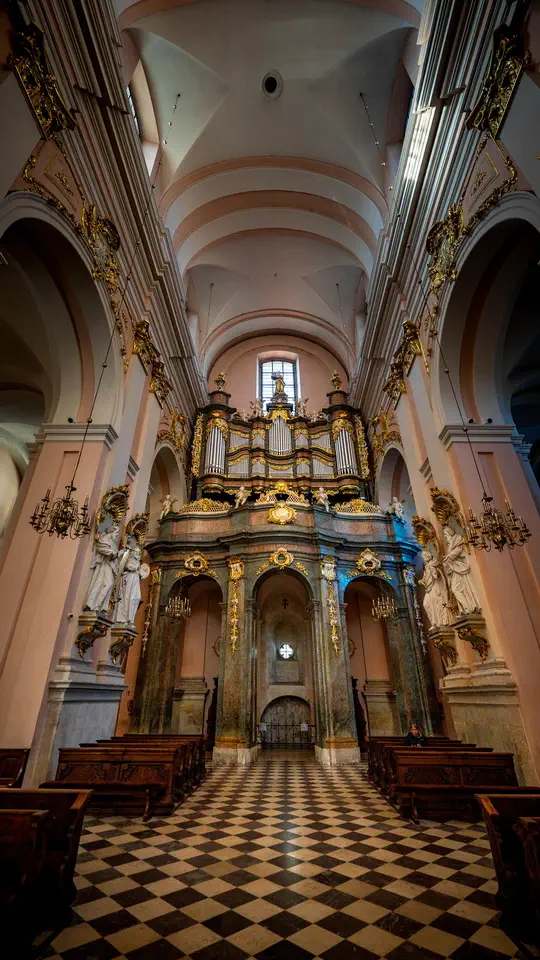
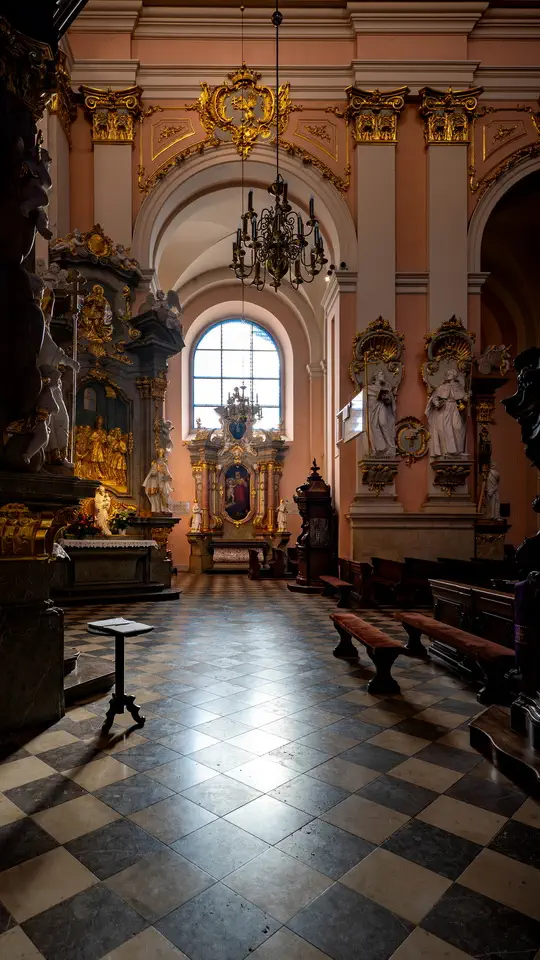
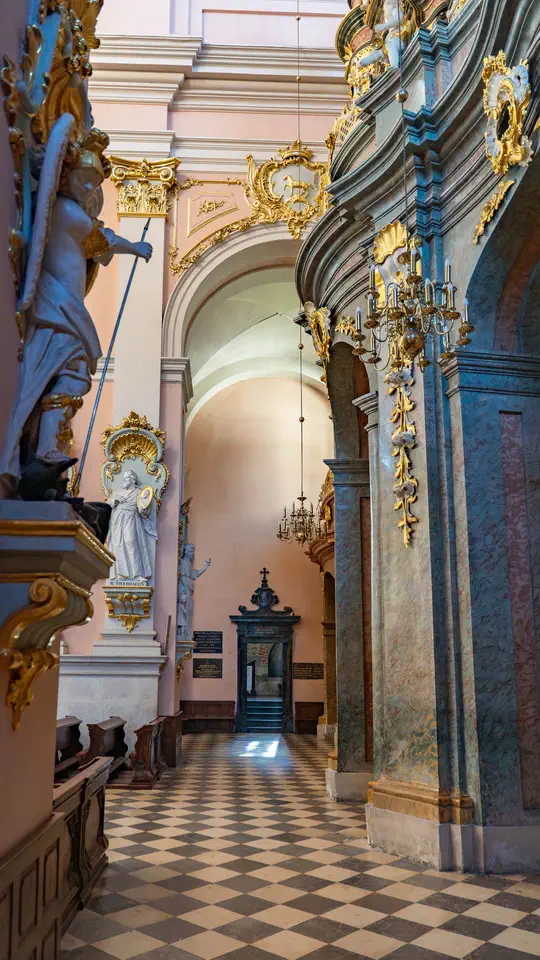
The history of the Basilica of the Holy Sepulchre in Miechów dates back to the second half of the twelfth century and is inseparably linked with the Order of the Holy Sepulchre, brought to Poland from Jerusalem. In 1163, the nobleman Jaksa of the Gryf coat of arms, returning from a pilgrimage to the Holy Land, settled the monks in Miechów and founded the first church together with a monastery. This marked the beginning of one of the most important Christian sanctuaries in this part of Europe.
The original church was Romanesque in character and served both as a place of worship and as a centre of monastic life. Of particular importance was the copy of the Holy Sepulchre located next to the church, modelled on the Jerusalem original. Already in the Middle Ages, Miechów became an important pilgrimage destination, especially at times when access to Jerusalem was difficult or impossible. In the following centuries, the basilica was repeatedly extended and rebuilt. The most significant changes occurred during the Gothic period at the turn of the fourteenth and fifteenth centuries, when the present three-aisled church with its massive form and soaring proportions was erected. At that time, the church gained the status of the main church of the monastic province of the Order of the Holy Sepulchre, and the Miechów monastery became their headquarters for the whole of Central Europe.
The fortunes of the basilica were not free from drama. The town and monastery were repeatedly ravaged by fires, destroying both buildings and valuable interior furnishings. Particularly severe fires occurred between 1379 and 1629, when Miechów burned as many as nine times. Each time, however, the church was rebuilt, often in a new architectural style. The seventeenth and eighteenth centuries proved decisive for the present appearance of the basilica, when, after fire damage, a thorough Baroque reconstruction of the interior was carried out. Richly decorated altars, stucco work and a new arrangement of the Chapel of the Holy Sepulchre were created at that time. The characteristic tower with its onion dome also dates from this period.
In 1819, by decree of the authorities of the Kingdom of Poland, the Order of the Holy Sepulchre was suppressed. This was a turning point in the history of the basilica: the monastery fell partly into ruin, and the church passed into the care of the diocesan clergy. Despite these difficulties, the church retained its function as a sanctuary and continued to attract the faithful.
The nineteenth and twentieth centuries saw a gradual restoration of the basilica’s importance, conservation work and care for the monument. Particularly intensive restoration efforts were undertaken after the Second World War, saving both the structure of the building and its priceless furnishings. The crowning moment of its centuries-long history came on 10 April 1996, when Pope John Paul II granted the church the title of Minor Basilica. This act confirmed the exceptional significance of the Miechów sanctuary in the history of the Church and the cult of the Holy Sepulchre.
Today, the Basilica of the Holy Sepulchre in Miechów is not only an active parish church and sanctuary, but also one of the most valuable sacred monuments in Poland. It is a living witness to nearly nine centuries of history, spirituality, and constant rebirth in the face of adversity.
The legend of the Tomb of Christ in Miechów
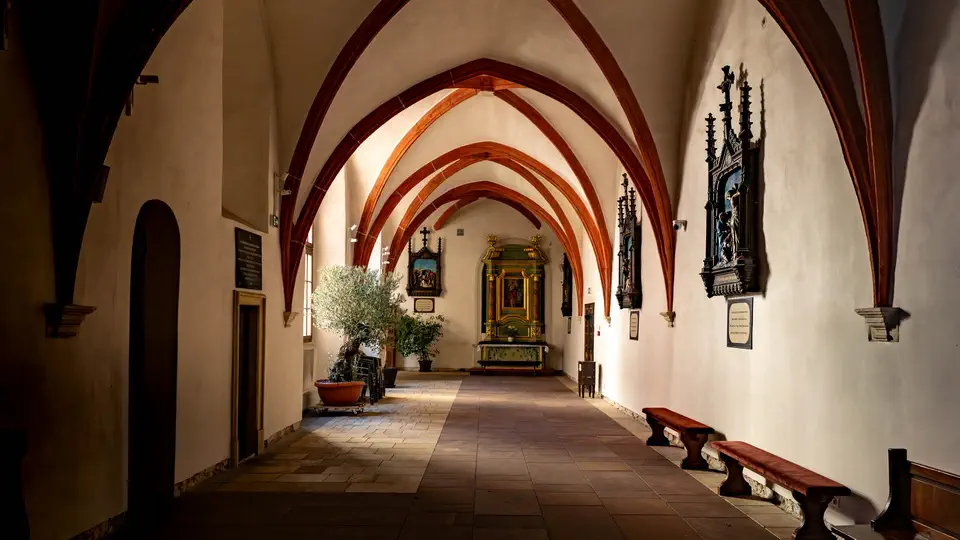
Long ago, in the time of the Crusades, the Polish nobleman Jaksa of the Gryf coat of arms set out on a long and dangerous journey to the Holy Land. According to legend, this was no ordinary pilgrimage – Jaksa was said to have vowed that if he returned safely to his homeland, he would do something extraordinary to bring the holy places of Jerusalem closer to the Polish people. During his stay in Jerusalem, Jaksa is said to have prayed at the Tomb of Christ with such fervour that he longed for at least a fragment of that place to exist in Poland as well. Legend has it that he took with him soil, and even a fragment of rock from the Holy Sepulchre, hiding it in a pilgrim’s pouch. Some claimed that this soil was miraculous, imbued with the holiness of the place of the Resurrection.
After returning home, Jaksa brought the Order of the Holy Sepulchre to Miechów and instructed them to build a church in which the Tomb of Christ would be recreated as faithfully as possible. The soil brought from Jerusalem was said to have been placed there, making Miechów a spiritual counterpart of the Holy City. According to the legend, from that moment on the graces bestowed upon pilgrims praying at the Miechów Tomb were the same as those received in Jerusalem. This is why, when the Holy Land fell into non-Christian hands and pilgrimages became impossible, believers from all over Europe began to flock to Miechów instead.
Over time, a belief arose that anyone who visited the Holy Sepulchre in Miechów with a pure heart would have their sins forgiven, and that prayers offered there possessed special power. It was this legend that led to the town being called the “Polish Jerusalem” and the basilica becoming one of the most important sanctuaries in this part of Europe.
The Chapel of the Holy Sepulchre in the Miechów Basilica
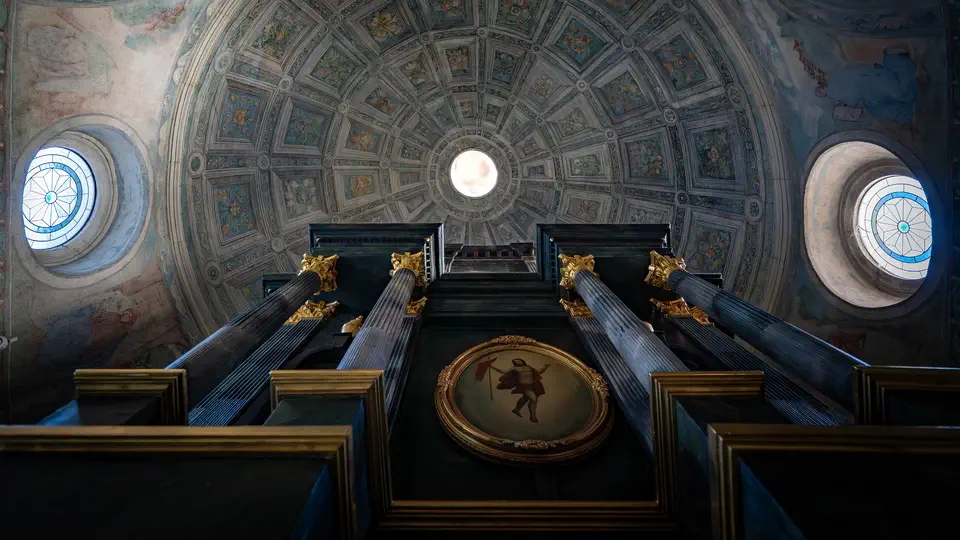
A particularly significant part of the Basilica in Miechów is the Chapel of the Holy Sepulchre, which houses a replica of the Tomb of Christ modelled on the one in Jerusalem (hence the basilica’s nickname, the Polish Jerusalem). The chapel is the destination of numerous pilgrimages by the faithful from across Europe and even from other parts of the world. From the very beginning, it was a crucial part of the church in Miechów built by the Canons of the Holy Sepulchre. The chapel forms part of the monastery, built on a square plan and covered by a dome with a central lantern, or oculus. Thanks to restoration work carried out in 2009, this Renaissance structure and the replica of the Jerusalem building can now boast beautiful polychrome paintings, uncovered and conserved during renovation. You will see scenes of the Crucifixion, landscapes, plant ornamentation and numerous coats of arms.
The chapel itself made a strong impression on me, although the replica of the Holy Sepulchre struck me as a rather kitsch staging. Concrete steps and walls, and in a hollow at the centre a mannequin wrapped in a sheet – well, I had expected something more. Of course, this may simply be my personal impression, shaped by a lack of religious sensibility. I would be curious to know your opinion.
Visiting the Basilica in Miechów – a few closing words
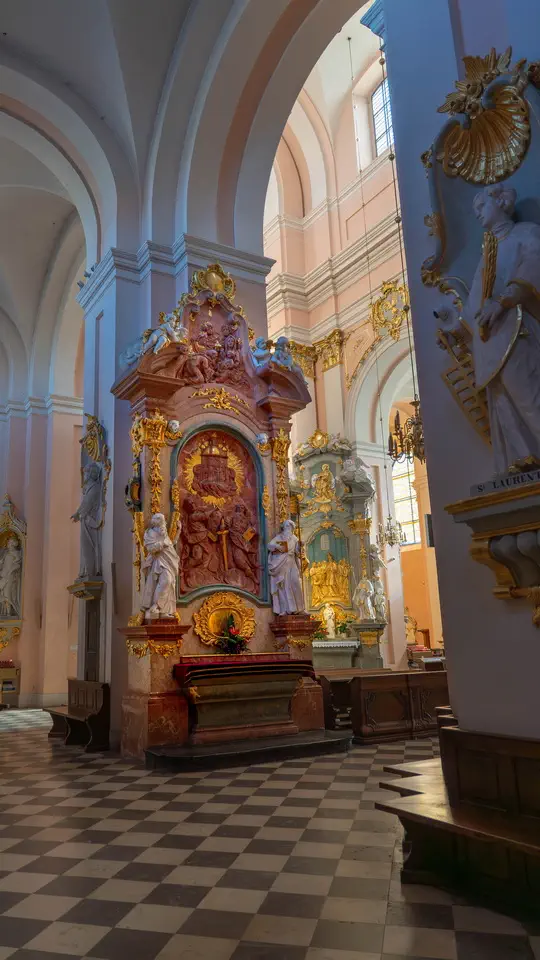
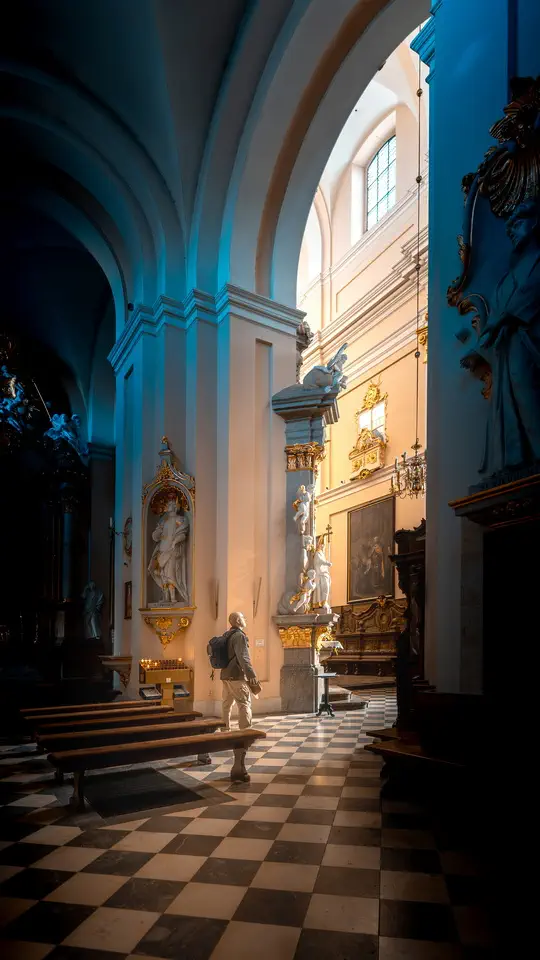
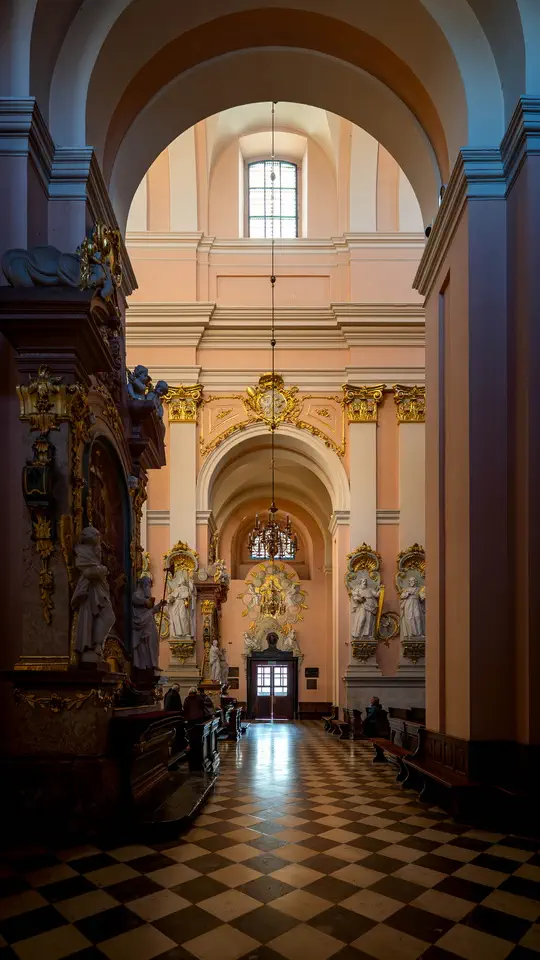
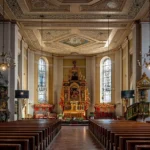
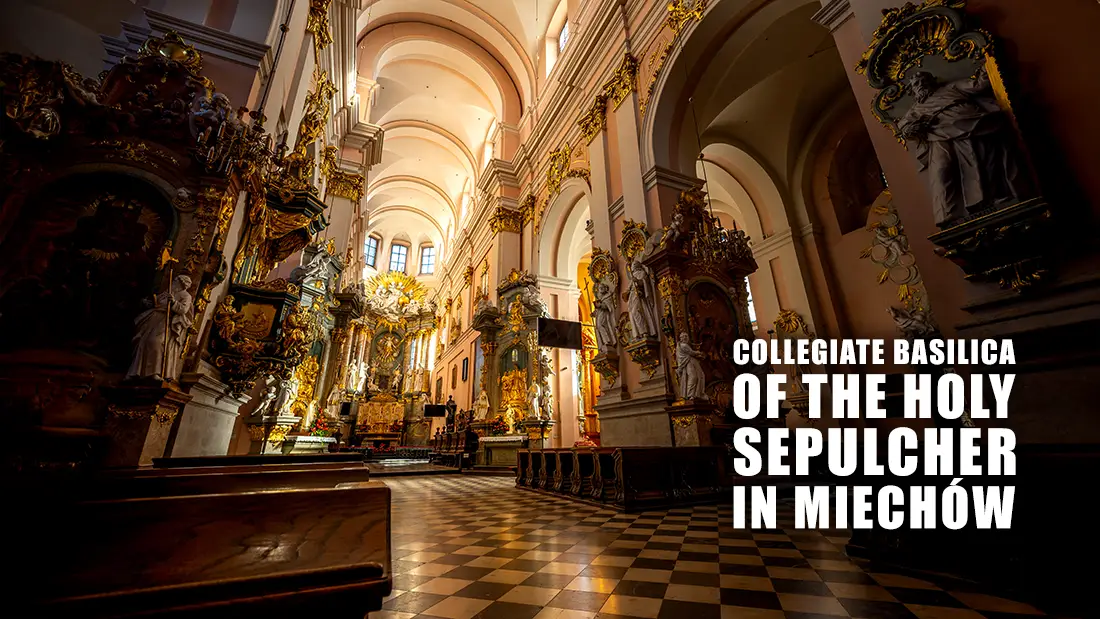
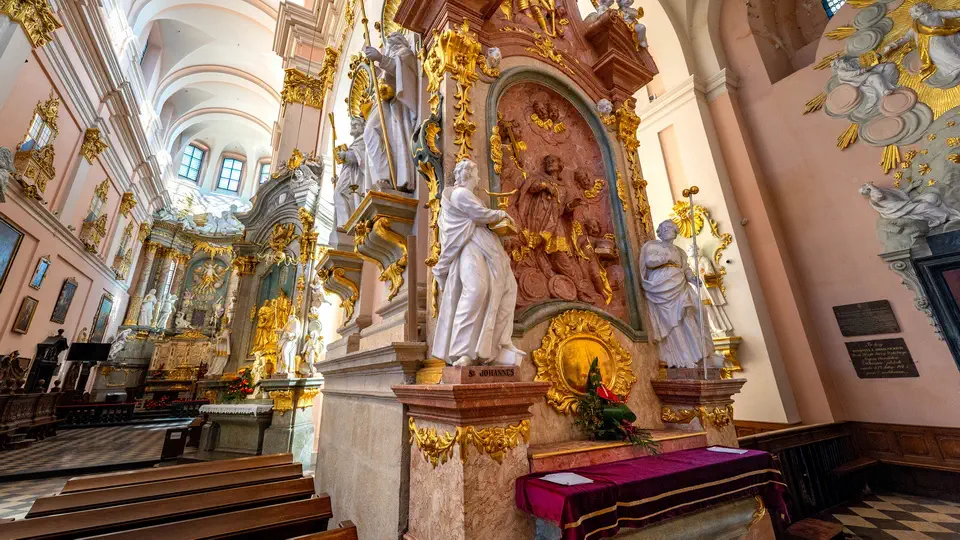
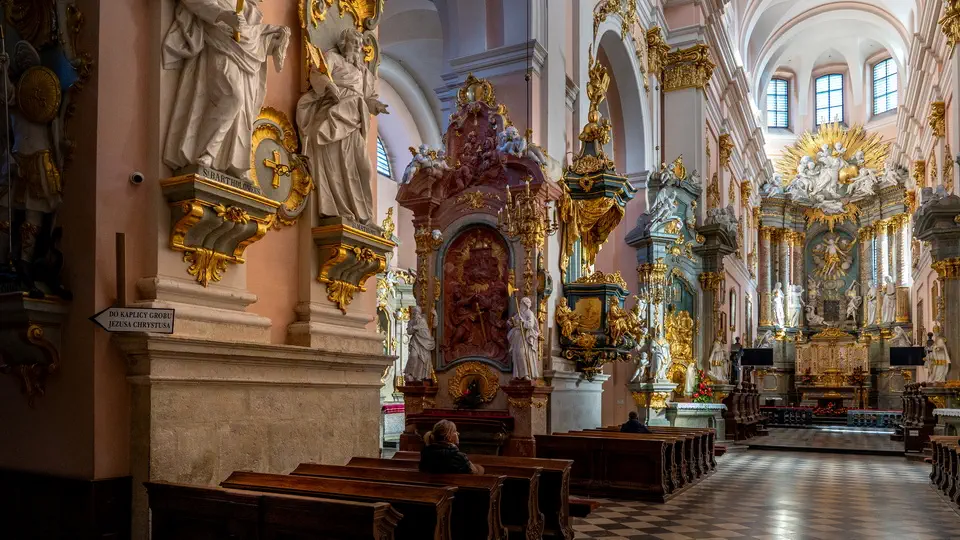
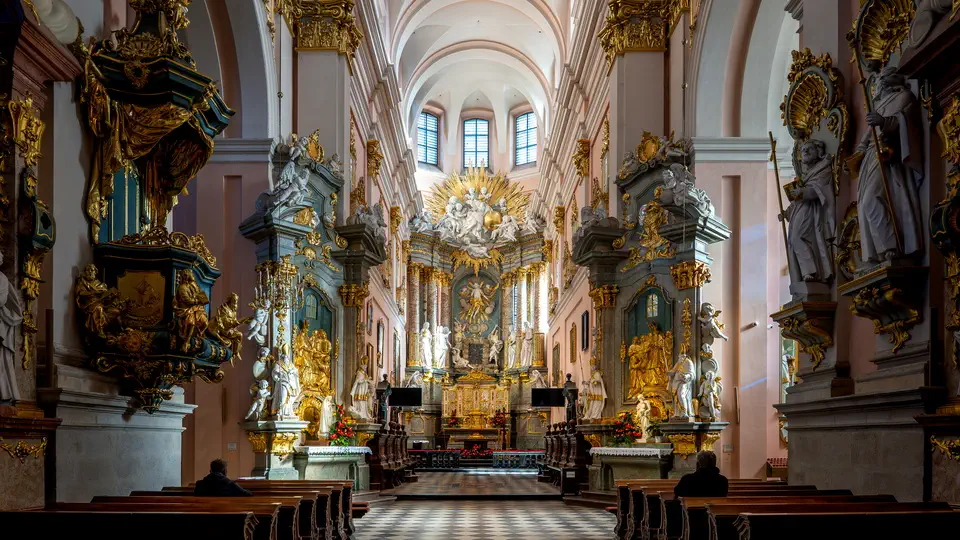
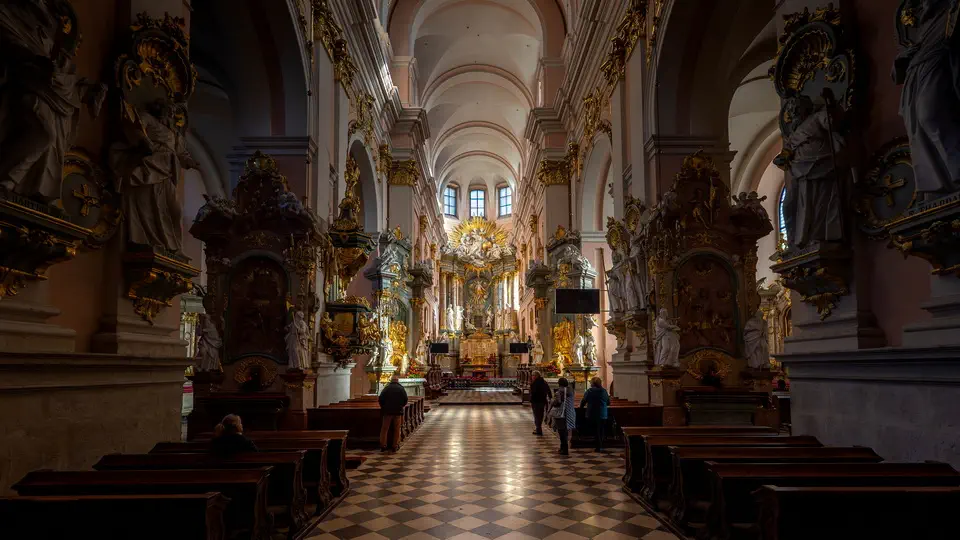
The Basilica in Miechów impressed me with its beautiful Baroque interior, especially the large Rococo high altar, which immediately draws the eye. It depicts the Resurrection of Jesus, along with angels, frightened guards and the women, including Mary Magdalene. The remaining altars are also richly decorated, with the most elaborate being those of the Virgin Mary and the Holy Cross.
Just beneath the church tower is the Chapel of Mary Magdalene, where you can see frescoes depicting scenes from the lives of hermits. Some of the chapel’s furnishings did not originally come from the Basilica in Miechów but were brought here from various churches and religious buildings in the surrounding area. One example is the altar, which was transferred here from the cemetery church as early as the nineteenth century. In one corner of the chapel there is an entrance to the crypt, whose dark interior served as a burial place for monks and priests.
As you will notice, the Basilica in Miechów is full of beautiful statues and sculptures, well worth close attention. Even before entering the church, you will see two seventeenth-century figures and a Baroque sculpture of Saint Hedwig of Silesia. Nearby, on pedestals, stand statues of Saints Peter and Paul, as well as several interesting angel figures. If you wander into the rectory garden, you will see a well-preserved relief on the portal depicting Our Lady of the Angels. The portal itself is made of black marble in the Baroque style and is truly impressive.
The interior of the church is a veritable exhibition of sculptures, polychromes, figures and coats of arms. In its nooks and crannies, on walls and cornices, dozens of gilded decorations and ornamental elements gleam. If this kind of architecture interests you, you could easily spend many hours inside the Miechów basilica.
The church organ is a story in itself; suffice it to say that together with the choir loft, it occupies the entire western wall of the church. This whole section was executed in the Rococo style, with no expense spared on detail. Even the extensions of the organ pipes are adorned with gilded figures of Saint Cecilia and singing angels. The entrance to the choir loft is difficult to find – it is located by the northern pillar – but it is well worth seeking.
Another important element of the basilica’s furnishings is its collection of paintings from different periods and executed in various techniques, allowing you to trace both the history of the church itself and that of the Order of the Holy Sepulchre. Particularly interesting are two canvases in the main nave depicting the history of the order. One shows Saint Macarius, Bishop of Jerusalem, while the other depicts the scene of Emperor Julian the Apostate granting the Jews permission to rebuild the Temple. The collection is complemented by beautiful frescoes on the walls and vaults.
Of course, that is not all – inside the church you will also find other traditional elements such as steles, confessionals and the pulpit. Each has its story and is inseparably linked to the history of the Miechów church. As I mentioned earlier, the interior is impressive, and it is clear that no expense was spared on detail – in short, it is lavish. I highly recommend dropping by this fascinating and ancient church if you happen to be in the area, even if the institution of the Church itself leaves you indifferent.
The Basilica in Miechów – facts, information, and curiosities
- The Basilica of the Holy Sepulchre in Miechów is one of the oldest places of devotion to the Tomb of Christ outside Jerusalem and one of only two such places in the world (alongside the original) with a preserved tomb-baptistery.
- It is here that the oldest replica of the Tomb of Christ in Europe is located – created at a time when access to Jerusalem was severely restricted.
- The Basilica in Miechów was founded in the twelfth century by Jaksa of the Gryf family, who brought not only monks from Jerusalem but, according to tradition, also soil from beneath the Tomb of Christ.
- A key role in the history of the sanctuary was played by the Canons of the Holy Sepulchre, an order renowned throughout the Middle Ages for its care of the Tomb of Christ and of pilgrims.
- The Basilica in Miechów has a Gothic structure dating from the fourteenth and fifteenth centuries, but its interior and external appearance largely reflect an eighteenth-century Baroque reconstruction.
- In 1996 the church was granted the title of Minor Basilica by Pope John Paul II.
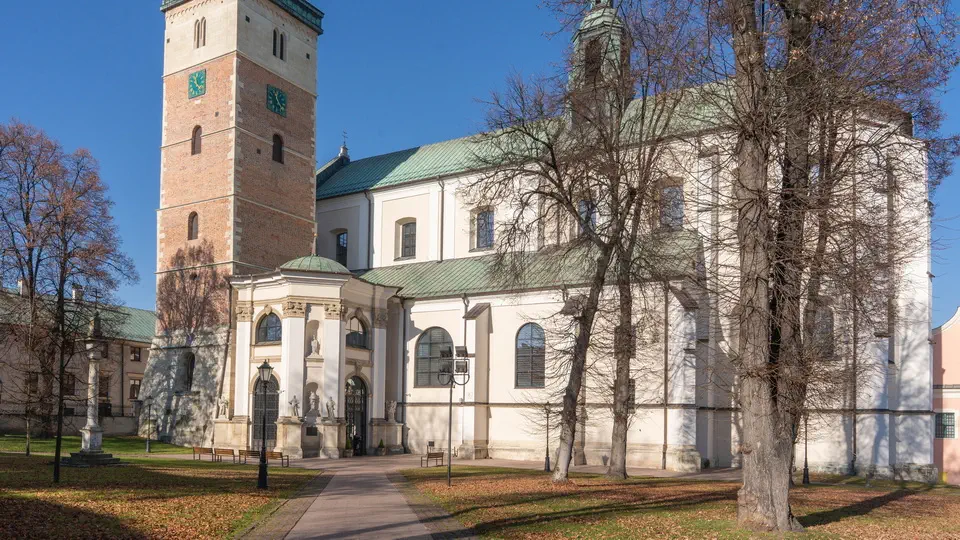
- Its most distinctive feature is the tower with a bulbous dome and a figure of the Risen Christ at its summit.
- The tower is 52 metres high and houses bells, the oldest of which dates back to 1637 (now displayed in the museum).
- Medieval spiral stairs have survived in the tower, although part of them was destroyed by a storm and rebuilt in the twentieth century.
- The basilica was of immense importance at times when Jerusalem was inaccessible to pilgrims – it was here that Christians from all over Europe came.
- Among the pilgrims were Kings Władysław the Elbow-high and Władysław Jagiełło, as well as Queen Jadwiga.
- The copy of the tomb visible today dates from around 1530, as the earlier one was destroyed in a fire in 1506.
- In the Chapel of the Holy Sepulchre you can see a fragment of rock in which, according to tradition, Christ’s tomb was hewn, set within a bronze crown of thorns.
- The Canons of the Holy Sepulchre introduced to Poland the custom of arranging the Tomb of Christ on Good Friday – previously unknown in these lands.
- The Basilica in Miechów and the entire church complex served as the seat of the generals of the Order of the Holy Sepulchre for almost 700 years (1163–1819).
- The complex combines various architectural styles – Romanesque, Gothic, Renaissance, and Baroque – reflecting centuries of expansion and reconstruction.
- The Land of Miechów Museum operates next to the basilica in the former monastic buildings.
- Miechów is often referred to as the “Polish Jerusalem” precisely because of the presence of this sanctuary.
- Every two years, the town hosts the Jerusalem Days – an event linked to the tradition of the order and the cult of the Holy Sepulchre.
- The Basilica in Miechów has a three-aisled, three-bay structure typical of large Gothic churches, but its interior also conceals Baroque altars and decorations.
- Another interesting basilica we described is the Basilica of the Sagrada Família in Barcelona.