Wells Cathedral, whose full name is the Cathedral Church of St. Andrew, stands in the town of Wells in the county of Somerset, southwest England.
Wells Cathedral and its impressive western façade, dating back to 1230, is one of the largest galleries of medieval sculpture in the world. We admired these stone-carved illustrations of the Christian faith on a rainy day in late April in Wells, in the west of England. In the article below, I will tell you about this remarkable monument, which has sheltered centuries of history within its walls.
Wells Cathedral and its history
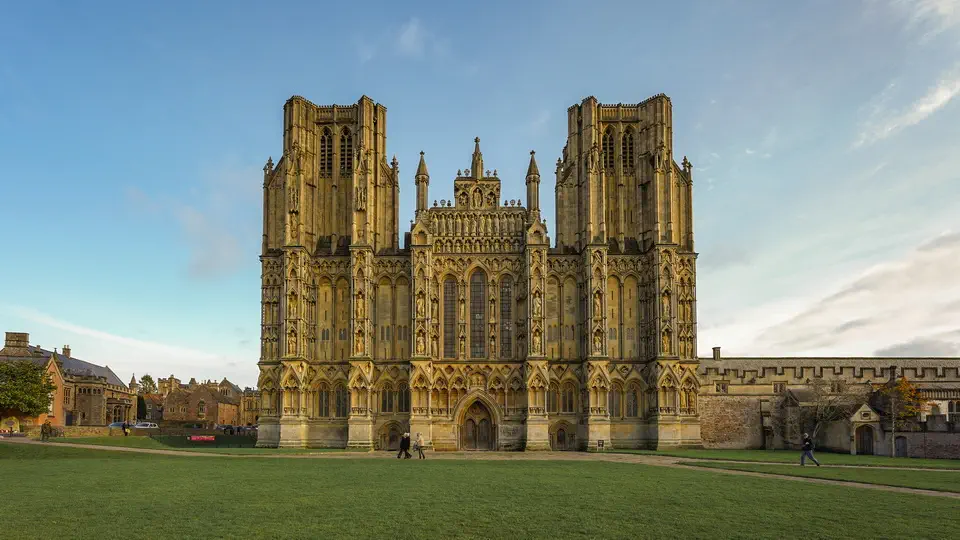
We set off for Wells from Bristol, just 30 kilometres away. The journey passed quickly, as the Somerset countryside is picturesque and full of sights to admire, so the road never felt long. Wells, in Somerset, is in the charming rural landscape so typical of this part of England. The character of the area is shaped by gentle hills and the flat expanse of the Somerset Levels. As agriculture plays a key role here, we passed colourful, well-kept villages and fields dotted with flocks of sheep along the way—idyllic, peaceful and simply pleasant.
Things became even more enjoyable when the initially rainy day unexpectedly brightened. By the time we arrived, the great Wells Cathedral was bathed in golden sunlight, allowing us to fully admire the impressive relief sculptures on the front of the building.
They begin in the lower niches with biblical scenes, then progress through depictions of kings, bishops, and ranks of angels, culminating in the twelve apostles with Christ above them all. The cathedral is surrounded by lawns filled with benches, trees and neatly maintained paths. In good weather, one can simply sit on the grass and admire the magnificent façade of the vast Wells Cathedral. Unfortunately, true to English form, the weather changed again within just a few minutes, and without much warning a heavy downpour began. There was no choice but to take refuge inside the church—an interior no less fascinating than its exterior, and, most importantly, dry.
Wells Cathedral and its impressive interior
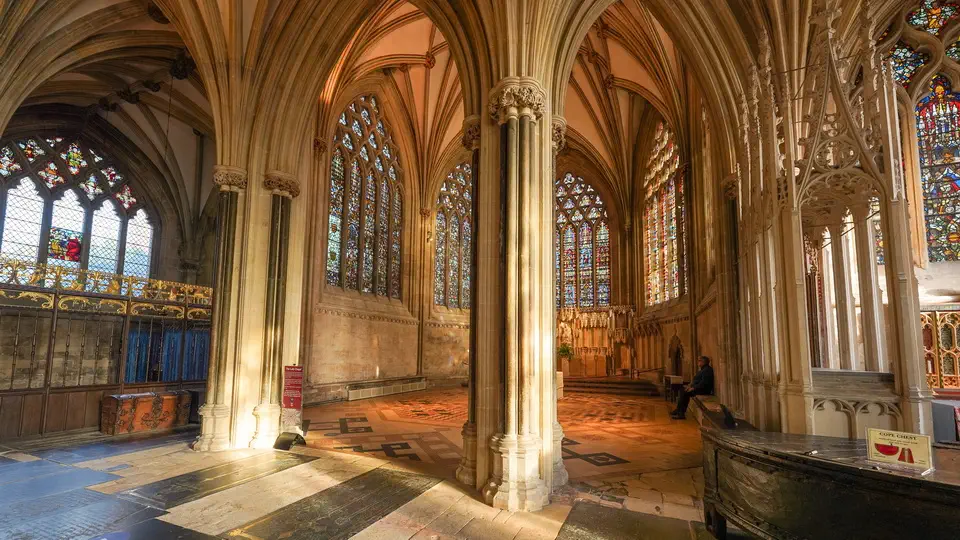
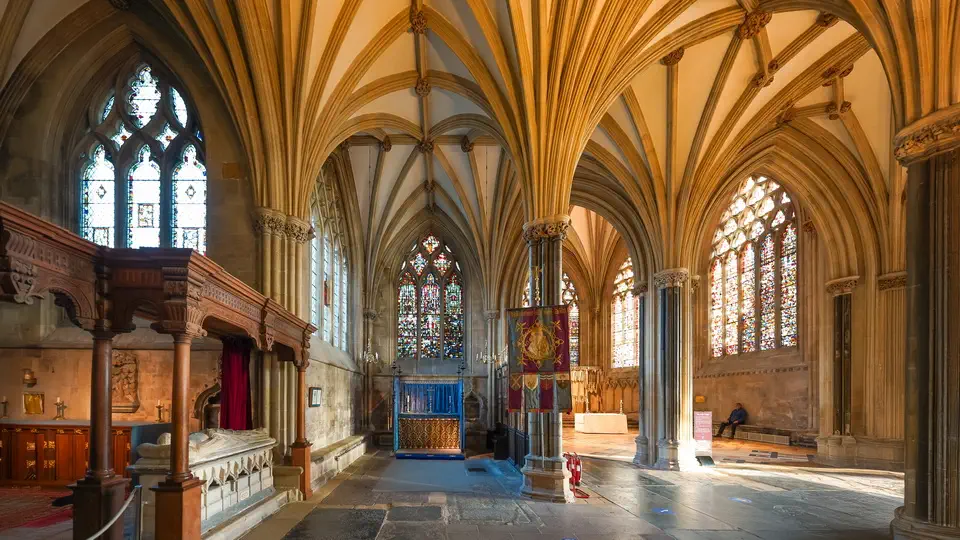
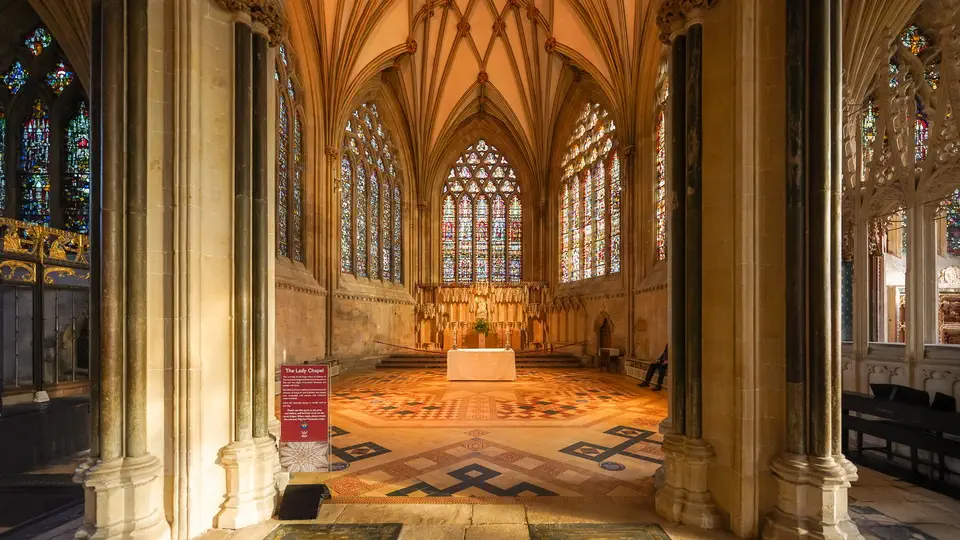
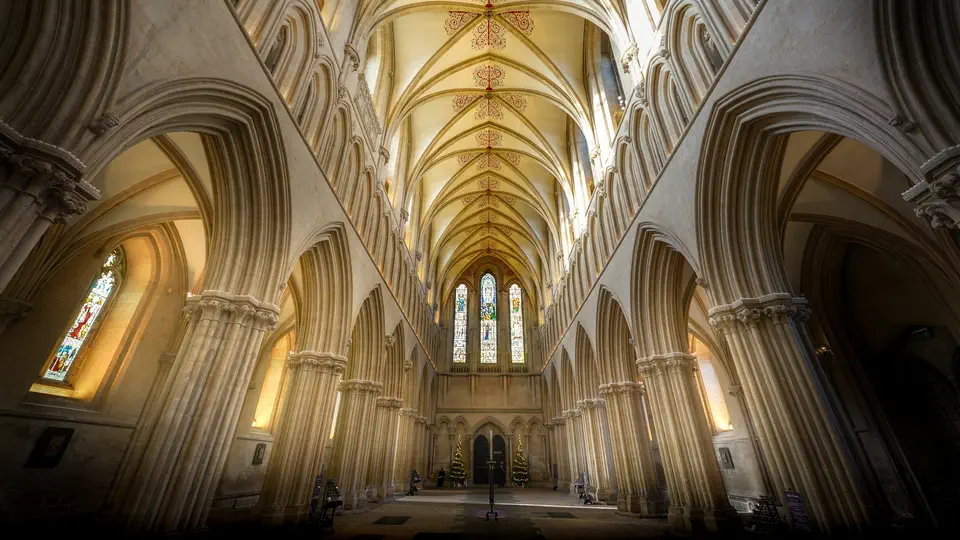
Inside the church, we saw the unique structure of the arched vaulting. This is simple yet astonishing design, often perceived as modern, actually dates back to the years 1338–1348. This type of vaulting was used because of the immense size of the cathedral as a whole, and especially because of its towers, which were enormous by the standards of the time. The system helped to relieve the pressure on the foundations of the vast structure. As can be seen in the photographs we managed to take, the arched vaults inside the cathedral form fairy-tale patterns which, combined with the colourful stained-glass windows through which rays of sunlight stream into the interior (provided it is not raining), are truly breathtaking.
In one of the naves, there is a clock that strikes every quarter of an hour. It is worth stopping to watch the wooden knights endlessly jousting in an uninterrupted tournament that has continued for centuries. This clock once set the rhythm of daily life for the people and for the cathedral itself, and it is hard not to think of the many generations who stood staring at this ancient mechanism, just as we do today.
The oldest part of the centuries-old cathedral
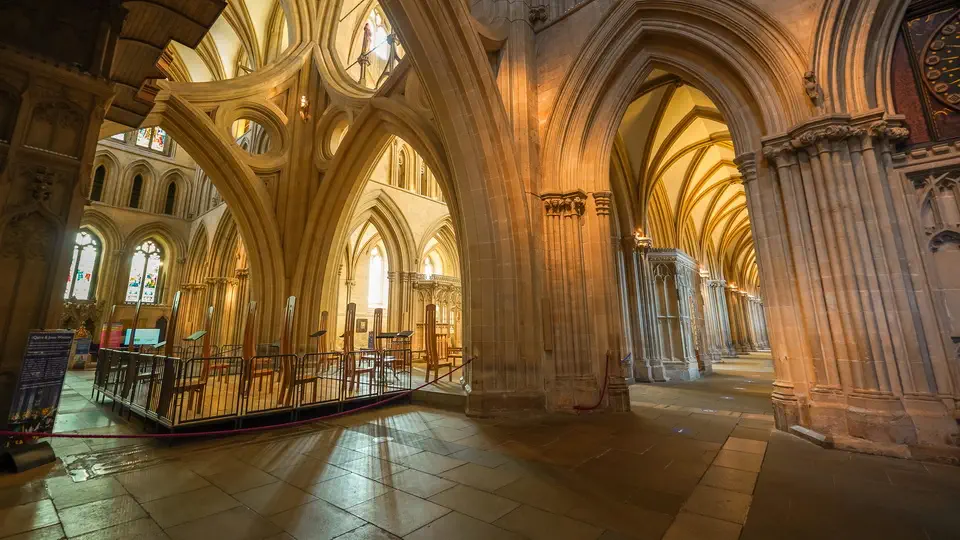
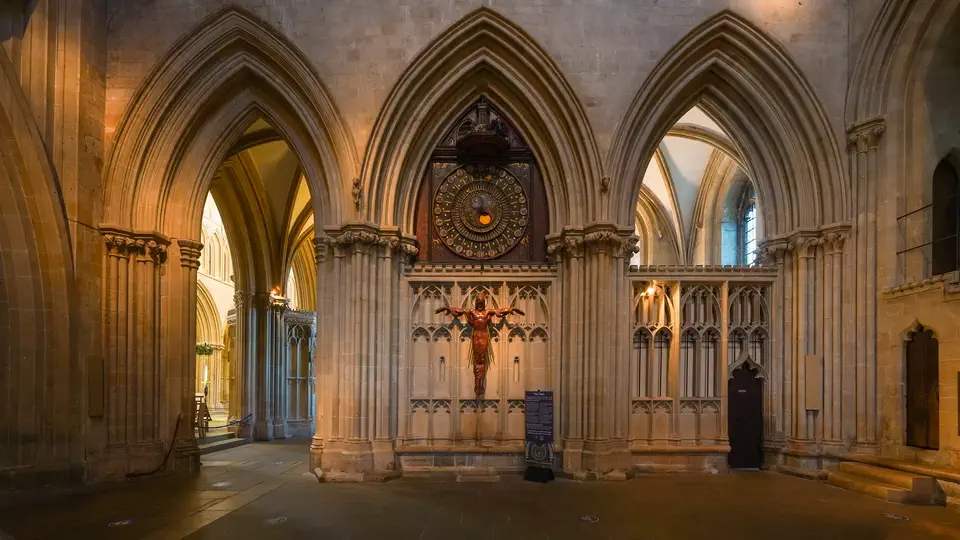
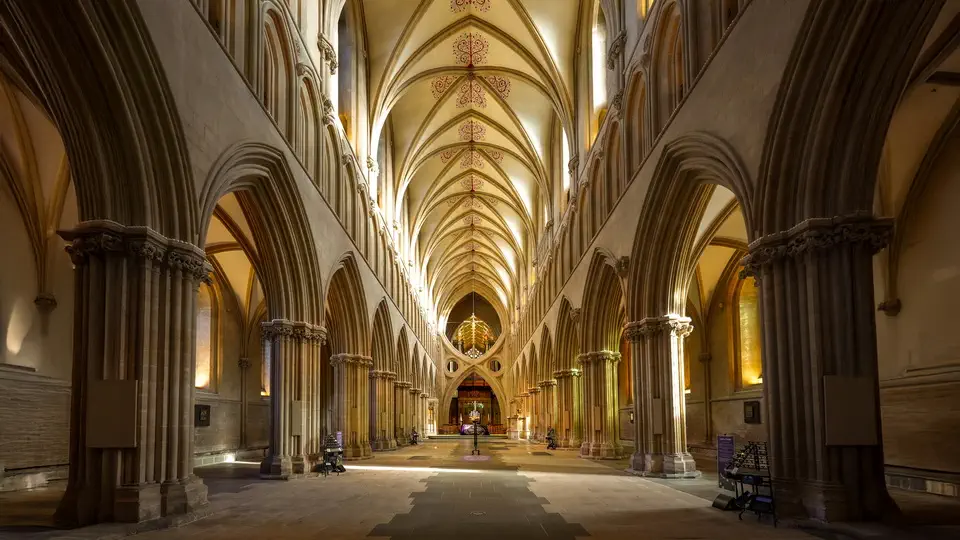
The oldest part of the cathedral is located on the western side of the church, where beneath the wooden benches you can see finely carved reliefs bearing the names of bishops. It was also there that we found worn stone steps leading up to the magnificent chapter house, whose construction was completed in 1306. This octagonal chamber was used for meetings of the canons and, in fact, still serves the same purpose today.
A small museum has been created there, where manuscripts and the tools once used to shape the stone for the cathedral’s walls can be admired in glass display cases. Of course, it is also well worth climbing one of the towers to see the library housed within it. It contains thousands of books, some of them several hundred years old. In this room, photography with flash is strictly forbidden due to the fragility of these rare and precious volumes.
Wells is not just a famous temple
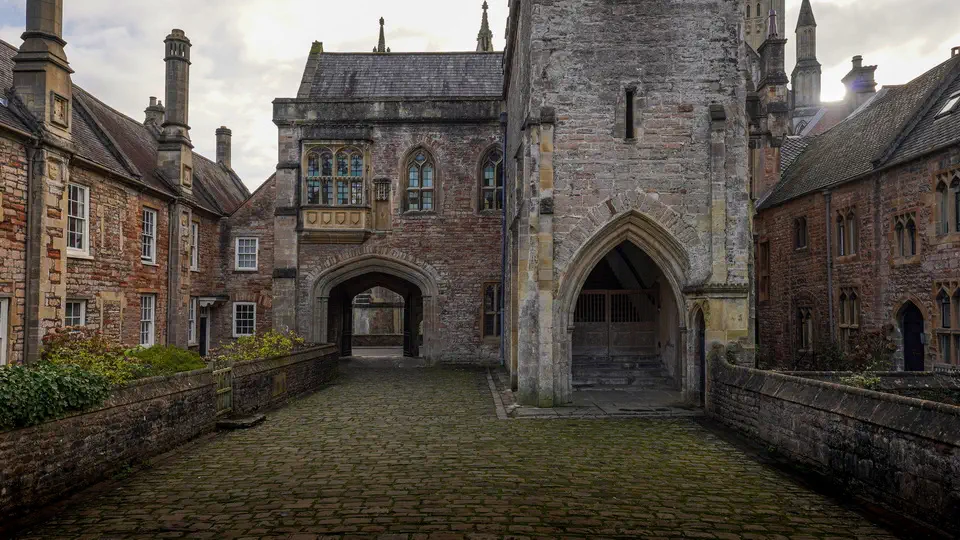
Wells is not defined by the cathedral alone. Right next to it runs Vicars’ Close, the oldest continuously inhabited street in Europe. The houses were completed in 1363 and were intended for members of the cathedral choir. Admission to the cathedral is free; however, maintaining these ancient walls in good condition costs around £3,000 a day. For this reason, I encourage visitors to leave a symbolic donation, especially since the cathedral does not receive direct government funding. I warmly recommend this remarkable place to everyone with an interest in history.
Wells Cathedral and a few words in conclusion
Wells Cathedral remains a place where history, art, and spirituality come together in perfect harmony. Its soaring arches, remarkable vaults and stone details speak not only of the craftsmanship of medieval builders, but also of centuries of faith and everyday life that unfolded within its walls. It is a space that invites reflection—whether one visits it as a historical monument, a masterpiece of architecture, or a place of prayer. Leaving Wells, it is hard not to feel that the cathedral lingers in the memory, encouraging a return and a renewed discovery of its calm, timeless beauty.
Wells Cathedral information and interesting facts
- Wells Cathedral has been the setting for numerous films and television series. Numerous documentaries and historical programmes have also been produced. One of the films, excellent by the way, is The Spanish Princess.
- Nearby, the cathedral is home to one of the oldest housing estates in the area. The houses on Vicars’ Close were built for the vicars and the Wells church choir.
- Wells Cathedral boasts one of the largest windows filled with colourful stained-glass. The stories depicted within them tell the story of British history.
- Beyond the cathedral itself, Wells offers many historical attractions, including the Bishop’s Palace, the bishop’s gardens, and several churches with a Saxon mortuary chapel.
- Wells Cathedral is dedicated to St. Andrew the Apostle and is the seat of the Bishop of Bath and Wells.
- Construction of the current cathedral began in 1175 and took decades to complete.
- It is considered the first cathedral in England built entirely in the Gothic style.
- Its west façade is adorned with over 300 sculptures depicting religious and secular figures.
- The sculptures on the façade were originally polychrome and shimmered with vibrant colours.
- A distinctive feature of the interior are the so-called scissor arches, which reinforce the tower’s structure.
- These arches were built in the 14th century to prevent the collapse of the cathedral’s central section.
- The cathedral houses one of the oldest functioning mechanical clocks in the world.
- The clock not only indicates the time but also the phases of the moon and elements of the medieval cosmos.
- The cathedral choir is renowned for its high standard of liturgical music and centuries-old traditions.
- The cathedral’s stained-glass windows are among the most valuable examples of medieval glass art in England.
- One of the most famous is the 14th-century Jesse Window.
- The cathedral houses a medieval library containing valuable manuscripts.
- During the English Civil War, the cathedral’s interior was severely damaged.
- Today, the cathedral is supported primarily by donations rather than direct state funding.
- Wells is considered the smallest town in England by population.
- The town’s name comes from the natural water springs that still exist in its centre.
- Wells received its city charter in the Middle Ages.
- The town developed primarily due to the presence of the cathedral and the bishop’s residence.
- Vicars’ Close in Wells is considered the oldest continuously inhabited street in Europe.
- This street was built in the 14th century for the cathedral’s clergy.
- Bishop’s Palace is one of the longest-inhabited episcopal residences in England.
- The palace is surrounded by a moat and extensive gardens.
- Wells Market Square has been in continuous operation for centuries, and markets are still held there.
- The town has retained its medieval urban layout.
- Wells was an important centre of the wool trade in the Middle Ages.
- The town boasts many preserved historic gates and stone buildings.
- Wells often serves as a film set for historical productions.
- Thanks to its compact size, the town is ideal for exploring on foot.
- Wells combines the atmosphere of a quiet town with the status of a significant historical and religious centre.